
The Institution of Civil Engineers
Founded in London in 1818, the Institution of Civil Engineers was the world’s first professional engineering society.
On January 2, 1818, a group of eight young engineers—James Ashwell, Charles Collinge, Joshua Field, James Jones, John Thomas Lethbridge, Thomas Maudslay, William Maudslay and Henry Robinson Palmer—gathered at the Kendal Coffee House on Fleet Street in London to form the Institution of Civil Engineers, the world’s first professional engineering society. Their efforts helped lead the transition of civil engineering as a practice of a few craftsmen whose knowledge was largely a result of their own observations and experience to a profession that drew from the accumulated knowledge of many individuals.
After two years of struggling to attract new members, Thomas Telford was appointed as the first president of the Institution in 1820. Having worked on hundreds of important civil engineering projects including the Caledonian Canal and Menai Suspension Bridge, Telford had world-renowned expertise and was able to attract new members from Great Britain and overseas, giving the Institution a major boost and helping it obtain a Royal Charter of Incorporation in 1828. Unlike John Smeaton's Society of Civil Engineers founded in 1771 (now known as the Smeatonian Society of Civil Engineers), Telford wanted the new Institution to be less of an exclusive social organization and concentrate more on the technical aspects of engineering and the open sharing of discussion and knowledge for the mutual benefit of members. He served as president until his death in 1834, bequeathing the Institution with his personal collection of books, drawings, and papers, as well as a sum of over £3,000, that were used to establish a library and permanent headquarters.
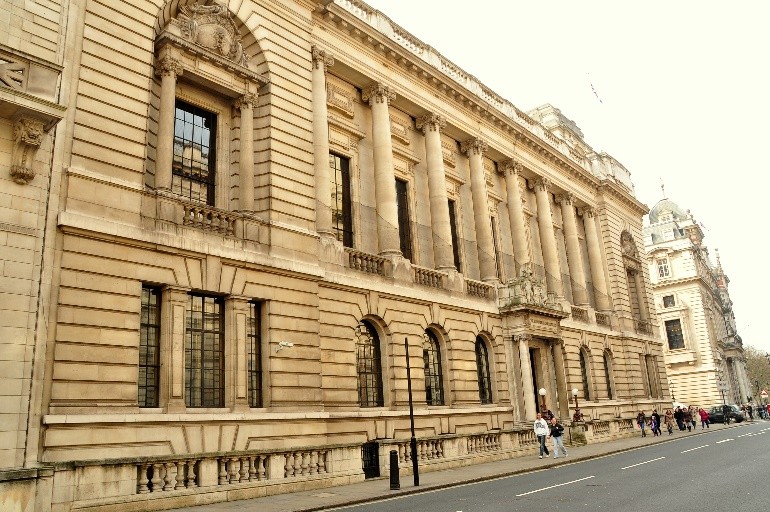
Since 1913, the Institution’s headquarters have been located at One Great George Street in London, near Big Ben and Westminster Abbey:
The Institution was designated as an International Historic Civil Engineering Landmark by ASCE and the Canadian Society for Civil Engineering during the Global Engineering Congress held at the Institution in 2018, the 200th anniversary of its founding.