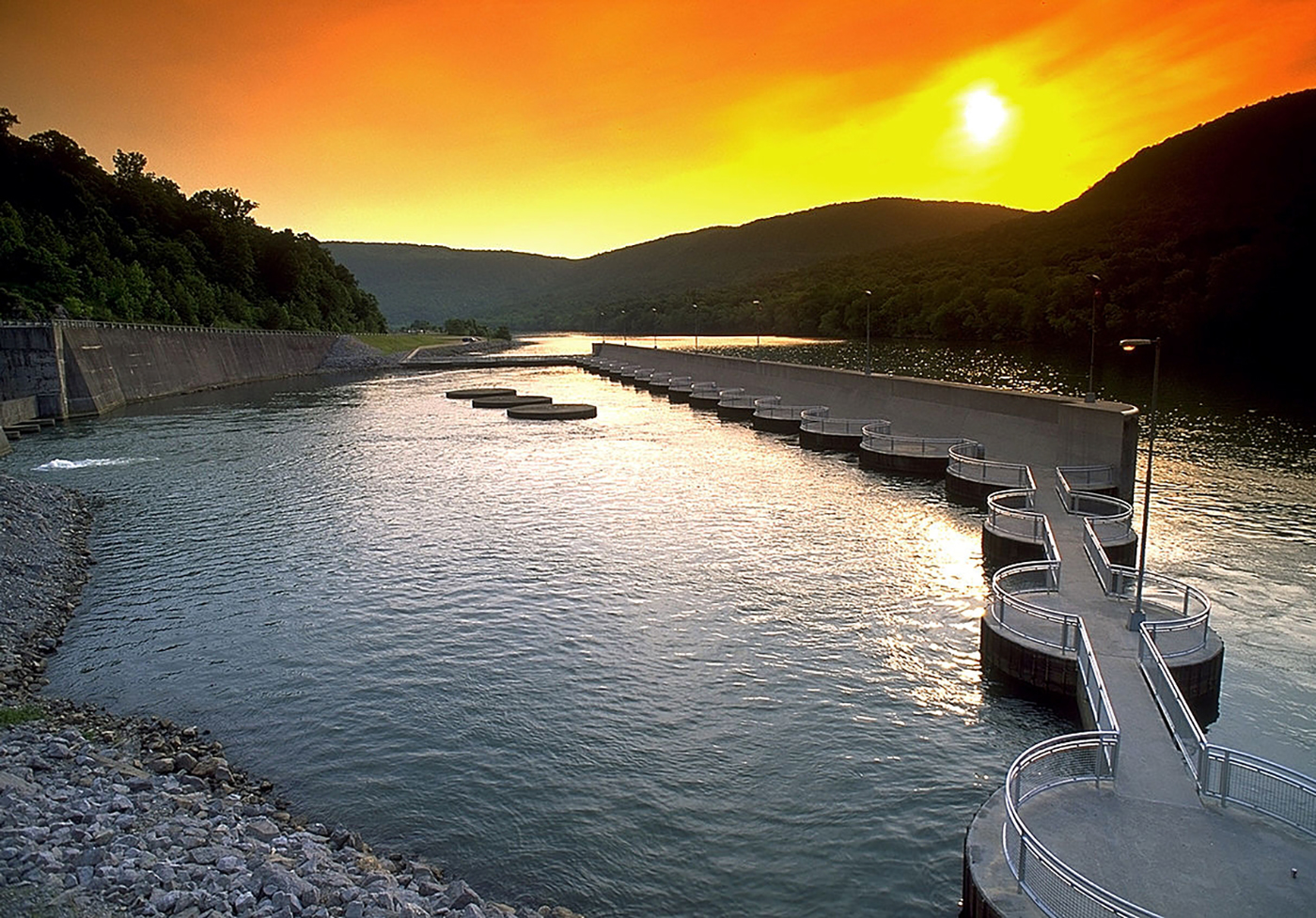
 Tennessee Valley Authority
 If the United States wants to “win the global race to dominate artificial intelligence and advanced manufacturing,” the solution should include new sources of pumped storage hydropower, according to the National Hydropower Association.
More than 60 gigawatts of proposed new pumped storage capacity is working its way through the regulatory pipeline, explained the NHA report Winning the AI Race: Tapping into Pumped Storage Hydropower, with 70 pumped storage projects awaiting licensing by the U.S. Federal Energy Regulatory Commission.
Further reading:
- Solar panels built over California canals generate power, save water
- Pittsburgh dams to be converted to ‘low-impact’ hydropower
- Can sand be used to create energy on demand?
To “unlock this proven technology” and bring new pumped storage capacity online will require policies “that remove red tape” and “speed up construction,” the report explained. Because if the U.S. cannot provide sufficient electricity “reliably, at the right locations, and quickly enough,” AI companies could turn to other countries that can, the report warned.
Pumped storage hydropower works by pumping water uphill during off-peak hours, “when excess power is available,” then releasing it to generate electricity during periods of high demand, the report explained. Such facilities act as “water batteries” to “firm up variable renewables and provide essential grid reliability services.”
Pumped storage hydropower also provides “several key services that are essential for grid stability,” the report stated. These include helping integrate renewable energy sources into the grid, especially at night or when the wind is not blowing, and balancing the grid when other sources become unavailable – such as when a nuclear plant is offline.
These services mean that pumped storage hydropower “is uniquely positioned to help policymakers expand grid capacity, accelerate interconnection of large loads, and ensure the reliability and affordability of power as demand from data centers that power AI and advanced manufacturing continue to rise,” the report concluded.
Changes needed
New pumped storage capacity is especially needed in the part of the U.S. power grid known as the Western Interconnection, which spans most of the western United States, including states along the Pacific Coast and throughout the Rocky Mountain region. Electricity demand in this region is predicted to grow by more than 20% during the next decade, “driven largely by data centers, advanced manufacturing, and electrification,” the report noted.
At the same time, more than 24 gigawatts of generating capacity will be lost in the region as coal, natural gas, and nuclear sources are retired.
To address the situation, the report touted pumped storage’s “untapped potential in the West,” where approximately 85% of the proposed new pumped storage capacity is planned. Unfortunately, even though some of these projects have been licensed, “none are under construction today, largely due to financing challenges and a punishing regulatory environment,” the report stated.
Because the U.S. “has entered a new era where power generation determines the speed of our progress in the AI race,” the report identified regulatory and legislative reforms designed to better promote the potential of pumped storage hydropower. In Congress, for example, the Federal Power Act, which regulates hydroelectric power, needs to be modernized, the report said.
“Currently, the licensing process for hydropower facilities, including (pumped storage), is costly, time consuming, and cumbersome,” the report noted, creating uncertainty and causing delays. “Depending on location,” the report explained, “relicensing a hydropower facility could involve up to 13 major federal statutes and five major federal agencies, as well as numerous state resource agencies.”
Revisiting the Federal Power Act
In particular, the report called for placing limits on the mandatory conditioning authority of the Federal Power Act to only “the effects directly related to hydropower projects.” This change would “rein in resource agency overreach, reduce unnecessary regulatory burdens, and ensure that mandatory conditions for a project’s approval are relevant and appropriate to the project’s impact.”
The report also advocated legislation that would provide greater tax support to “preserve and enhance existing hydropower facilities,” including pumped storage, so that these “forever assets” can continue to meet the nation’s growing energy needs.
On the regulatory side, the report called on FERC to direct regional transmission organizations and independent system operators “to revise unjust, unreasonable, or unduly discriminatory market rules.” Together with other changes, these reforms would “create market conditions that properly value reliability, enabling pumped storage and a broader array of long-duration storage solutions to compete on their merits,” the report stated.
The Department of Energy’s Energy Dominance Financing Office could also leverage its $250 billion in loan guarantee authority to prioritize pumped storage hydropower, which represents both an emissions-reducing asset and critical reliability infrastructure to ensure “the 24/7 availability of power demanded by data centers and industrial loads,” the report concluded.

Feed Your Brain
Interested in topics like this? ASCE2027: The Infrastructure and Engineering Experience, a first-of-its-kind event bringing together subject-matter experts from all across the infrastructure space, March 1-5, 2027, in Philadelphia, is where such matters will be discussed. So, yes, we know you’re excited about the Philly cheesesteaks, but ASCE2027 also is the perfect place to satisfy your appetite for learning.
Technical deep dives. Infrastructure expertise. Come feast!
Learn more about ASCE2027: The Infrastructure and Engineering Experience.