
By Sarah King, P.E., M.ASCE
Threading a large-diameter water transmission main through a congested urban community required careful planning and engineering. The results will improve water reliability for the San Diego region.
During a planning study by the San Diego Public Utilities Department, the city of San Diego identified the need to provide redundant water transmission to the coastal regions of La Jolla and Pacific Beach. To meet this objective, the Alvarado 2nd Extension Pipeline project was born.
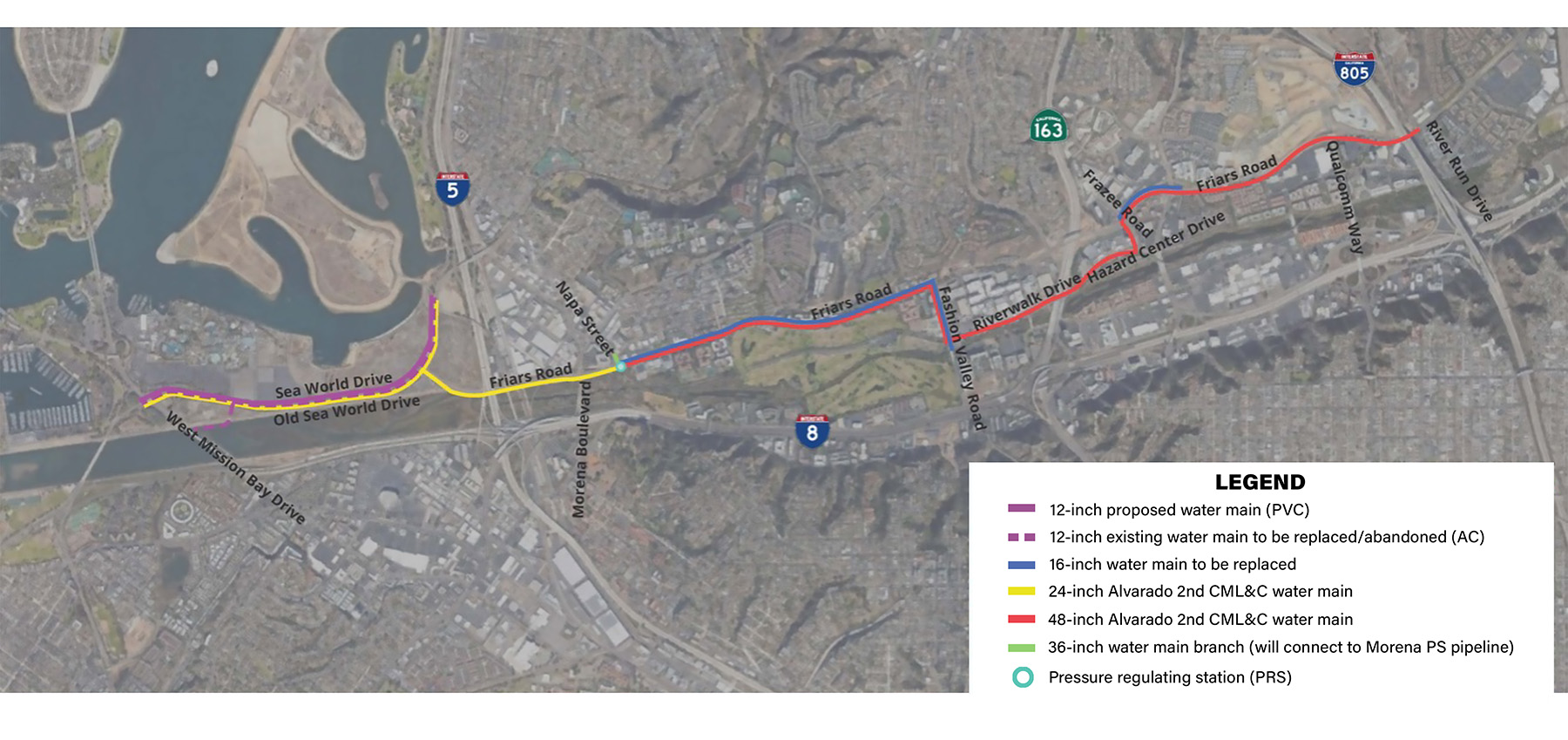
The new transmission line will extend the existing Alvarado 2nd Pipeline 6.25 mi west, conveying water through a 48 in. diameter welded-steel pipe at approximately 250 psi. It will traverse a diverse urban landscape, including three state highways, an earthquake fault zone, two large shopping centers, residential developments, and a coastal landfill adjacent to SeaWorld San Diego. Once complete, the extension will reduce reliance on the city’s existing aging pipeline system.
To protect downstream coastal infrastructure that accommodates the existing distribution system’s lower water pressures, the design team decided to also include a pressure-reducing station at the corner of Napa Street and Friars Road.
The city completed the planning study for the pipeline extension in August 2015. In 2017, Kennedy Jenks Consultants Inc. was selected to design the pipeline. Construction began during the third quarter of 2025, with completion expected by December 2029.
The design and construction teams have encountered many technical challenges for this large-diameter, high-pressure pipeline project, including the anticipated presence of contaminated soils and groundwater, potential liquefaction zones and corrosion issues, and the need for a trenchless installation at key crossings. In addition, the project has also faced several so-called “soft” challenges: extensive community outreach efforts, traffic control measures, and schedule and cost uncertainties during a period of fluctuating prices, supply chain issues, and other concerns.
Soil and water
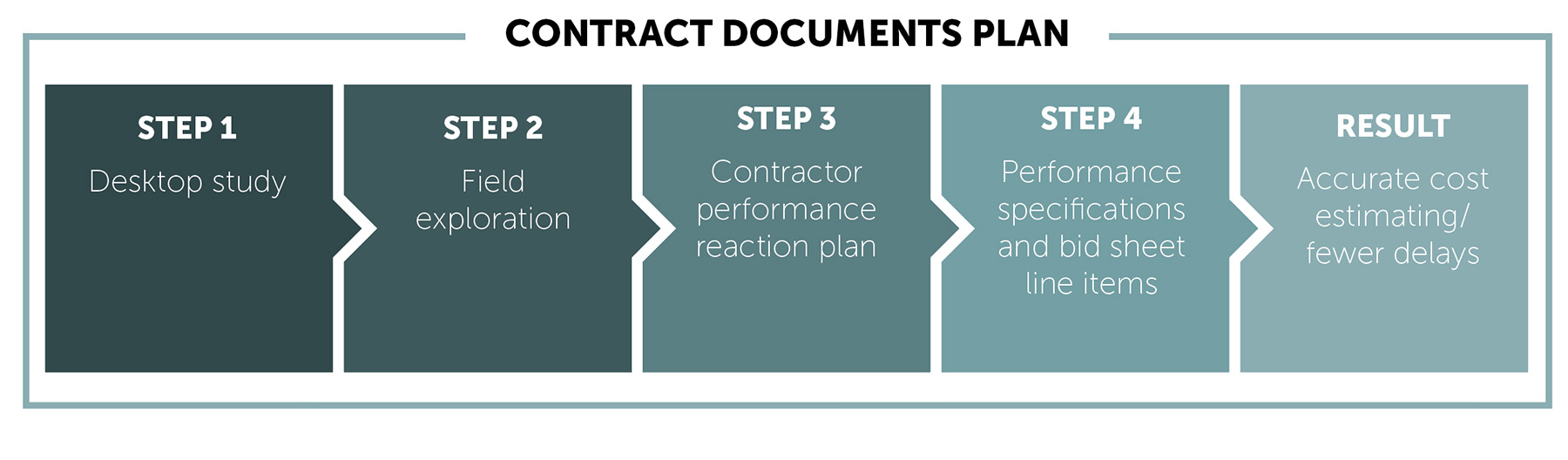
The project was complicated by the presence of 71 leaking underground storage tanks within 1,000 ft of the alignment, with six of these tanks likely from old gas stations, directly in the project footprint. Kennedy Jenks developed a multistep plan to collect data and incorporate mitigation measures into the contract documents. Early on in the design phase, the project team performed desktop research by reviewing online documents in GeoTracker and EnviroStor to find where contamination was likely to exist and where the groundwater was shallow enough to encounter contaminated plumes.
Based on the findings of the desktop study, the project team devised a sampling and analysis plan to strategically test soils for certain targeted contaminants along the alignment. This sampling effort was combined with the fieldwork for the geotechnical exploration, reducing the costs of soil sampling by combining traffic control and permitting. It will also likely reduce the number of construction change orders and delays.
After analyzing the field data, the team prepared an environmental soil sampling results and recommendations plan. This plan included a draft community health and safety strategy outlining performance specifications within the bid documents. When the contractor encounters contaminated materials, the plan serves as a clear roadmap for handling and disposing of materials. Additionally, the bid sheet included an allowance for contaminated materials, which will reduce the time to process change orders and handle delays during construction.
Liquefaction zones
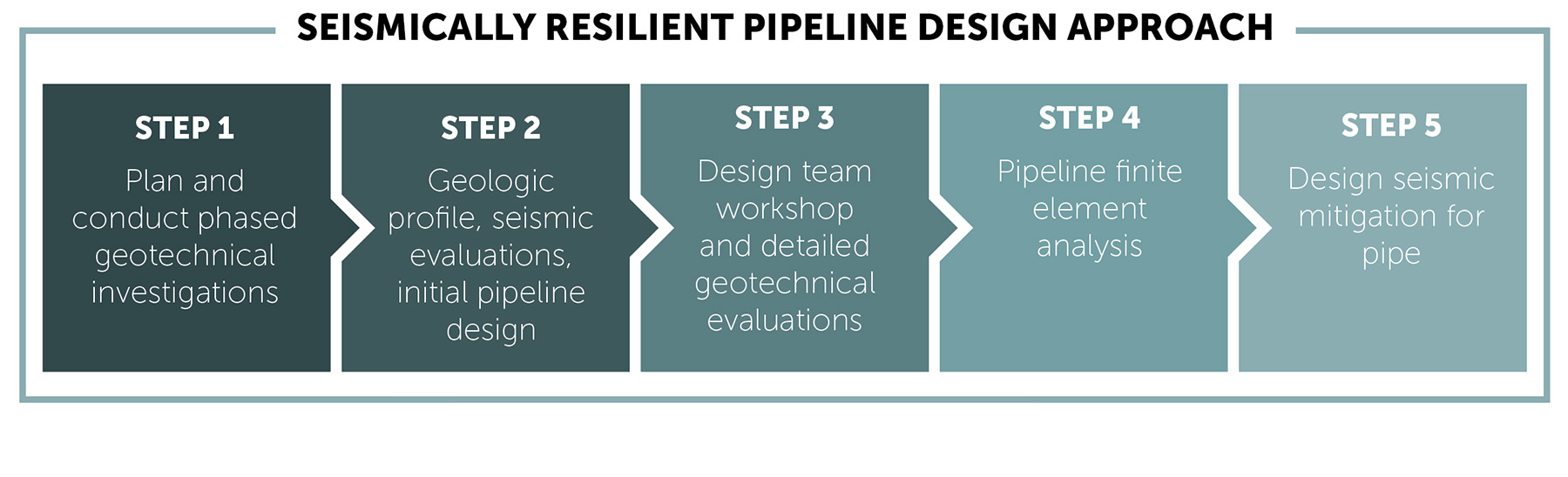
The pipe alignment crosses the Rose Canyon Fault Zone within areas of sandy soils and high groundwater. The fault has a maximum earthquake magnitude of 6.8 and an estimated slip of 1 to 5 mm/year. (Slip refers to the amount of displacement that occurs along a fault during an earthquake.) These factors contribute to a high potential for soil liquefaction during ground shaking, particularly in the sandy soils at the western end of the alignment.
The team performed a targeted geotechnical exploration to delineate the margins between the liquefaction-prone flood deposits and older, more stable alluvium (loose sediment). From this information, the team derived the design ground acceleration criteria and performed an evaluation of liquefaction potential and possible settlement that might result from ground strength loss.
Although the state building code’s seismic design requirements apply to structures or facilities for which life safety is a concern, they do not apply directly to underground pipelines. Therefore, the team applied the seismic design guidelines and requirements developed by the American Lifelines Alliance titled Seismic Guidelines for Water Pipelines. These guidelines group pipelines into four classes based on their importance and/or function and provide the design earthquake return periods for each class. This extension pipeline is classified as Pipe Function Class II, with a design earthquake return period of 475 years and a peak ground acceleration of 0.32g.
The team used the San Diego Public Utilities Department’s Water Facility Design Guidelines to address the potential seismic risks of the pipeline’s valves.
These guidelines state the following:
(Pipes) shall include suitable in-line valves (at) either side of the fault zone, spaced far enough apart such as not to significantly increase the chance of failure of the pipe due to fault offset. The in-line valves may be manually or automatically actuated. Automatic actuation valves are required if the failure of the pipeline at the fault offset will credibly cause a life safety concern to nearby people, or cause enough erosion as to create a significant loss to nearby facilities. Automatic actuation should be based on instrumentation that senses whether the pipeline actually has broken, such as by sudden drops in pressure and increased flow, coupled with very high levels of peak ground acceleration (over 0.3g).
Because it might be difficult to access the isolation valves in the aftermath of an earthquake, and because it could take time to close each large valve manually, the team considered the use of hydraulic line break valves equipped with spring-return actuators. These actuators automatically close the valves in the event of an excessive, sustained drop in line pressure. Ultimately, though, the team opted for manual valves because they are simple to maintain long term.
To ensure a resilient pipeline design, the team also selected a specialized bedding material and backfill and chose pipe components that were stiff but still flexible enough to accommodate ground movement.
Trenchless design
Because the pipeline extension crosses three freeways, railroad tracks, and several large, shallow corrugated steel storm drain culverts, the team evaluated various trenchless technologies based on feasibility and risk. An assessment of the severity of these risks required specialty subsurface investigation, identification of potential hazards, and quantification of probability of occurrence. The team also needed to understand the potential consequences, such as inadvertent fluid returns (known as a frac-out) or an unstable borehole.
Once the risk severity had been determined, the team selected and implemented the appropriate mitigation measures and tunneling techniques. The site characteristics for each location were assessed and preliminarily evaluated for which trenchless technologies would be most feasible.
As the design evolved, the options for the trenchless crossings at the freeways changed significantly when the California Department of Transportation allowed the use of open-cut crossings at freeway overpasses. Also, one potential crossing was eliminated by an alignment adjustment, and one crossing used an abandoned storm drain under the railroad as a casing, which eliminated the need for a trenchless installation at that site.
Community outreach and traffic control
The pipeline alignment is in a highly congested area with high traffic volume. Some spots along the alignment are mixed-use areas with both residential and business entities. These areas are particularly challenging to construct in because nightwork cannot be conducted due to residential noise restrictions and the requirements that businesses must remain open during the day and emergency vehicles able to operate unimpeded.
During the design phase, the team — consisting of the city’s project management staff, design consultant, and outreach specialist — hosted informational sessions with various community groups and businesses. Individual presentations were prepared to explain in detail how each area would be impacted during construction, and in some cases the team provided the justification for the project alignment.
The project team also created fact sheets for distribution and mailed letters to stakeholders whose homes or businesses were within 500 ft of the alignment. Traffic control was designed to avoid causing delays or creating backups on roads as much as possible. Traffic control plans maintained open access to driveways or provided mandatory flaggers to facilitate access to homes and businesses throughout construction.
As a result of these efforts, the project will enter construction with informed stakeholders, though maintaining communication and disseminating information throughout construction are critical steps for continued success.
Corrosion concerns
Corrosion is another obstacle that needed to be overcome due to high brackish groundwater and proximity to gas lines and railroads, which can present stray current.
The fluctuating brackish groundwater at the west end of the alignment can create an especially challenging condition for the buried metal pipe. In this scenario, dissolved salts in the groundwater can precipitate at the metal surface as the water recedes and evaporates. Additional salts are then repeatedly introduced and precipitate with each groundwater cycle until salt concentrations at the metal surface become much higher than the nominal concentration in the surrounding soil. To identify the possible problem sites, soil samples were tested and monitoring wells were installed to determine groundwater depths.
Regarding potential stray current risks caused by the pipe’s proximity to gas lines and railroad tracks, a utility investigation — consisting of desktop research of existing record drawings from utility owners in the area — helped determine the precise locations of facilities along the alignment that could inadvertently cause stray current and corrosion to nearby metallic pipelines. Once the sources of corrosion were identified, the team evaluated active and passive protection measures and ultimately developed a detailed cathodic protection design. This plan included the use of protective coating systems and the installation of test stations every 1,000 ft.
A minimum separation of 5 ft will be implemented at isolated close points to keep stray current from protected lines, given the resistivity of the anticipated silty-sand soil conditions. The team also specified the use of a bonded dielectric tape coating system — 80 mils thick — with a protective rock shield coating.
Cost certainty
Estimating costs accurately in today’s market is complex because of constantly shifting market prices, supply chain issues causing delays and cost overruns, and contractor selectivity. What’s more, there have been various market factors at play during the extension project. For example, the city of San Diego has other infrastructure projects in the works, including the Pure Water Program, which features large conveyance elements that require the time of major contractors around the region, potentially reducing the pool of available contractors. Additionally, the pipeline extension project suffered a delay between design and advertisement primarily due to obstacles surrounding property acquisition.
To cope with these issues, the design team prepared cost estimates at each phase of design, increasing the accuracy as the design was refined. The estimates were escalated to the midpoint of construction to provide the most realistic number. Due to the delay of the bid and advertisement of the project from 2021 to 2024, the cost estimate increased 40% over this time.
Ultimately, only two bids were received, which reflected the market pace and limited contractor bandwidth to take on additional large projects. However, the project bid amounts were acceptable, with a low bid slightly below the design engineer’s cost estimate of $127 million.
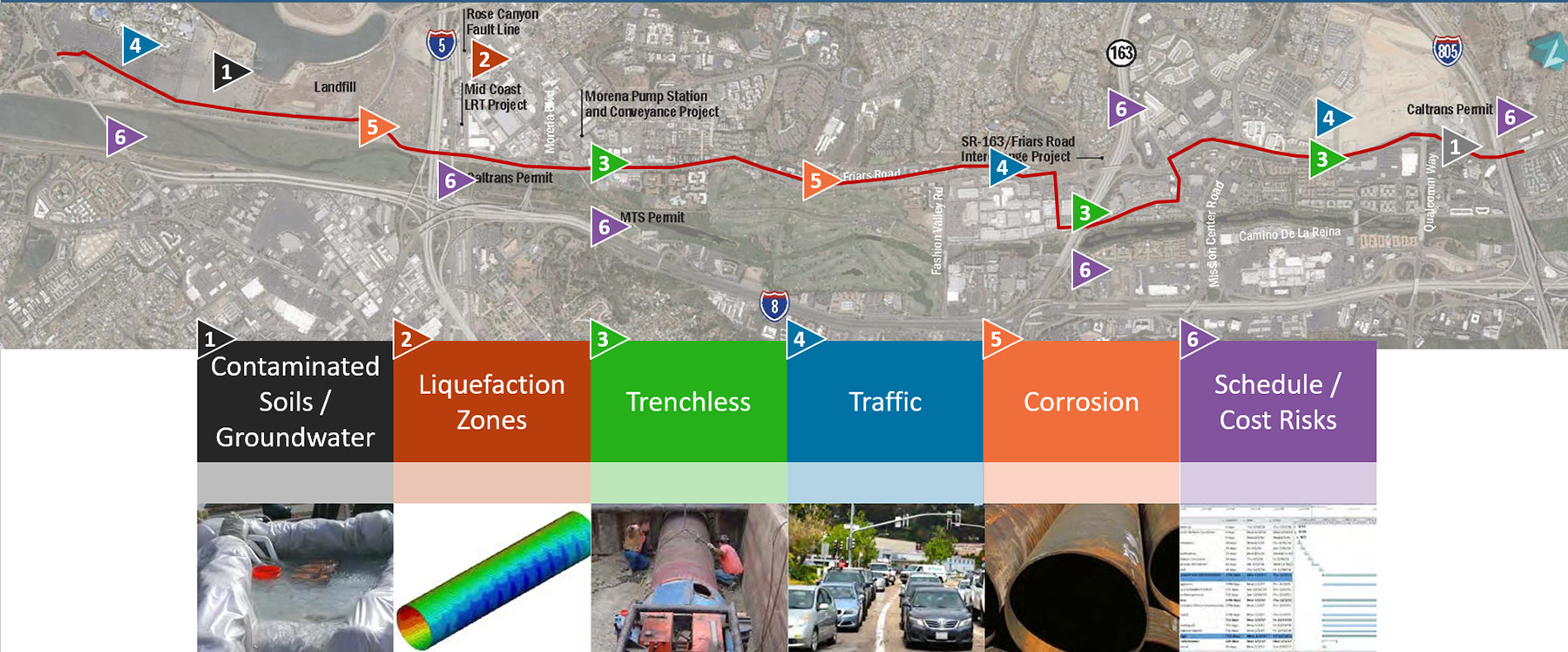
During the design phase, the project team successfully identified potential challenges early on — from contaminated water and soil to liquefaction, trenchless crossings, outreach, and corrosion — and mapped out an approach to address each one and achieve the project objectives, which laid the groundwork for a smooth construction phase.
When the project is completed in 2029, the benefits of water reliability, redundancy, and security will be further realized for San Diego coastal communities.
Sarah King, P.E., M.ASCE, is a vice president and principal engineer for Kennedy Jenks Consultants Inc.
This article is a summary of the paper the author will be presenting at the UESI Pipelines 2026 Conference August 1-5 in Detroit. Find out more at www.pipelinesconference.org.
This article first appeared in the July/August 2026 issue of Civil Engineering as “Urban Extension.”
