 Purdue
The typical civil engineering student of 2026 is a fully 21st-century person, born and raised.
Growing up immersed in the digital age, you could excuse students for finding the ways of the past archaic and not worthy of attention, perhaps even irrelevant. The popularity of a course at the Lyles School of Civil and Construction Engineering at Purdue University suggests otherwise.
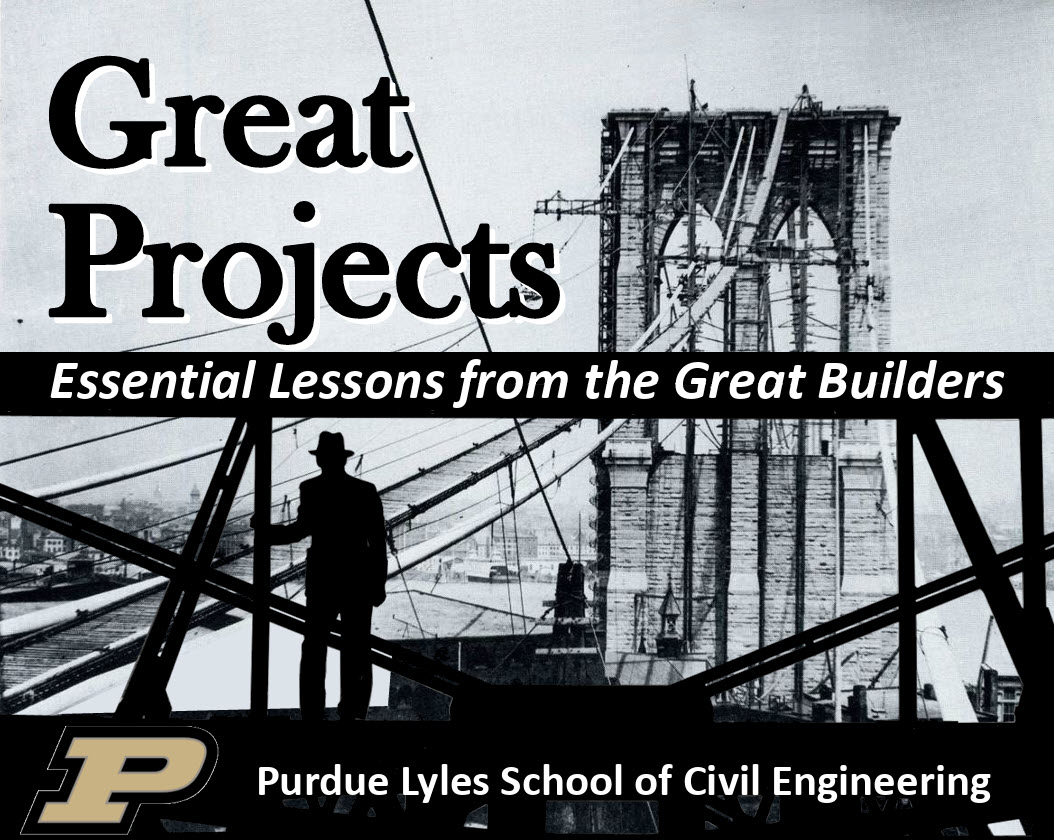
In The Great Projects: Essential Lessons from the Great Builders, Paul Giroux, Dist.M.ASCE, NAC, professor of engineering practice, shows students that the achievers and achievements of the past remain entirely relevant to modern practice. To reinforce their relevance, they are evaluated in the context of the outcomes of ASCE’s Civil Engineering Body of Knowledge, which sets the foundations for what all civil engineering professionals should know.
“If you think about it, the ASCE body of knowledge is the summarization of nearly 175 years of civil engineering’s history and lessons learned,” Giroux said.
In his course, “when we explore the lessons of the great builders, we not only learn their technical and professional lessons, but we also learn their important personal lessons” beyond the CEBOK, among them personal courage, seeking opportunity, being goal driven, and parametric agility, among others, Giroux said.
Parametric agility is the ability to adapt to ever-changing project conditions in real time to optimize objectives. “All of the great builders had this essential skill, and it’s one of the key differentiators of really good engineers and builders,” Giroux said. “How do you respond in real time and still achieve optimized outcomes? We have to do this all the time.”
Giroux started the class in 2023 after retiring with 45 years’ experience as a practitioner, with his perspective of the “great projects” influenced by his real-world experiences having worked on modern mega-projects such as Boston’s “Big Dig,” the I-95 Fort McHenry tunnels in Baltimore, Maryland, the new San Francisco Oakland Bay Bridge East Span, and other projects.
Seniors and grad students are the course’s intended targets. At the start, they are introduced to the CEBOK technical and professional outcomes, from design, risk, and uncertainty to leadership, communication, and ethics. For their first homework assignment, students complete a self-assessment of where they think they are on what Giroux calls the “BOK Journey.” He said he is surprised how few students have even heard of the CEBOK. As ASCE is the lead society for providing input to the Accreditation Board for Engineering and Technology on civil engineering program criteria for student outcomes, the BOK and ABET outcomes reinforce each other.
Giroux devotes four-hour blocks for each great project, including the Transcontinental Railroad, the Panama Canal, the Eads Bridge, the Brooklyn Bridge, the Hoover Dam, and the Golden Gate Bridge, among many others. Using vintage photographs and detailed animations, Giroux demonstrates how major construction operations were accomplished. Some 200 major events, or 25 per project, are evaluated to help students explore successes and failures through the CEBOK outcomes, as well as supplemental outcomes that Giroux has devised.
Through storytelling, Giroux humanizes the engineering process. One of Giroux’s 200 events is the traumatic experience of engineer David du Bose Gaillard, a West Point graduate who, as a U.S. Army Corps of Engineers captain, was assigned in 1908 to construct the central portion of the Panama Canal, crossing the continental divide. He devoted 12-hour days to overseeing the excavation of the challenging Culebra Cut through the core of the Isthmus of Panama, a source of continual frustration due to catastrophic landslides that would erase weeks or months of work in a very short period.
Class discussions on the events are followed by homework analyzing the event’s CEBOK outcomes. Giroux said. “Gaillard worked hard to keep his team safe and motivated throughout the landslides, and so important professional outcomes to analyze could include teamwork and leadership, professional responsibilities, and ethical responsibilities. And because of all the collective challenges Gaillard faced each day, a compelling personal outcome to analyze could be personal courage.”
Students can relate to the toll such challenges took on Gaillard, who had to return to the U.S. suffering from what was believed to be nervous exhaustion brought on by the overwork. He was only 54 when he died of a brain tumor in December 1913 and is buried at Arlington National Cemetery.
The final term project requires students to select their own major civil engineering project or operation and to provide analyses using the BOK evaluation techniques learned in class.
What does Giroux ultimately want his students to come away with?
“I’m trying to teach my students that every civil engineering endeavor can provide valuable technical, professional, and personal lessons, to gain pride in the rich history and heritage of civil engineering, to understand how to evaluate and create holistic engineering solutions, and to be passionate lifelong learners.”
At the end, students complete a BOK self-assessment and prepare a career growth plan. Giroux said, “It’s gratifying to see the growth and confidence the students gain during the class. Ultimately, the most important thing great builders build is people. Indeed, we can all be great builders.”
In their evaluations, students say the course made vital connections that made them value the body of knowledge and how its guidance can be found in the great builders, their great projects, and how they achieved success.
“Professor Giroux’s lectures truly brought these projects to life. Hearing how engineers and contractors confronted unprecedented challenges with innovation, collaboration, and sheer determination was inspiring. As a practicing engineer, I found myself relating my own experiences to the great projects,” wrote Cole W. Cavalieri, P.E., seeking his master’s degree. “In fact, I was amused to learn that some of the obstacles faced by the Roeblings during the construction of the Brooklyn Bridge were not all that different from challenges I’ve encountered on modern projects. It reinforced the adage: ‘The more things change, the more they stay the same.’ ”
The ASCE Body of Knowledge, third edition, is available as a free download. A fourth edition is in development.