By Leslie Nemo
Two states managed to unite and build the world’s longest suspended span.
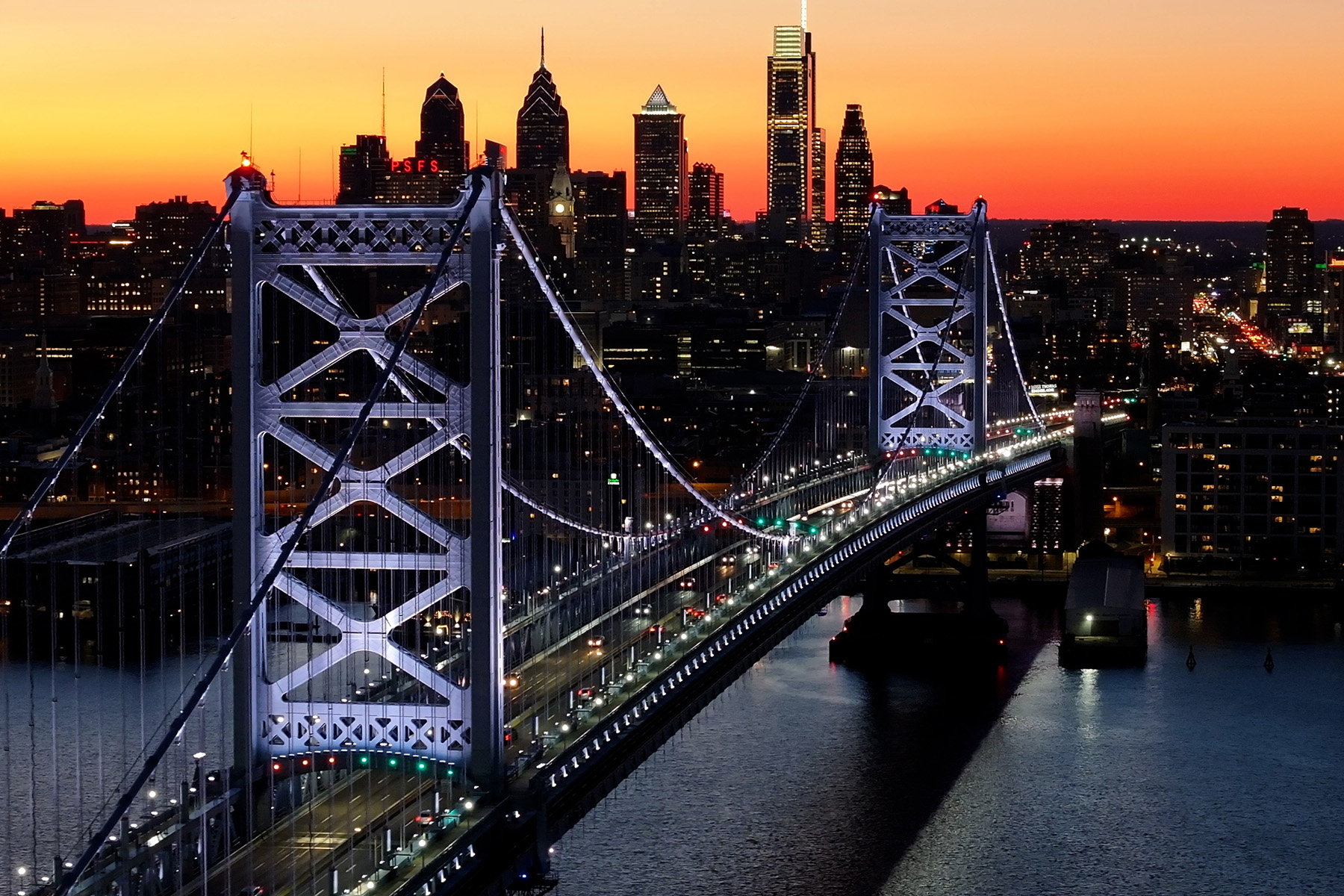
This year is the 100th birthday of the Benjamin Franklin Bridge, which helps drivers cross from Pennsylvania into New Jersey and back again. Originally named the Delaware River Bridge, the structure has a 1,750 ft long main span, which was the longest of its type in the world when the bridge opened. The project applied innovative equipment to bridge building and pushed the two states on both sides of the river to collaborate — even if negotiations hit rough patches along the way.
This year is the 100th birthday of the Benjamin Franklin Bridge, which helps drivers cross from Pennsylvania into New Jersey and back again. Originally named the Delaware River Bridge, the structure has a 1,750 ft long main span, which was the longest of its type in the world when the bridge opened. The project applied innovative equipment to bridge building and pushed the two states on both sides of the river to collaborate — even if negotiations hit rough patches along the way.
Over the course of history, ferries had long kept residents of Camden, New Jersey, and Philadelphia in touch with one another. Even British troops found the commute system useful, docking at a ferry landing in Camden during their occupation of Philadelphia (1777-1778) during the Revolutionary War. As both cities grew, ferry traffic increased, so much so that serious suggestions to build a bridge over the Delaware River started in the early 1800s.
But it would be 1919 before plans solidified. The New Jersey and Pennsylvania state legislatures passed matching laws to create the Delaware River Bridge Joint Commission. The following year, the commission chose its Board of Engineers: George S. Webster, an assistant engineer for the city of Philadelphia; Laurence A. Ball, M.ASCE, a consulting engineer with expertise in steelwork; and Ralph Modjeski, M.ASCE, a civil engineer, chair of the board, and cofounder of one of the country’s preeminent civil engineering firms — Modjeski & Masters.
The commission began this great endeavor by weighing two design options: a suspension bridge with wire cables versus a cantilever bridge with a suspended span, according to Modjeski in his article “The Delaware River Bridge between Philadelphia and Camden,” which appeared in the January 1922 issue of the Journal of the Franklin Institute. The suspension style won out for several reasons. The design was about $2 million cheaper, safer to construct, more easily divided into construction contracts, and better looking, according to the Board of Engineers.
The commission also decided where, exactly, vehicle traffic should terminate in each city, according to Modjeski. For three weekdays in December 1920, the commission stationed workers at the six ferry lines between Philadelphia and New Jersey. Drivers were asked where they started, down to the exact street corner, and where they were going. Plotting the thousands of records showed that a straight-line route from Camden to Market Street in Philadelphia would represent 80% of the waterway traffic. Modjeski wrote: “The location which has been chosen is as near Market Street as consistent with reasonable cost and as physical conditions permit.”
Integrating military clearance requirements with its surveys and the results of test borings, the Board of Engineers selected a structure that would be 1.8 mi long at an estimated cost of $28,871,000. The roadway for vehicular traffic would be 57 ft wide between curbs and would have six lanes, two of which were designed so that the direction of traffic could be switched, depending on the time of day. The design also included an additional four lanes — two for streetcars and two for rapid transit — bringing the total width to 125.6 ft. Sidewalks are above the rapid transit lanes.
The two states agreed to contribute matching funds, but that meant the total dollar amount needed was not always available. For example, when it was time to acquire land for the towers and anchorage foundations, the board chose to buy it in pieces as funding was made available. The ease with which construction of a suspension bridge could be broken into multiple contracts was useful here, too. The agreements could be inked as money was provided. The planned sequence for letting contracts was the two main piers, the two anchorage piers, the towers, then the cables and suspenders, and finally the trusses and floor, per Modjeski.
On January 6, 1922, in Philadelphia, the first planks of Municipal Pier No. 11 were removed to make way for the Philadelphia pier during a ceremony with the governors of the two states and the mayors of the two cities. Airplanes trailing ribbons flew overhead. Construction was officially underway.
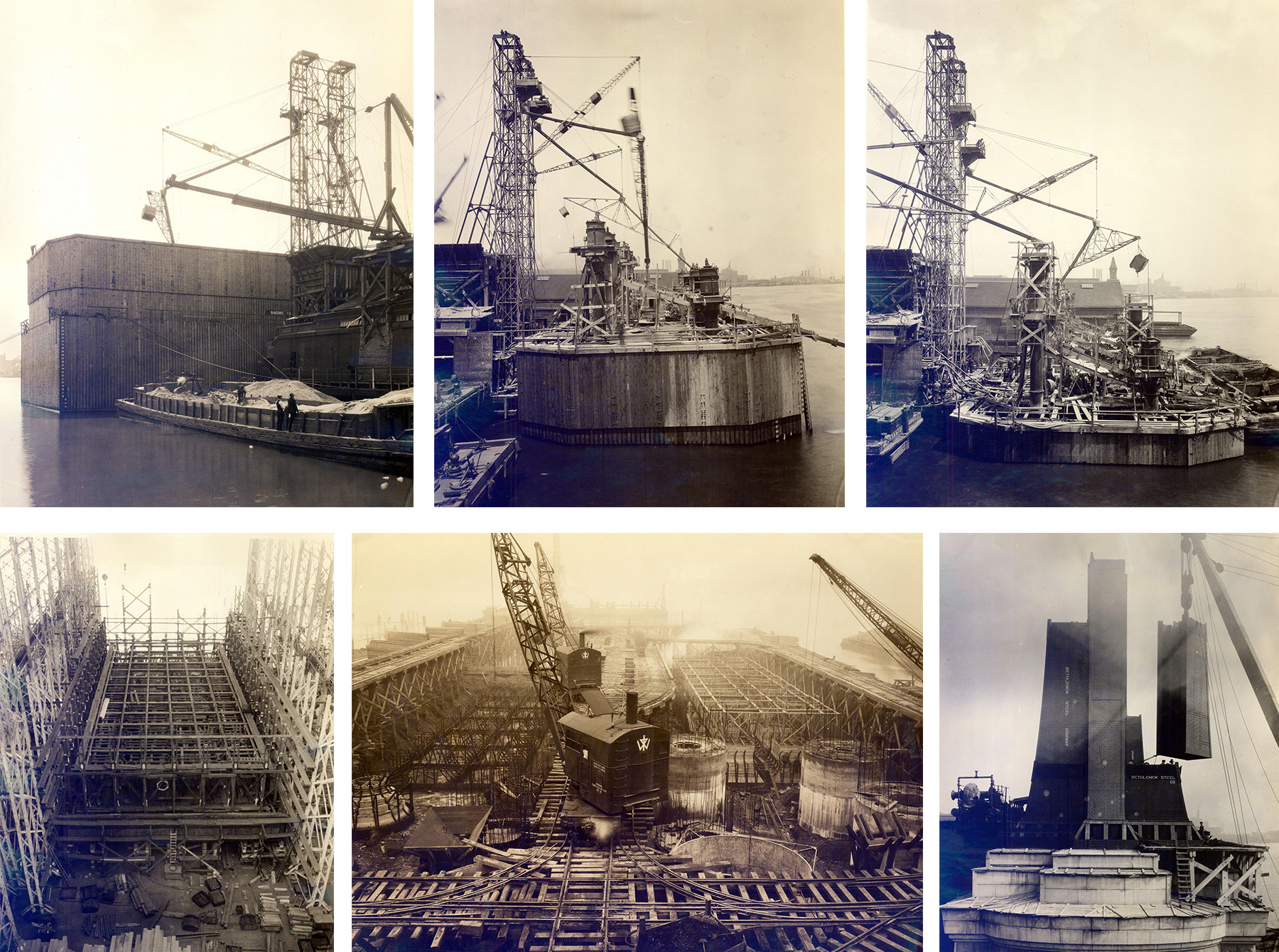
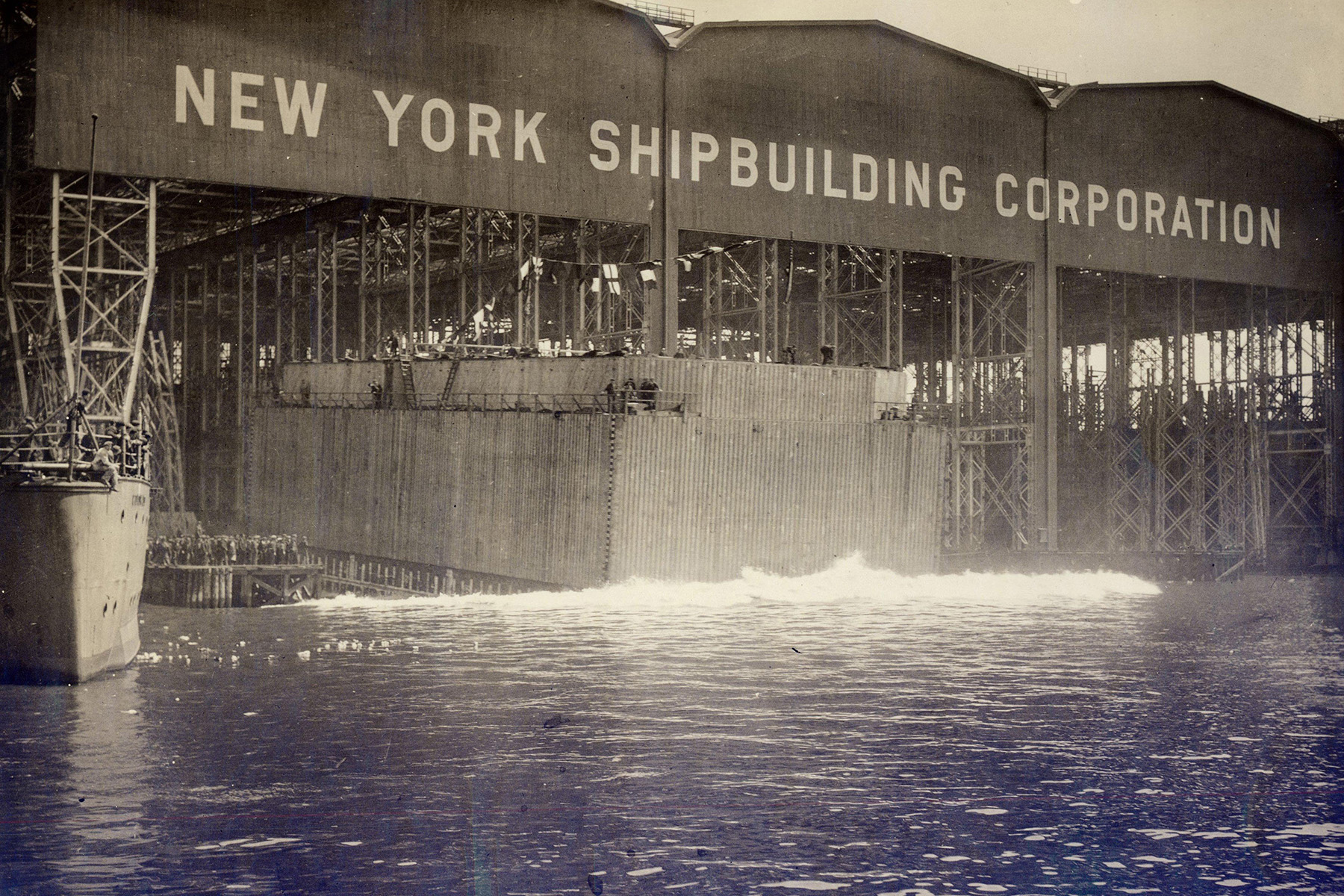
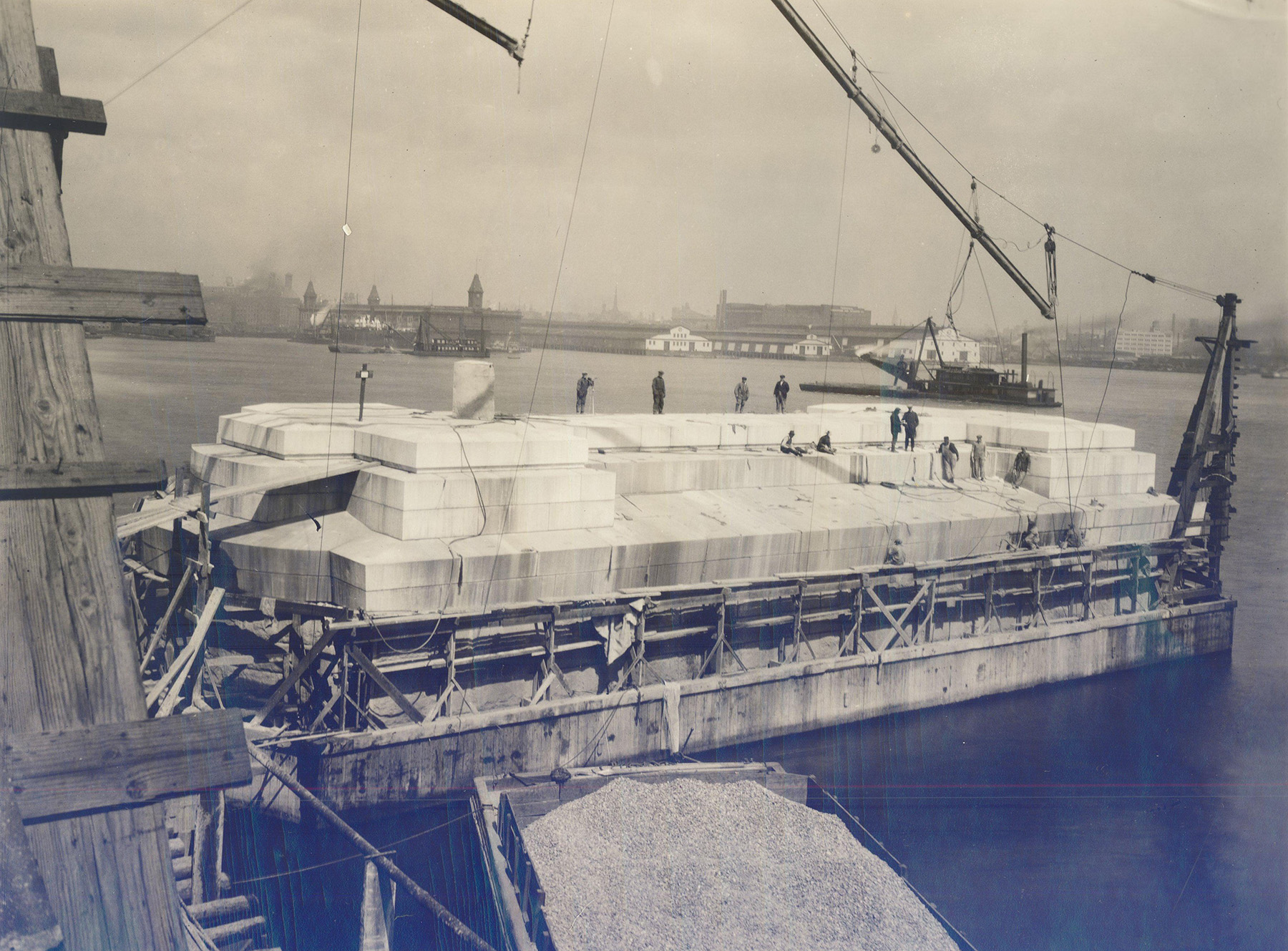
First were the two main piers. A structural steel caisson, measuring 69 ft 8 in. by 143 ft, was built for each pier. They were assembled under the protection of a covered shipway “large enough to accommodate a battle cruiser,” according to Charles Carswell, the assistant engineer of the Delaware River Bridge Joint Commission, in his book The Building of the Delaware Bridge. On April 24, workers launched the Philadelphia pier’s caisson, and they finished sealing the air chambers by July 1. Workers launched the Camden pier’s caisson on July 18, and sealing was completed on October 10.
As the pneumatic caissons sank and air pressure increased, the “sand hogs” (underground laborers) worked shorter shifts. At less than 20 psi, they toiled in four-hour stints with hour-long breaks. By the time the work got to 30 to 35 psi, shifts were two hours long and came with two-hour breaks. When it was time to seal the working chambers, concrete was allowed to fall through the material shafts for the sand hogs to rake into place. Grouting through the air lines finished the job. Granite blocks for the piers came up from Georgia and were set in place in spring 1923.
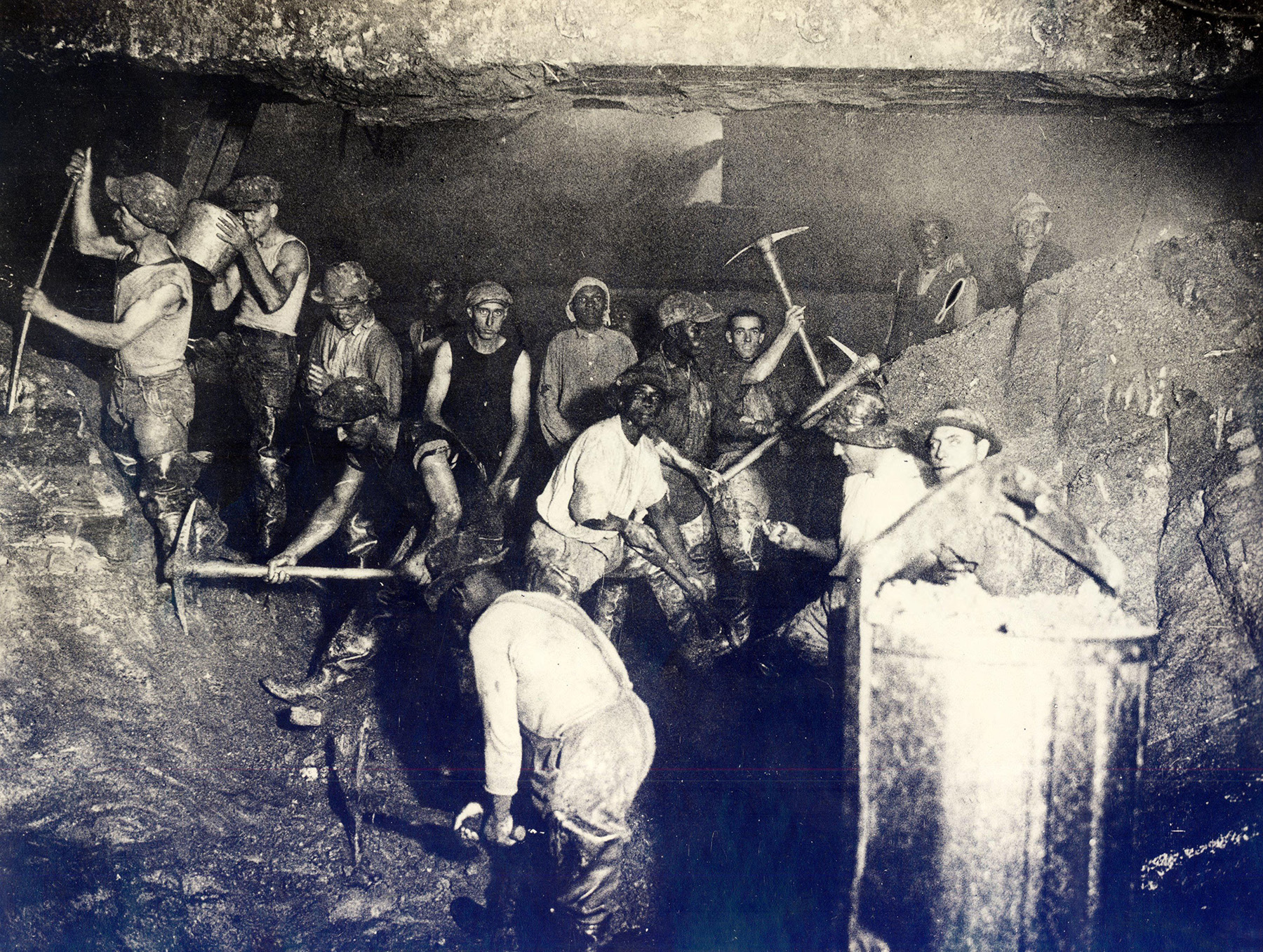
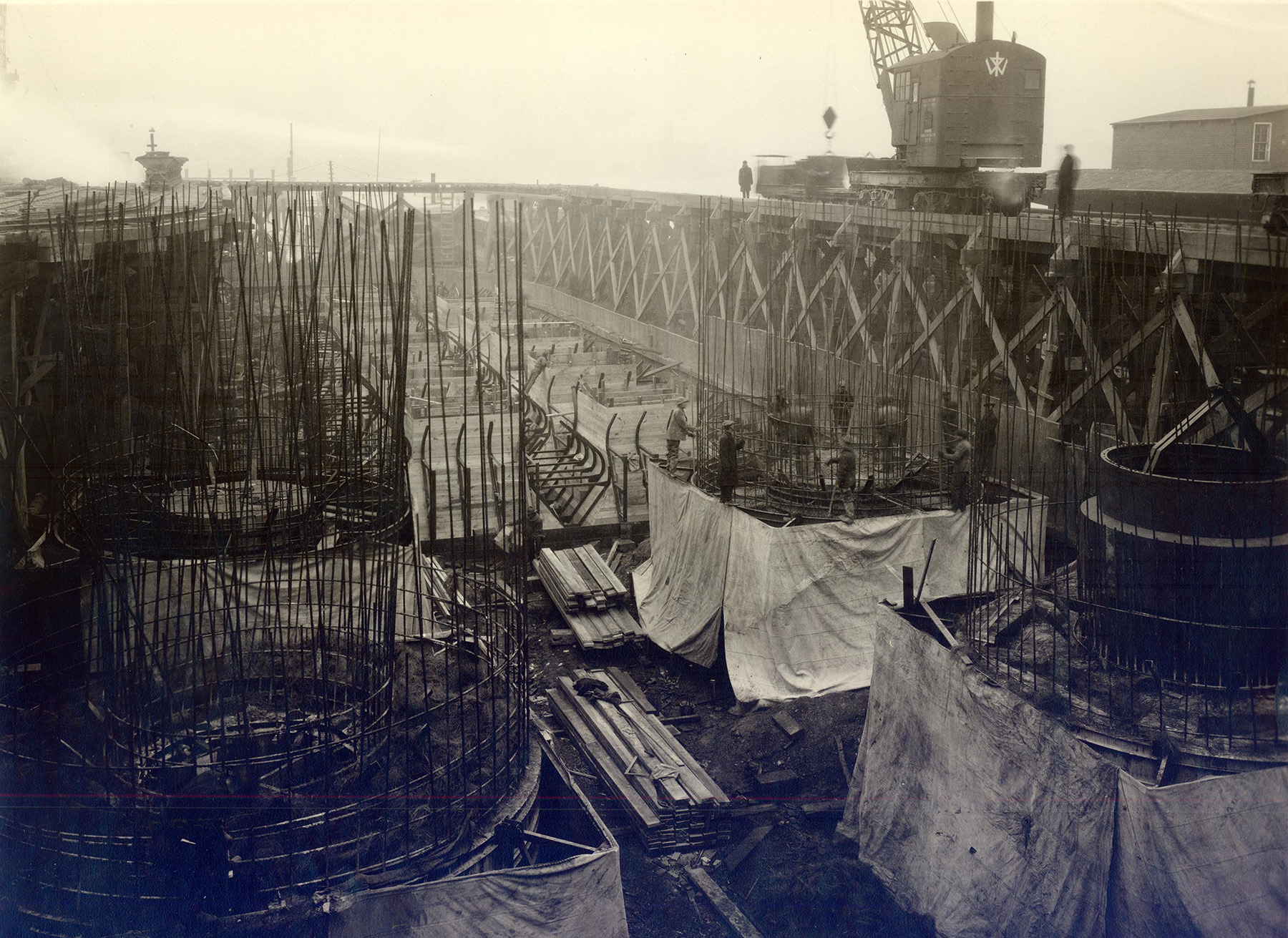
Caissons made a second appearance for the anchorage foundations. On each side of the river, teams sank 12 circular caissons and two rectangular ones. The rectangular caissons were “great concrete boxes with neither bottom (nor) top,” according to Carswell. These were built to a height of 30 ft on land. Once that stretch entered the water and sank to be even with ground level, another 20 ft of concrete was placed at the top. Each anchorage was equipped with steel girders for the cables to attach to via eyebar chains, as well as an anchorage bent with a 42-ton base.
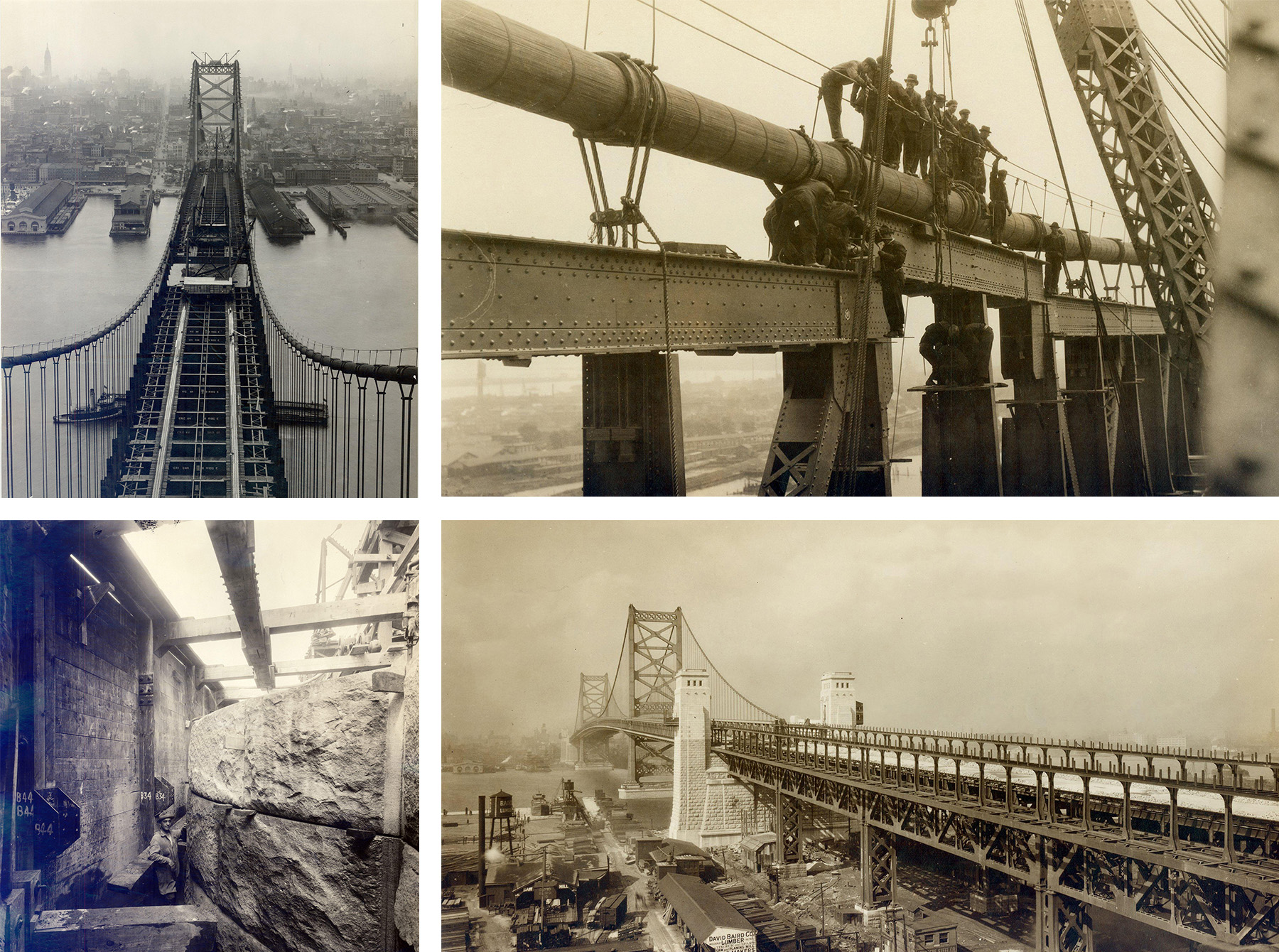
For the towers, the engineers decided on silicon steel sections weighing up to 50 tons that would be built up to a height of 380 ft above the water. They were also designed to flex 20 in. toward and away from the shore without damaging the steel. Creeper travelers, which were mounted to the in-progress towers, assembled the sections on-site. Laborers inside the steel shafts received their hot rivets via pneumatic hoses that shot the fasteners 100 ft or higher up to the point of assembly. Erection and riveting wrapped up on both towers by May 1924.
“The Delaware River Bridge did not escape the controversy which has raged about every great suspension bridge for twenty years or more as to whether the main cables should be built of eyebars or steel wire,” wrote Carswell. What settled the debate was an unusual field trip to New York. There, crews were replacing faulty protections on the cables of the Williamsburg Bridge. The Board of Engineers climbed the temporary scaffolding to see that despite the poor protection, the ungalvanized Williamsburg Bridge wires still had not rusted. When the board returned home, they decided that the wires would be built from No. 6 galvanized steel wire.
The wire, which was made by the American Wire Co. and shipped to the Camden side of the bridge in big coils, was spliced in a warehouse into lengths stretching about 100,000 ft and then wound in reels. A “hot dip” into a liquid that was 99.75% pure zinc galvanized the strands. Workers mounted the giant reels of wire onto each anchorage and unwound each reel across the water via a sheave.
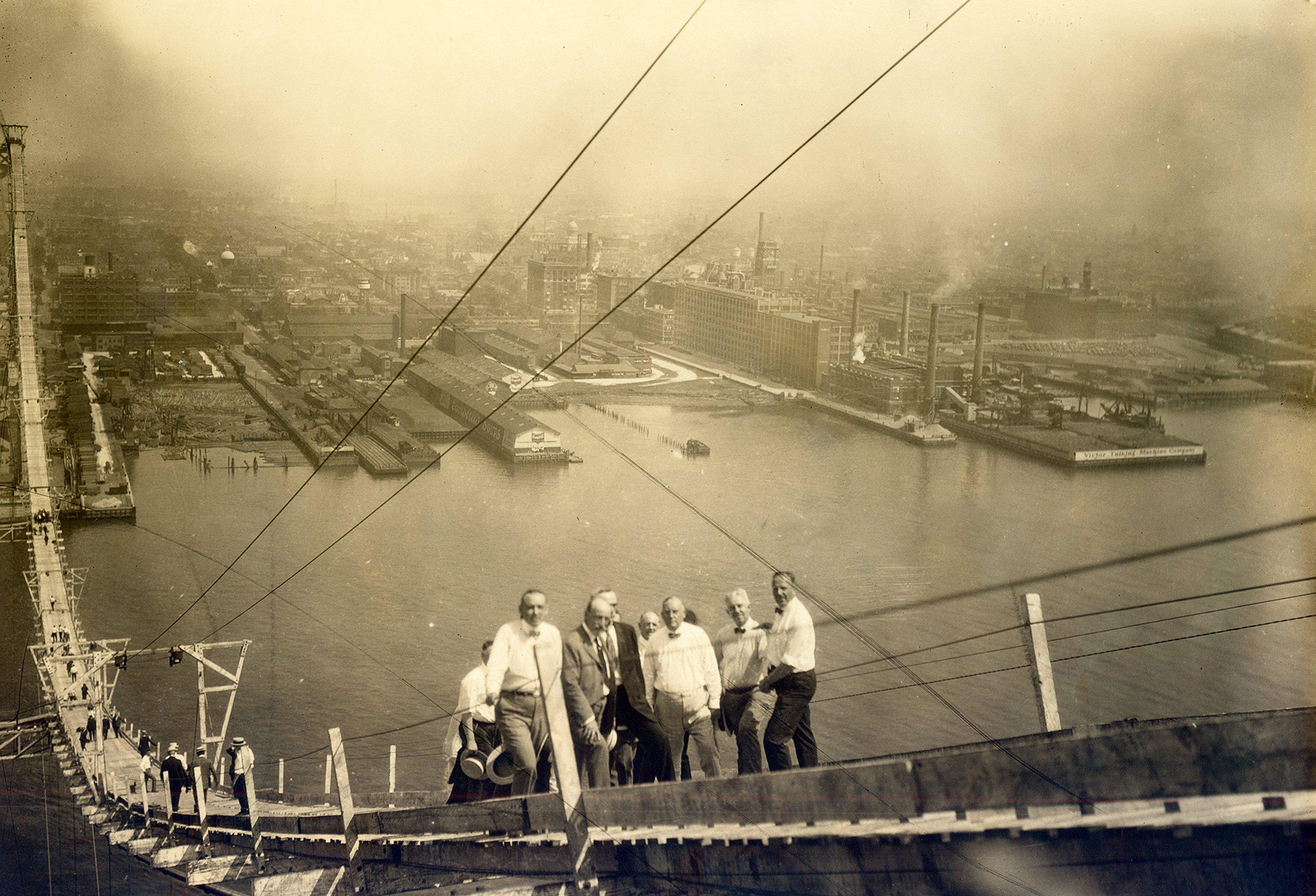
For further progress, workers needed temporary footbridges. To put these structures in place, a ferry dropped 12 wire ropes across the riverbed. Workers then paused boat traffic so that the wires could be hoisted from the water into temporary saddles on top of the towers. The footbridge planking — made less slippery with cleats at either end, where the incline became steeper — was then added from a platform hanging off the wires.
The footbridges were ready in early August 1924. On August 8, Modjeski led the first crossing. Halfway across the bridge was radio equipment from the Philadelphia station WLIT. Modjeski, along with other members of the commission and the chair of the Executive Committee, made a short broadcast from above the water before finishing their trek across the footbridge.
Haulage ropes carried the sheaves, which in turn carried the bridge wires. As the sheaves moved back and forth across the water, they brought loops of wire with them. Laborers would take off the loop at its destination, attach it to a casting, attach a new loop, and send the sheave back, slowly building up the wire into one cable. The wires for each cable were passed back and forth across the river 306 times to make one strand, and 61 strands made for a single cable. Carswell described the two main cables this way: “Over 25,000 miles of wire are contained in the two cables — enough to circle the earth at the equator. The two cables weigh 6800 tons. The strength of the wire is such that over three tons are required to break a single piece.”
Altogether, stringing the wires into the cables took 24 weeks. For the curious public, a 5 ft section of cable was put on display near the construction site.
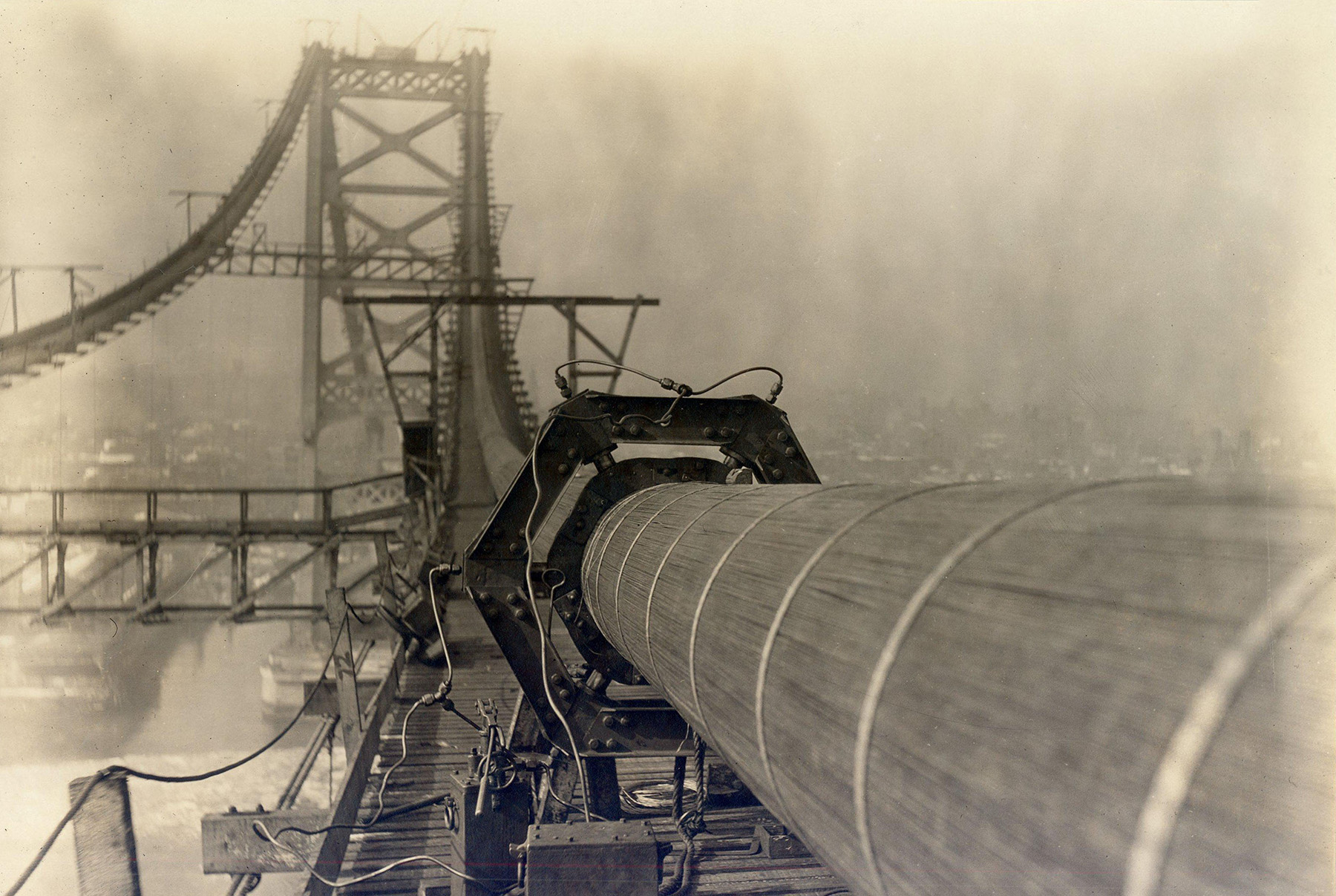
Compacting the 61 strands into one tight cable was done by six hydraulic jacks organized into hexagonal steel girdles, each applying 30 tons of pressure at the same time through bearing blocks. The girdles squeezed the cables from a diameter of 35 in. to 30 in. The machine was a new development made specifically for the bridge, since its cables had a larger diameter than previous compaction tools could handle. Compacting the cables began in January, finishing in early March.
In 1925, work began on the suspended steelwork. Crews erected three panels of steelwork — “vertical posts, bottom chords of the stiffening trusses, and floor girders,” per Carswell — on either side of the river that would hold the rails that the travelers would run on. The travelers, with their foot booms and hoisting engines, allowed workers to take the steelwork off the barges and lift it into position.
The construction schedule was arranged to keep the weight of the stiffening trusses equally distributed, although there were brief intervals when there was more steel on the main span than the side spans. This is where the flexible steel design of the main towers came into play. The towers bent about a foot inward, causing some alarm in the local newspaper about the contorted bridge. “Bend they did and bend they will, backwards and forwards, as they carry on their duty,” wrote Carswell. Eventually, the towers straightened out, and the final main span truss was put in place in October 1925.
This work, unfortunately, was some of the most dangerous of the project. Leading up to this phase, there had been three deaths on-site. While the steelwork was being installed, another 10 workers died from falling either to the ground or into the water, bringing the death toll to 13. In an unfortunate accident eight years later, Clement E. Chase, M.ASCE, principal assistant during the initial bridge building stage and one-time partner in Modjeski & Masters, fell from a girder to his death while inspecting the bridge.
Both state legislatures had continued to contribute matching money to the bridge, even when costs were higher than expected. By the end of 1924, calculations showed that the necessary land would be significantly more expensive than expected, pushing estimated construction costs to $36,000,000.
But come 1926, the two states realized they had very different stances about how the final sections of the bridge would be finished. Pennsylvania said no tolls would be allowed, while New Jersey officials said their understanding of what voters approved meant that tolls had to pay for the rest of construction. New Jersey’s attorney general eventually said the state would not participate in authorizing more contracts until Pennsylvania agreed to a toll.
The debate went so far as to reach the U.S. Supreme Court, which allowed Pennsylvania to bring a lawsuit over the tolls. Before legal proceedings got too far along, in January 1926, the Pennsylvania legislature had a change of heart. The lawsuit was withdrawn, and the two states decided to move forward as quickly as they could to finish construction.
The commission and Board of Engineers hustled to let the finishing contracts for the roadways, pedestrian spaces, railings, lamps, and — of course — toll booths. The wrapping of cables in galvanized steel wire came at this phase, too.
Ultimately, the bridge was finished ahead of schedule, beating its deadline by a few days to open July 1, 1926. Residents had been told the bridge would be open by July 4 of that year, and the toll dispute had put the team behind schedule.
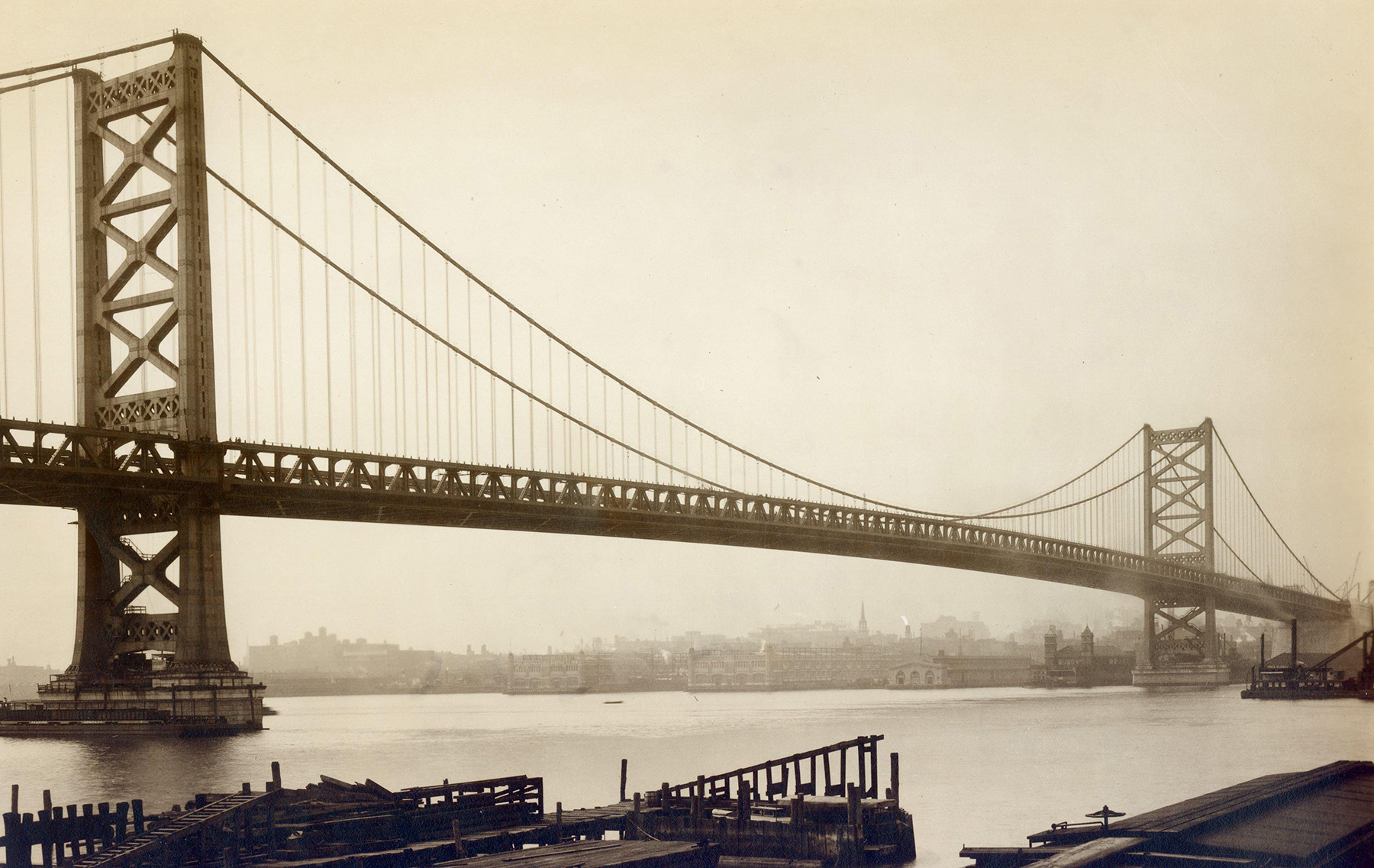
The bridge took on the name it has today in 1955 (and never carried the name of the town of Camden, despite citizen campaigns in 1925). Though the span is no longer the longest of all suspension bridges in the world, the Benjamin Franklin Bridge is still a fixture for commuters who have used it for decades to cross the Delaware River.
Leslie Nemo is a journalist based in Brooklyn, New York, who writes about science, culture, and the environment.
This article first appeared in the July/August 2026 issue of Civil Engineering as “Rising Above.” To learn more about civil engineering history and ASCE’s Historic Civil Engineering Landmark Program, visit the Historic Landmarks page.

Your History Is Our History
ASCE celebrates its 175th anniversary in 2027.
ASCE2027: The Infrastructure and Engineering Experience, a first-of-its-kind event bringing together infrastructure professionals from across sectors, is the perfect place to celebrate that history, March 1-5, 2027, in Philadelphia.
Come take your place in the rich and storied history of civil engineering!
Learn more about ASCE2027: The Infrastructure and Engineering Experience.