Brian Brenner, P.E., F.ASCE, is a professor of the practice at Tufts University and a principal engineer with Tighe & Bond in Westwood, Massachusetts. His collections of essays, Don’t Throw This Away!, Bridginess, and Too Much Information, published by ASCE Press, are available in the ASCE Library.
In his Civil Engineering Source series, More Water Under the Bridge, Brenner shares some thoughts each month about life as a civil engineer, considering bridge engineering from a unique, often comical point of view.
Some people want to visit Disneyland, or snorkel on the Great Barrier Reef, or sip iced tea next to Lake Louise.
I want to see bridges. I like to go on bridge vacations (see Note 1 below).
A bridge vacation doesn’t need to only be about bridges. In addition to visiting a place to see all the good bridges, you can plan to do other things like eat or play pickleball. In fact, most of my vacations haven’t (officially) been about only touring bridges. They just seemed to have routes laid out to bump into all the good bridges. Like, for example, the time we went to England and I thought we should visit the city of Hull. Apparently, Hull was not really thought of as a tourist destination, except if you want to drive across the Humber Bridge.
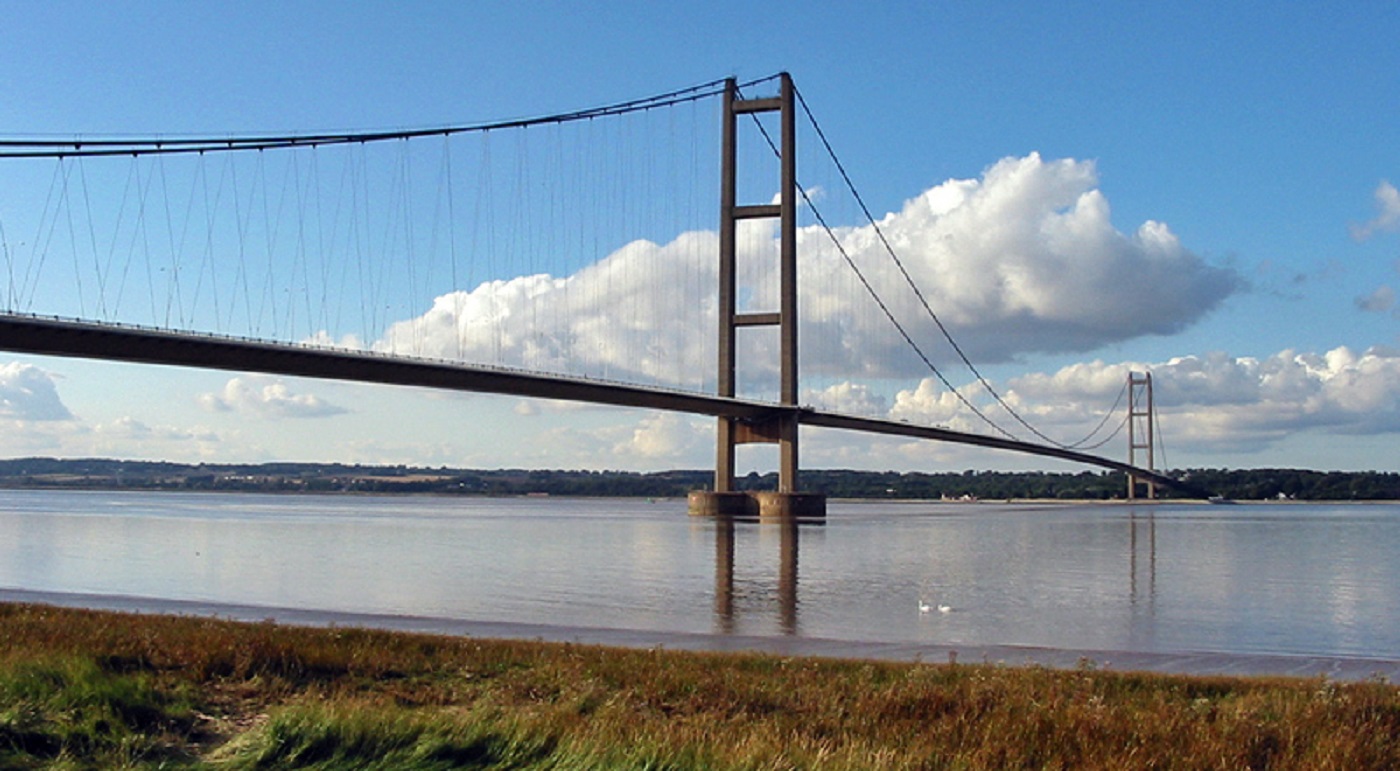
There are places around the world that are great for bridge vacations.
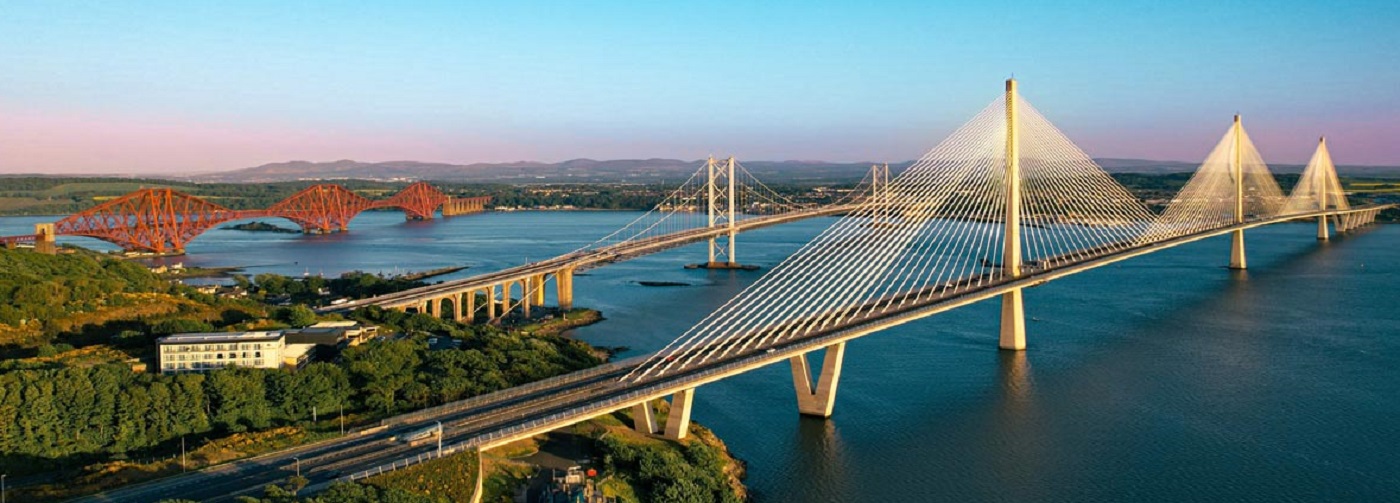
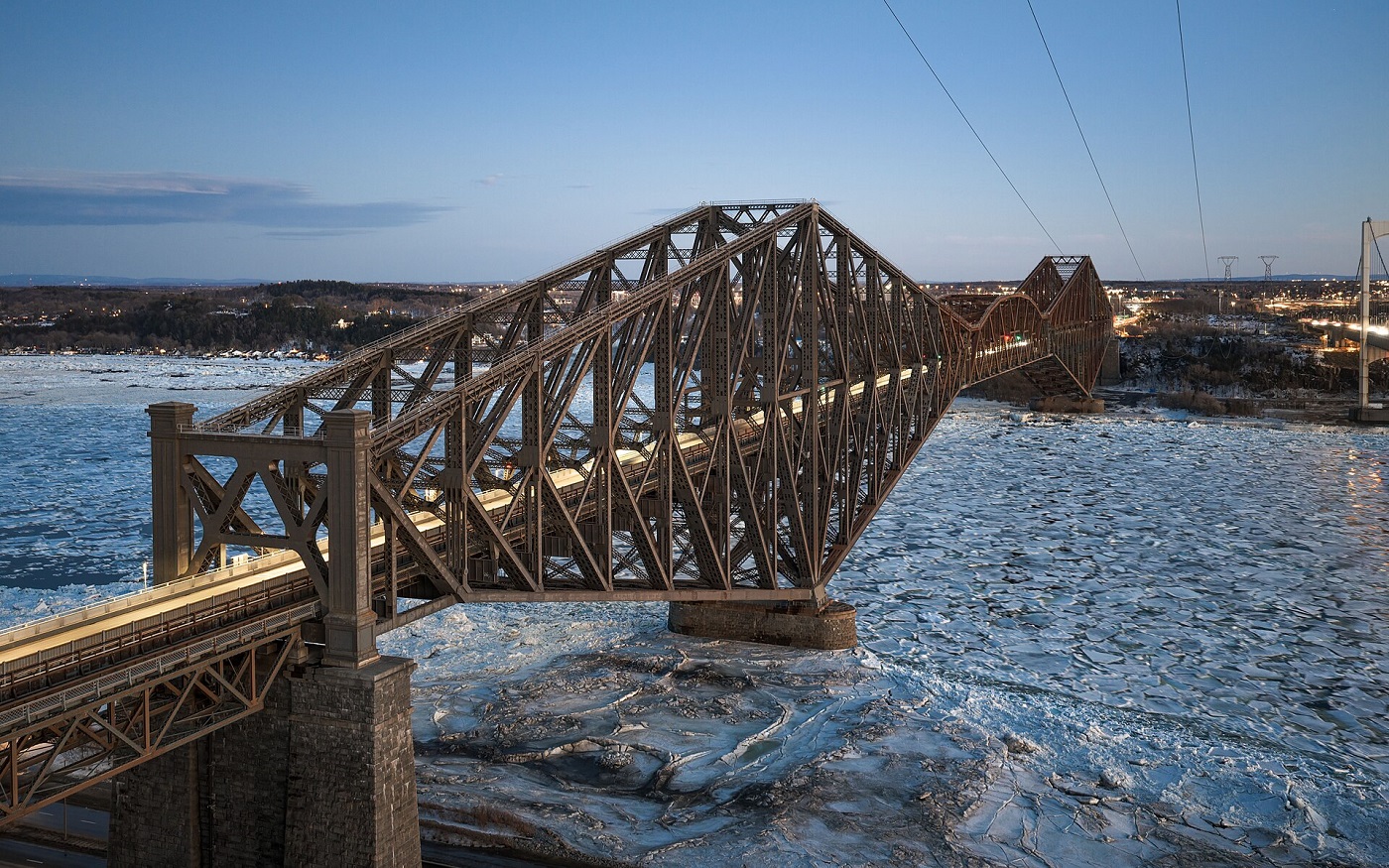
One of the best destinations can be found about 15 miles west of Edinburgh, in Scotland. You can stand on the banks of the Firth of Forth and observe three great long-span bridges: the Forth Rail Bridge, the Forth Road Bridge, and the Queensferry Bridge. The three bridges provide a living history of long-span bridge design. The historic rail bridge is a double cantilever truss which featured the world’s longest span in its day.
 scottishtours.co.uk
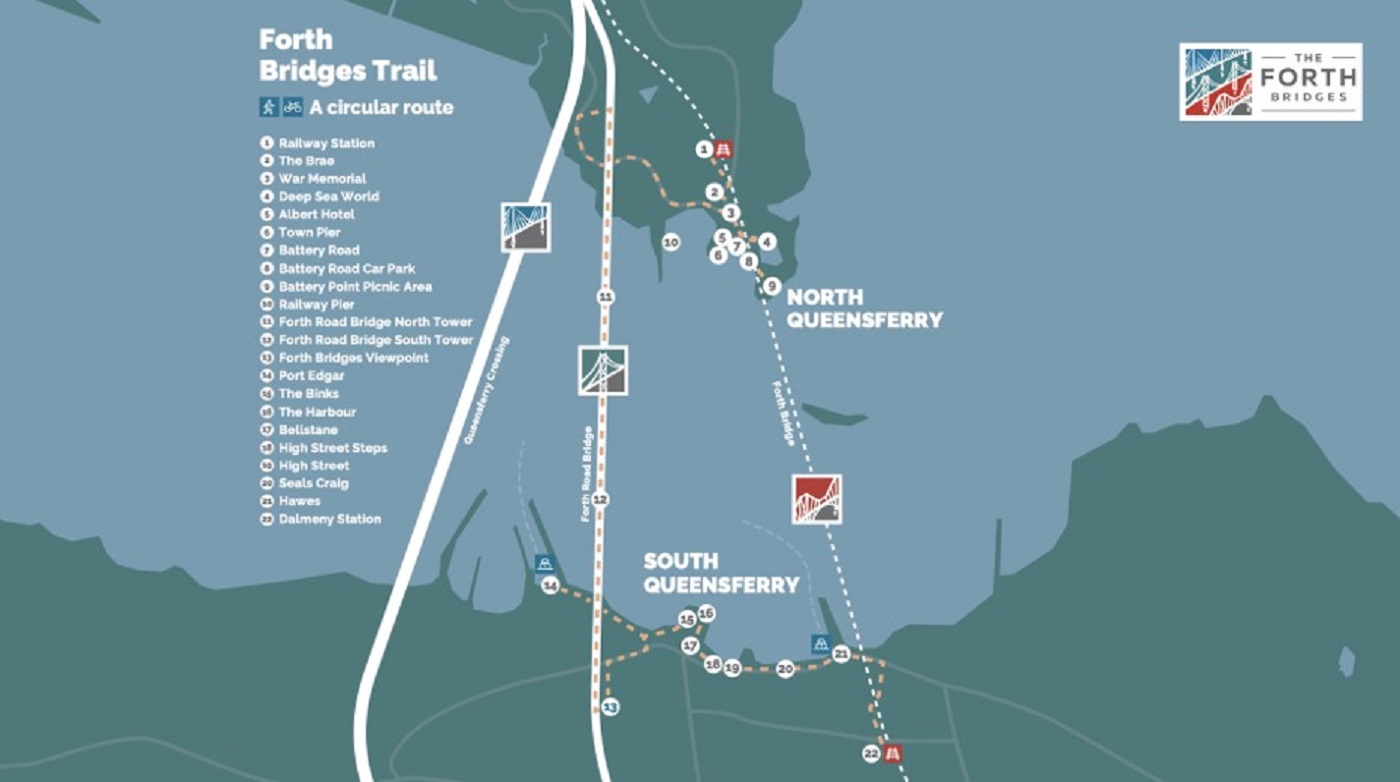
Scotland provides a 5-mile-long hiking trail for touring the bridges. The trail has many stopping points to visit non-bridge destinations. On the circular tour, guests are invited to ride a train across the Rail Bridge and later hike back across the Forth via the Road Bridge. So you get to take in the views from both banks of the river.
 theforthbridges.org/
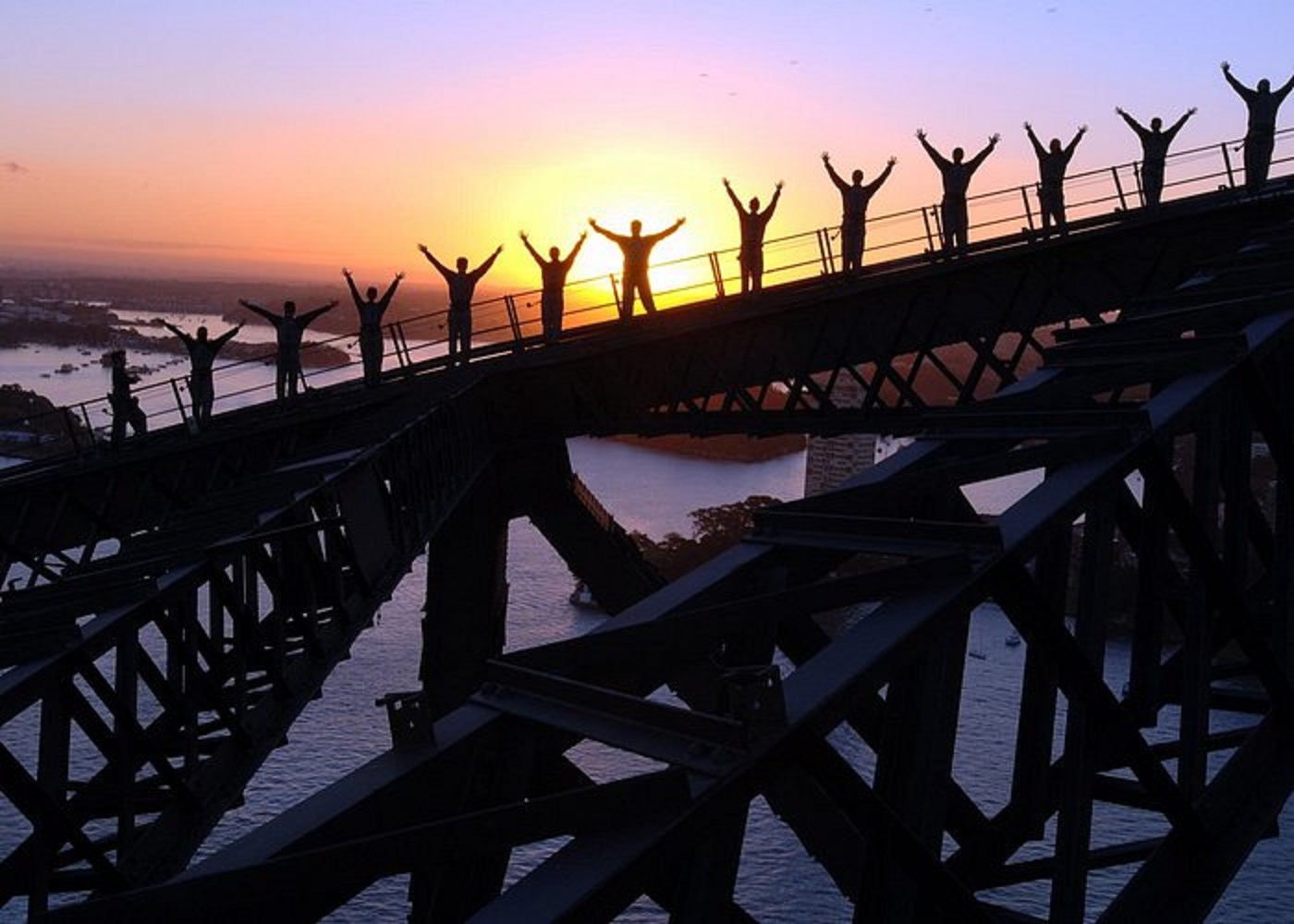
 For more active bridge vacationers, consider signing up for bridge walks. On these tours, participants climb up and over unique bridge passageways that are not usually accessible.
The Sydney Harbour Bridge has a “Bridge Climb,” which has several different options. You can climb on top, or on the lower chord, or parts in between.
Another prominent arch span, the New River Gorge Bridge in West Virginia, has a guided tour on a catwalk just below the deck. This bridge doubles as an adventure site. Not only can you hike on the catwalk, but you can also bungee jump off it. Once a year on Bridge Day, typically the third weekend in October, daredevil engineers are challenged to bungee jump and rappel off the side of the bridge. A line is strung from the catwalk below for slightly less daring riders to glide down to the river.
Some people like to simplify vacation travel by limiting their number of different overnight sites. Packing and unpacking can be a lot of work. One solution is to take a cruise and have your accommodations move for you. To visit bridges, this can work best on river tours. Rivers tend to have more bridges to see than ocean cruises.
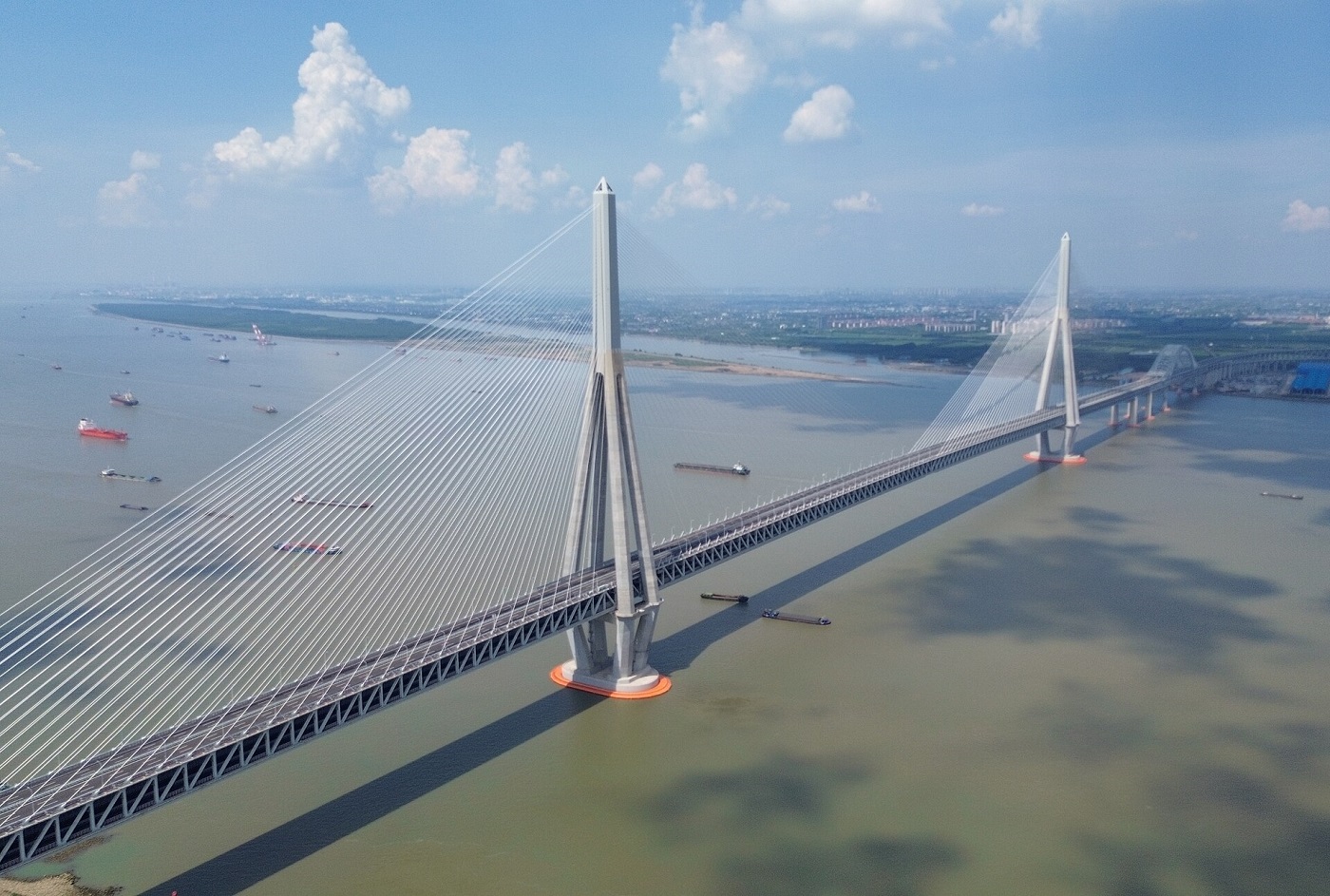
River cruises are available on the Yangtze River in China. Many of the cruises focus on the Three River Gorge area, where the river flows through a scenic canyon that unfortunately does not have as many bridges. The stretch of river further east flows through large cities and a more industrial, flat terrain. This is not as favored by tourists, but if you are a bridge engineer, some of the most impressive new bridges have been constructed here.
Instead of a cruise, another approach is to visit a city renowned for bridges. In this way you set up camp at one site and take advantage of the local bridge scenery all around you.
Good choices for an urban bridge vacation include Venice, Pittsburgh, Portland (Oregon), and New York City. Both Pittsburgh and Portland have been nicknamed as Bridge Cities. New York has too many other features to be considered only as a Bridge City. But the variety and number of bridges in NYC is amazing and a good base to experience many different types of bridges.
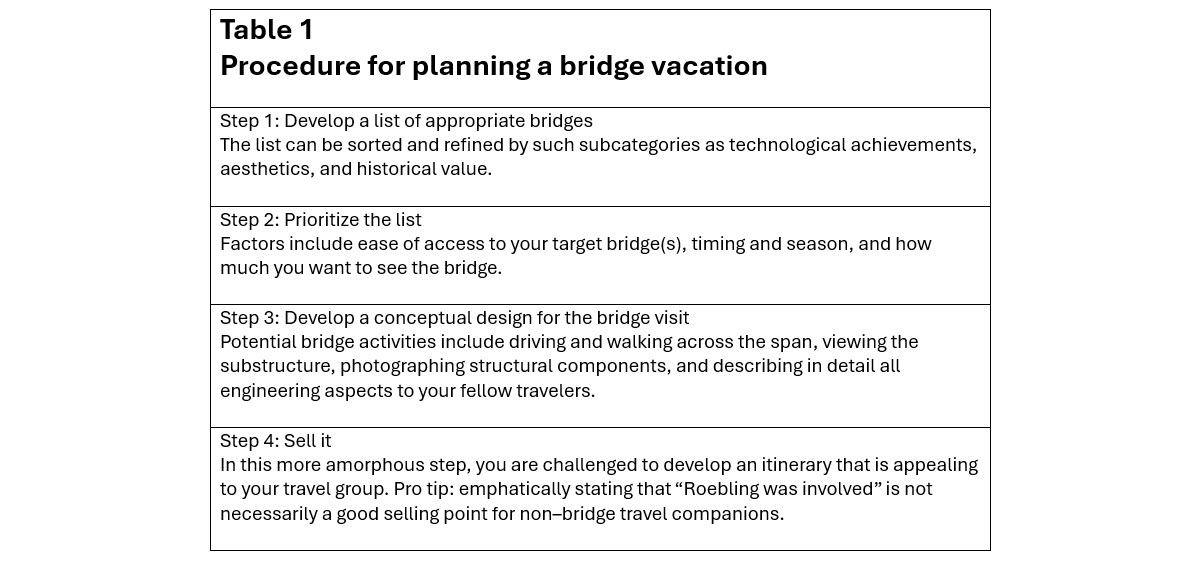
The reality is that there are so many bridges and not enough time to cross them all. How should an engineer plan for a bridge vacation? An engineered approach can help. Follow the procedure listed in Table 1 below:
If your spouse / significant other is not a bridge engineer (see Note 2 below), what is the best way to introduce the topic of going on a bridge vacation?
We had an airline credit that had to be used within a year. The airline started a new route for service to Traverse City, Michigan. That seemed promising.
I proposed to Lauren that we schedule a summer vacation in Traverse City, Michigan.
She said, “What is in Traverse City, Michigan?”
This was a challenging question since I didn’t really know. I did some quick research, and it turns out that Traverse City, Michigan, has a lot of interesting things in addition to the real reason I wanted to go. So I said to Lauren—
“Traverse City, Michigan, is well known for cherries. You go to festivals and you can eat all or part of a cherry pie.”
Lauren said, “And??”
“Vineyards,” I responded. “Many vineyards. With grapes. There is a large peninsula which has a dozen vineyards with wine-tasting and cheese platters. You drive up and down this peninsula and sample delicious wines.”
 cdn.hourdetroit.com
 She was starting to get interested because we both like vineyards. But she still wasn’t convinced about my motivations.
She said, “And??”
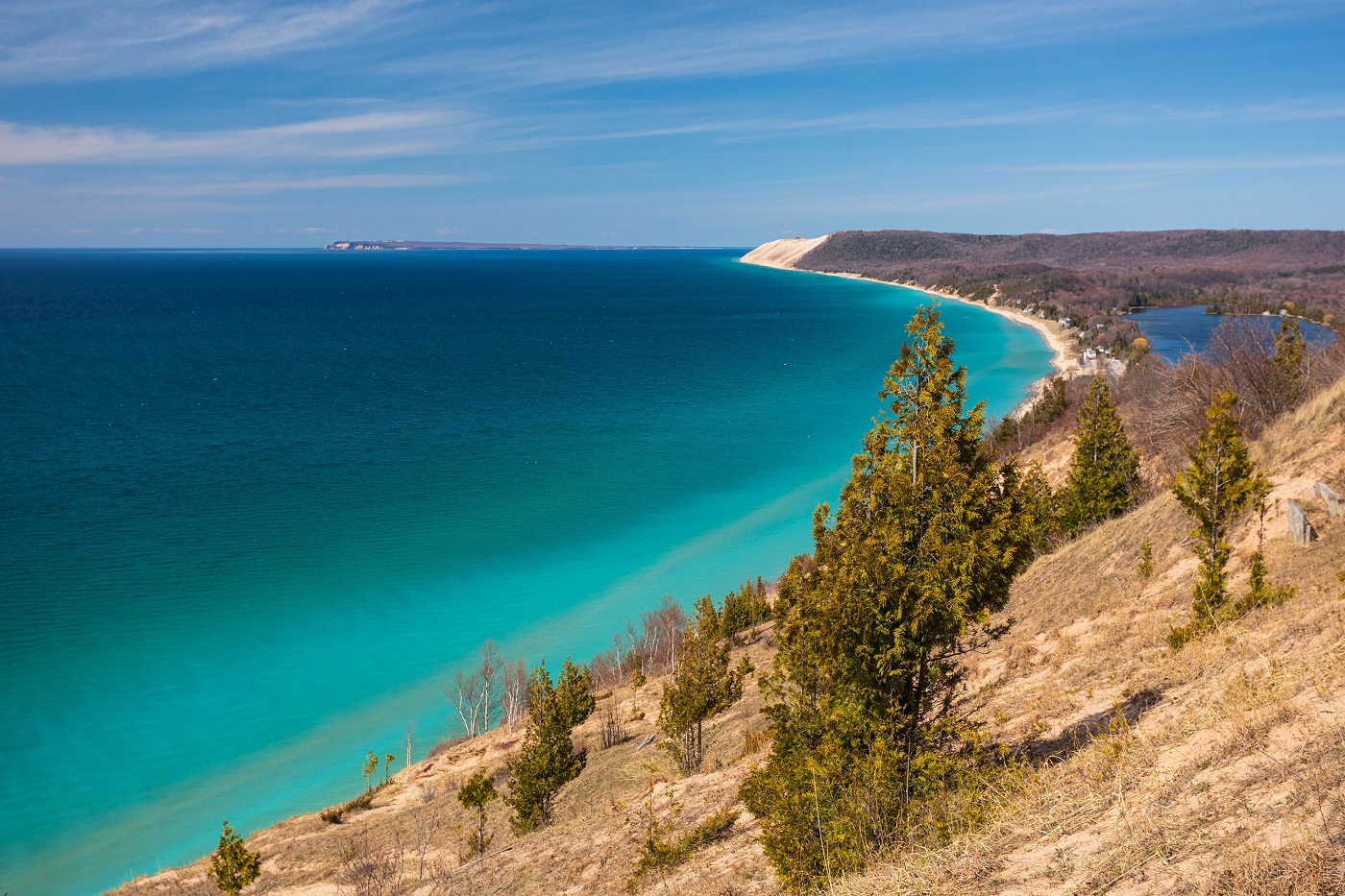
I said, “There is a giant lake that is so wide, you can’t see the other side. It would be like going to the ocean, but it’s not because it’s a lake.”
 golocalsguide.com
 That also seemed interesting, but maybe a trip just to see a lake that looked like the ocean wasn’t a dream vacation.
Lauren said, “And??”
I responded, “Well, there’s a bridge.”
Lauren smiled.
The bridge in question, long on my bridge bucket list, is the amazing Mackinac Bridge, connecting the state’s upper and lower peninsulas.
The site is remote and I had never concocted a reason to visit. Until now. The combination of having to spend an airline credit along with the new direct flight provided good motivation for a short summer trip.
Using the approach described in Table 1, I planned our vacation. The itinerary was to visit for five days. On one of the days, we would drive two hours north from Traverse City to St. Ignace, where you could take a ferry to visit Mackinac Island offshore in Lake Huron. The island is a well-known destination for Midwest vacationers and it has a lot of things to do and see in the summer. But of course, that wasn’t the point.
Lauren looked at the map and was confused. She said, with a smile, “Why don’t we take a ferry from Mackinac City? That looks more convenient than St. Ignace.”
To get to St. Ignace before boarding a ferry, you had to drive across the bridge. Several times. I responded coolly, trying to mask my horror:
“I heard the ferries from Mackinac City are a little dangerous. There are late season icebergs and the potential for aggressive freshwater sharks. Just to be safe, we should go to St. Ignace."
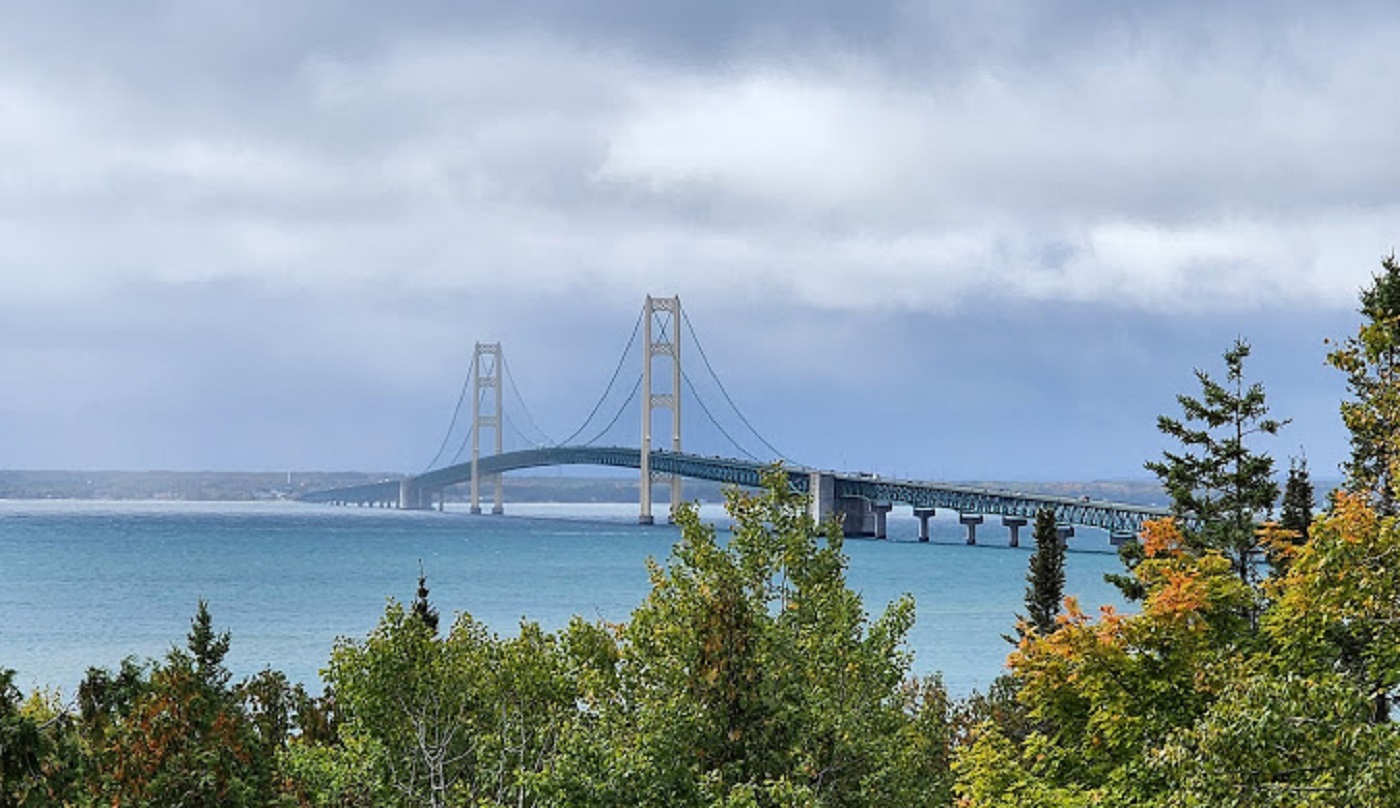
Starting our vacation, we arrived at Cherry Capital Airport, which is the small and excellent facility serving Traverse City. Our inn was on a long and wide bay of Lake Michigan. After a day of getting acclimated, we set out for the two-hour drive north on I-75 to the Straits of Mackinac. The terrain was interesting. It was mostly rural and wooded, and it had some modest hills and slopes. Getting closer, the bridge first announced its presence. The enormous towers are visible from I-75 for several miles before you get to the bridge. Approaching, you can experience the beauty and grandeur of the crossing. This gradual siting increases the bridge drama.
The straits connect Lake Michigan and Lake Huron. Technically, these two are really one giant lake. Unlike the other Great Lakes, they are at the same elevation and share continuous direct water flow. The straits are about 5 miles wide and posed enormous challenges for bridge engineers in the 50s. The water is up to 300 feet deep, and winters are fiercely cold and windy. The waterway usually is completely covered by ice. To keep the navigable waterway open, icebreakers ply the straits.
Fortunately, we were crossing in July, but a record heat wave was roasting northern Michigan. The lake had more of a tropical feel than deep tundra. We passed north on the interstate through the Mackinac City exits and started our crossing.
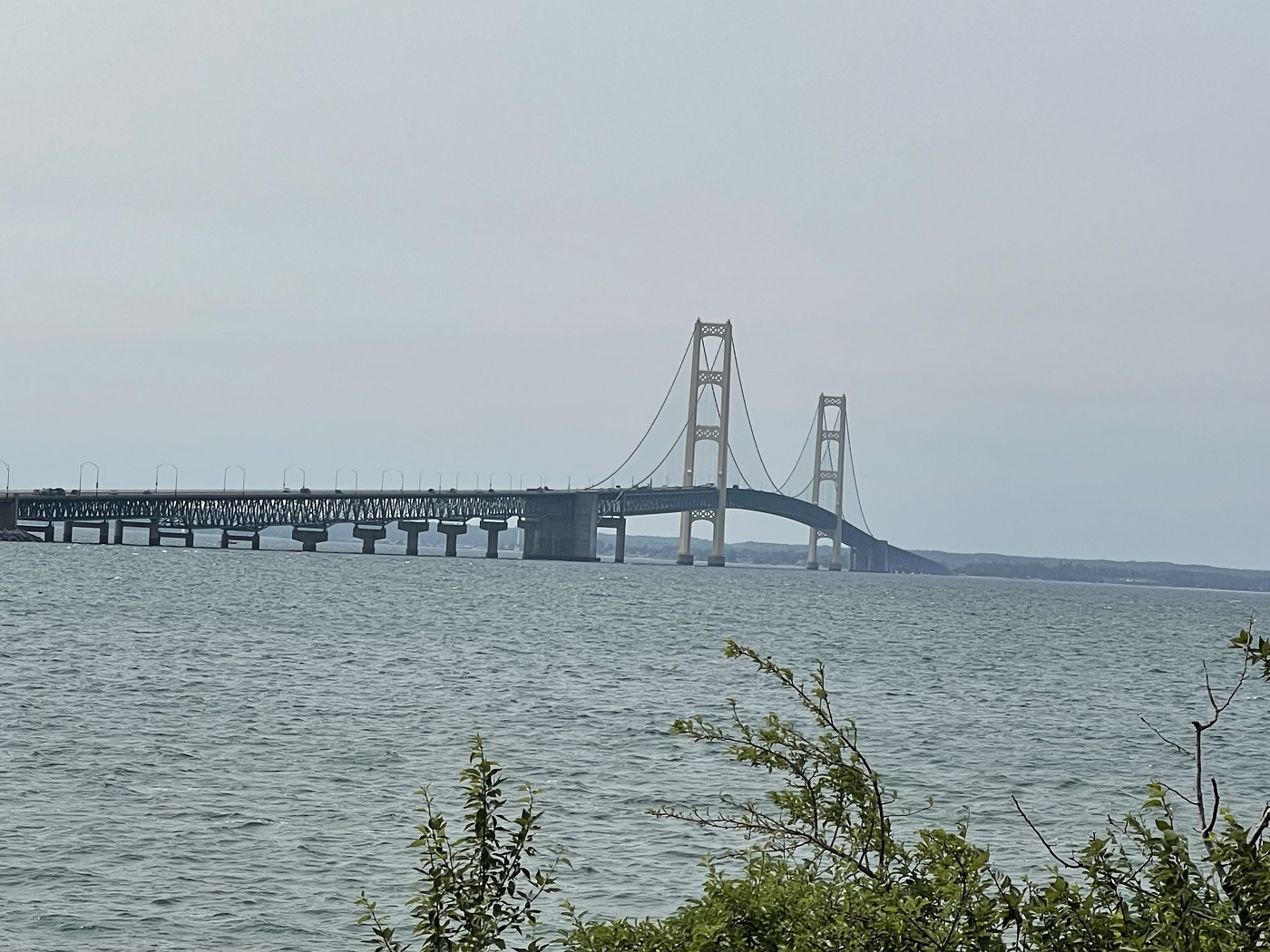
The bridge starts with large deck-truss approach spans on concrete frame and hammerhead piers. The road gradually rises at a pretty good grade to the showpiece, a long and graceful suspension bridge. The bridge span was the third longest in the world when it opened in 1957. The overall suspended portion was the longest, since the back spans are unusually long in proportion to the main span.
 Lauren Brenner
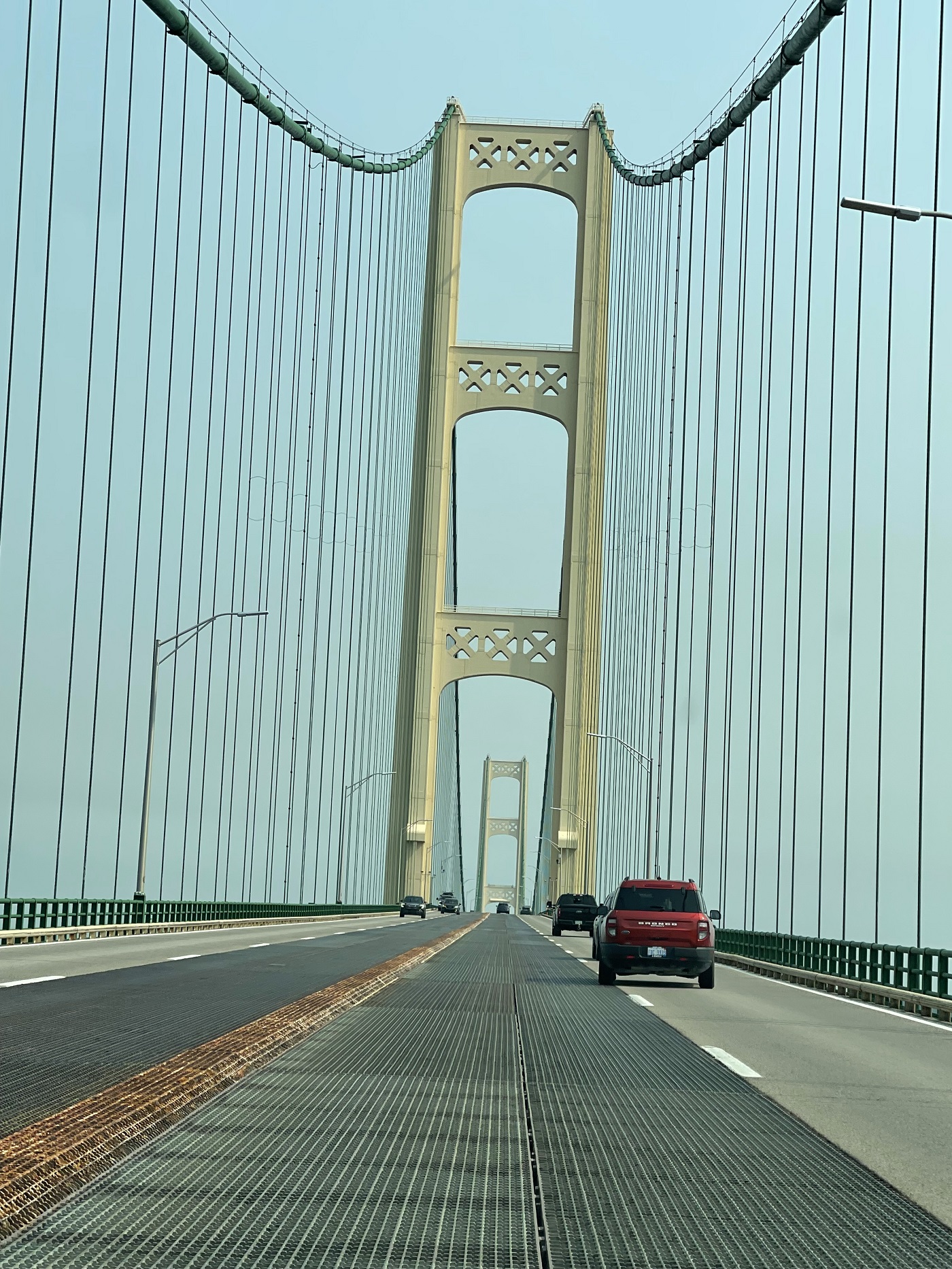
 Crossing the main span is one of the world’s great bridge driving experiences. The towers are tall and monumental, with a pale cream color curiously different from the green superstructure. The color scheme was based on illustrations by an advertising campaign promoting the bridge, and later adopted by the Bridge Authority. Riding on the deck, you are gracefully suspended in an airy expanse of sparkling light. Water extends in all directions at the confluence between the two lakes. The world below looks glowing, distant, and blue.
The crossing is also one of the scariest of bridge experiences. If you have a fear of bridges, you may want to pass on this one. One issue is the metal grating used for the middle lanes of the suspension bridge. The Mackinac Bridge was designed to avoid the fate of Tacoma Narrows Bridge. In addition to deep stiffening deck trusses, the use of metal grates reduces the potential for the torsional movement that led to the Tacoma Narrows collapse by allowing vertical wind gusts to pass through instead of buffeting the structure. But a thin, shaky grating that allows you to see the swirling waters far below is not a comfortable experience. Most drivers ride on the exterior, concrete lanes.
 Lauren Brenner
The bridge fascias have low barriers by current standards. Also, the suspender cables are connected to the truss below, but with an open-air gap between the cable plane and bridge deck. The experience is one of unobstructed views in all directions. But the gossamer cables, narrow lanes and low barriers also can imply that with one false move by the driver, you will plunge off the side and swim with the (freshwater) fishies.
What is most interesting about the Mackinac Bridge is its prominent place in Michigan society. The structure is a beloved and appreciated part of the landscape. It is how decades of Michiganders have gone on vacation to north peninsula from the south. It is representative of ingenuity, of overcoming adversity, and of connecting the unconnectable. The bridge looms over its domain with grace, wistfulness, and beauty. These feelings of quiet importance were there everywhere you went.
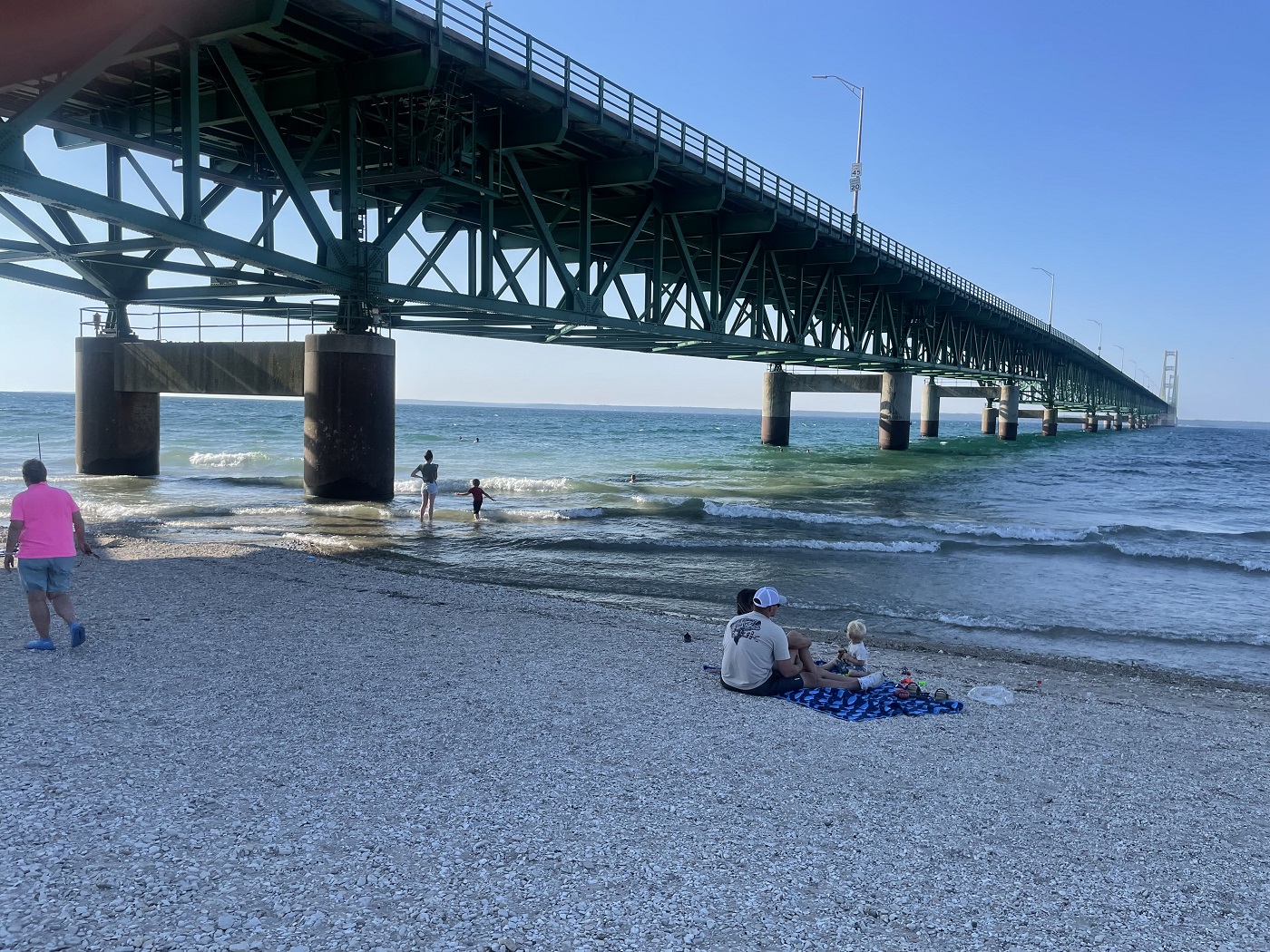
Sometimes the expression was more direct, such as the appearance of Mackinac bridge images on state license plates. Sometimes it was more subtle, such as the way swimmers casually frolicked off the beach in Mackinac City next to the bridge piers. Always, the feeling that the bridge was important and appreciated made for a great bridge vacation destination.
 Brian Brenner
 We had a great trip touring the bridge (and doing other non-bridge things). Lauren was concerned that we might run out of sites to visit for future bridge vacations. I told her not to worry. I was sure we would come up with something. A bridge designed by Roebling (Roebling!). Or something just as good.
 Quintin Soloviev
 Notes
Note 1
This essay describes “bridge vacations,” where visiting at least one bridge is a key objective of the trip. A “bridge date” is a shorter-duration visit, and it is discussed separately.
Note 2
It is possible for a couple to both be bridge engineers. But statistically this is unlikely, so alternate procedures for communication and vacation planning are desirable to bridge that relationship gap.