
By Carrera Dean, P.E., Louise Koepele, EIT, Jessica Manning, Environmental EIT, and Noah Belinowiz
In eastern Rwanda’s rural Kirehe district, the Kigongi River had repeatedly washed away bridges, making travel difficult and dangerous for those trying to cross the river to reach vital services such as hospitals, schools, markets, and main transportation routes. For one local resident who assisted in the recent construction of a more permanent crossing, the challenge was quite personal: “My sister experienced a critical situation during labor,” explained Mukeshimana Jeaninine. “Due to the impassable conditions, we were forced to carry her across the river, risking all our lives.”
The impact that these repeatedly destroyed bridges were having on the surrounding communities — including Rutare, Karambi, Kamarashavu, Rukira, Nyungwe, and Tonero — came to the attention of Fika (formerly known as Bridges to Prosperity), an international nonprofit organization. The mission of Fika, which means “to arrive” in many African languages, is simple yet profound: to partner with “communities, governments, private sector, research and technology, and other stakeholders to help plan, prioritize, assess, construct, and manage transport access for rural communities around the world,” according to its website.
Fika partnered with the regional government to build a 50 m suspension bridge spanning the Kigongi River northwest to southeast, connecting more than 3,100 people. Residents southeast of the bridge had been particularly isolated from essential resources and opportunities northwest of the river. Weston & Sampson, a U.S. engineering and environmental consulting firm, had worked with Fika and was proud to partner with the group again, sponsoring the Kigongi River Bridge via financial contributions, funding a team of 10 to assist with construction, and providing donations of personal protective equipment and tools for continued bridge work throughout Rwanda. The firm also donated toys and educational supplies to one of the schools nearest to the bridge.
Through Fika’s design, our Weston & Sampson team — which included civil and environmental engineers, geologists, and environmental and wetland scientists — assisted in construction, monitored quality control of bridge components, taught bridge maintenance and construction skills to the community team, and provided feedback on structural design and construction procedures to Fika for future bridge projects.
Before our arrival, the on-the-ground team of about 20 people — including local residents and Fika staff — had prepared the substructure by hand-digging trenches and mixing concrete to form abutments on each side of the river that would anchor the bridge’s two 6 m tall towers into the landscape. Decking approach ramps were adorned with beautiful stone mosaics — a tribute to local craftsmanship that reflects similar designs on nearby homes. This crew had worked on the structure for nine weeks, from July 28, 2025, until we reached the site on September 29.
We were given accommodations in a modest, courtyard-style Rwandan family’s home in Birenga, 15 km west of the bridge site. Here, we were greeted by Fika staff, as well as the team with whom we would live for the next two weeks, including project managers, drivers, security guards, and even local chefs who would prepare traditional cuisine.
That first day, everyone gathered in the main room of our accommodations, trading stories and sharing excitement for the upcoming weeks. We savored meals together, reflected on daily highs and lows, and ended nights with board games. Those simple routines made the house feel less like temporary lodging and more like a place of connection.
As our team traveled to the project site via car along a winding 38 km route through hillside villages, the community’s energy fueled our team. Each workday started with singing Kinyarwanda songs such as “Tuzarwubaka!” (meaning “We will build it!”), a tune about building Rwanda into a beautiful country together. This instantly raised all our spirits and inspired everyone to meet each day’s goals.
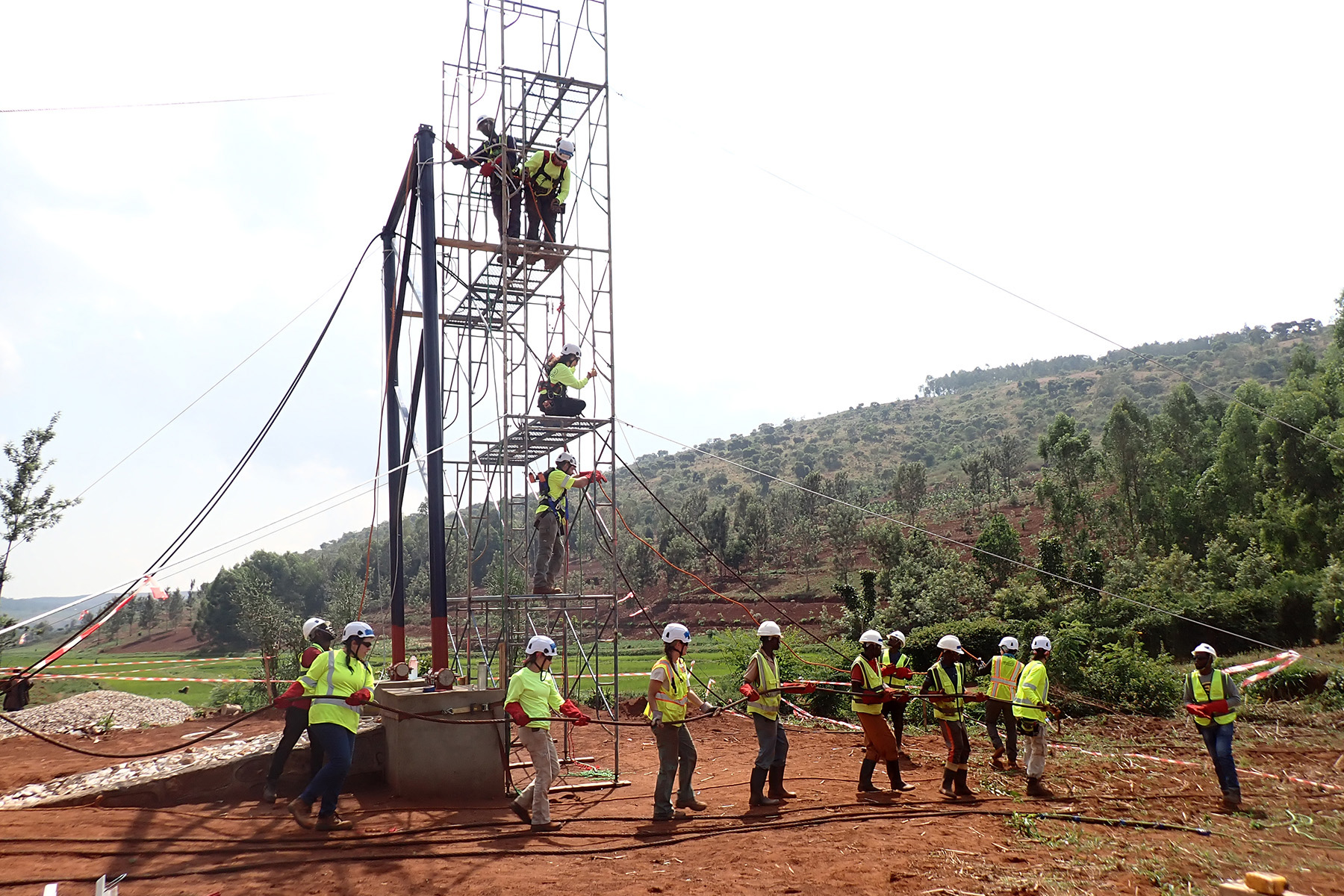
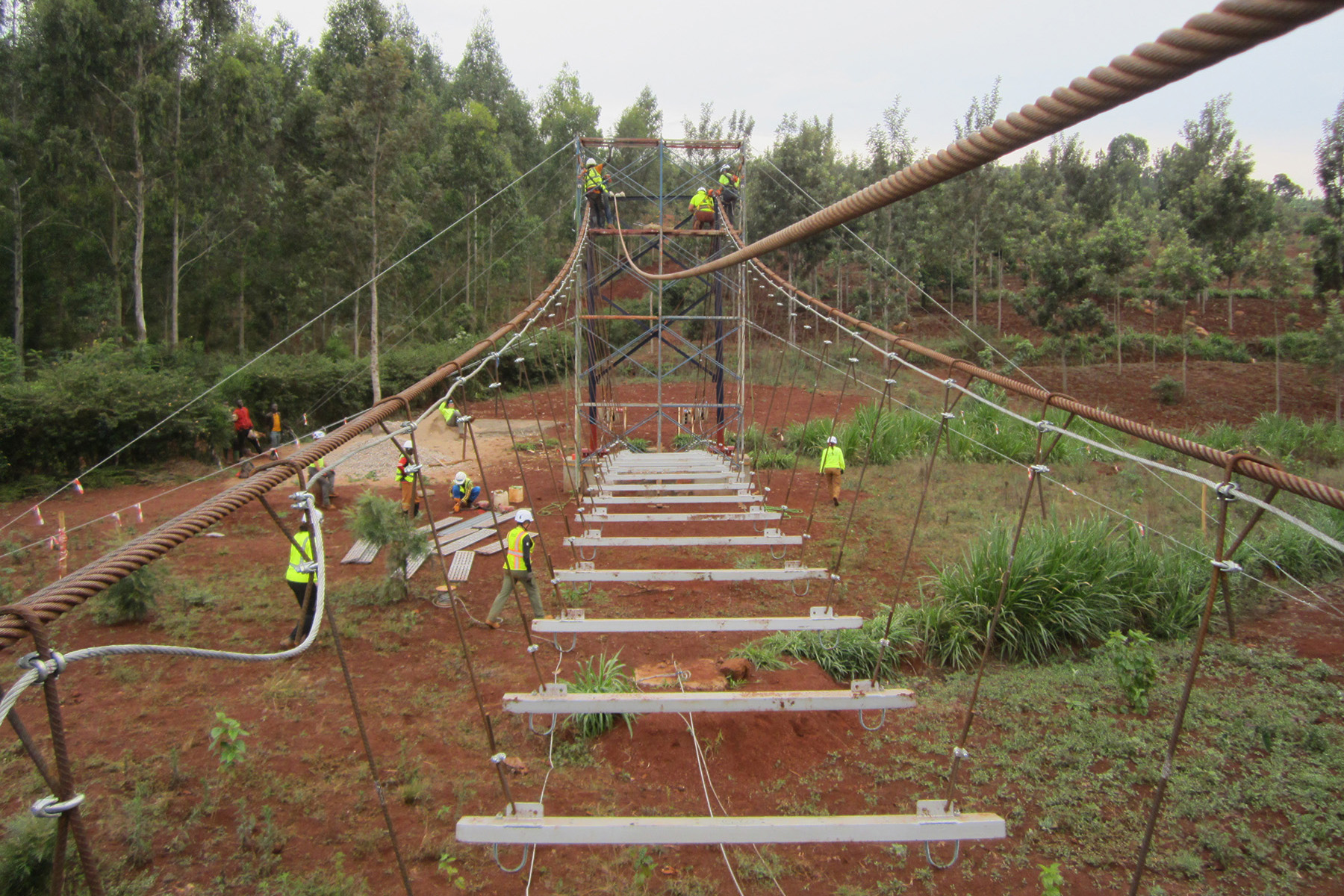
Community members and the Weston & Sampson team constructed temporary steel scaffolding adjacent to the towers. The towers themselves featured hinges at their base that helped us raise them into position using a winch and repurposed 29 mm diameter cables that had formerly been used at Tanzanian shipyards to unload containers. Concurrently, 10 mm rebar suspenders were cut, shaped, leveled by hand, and secured to 2 m long galvanized-steel decking swings with bolted connections. The decking swings and suspenders were affixed to the suspension cables at 1 m intervals, followed by crews installing decking planks for the walkway and fastening handrails and fencing.
The bridge met the project’s objective of safe passage across the Kigongi River, maintaining a minimum freeboard of 2.5 m between the high-water level and the underside of the deck along the main span. Despite differences in experience and language, our team and the community worked as one to build the structure, cementing personal connections that will last a lifetime.
As the end of our two-week journey approached, and the bridge was on schedule for the final stages of assembly, we were able to visit the local school northwest of the Kigongi River, attended by roughly 1,000 students, many of whom reside southeast of the new bridge. The children shared personal stories, including some who aspire to become engineers themselves after witnessing the bridge come into fruition. They explained how engineering of the bridge will provide year-round access to school and encourage continuance of their education.
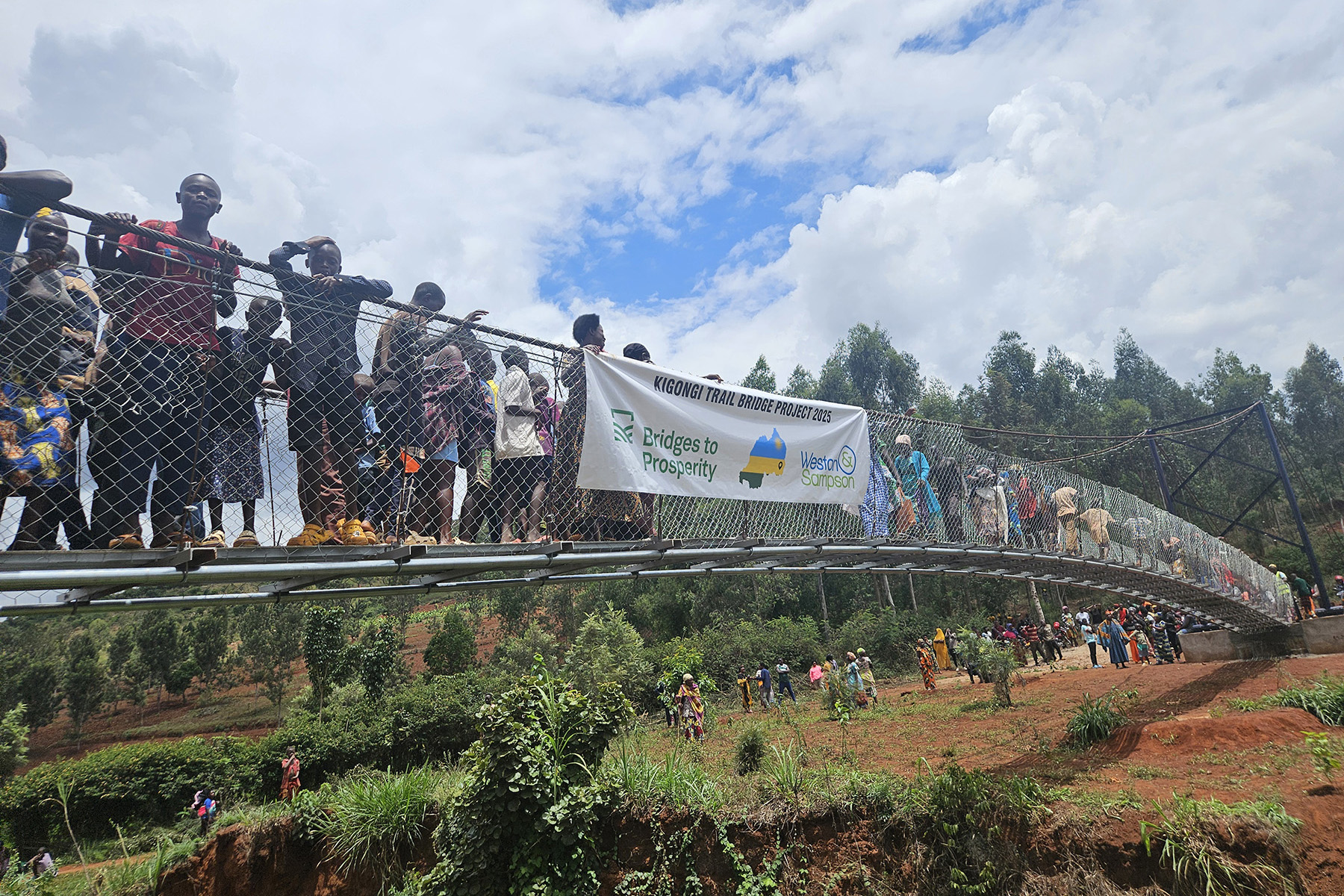
As inauguration day arrived on October 10, regional government officials and local residents joined us and the community team to celebrate the finished bridge. Traditional songs and dances filled the celebration with cheers, laughter, and smiles. Ten community team members, selected to maintain the bridge, were recognized in the ceremony for their hard work and future efforts to preserve the bridge’s integrity.
After their work constructing the substructure and the training they received from our team on the use of power tools, safe work practices, and proper measuring techniques, this local team is well-prepared and enthusiastic about their roles in maintaining the new crossing. The Kigongi River Bridge will serve a community quite deserving of its lasting benefits.
The authors would like to extend their sincere appreciation to additional Weston & Sampson team members including Chip Hutchens, P.E., regional manager; Jamie Craig, P.E., project manager II; Joseph Lauria, P.E., team leader; Devin Herrick, certified wetland scientist and technical specialist II; Jessica Liggiero, engineer II; and Jessica Podesta, environmental specialist II.
Carrera Dean, P.E., is a project engineer, Louise Koepele, EIT, is an engineer III, Jessica Manning, Environmental EIT, is an engineer II, and Noah Belinowiz is a geologist II for Weston & Sampson.
This article first appeared in the July/August 2026 issue as “Crossing Challenges.”
For more information about Fika, visit fika.org. And if you have a story about giving back, email us at [email protected].


