By Kayt Sukel
Historically, scientists have studied earthquakes — like the recent magnitude 7.5 quake in Venezuela — using seismometers deployed on the ground near fault lines, but even the most sophisticated of instruments can only record data in the aftermath of a quake. What’s more, their locations on the surface simply cannot capture the physics of movements occurring kilometers below.
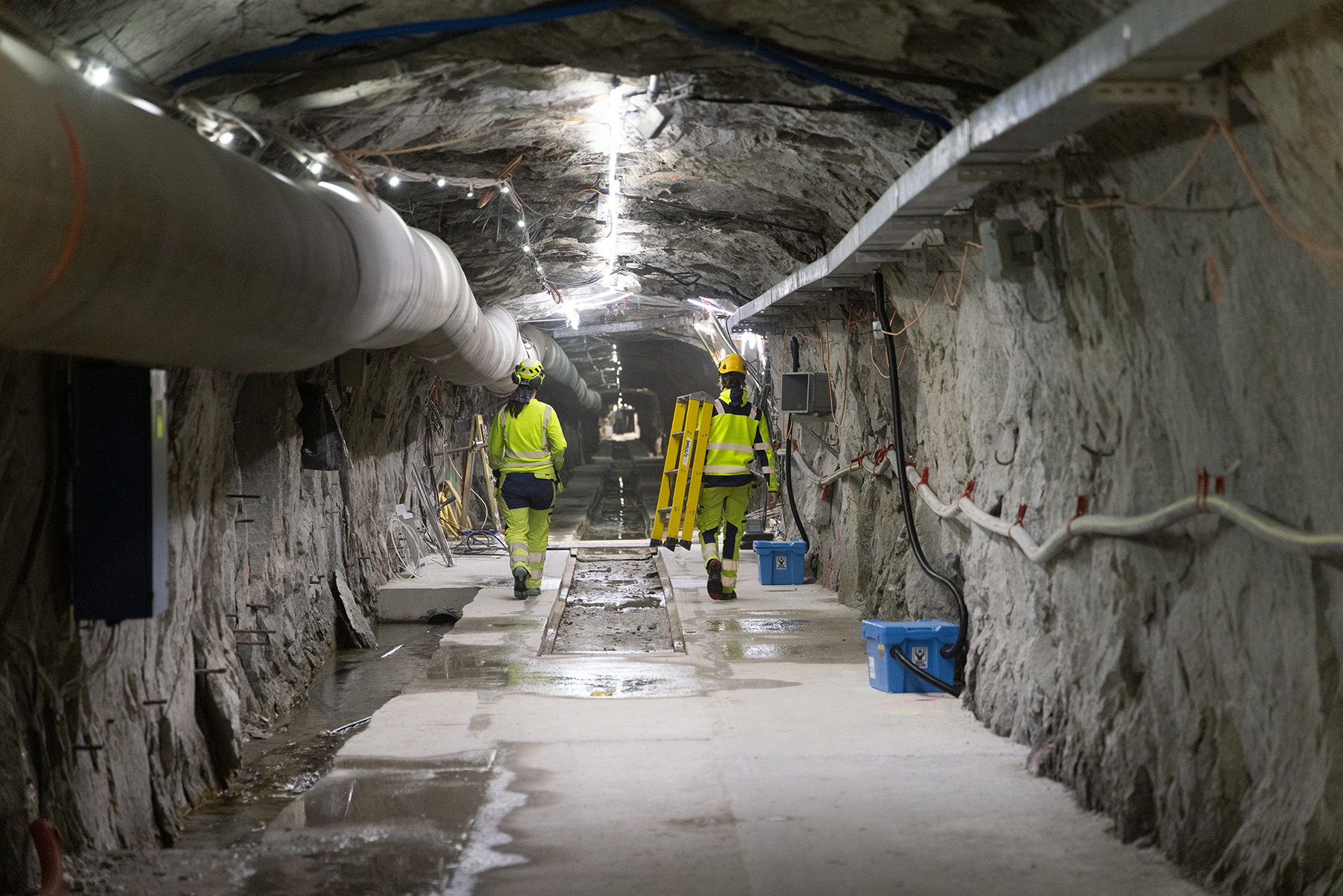
Now, researchers from Switzerland’s Eidgenössische Technische Hochschule Zürich, Germany’s Rheinisch-Westfälische Technische Hochschule Aachen University, and Italy’s Istituto Nazionale di Geofisica e Vulcanologia have built a one-of-a-kind laboratory, nestled about 1,500 m beneath the Alps, to study the physics of small-magnitude earthquakes up close and personal ... by using the natural fault in the mountain to cause them.
“If we want to understand induced seismicity, we need to do experiments directly on the fault at the depth where quakes are taking place, not at the surface,” said Domenico Giardini, Ph.D., chair of seismology and geodynamics at ETH Zürich.
A novel underground laboratory
Florian Amann, Ph.D., is the chair of engineering geology and hydrogeology at RWTH Aachen. He said the idea to create what is now the Bedretto Underground Laboratory for Geosciences and Geoenergies — in an expanded service tunnel originally built for a local rail line — started while conducting experiments on enhanced geothermal systems, which are reservoirs specifically engineered to extract heat from the Earth’s crust to generate electricity.
Amann said that extracting heat from dry, hard rock underground can sometimes trigger small quakes. That inspired the idea to create a unique underground lab that could serve as a test bed to learn more about “how (an earthquake) starts, how it propagates, and how it ends.”
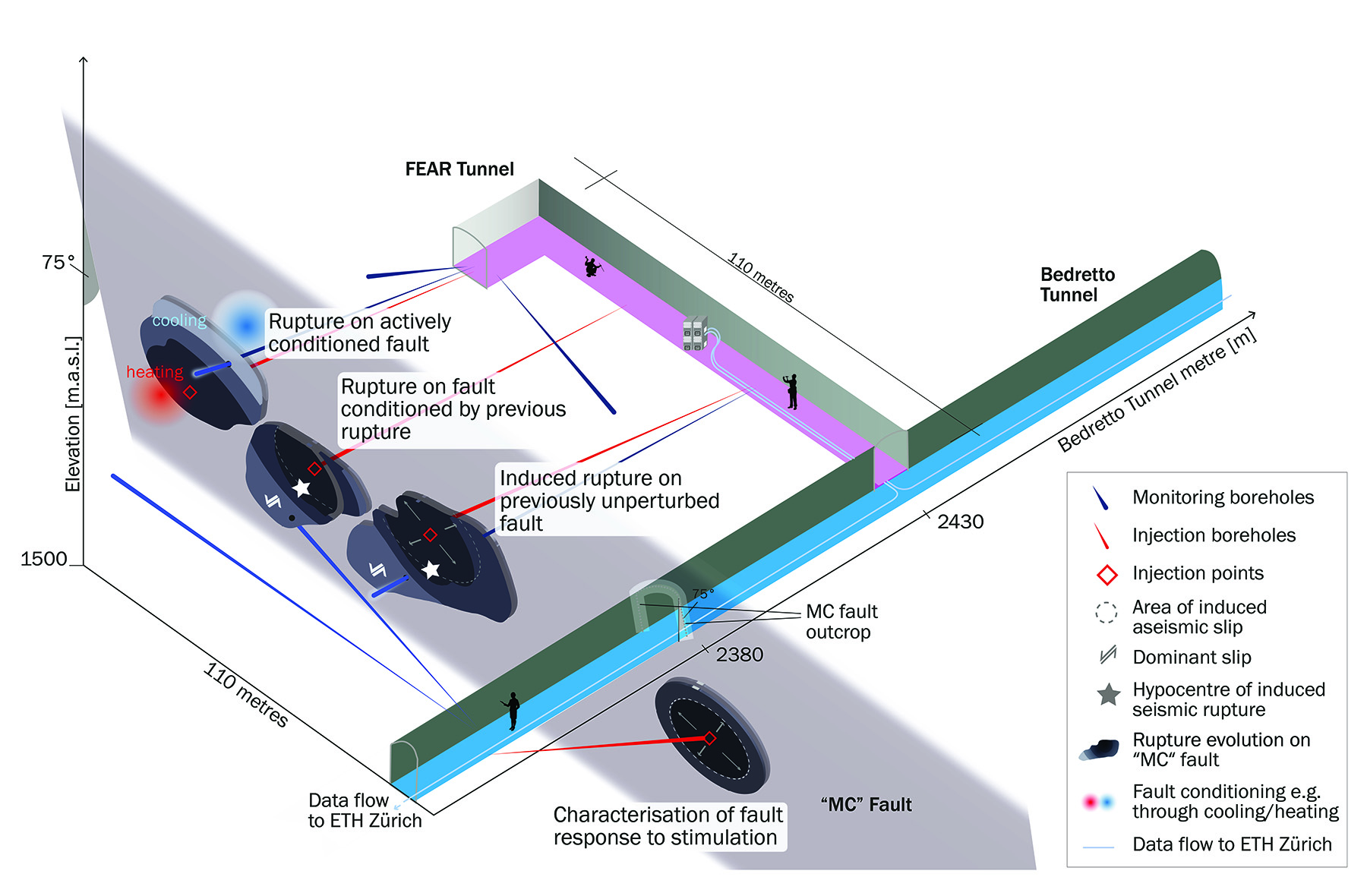
With a €13.7 million grant from the European Research Council, Giardini, Amann, and their colleagues have begun the Fault Activation and Earthquake Rupture project, known as FEAR. The team expanded the aforementioned tunnel, which runs along a natural fault, and then drilled dozens of boreholes along 3.6 km of its length. Those holes are used for two distinct purposes. Some house a dense network of sensors and instruments to record data. Others allow the team to use hydraulic fracturing, or the injection of water at 20 megapascals of pressure, to stimulate the fault and initiate a small seismic event.
“We drill holes that go deep into the rocks, say 250 m to 400 m, and we cement in each one hundreds of sensors that measure every possible physical and chemical parameter,” said Giardini. “Then when we inject water into the rock and stimulate the fault to move, the sensors can tell us if there is a difference in inclination, in pressure, in content of radon gas, in velocity of seismic waves, and so on.”
Dealing with the data
In April, the research team injected 750 cu m of water at 20 megapascals of pressure into specific boreholes near the fault planes to induce the fault to move. The resulting seismic events ranged from -5 to -0.14 magnitude. The next challenge, however, is making sense of the reams of resulting data captured during these minuscule quakes.
“We have instrumented this fault zone so densely, both spatially and temporally, and some of the sensors have a sampling rate where you collect more than a thousand points of data per second during the experiment,” Amann explained. “The data we produce within an hour is in the range of terabytes.”
Giardini said the team is relying on machine learning and artificial intelligence techniques to build new models to characterize the physics of the small, induced earthquakes in this unique underground laboratory. “We are using digital twins,” Giardini said. “All the data is essentially fed directly into computer models and then into simulations so that the models can grow by assimilating the data. We then keep tailoring and improving the models so that we can extract more data from the noise.”
The ultimate goal is not necessarily to be able to predict an earthquake — although, Amann admitted, that would be helpful, especially for people living in earthquake-prone areas. “I cannot promise that we end up, a year from now, with a model that predicts an earthquake,” Amman said. “But I can predict that we end this project with a lot of additional learning and knowledge about earthquake physics.”
Applying the physics
Other scientists are using this innovative test bed to better understand the “variability of geological response,” as Giardini phrased it, that is observed in geothermal facilities and mining projects that involve injecting water at pressure underground to generate energy, expand tunnels, or manage waste.
Giardini stated that sometimes, in different underground initiatives, engineers do not know whether they might initiate small quakes when they introduce water, which could risk worker safety or impact the success of the project. Sometimes, engineering teams can inject water without stimulating a fault. Other times, they will see unexpected — and unwanted — seismic activity in areas they thought were stable.
Predicting seismic activity is complicated because “our knowledge is scarce,” said Giardini. “So, we are working directly with industry ... when industry says, ‘We would like to test a new way to inject water, what do we need to know so (that we) will not produce a quake, or if the quakes come, what knowledge do we need to keep them small?’”
The results from future experiments could impact the way underground work is performed. One experiment will look at the difference between injecting cold or hot water to increase permeability so that fluids can circulate more easily in various geothermal projects. Another experiment will study the seasonal differences that influence how much heat can be extracted from rock.
Giardini hopes that as techniques advance in these different underground pursuits, more industry partners will come to the lab to collect data about different questions they may have. In the meantime, the FEAR team will continue to analyze the troves of data they have collected. The research team is also planning more experiments beyond those scheduled for September in order to add to and refine their existing models. By the end of the FEAR project, Amann hopes that the field of geophysics will gain a much deeper understanding of how earthquakes develop in time and space.
Kayt Sukel is a science and technology writer based in Overland Park, Kansas.
This article first appeared in the September/October 2026 issue of Civil Engineering as “Learning From Little Earthquakes.”