

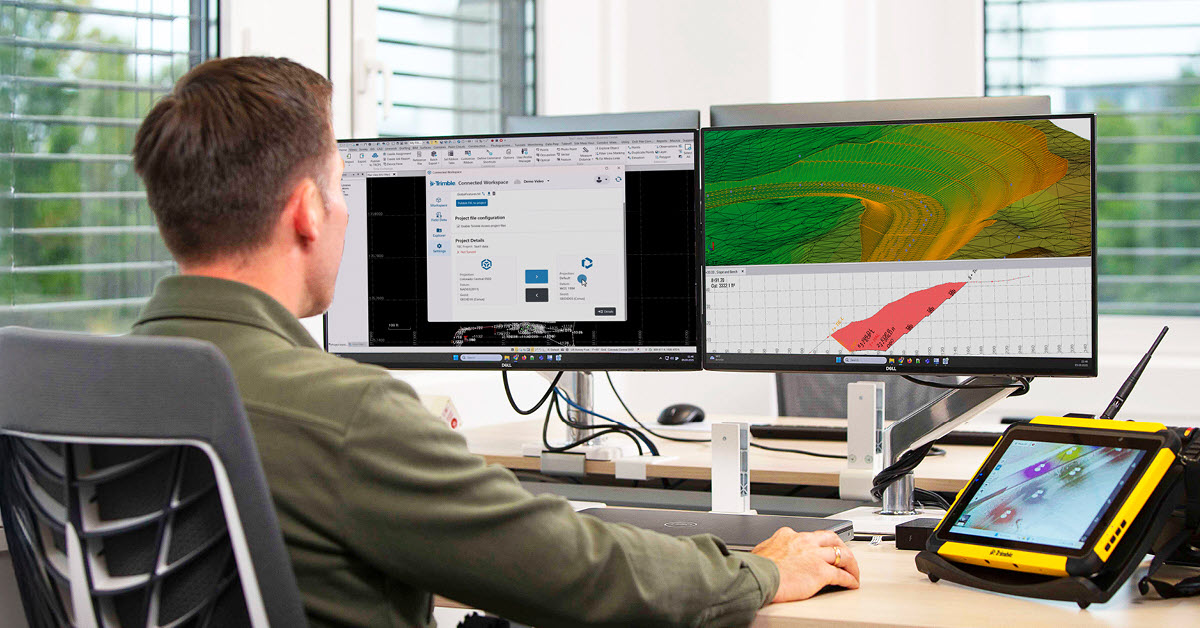
In civil engineering, precision is paramount and the stakes are high — a single coordinate error or inaccurate bid can cost millions. Yet a persistent bottleneck remains: design files are rarely built for heavy machinery on site. This divide leads to manual data prep, translation errors and "bid blindness" during estimation. To eliminate this disconnect, civil engineers need a single command center that transforms raw field measurements and flat design sheets into constructible 3D models.
Stop stitching your software together
Many engineering firms fall into the trap of a "Frankenstein" workflow — using multiple incompatible software packages for survey data, CAD drafting, GIS and estimating. Juggling files between Autodesk Civil 3D, Bentley, and specialized point cloud utilities wastes hours converting formats and causes data degradation. While other platforms produce standard design models, they are not natively built for heavy earthmoving equipment. Trimble Business Center (TBC) office software bridges this gap — taking those initial design models and transforming them into true "constructible models" formatted directly for machine control on the job site.
TBC unifies these workflows into a single workspace for raw sensor data, photogrammetry, point clouds and design vectors. TBC’s built-in CAD engine handles drafting and plotting directly, reducing CAD handoffs, minimizing training overhead and streamlining office collaboration.
The office-to-field bridge: data prep and estimation
At the heart of TBC is a powerful site modeling and takeoff engine. Instead of guessing on flat 2D PDFs, estimators can rapidly build construction-ready 3D models with speed and precision, protecting project margins from day one.
The workflow follows three critical technical milestones:
- Digitizing PDF plans into editable CAD data: TBC lets you turn flat sheet sets and paper plans into editable CAD linework you can use for takeoff and modeling — faster than days of manual tracing outside a construction workspace.
- Generating precise surfaces: With design data prepped, you can dynamically create subgrade and finish grade surfaces with no manual rebuilding and no guesswork.
- Completing takeoff reports: TBC calculates earthwork cut/fill quantities from your 3D model. Building the site in 3D helps ensure earthwork volumes are calculated accurately — so you can reduce bid blindness and submit competitive bids with confidence.
By digitizing flat 2D PDFs for fast estimating, TBC helps teams submit confident, competitive bids on time. Once the job is won, contractors bring digital CAD designs into TBC to verify their bid model before pushing a final, constructible model out to the field — protecting project margins throughout construction.
Data confidence: QA/QC and mixed-fleet interoperability
Beyond takeoffs, project success hinges on data integrity. Traditional design CAD packages lack tools to adjust raw survey measurements. TBC maintains a dynamic link to raw observation data, allowing engineers to inspect vector quality, correct blunders and run least-squares adjustments before errors reach the site.
Once verified, TBC makes field distribution seamless. You can publish a design surface directly to the field via Trimble WorksManager software and assign it to heavy machinery in the field (such as dozers and excavators running Trimble Earthworks software). If your clients utilize other CAD or GIS platforms, TBC exports easily to Autodesk, Bentley and Esri formats, preserving crucial attribute metadata and maintaining open-file interoperability.
Build smarter with a 21-day free trial
Stop letting disjointed software and file conversion bottlenecks slow down your projects. See how TBC can streamline your data preparation, secure your takeoffs and connect your entire workflow from field to finish.
Start your 21-day free trial of TBC today.
