
Baldwin Water Treatment Plant
41 ° 29’ 34.4” N,
81 ° 36’ 19.1” W
 Courtesy of Cleveland Water
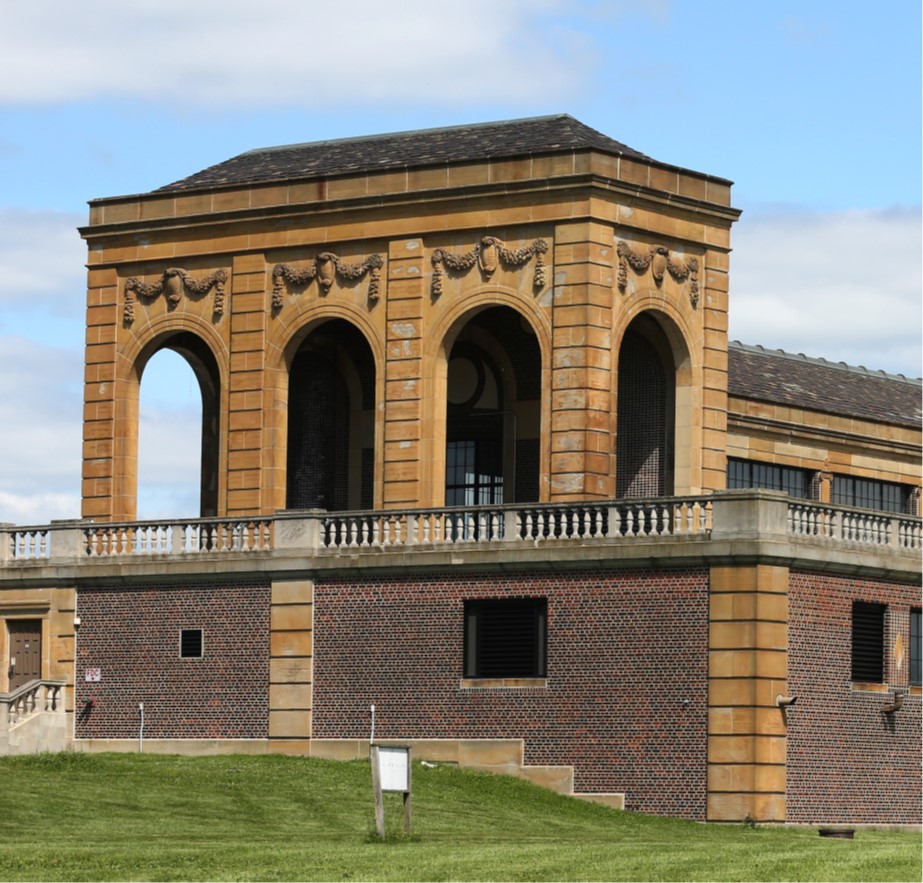
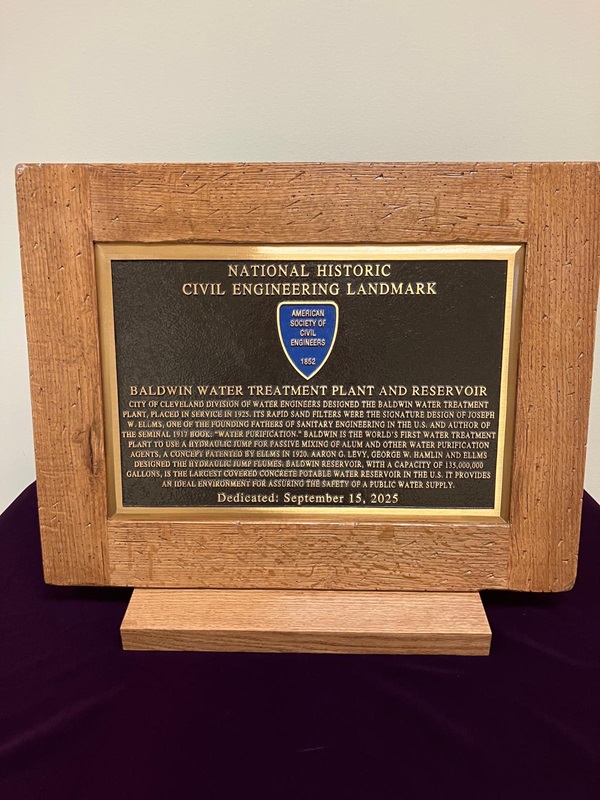
The Baldwin Water Treatment Plant and Reservoir in Cleveland, Ohio became operational on October 20, 1925, and has provided clean water for Cleveland and the surrounding communities for over a century. It is commemorated as an ASCE National Historic Civil Engineering Landmark primarily for the following four reasons:
1. Joseph W. Ellms, one of the founders of sanitary engineering in the United States and author of the seminal 1917 book, Water Purification, designed the Baldwin water filters.
2. Three Cleveland Water engineers who led the Baldwin design, J. W. Ellms, G. W. Hamlin, and A. G. Levy, were subsequently members of the ASCE Committee of the Sanitary Engineering Division that wrote the nationally significant ASCE Manual No. 19 – Water Treatment Plant Design.
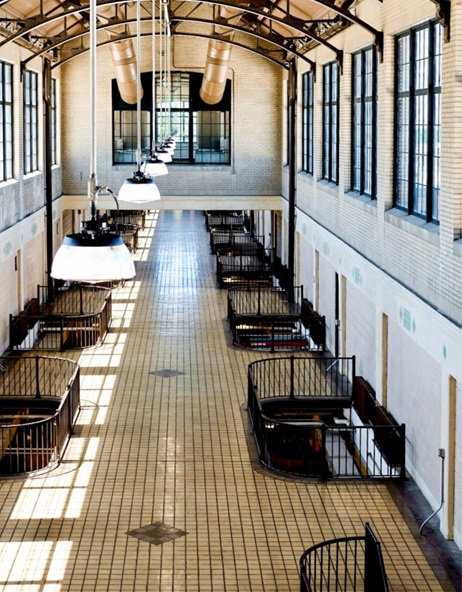
3. The Baldwin plant demonstrates the effectiveness of using a hydraulic jump as a practical passive mixing device. It also utilized innovative, effective, state-of-the-art rapid sand filters, designed by Ellms.
4. The covered concrete Baldwin Reservoir, with a capacity of 135,000,000 gallons, is the largest covered concrete reservoir in the United States and serves as a model for current design of covered concrete reservoirs. Its groined roof demonstrates the effectiveness of vaulted unreinforced concrete construction.
In 1931, Ellms, Hamlin, Levy, and Linders published “Baldwin Filtration Plant, Cleveland, Ohio” in Transactions of the ASCE (Vol. 95, pp. 459-532). The scope and specificity of the paper made it a valuable resource for designers of water purification plants, providing details on hydraulic and structural design, construction, and costs.
A total of 1041 unreinforced concrete columns spaced 15’9” apart support the groined roofover four coagulation basins having total dimensions of 757 x 457 feet. The columns have varying heights to accommodate a sloping floor that facilitated cleaning. Additionally, 1196 unreinforced columns support the vaulted roof of two finished-water reservoir basins, with dimensions 1035 x 551 x 39 feet.
Herman Kregelius, Cleveland City Architect, designed the architecture which features bronze doors and other castings, stone balusters, marble details, slate roofs, and beautiful masonry work. In 2004, Cleveland Water completed a large-scale restoration of the project, which earned a Historic Preservation Award from the Cleveland Restoration Society.
The American Water Works Association designated Baldwin as a National Water Landmark in 1991. The Historic American Engineering Record of the National Park Service documented the Baldwin Filtration Plant and Reservoir in 1978.
The Baldwin Plant is a monument to wise civic investment and to the vision, skill, creativity, and dedication of civil engineers in public service.
References:
“Building the Baldwin Reservoir, Cleveland Waterworks,” (1922). Engineering News-Record, Vol. 89, No.22, p. 916-920.
Chase, E.S. (1953). “Progress in Sanitary Engineering in the United States,” Transactions of the ASCE, Centennial Transactions, Vol. CT, p. 556-566.
Ellms, J.W., Hamlin, G.W., Levy, A.G., and Linders, J.E.A. (1931). “Baldwin Filtration Plant, Cleveland, Ohio,” Transactions of the ASCE, Vol. 95, p. 459-532. https://ascelibrary.org/doi/epdf/10.1061/TACEAT.0004244
Ellms, J.W. (1920). “Apparatus for Water Purification,” U.S. Patent Number 1,362,611.
Ellms. J.W. (1917). “Water Purification,” McGraw-Hill Book Company, Inc. New York, NY
 Courtesy of Cleveland Water