 Brian Tarallo
Artificial intelligence is reshaping how people work.
It's a cross-industry phenomenon. Civil engineers, like many others, are integrating AI into their daily practice. But until now, there hasn't been an industry-wide consensus on how exactly it should be used and regulated.
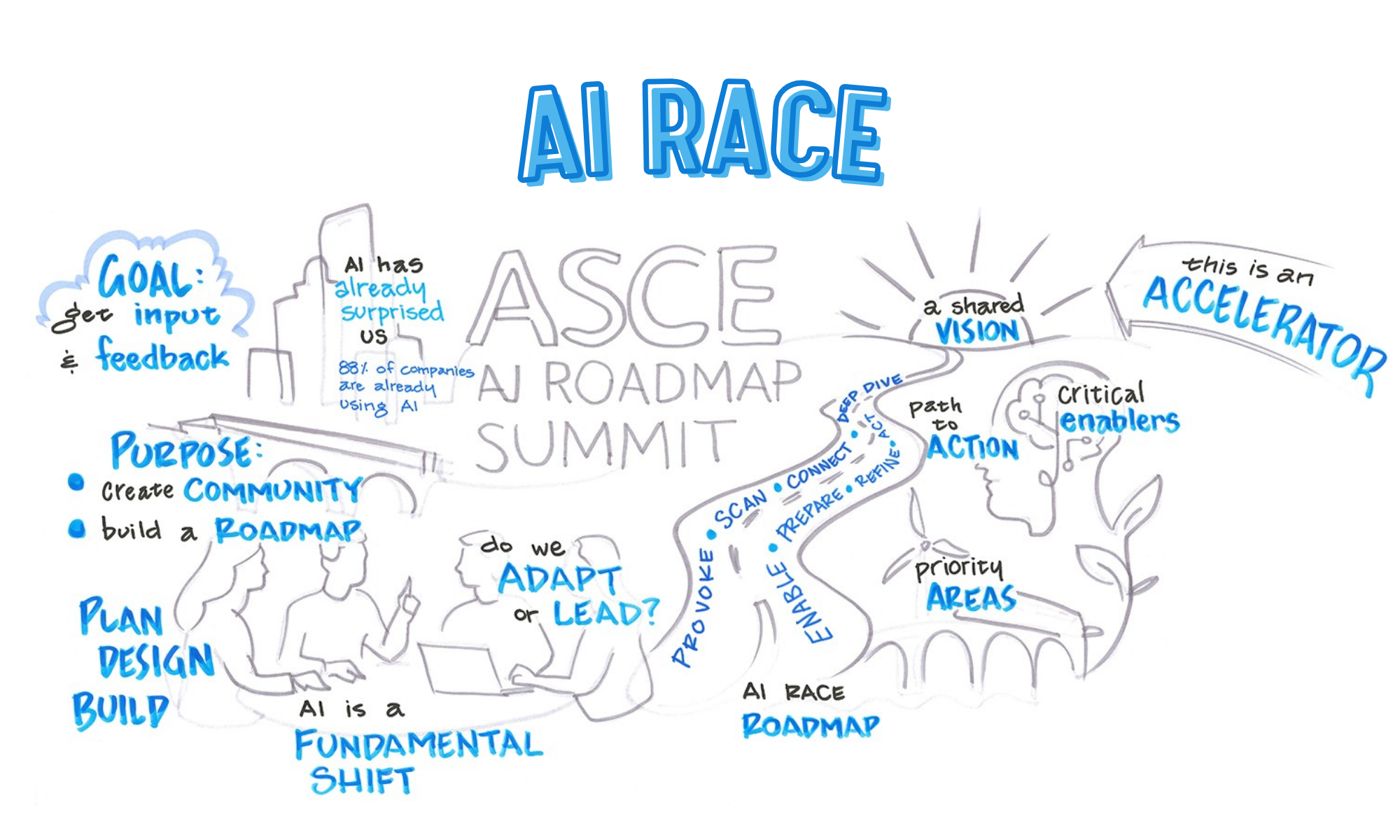
ASCE’s AI Roadmap for Application in Civil Engineering, or AI RACE, offers a solution.
“AI RACE provides a strategic framework to help civil engineers move from isolated AI applications toward systematic, responsible integration of AI throughout infrastructure planning, design, construction, operations, and maintenance,” said Yinhai Wang, Ph.D., P.E., Dist.M.ASCE, a professor of transportation engineering at the University of Washington and chair of the AI RACE advisory committee. “It identifies priorities and actionable pathways for improving productivity, safety, resilience, and sustainability. More importantly, it positions civil engineers to lead, rather than simply react to, the AI revolution.”
Developed by key subject matter experts representing a broad range of disciplines and practice settings, AI RACE gives civil engineers a comprehensive roadmap for the responsible use of AI. It emphasizes maintaining “responsible charge,” the human oversight and leadership required for civil engineers to safely and effectively use AI. It includes a foundational layer and 11 pillars that are presented through the lens of short-, medium-, and long-term maturity arcs from assistive to autonomous AI.
“The roadmap gives us clarity on priorities which will guide the focus of resources, both human and capital,” said ASCE 2026 President Marsha Anderson Bomar, Ph.D., AICP, ENV SP, NAE, H.ITE, F.ASCE. “It also underscores the urgency with which we need to respond, while maintaining the integrity of the civil engineering profession.”
ASCE gathered subject matter experts to develop the roadmap over the course of the year. It was finalized during a two-day workshop in September and secured support from the ASCE Board of Direction at the board meeting on Oct. 17.
The roadmap details different AI use cases in civil engineering, identifies challenges associated with the technology, and proposes ways to address potentials missteps. Woven through the entire roadmap is a strong emphasis on the human element of AI: civil engineers must institute strong governance and maintain oversight. The human gets the final say.
“ASCE serves as the ‘human in the loop’ to keep that aspect centered,” Bomar said.
The roadmap also underscores that these points aren’t limited to one institute or organization; it affects the entire civil engineering industry.
“By bringing together expertise across civil engineering disciplines, AI RACE can accelerate innovation, facilitate knowledge sharing, guide AI-empowered applications, and help translate emerging AI technologies into practical solutions that better serve our society,” said Wang.
Ethics takes center stage
AI RACE was developed with a vision of AI as a “trusted collaborator” in building safe, sustainable, and resilient infrastructure.
Maintaining responsible charge is necessary to achieve that vision. AI can support aspects of a project, but it can’t replace the judgment of a civil engineer.
“AI is a tool, and just as with woodworking that takes a master craftsman to hone it to its finished state, the civil engineer employing AI tools must be the expert to ensure the outcomes are valid, there is quality in the responses, and the outcomes abide by the code of ethics,” said Anderson Bomar.
“Ethics, Governance, Licensure & Public Trust” is one of AI RACE’s 11 pillars. There are already several challenges that come with AI ethics, such as underdeveloped liability standards, concerns about ownership and intellectual property, and unclear sovereignty rules across corporate and jurisdictional boundaries.
“Civil engineering directly affects public safety and well-being, making reliability, transparency, fairness, accountability, and human oversight especially important,” said Wang. “AI RACE emphasizes the need to address issues such as data quality, algorithmic bias, explainability, privacy, and potential risks throughout the development, deployment, and operation of AI-empowered systems in engineering practice.”
In the short term, ASCE will collaborate with key stakeholders and set new standards and guidelines on intellectual property, data rights, and data sovereignty in engineering practice. The Society will serve as a global reference point for infrastructure AI governance. It will also work to prevent major failures that could degrade public trust in the technology or the profession.
“Building public trust in AI-enabled infrastructure is just as important as advancing the technology itself,” Wang said.
Preparing all generations
A well-trained workforce is crucial to responsibly implementing AI.
AI literacy gaps exist within all generations and career stages. But there are ways to fill in these gaps and increase industry-wide understanding of the technology to improve outcomes. Colleges and universities are beginning to offer courses on AI. Companies can provide training.
ASCE will lead initiatives to train civil engineers on AI. The roadmap states that ASCE plans to develop CEUs, certificates, and webinars to provide additional resources for AI learning. The Society will also provide support to smaller firms and public agencies that may not have the resources to implement AI on their own.
“We will roll out select technical content in a timelier fashion and develop training opportunities,” said Anderson Bomar. “There is also a workforce development component that looks to inform our structure, summits, content, and body of knowledge.”
Education and training are valuable tools for bringing AI RACE’s vision to life, enhancing civil engineers’ ability to harness the many benefits of AI.
“By promoting AI literacy, lifelong learning, and the integration of AI capabilities with established engineering principles and professional judgment, AI RACE will help prepare the civil engineering workforce of all generations to lead and thrive in an AI-enabled future,” Wang said.
A standardized foundation
AI tools aren’t new to civil engineering; many engineers use AI-enabled technologies such as digital twins or other autonomous systems in their work. The current challenge is that they are being built without the guidance of civil engineering standards and without cross-sector collaboration.
AI RACE aims to unify the implementation of AI development and deployment across the entire civil engineering industry in both the digital and physical sense.
As the guiding force, ASCE will promote intentional planning of AI infrastructure with standards of practice for siting, designing, powering, cooling, and securing AI-related infrastructure, such as data centers, which require enormous amounts of water and power. The Society will also develop machine-readable versions of key standards.
Additionally, ASCE will develop standards for AI-assisted project controls, different types of systems, such as digital twins or autonomous capture technologies, and ethics.
Standards are something that matters with any new technology. Tools civil engineers have used for generations were once new, and like AI, required new regulations and the establishment of norms and ethics.
Having industry-wide requirements for AI systems and AI use will allow civil engineers to maintain responsible charge as organizations further integrate AI technologies into their workflows. And growing their knowledge of a technology will allow them to use it in more effective and inventive ways, keeping civil engineers ahead of the AI game and enhancing their ability to serve the public.
“At the end of the day, it is a civil engineer's responsibility to live up to the higher calling to society and have the final say,” said Anderson Bomar.