
Dreher Shoals Hydroelectric Dam Project
34°03'11.9"N
81°13'04.1"W
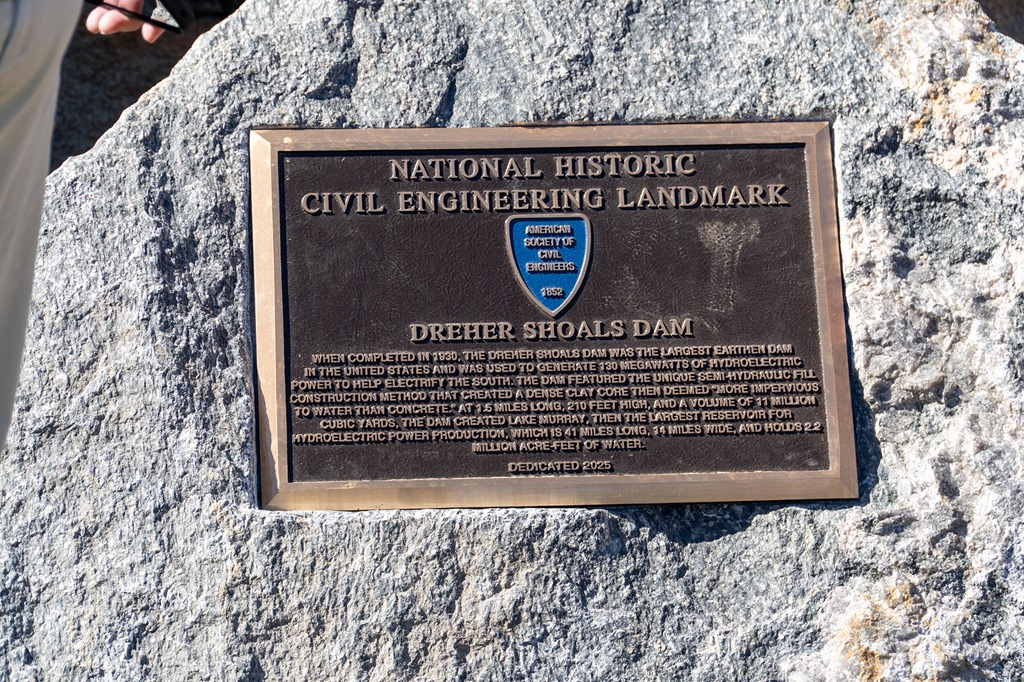
Dreher Shoals was the largest earth-fill dam in the United States at that time, with a volume of 11 million yd3. Its reservoir, Lake Murray, was the largest lake for power production. To date, it remains the largest dam in South Carolina. With its construction, South Carolina was the fifth ranking state in the production of hydroelectric power in 1930.
The Dreher Shoals Dam Hydroelectric Project, also known as Saluda Dam, began construction in 1927 and was completed in 1930 to harness the energy of the Saluda River to help “electrify the South.” At 1.5 miles long and 213 feet high, it was the largest earthfill dam in the United States at that time, with a volume of 11 million yd3. Its reservoir, Lake Murray, was the largest lake for power production. Lake Murray has a surface area of 48,000 acres and a volume of 2.2 million acre-feet (700 billion gal) when full. It remains the largest dam in South Carolina.
The hydroelectric powerplant originally included four Francis turbine-generator units serving the entire Southeastern United States, making South Carolina the fifth ranking state in the production of hydroelectric power in 1930. In 1971, a fifth Francis turbine-generator unit was installed that more than doubled the output of the powerplant. The dam included an emergency spillway 2,900 feet in length, controlled by four steel Tainter gates, each 37.5 feet x 25 feet. In 1943, two more Tainter gates were added, and the spillway was enlarged to increase capacity in case of high rainfall. The spillway and reservoir can accommodate a flood with a peak inflow of 180,000 cubic feet per second without water passing through the penstocks or the diversion tunnel.
The dam’s construction used the semi-hydraulic fill method, which had been used previously on a number of smaller earth-fill dams in the western United States. Dam construction involved use of steam-powered shovels, which, though not the first, was a novel approach in the southeastern region and was one of the largest embankment-dam construction applications in the world at that time. The semi-hydraulic fill method was used to build the dam embankment, with the interior clay-puddle core formed by washing the fine clay out of the dumped earthfill to create a water-tight core zone. Two parallel dikes were constructed by dumping earthfill from rail cars conveyed on wooden trestles. A “segregation pool” formed between the dikes by pumping water from the river and using large water cannons, called “hydraulic giants,” to wash the clay and silt-sized soil material from the inside faces of the dumped earthfill to form the dam’s core zone. No mechanical compaction was used, only hydraulic and gravity consolidation of dam’s earth-filled materials. The result was a low relative density earthfill. The dam withstood several major storms (hurricanes and other tropical heavy rain events) during construction.
The use of The Citadel and University of South Carolina students during design provided a unique training opportunity for South Carolina’s civil engineering students. A roller-compacted concrete dam with two zoned rockfill embankments was constructed from 2002 to 2005 as a “backup dam” at the downstream toe of the original dam to address seismic-safety concerns.
References:
Popular Mechanics, May 1931, “Mile-Long Earth Dam is Impervious to Water.”
“Hydro-Electric Development on the Saluda River Near Columbia, S.C.,” Associated Gas and Electric System, New York, 1929.
Federal Writers Project. South Carolina: A Guide To The Palmetto State. Volume 5 of American Guide. Somerset Publishers, Inc., 1941. p. 377. ISBN 9780403021895.
Engineering News-record. McGraw-Hill. 1946.
“Development of Dam Engineering in the United States,” U.S. Committee on Large Dams, 1988.
Saluda River Hydro-Electric Development, Associated Gas and Electric System (known as the ‘red book’), 18 p., published in ~1930 and available via Dominion as pdf)
 Dominion Energy