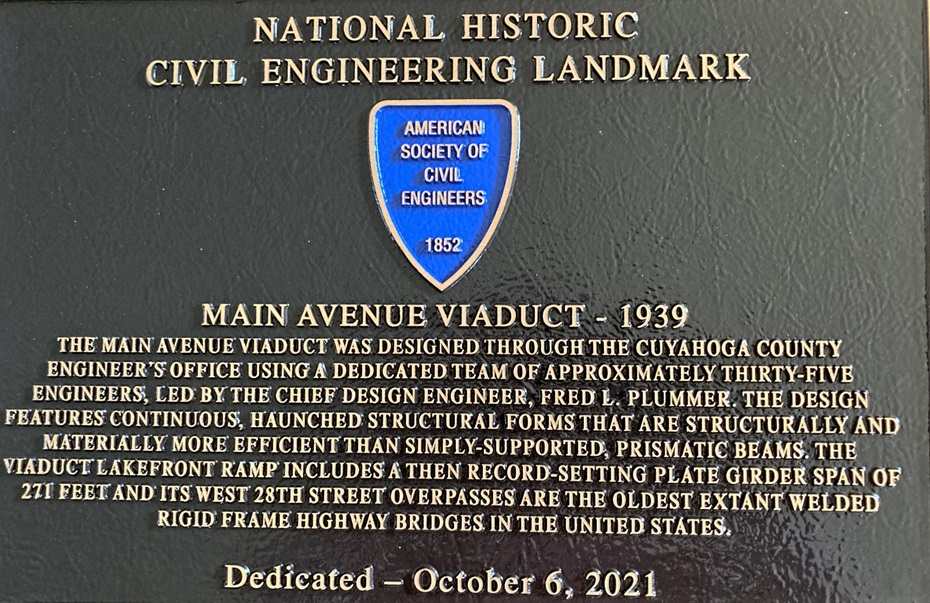
Main Avenue Viaduct
41°29'55.2"N
81°42'18.5"W
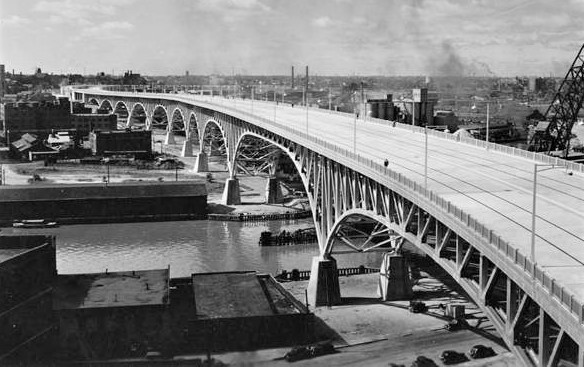
The Main Avenue Viaduct in downtown Cleveland, Ohio opened on October 6, 1939. With approach ramps, the viaduct is approximately 8,000 feet long. It is the northernmost high-level crossing of the Cuyahoga River Valley and serves as an east-west transportation link that does not require motorists to go through downtown Cleveland streets. Because of terrain elevation changes and river navigational constraints, the viaduct has a complex geometry, with five horizontal curves and several vertical curves.
An ad-hoc task force of approximately thirty-five engineers, led by the Chief Design Engineer, Fred Leroy Plummer, designed the viaduct through the Cuyahoga County Engineer’s Office. The project began in 1937, during the Great Depression, and thus the need for economy in both material and construction costs strongly influenced the design. To achieve economy, Fred Plummer set and orchestrated distinct design themes: Use continuous structural systems with non-prismatic members for efficient use of materials and improved appearance; use bare structural members with practically no architectural embellishments; and adopt welding where appropriate and cost-effective. The executed design has many innovative, record-setting features including:
• Non-prismatic plate girders, continuous over four spans. One of the spans has a then-record-setting dimension of 271 feet.
• Concrete-steel composite piers for the plate girders to accommodate railroad right-of-way restrictions.
• Ten spans of non-prismatic, continuous cantilever trusses.
• Hollow concrete piers for the trusses with a 2 ½ inch minimum cover for the reinforcing steel. As of 2021, the concrete surfaces are original and corrosion-free. One of the surfaces of the piers is a hyperbolic paraboloid. This is, almost surely, the first use of such a surface on U.S. bridges.
• The foundations of the truss piers nearest the river consist of concrete mats within subsurface sheet-piling enclosures driven below potential soil slip surfaces. These have demonstrated complete stability over time.
• All-welded rigid frame bridges. These are the oldest extant welded rigid frame bridges in the U.S. As of 2021, they are completely fatigue-crack-free.
The viaduct design incorporated advanced safety features, including automated low-pressure sodium vapor lighting, concrete curbs to separate east-bound from west-bound traffic, and superelevated roadways on the horizontal curves. Contract documents prove that the viaduct required practically no demolition of structures and no displacements of people or businesses. Both design and construction were completed in under two years.