
New Orleans Drainage System
N 29° 57’ 02.5”,
W 90° 05’ 43.7”
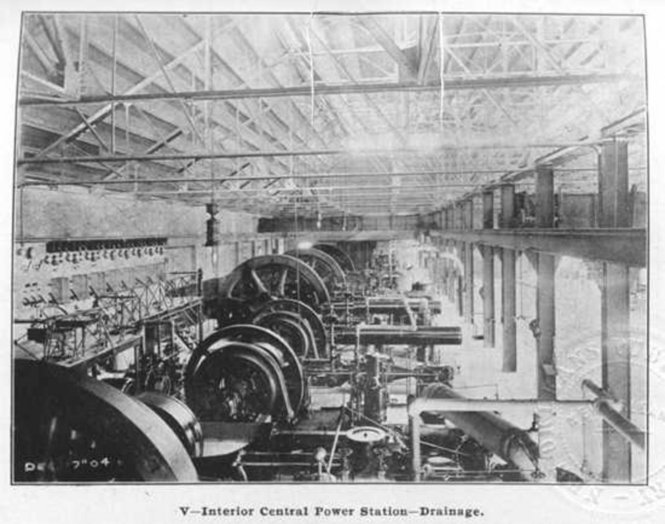
The topography of New Orleans is naturally unfavorable to urban development. Despite this, New Orleans became a major American city due to its economically strategic position near the mouth of the Mississippi River. Before 1895, precipitation overwhelmed the rudimentary street drainage, and runoff lingered in the “back of town” toward Lake Pontchartrain, away from the developed city. Public health was notoriously poor, and the city was prone to epidemics intensified by the lack of drainage and sewerage infrastructure. Without an effective and flexible drainage system, the city was highly unlikely to attain its potential to flourish economically and culturally.
The New Orleans drainage system was conceived on a large scale for its time, encompassing the drainage of an entire developed city with a population of 280,000, plus reclamation of tens of thousands of acres of soggy, cut-over forest and uninhabited wetlands. The central problem facing civil engineers was the creation of an artificial slope where there was little, no, or unfavorable natural slope, so that gravity drainage could occur to minimize the need for mechanical pumping.
The drainage capacity necessary in the subtropical climate led engineers to separate drainage and sanitary sewerage systems. Previously, the city’s drainage emptied haphazardly into Lake Pontchartrain through drainage and sea-level navigation canals. Engineers recognized the largely organic pollution in runoff to be a problem and thought this pollution would become unsustainable as the city grew.
The New Orleans 1895 Drainage Plan contributed to the advancement of civil engineering with the following significant improvements to the technical knowledge concerning drainage:
1. The unprecedented scale of the project. No municipality in the world had sought to develop such a complicated system of separate stormwater and groundwater removal.
2. The innovative concept of a series of pumping lift stations. This transmitted flow and provided the final discharge of the surface runoff taken by the drainage network.
3. The innovative application of engineering practices to determine flow and discharge requirements. These were adopted nationally to become the preferred urban-drainage design approach.
4. Fully developed and applied the concept of separate storm and sanitary sewerage systems to prevent pollution in an adjoining natural water body, a practice that was not then generally adopted in the United States or elsewhere.
Albert Baldwin Wood, M.E., was a key figure in the history of the New Orleans drainage, sewage, and water systems. He was responsible for the development of multiple innovations, including dramatically superior drainage pumps that replaced the first-generation pumps in the New Orleans drainage system. Wood’s pumps vastly increased the capacity and efficiency of the system. Wood’s name has become almost synonymous with the distinctive technological features of the New Orleans’ drainage and sewerage systems.