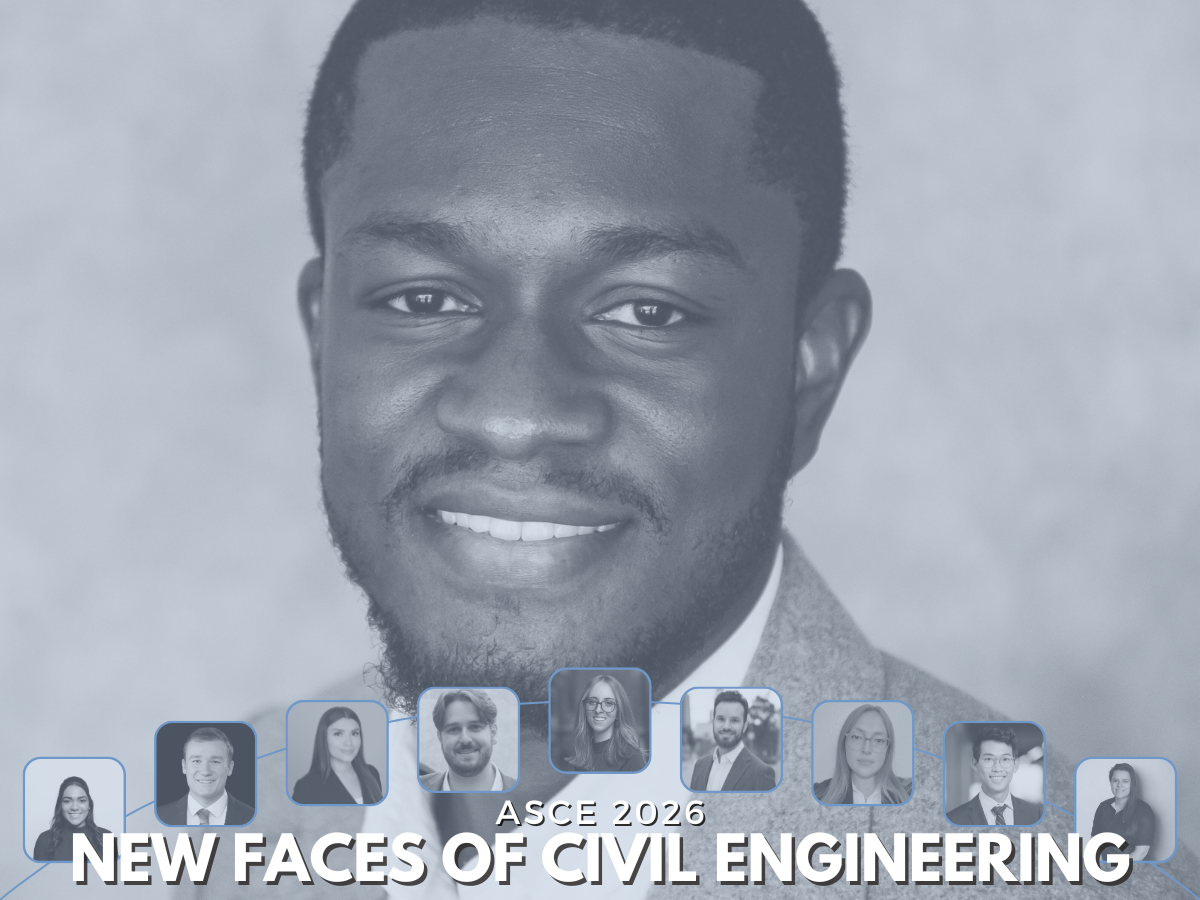
Sure, cartoons and video games are fun, but parents take note: if you want your kids to grow up to be civil engineers, perhaps you should consider a different kind of entertainment for them.
“As a kid, I remember my dad had a lot of documentaries on his laptop,” said Kwadwo Amankwah-Nkyi.
“And two civil engineering projects always stood out: the Petronas Twin Towers in Malaysia and the Kansai International Airport in Japan. We used to play those documentaries constantly.
“Those projects sparked my curiosity.”
And it worked.
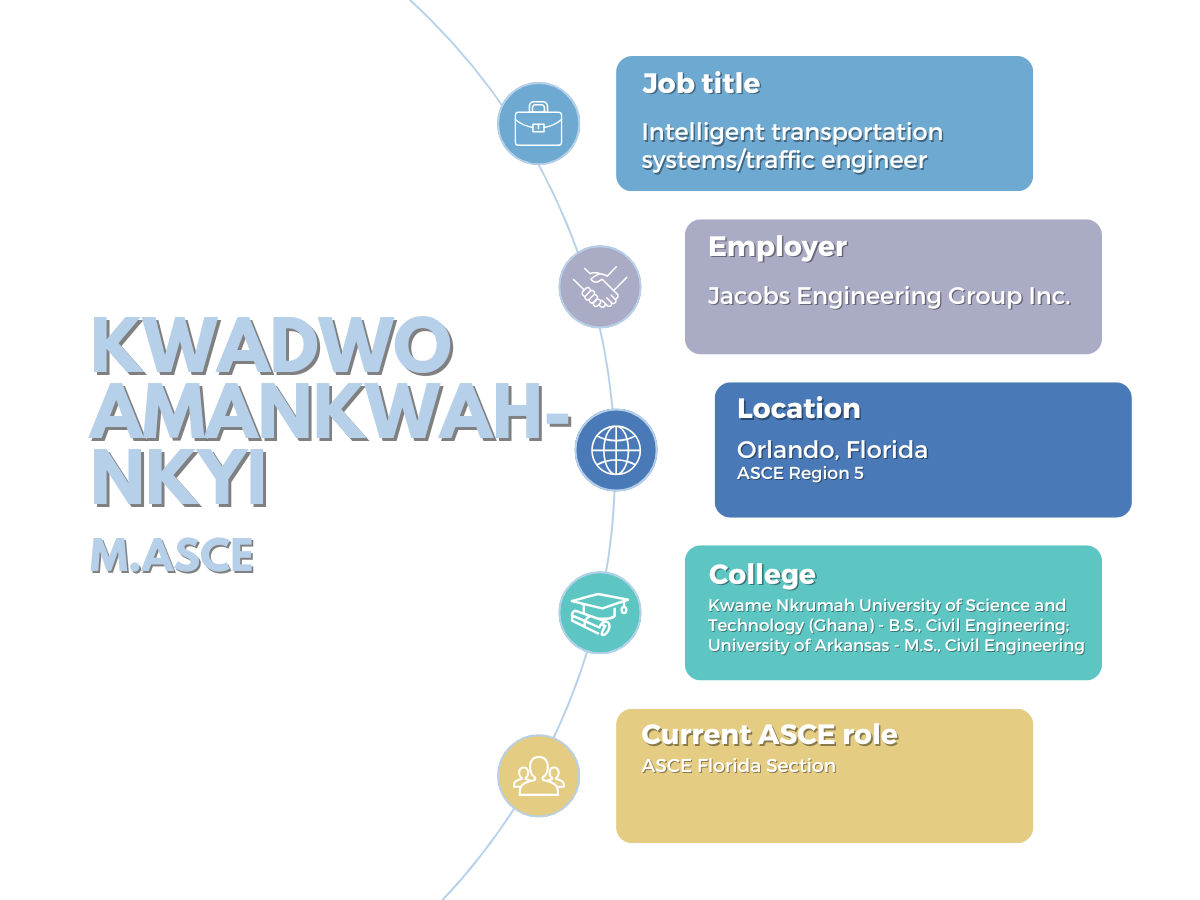
Amankwah-Nkyi now works as a transportation engineer specializing in traffic and intelligent transportation systems for Jacobs in Orlando, Florida. He’s developed innovative technology. He’s served as design team leads on massive transportation projects across the American South. He’s won awards – the Arkansas Traveler Award, for instance – for his outreach work with students.
And ASCE has honored Amankwah-Nkyi as a 2026 New Face of Civil Engineering. Clearly, a steady diet of documentaries as a kid is the key to success.
“Exactly,” Amankwah-Nkyi laughed. “You never know what will capture a child’s imagination.”
Amankwah-Nkyi grew up Kumasi, Ghana, the country’s second largest city with nearly 4 million people.
“I come from a family where we always watched the evening news together, and I’d see how kids in rural areas had to trek long distances to school or their schooling was outside under some trees,” Amankwah-Nkyi said. “So, I saw early on how privileged I was with the opportunities I had living in the big city.
“But then, at a point in high school, I struggled a bit with mathematics. There was a semester when my grades were not too impressive. With the help of a private tutor and encouragement from my father, I turned that weakness into achievement and ended up as one of the top students in math by the time I graduated.
“That gave me the confidence to pursue civil engineering in college [Kwame Nkrumah University of Science and Technology] and set me on this path of wanting my work to impact people.”
Amankwah-Nkyi moved to the United States in 2021 to pursue graduate school at the University of Arkansas. He hasn’t been able to get back to Ghana to see his family – parents Richard and Esther; and younger sisters Adwoa and Yaa – since but is leading by example from afar. Especially for his sisters, who are in their final years of medical school and law school, respectively.
“They’ll graduate next year, and I’m excited for all the big things they will achieve in their careers,” Amankwah-Nkyi said. “As the first child and only son, I want to be an example for my siblings so they can look to me to set that standard within the family.”
Amankwah-Nkyi spoke recently with Civil Engineering Source about his civil engineering career.
Civil Engineering Source: As you look back on your life and your career so far, what is the accomplishment or experience you’ve had that you’re most proud of?
Kwadwo Amankwah-Nkyi: I believe the aspect of my career that I’m most proud of is the mission I’m currently on, creating opportunities for people through the impactful projects I work on. These projects are what I call “tunnels of success,” right? They break barriers and give access to opportunities.
Earlier in my career, back in Ghana, I worked on pavement construction projects. Those projects delivered opportunities by shortening the long and difficult trips students took. They also provided reliable means for residents to get to their workplaces and access essential services like healthcare.
Moving to the U.S., the mission is still on course.
The projects I work on now focus on safer roads – making it easier for kids biking to school; more accessibility for the elderly and people with disabilities; and creating more efficient systems for the entire community.
So when I look back at the smiles of people impacted by these life changing projects, I feel very proud. These projects provide opportunities for communities and create a fair chance for future success.
Source: What do your parents think now when they see how far you’ve come?
Amankwah-Nkyi: They’re really proud. My dad is a first generation college student, and he’s proud to see his son working as a civil engineer and impacting lives around the world.
I came to the U.S. for grad school and continued my career here, and they’re always looking out for the next big thing I’ll do in the profession.
Source: Cutting-edge technology is a big part of your job, going back to graduate school, too, right?
Amankwah-Nkyi: In graduate school, I was part of a team competing in the AI City Challenge by CVPR and NVIDIA. We developed an innovative real time helmet violation detection system using advanced computer vision and machine learning.
Helmet violations contribute to about 15% of traffic crashes, even though motorcyclists are only about 3% of registered vehicles in the U.S. So detecting helmet usage can be a major part of achieving Vision Zero. The goal is to support better road enforcement strategies and help build safer communities.
As engineers, we need to harness the positive side of rapidly evolving technology to help our communities. Using technology should make our systems safer and more efficient. Technology plays a major role in making our systems smarter and safer.
Source: What was it like moving to Arkansas from Ghana for grad school?
Amankwah-Nkyi: Wow, I didn’t know what to expect, moving from a city of 4 million to Fayetteville, Arkansas. It was a big change but a really good experience.
I enjoyed grad school, made good friends, volunteered in the community, and worked on exciting research projects. Arkansas became an important part of my identity. I always identify as a Razorback.
Source: Was it a difficult decision to move to the U.S., or were you excited?
Amankwah-Nkyi: I guess it was both. I have two younger siblings, and leaving them behind and traveling over 5,000 miles to the United States was hard.
Then again, I looked forward to the opportunities and the new adventure in the U.S. I was ready for it. So, definitely mixed emotions.
Source: How has Florida been? Do you like it?
Amankwah-Nkyi: Florida’s weather is comparable to Ghana’s. It’s very, very good weather. I have a great opportunity to work for a company like Jacobs, working on exciting projects in Florida. The state is really advancing in technology and innovation in its transportation system, and I’ve enjoyed networking and making new connections in Orlando.
Source: What would you like your civil engineering legacy to be?
Amankwah-Nkyi: There are two things.
Civil engineering is a human centered profession, right? I never want to lose sight of the people behind every project. I want to be the person who harnesses technology and innovative solutions to create safer roads and infrastructure. This ties back to my mission of creating opportunities through impactful projects and giving people a fair chance at success.
Beyond the professional side, I see myself as someone who aims to be a servant leader – someone who guides students in meaningful and positive uses of technology, engaging K-12 students to spark their curiosity as mine was sparked. I want to be someone who combines innovation, mentorship, and outreach to create a thriving pipeline for future civil engineers.