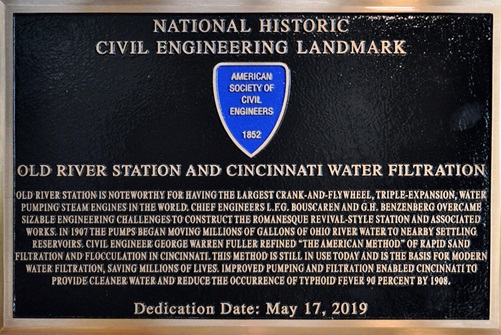
Old River Station
N 39° 04’ 11.1”
W 84° 25’ 53.7”

The Old River Station was constructed from 1898 to 1907 on the Ohio River 10 miles upstream from Cincinnati, Ohio.
Chief Engineers L.F.G. Bouscaren and G.H. Benzenberg faced numerous challenges in the design and construction of the intake, pump house and related facilities. The project was built prior to water-controlling dams on the river, with water depth fluctuating 75 feet. To manage this great depth, John H. Lewis of R.D. Wood and Co., Philadelphia, designed four 104 feet high, 1,400 ton, 1000 HP, 30 MGD capacity, crank and flywheel, triple-expansion steam water pumping engines, believed to be the largest of their type to ever be built.
Site selection was based for its wide river width and depth and required placing the intake on the Kentucky side at its deepest point then connecting the intake to the pump on the Ohio side with a 7 feet diameter brick lined, 1400 feet long tunnel excavated by hand using mule haulage for removing material.
A major and unexpected problem occurred early in construction when the bottom deck of the pump house, on which the engines were mounted, developed a heave in the center due to hydraulic forces, which caused the engines to tip out of vertical. After three attempts in five years, the problem was solved by installing iron counterbalances to offset the uplift deflections at the center of the pump house caisson floor and by engine assembly modifications.
The pumphouse was designed in a Romanesque Revival Style by Project Architect, Gustave W. Drach, with intricately dimensioned, hand-finished, Bedford limestone as the exterior finish. Tiffany white-enameled brick lined the above ground interior and bright polished brass handrails decorated the spiral stairways from pit floor to the top of the engines encompassing quality engineering and construction.
One of the greatest benefits of the project was the water treatment facility designed by George Warren Fuller. Fuller had conducted extensive research into improvements of the rapid sand filtration process by adding aluminum sulphate to the water then introducing a sedimentation step before final filtering. When the filtration system went online in 1906, the occurrence of typhoid and other waterborne diseases was dramatically reduced and was reduced even more when chlorine addition was introduced in 1918. This soon became the standard across the nation and is recognized as a major milestone in public health protection, saving millions of lives around the world.
The triple-expansion engines operated until 1963 and can now be visited by public tour on the first Saturday of every month. Much of the original filtration plant operates to this day.