
Sydney Opera House
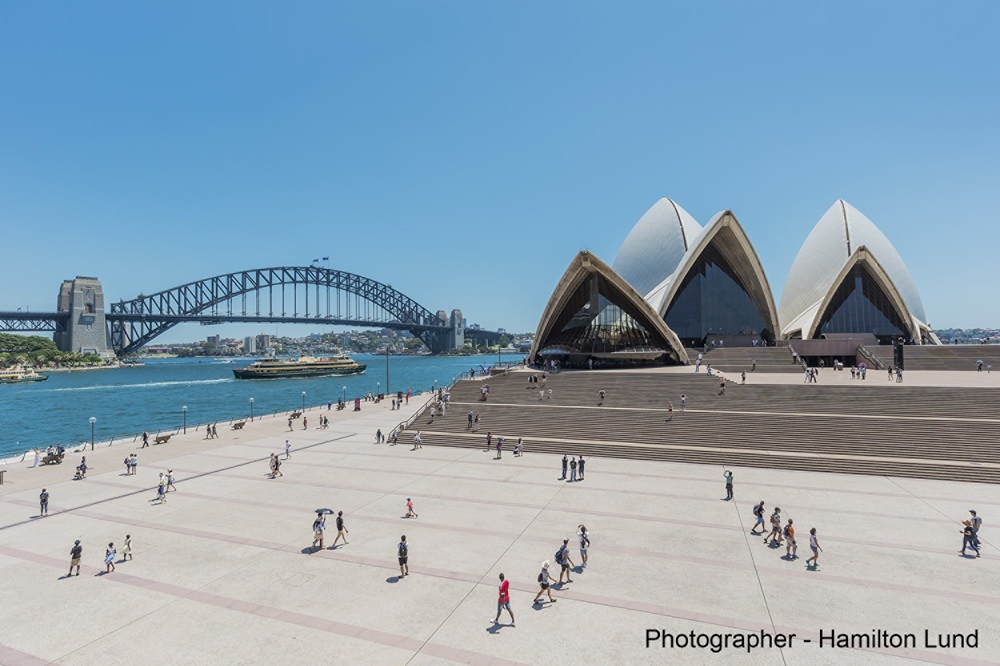 Hamilton Lund Photography
 The design was innovative and of great complexity. None of the traditional details of building or bridge construction worked, and all, from small waterproofing details to large-scale erection, had to be researched and developed from first principles.
Sydney Opera House is of outstanding universal value for its achievements in structural engineering and building technology. A vibrant and creative interaction emerged between architects, industrial designers, engineers, manufacturers and the construction industry — all striving to meet the challenges of its unprecedented design concept as well as the constantly evolving and exacting design requirements encountered during construction of the building.
Utzon's original design concept and his unique approach to building gave impetus to a collective creativity. Ingenuity and technical innovation flourished in collaborative teams of architects, engineers and builders. The realization of the design concept demanded outstanding engineering feats by Ove Arup & Partners whose work has also been internationally acclaimed. New technologies, approaches and materials evolved to create unique architectural forms and a building of rare quality and character. Utzon's architectural vision, which became reality, was matched by the quality of the technology and the creativity of the Arup engineers.
Utzon's design represents an extraordinary interpretation and response to the setting in Sydney Harbour. The juxtaposition of the massive, hollow podium and the sculptural superstructure of the shells is unmatched in 20th century architecture and engineering. He successfully contrasted and married seemingly antithetical ideas and styles. This is encapsulated in the shells where the strong and dramatic character of the concrete geometrical shapes simultaneously contrasts and merges with their equally irrepressible qualities of sculpture, lightness and poetry and their place as an elemental part of the natural landscape. While the Sydney Opera House is an outstanding representative of late modernism, it may also be seen as a rare specimen that defies and resists simplistic categorisation into a singular architectural style. The Opera House could not have been created in its present form without the outstanding creative and pioneering engineering contribution of consulting engineers Ove Arup & Partners, and the builders Hornibrook.
The Sydney Opera House is an outstanding example of 20th century cultural heritage. Its power to fascinate and excite is universal and it belongs to the world as a great artistic monument and an iconic building. The Sydney Opera House has become a building that inspires and delights people around the world and attracts people to explore its many remarkable features. It could be seen as making a contribution to architecture as an expression of universal culture. The Sydney Opera House has been influential in architecture, with others striving to replicate its success.
The Sydney Opera House is an enduring symbol of modern Sydney and Australia, both nationally and internationally. The profile of the distinctive ceramic clad roof shells has become an instantly recognizable national emblem. For example, it provided the inspiration for the logo used to promote the 2000 Olympic Games held in Sydney. The building’s role as a cultural icon is also derived from the numerous performances conducted there (100,000 since 1973), and the place’s role as a focal point for community events. The Sydney Opera House is a mecca for both Australian and international visitors to Sydney, attracting over 100 million visitors since the opening in 1973.
The nomination of the Sydney Opera House for the IHCEL award was prepared and submitted by the ASCE Australia Section, Engineers Australia, the ASCE History & Heritage Committee, and the Sydney Opera House Trust in 2021. As stated in the description of the NFT, the IHCEL digital plaque consists “of a video that runs through the text of the award citation while displaying features of the Sydney Opera House and moments during its design and construction. A summary of the award name and citation as well as an acknowledgement of the photographs by Max Dupain (courtesy of the Mitchell Library, State Library of New South Wales) are provided at the end of the video. The video was designed and developed by the Sydney Opera House in collaboration with the American Society of Civil Engineers (ASCE) and Engineers Australia
Sources:
• Commonwealth of Australia (2006) Sydney Opera House: Nomination by the Government of Australia for inscription on the World Heritage List 2006.
• Croker A (2017) Respective the vision: Sydney Opera House – a Conservation Management Plan, 4th edition, Sydney Opera House Trust.
• Nutt J (2006) Constructing a legacy: technological innovation and achievements, in Watson A (editor) Building a masterpiece: the Sydney Opera House, Powerhouse Publishing, 104-121.
• Landmark Nomination of Sydney Opera House, 2021: ASCE Australian Section, Engineers Australia and Sydney Opera House Trust