Brian Brenner, P.E., F.ASCE, is a professor of the practice at Tufts University and a principal engineer with Tighe & Bond in Westwood, Massachusetts. His collections of essays, Don’t Throw This Away!, Bridginess, and Too Much Information, published by ASCE Press, are available in the ASCE Library.
In his Civil Engineering Source series, More Water Under the Bridge, Brenner shares some thoughts each month about life as a civil engineer, considering bridge engineering from a unique, often comical point of view.
You are a bridge engineer. You are deeply involved in the process of bringing a new bridge into the world. You started with the proposal phase, went to the interview, and then got the go-ahead to proceed with a new bridge design.
It was a long and winding road, starting with the conceptual design. What would your young bridge grow up to be? It was first shown in the alternatives analysis. Moving on in design, you sweat over the calculations, worked through the twists and turns, and then made it to final design. The date was set, scheduled to be many months after conception of the plans. And this was engineering, so the schedule was, of course, like clockwork. Everything was in place. There were to be no further delays, and on the designated date, your new creation, a bouncing baby beam bridge, entered the world.
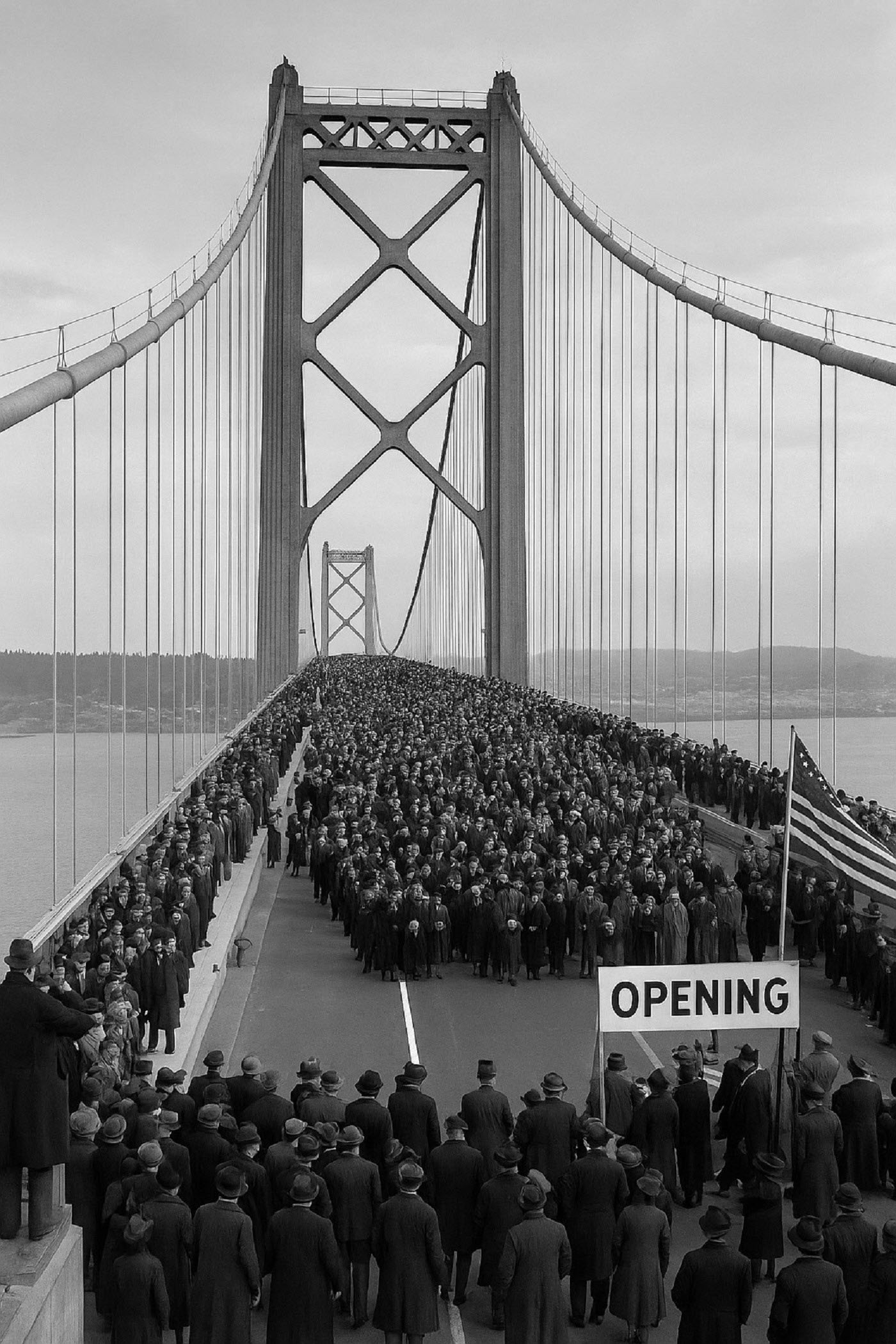
What next? Your new bridge looks forward to a robust 75-year design life. It is a big investment of time and resources, and a big responsibility. You may be the Engineer of Record, but it takes a community to raise a bridge. What is the best way to proceed?
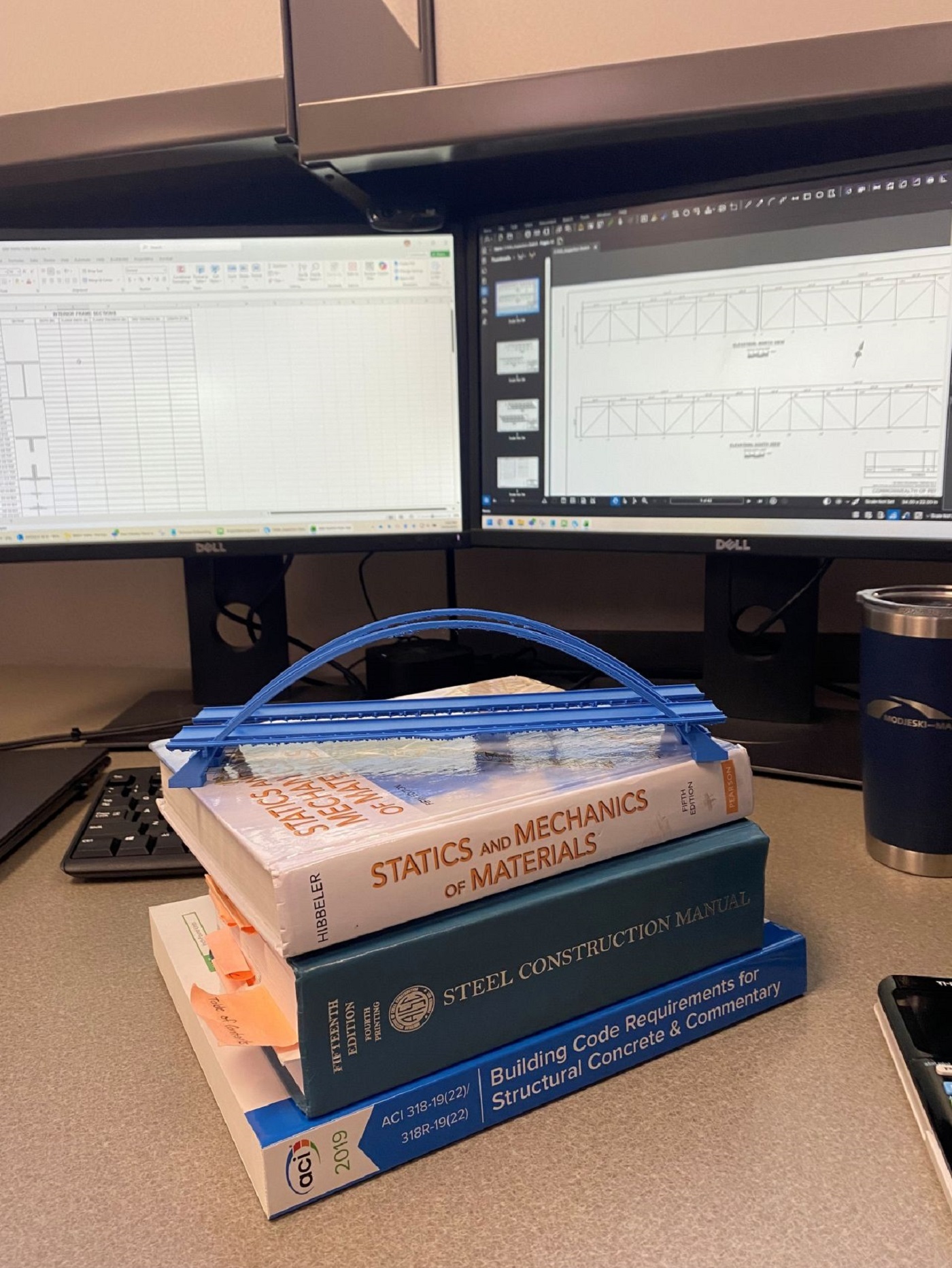
Colleagues at Modjeski and Masters have part of the answer. They have created a new company semiholiday, Bring Your Bridge to Work Day. It is patterned after Bring Your Kids to Work Day, but with bridges instead of kids. On Bring Your Bridge to Work Day, engineers bring miniature models of bridges to the office to show off to the other bridge parents. Now, we all know (at least we think we all know) that bridge models are not actually alive. But if they were, we can imagine that on Bring Your Bridge to Work Day, the young bridges would get to see and experience the professional lives of their bridge parents.
I spoke with Erin R. Bray, senior communications coordinator at Modjeski and Masters, and Geoffrey Forest, a senior mechanical engineer. Erin is the founder of the semiholiday, and she shared some details of how it came about.
Me: What was the motivation for having Bring Your Bridge to Work Day?
Erin Bray: In my role of senior communications coordinator at M&M, I oversee external communication efforts, including our social channels. My goal in developing content for those channels is not only to feature our firm’s technical capabilities, but also, equally important, to tell the stories of the people behind our work. We do that by sharing field photos and subject-matter expertise, and sometimes it takes the form of nontraditional campaigns like this. In addition to Bring Your Bridge to Work, we’ve also featured Kids on Engineering, Bridge Poetry for Valentine’s Day (See Note 1 below), Roaming Ralph, Future Bridge Designers, and more. In line with our effort to bring creativity to our content, we partnered with our public relations firm, Abel Communications, to bring this idea to life.”
Me: What was the objective for the day?
Erin: You’ve heard of bring your kid to work, bring your pet to work, but what if you brought an actual bridge to work?
That was the question we asked our staff. We knew we had several engineers in our Mechanicsburg office who owned 3D printers. We obviously had staff who could model the bridges. And we usually have a good group of people willing to participate in these initiatives. What if we created a day when, instead of sending engineers to the field, we brought their bridges to the office?
We opened it up to anyone willing to participate across our organization. The bridges were modeled and printed in Mechanicsburg. Staff from St. Louis, New Orleans, Washington, D.C., Poughkeepsie, New York, Edwardsville, Illinois, and Mechanicsburg participated. In addition to the 3D-printed models, we also had one engineer build a bascule bridge from a model train kit, and someone who has a laser cutter used it to model the Golden Gate Bridge.
Me: How were the models designed? Was there some trial-and-error, design iteration before you got to the final product?
Geoffrey Forest: We worked with our 3D visualization specialist to get the models ready to print.
Most of the bridges printed had been previously modeled for marketing purposes, while others had been modeled to feature in a small Modjeski and Masters video game. But all needed to be scaled to a printable size. Some bridges looked good with their actual proportions, but others looked better with different scaling (shorter than their actual length). Slender elements had to be thickened to print correctly, and other small details, too small to print, were removed. Each revised model was then processed through the printing software to simulate the final output. Once we had a successful simulation, we hit print.
Me: What types of bridge models were selected?
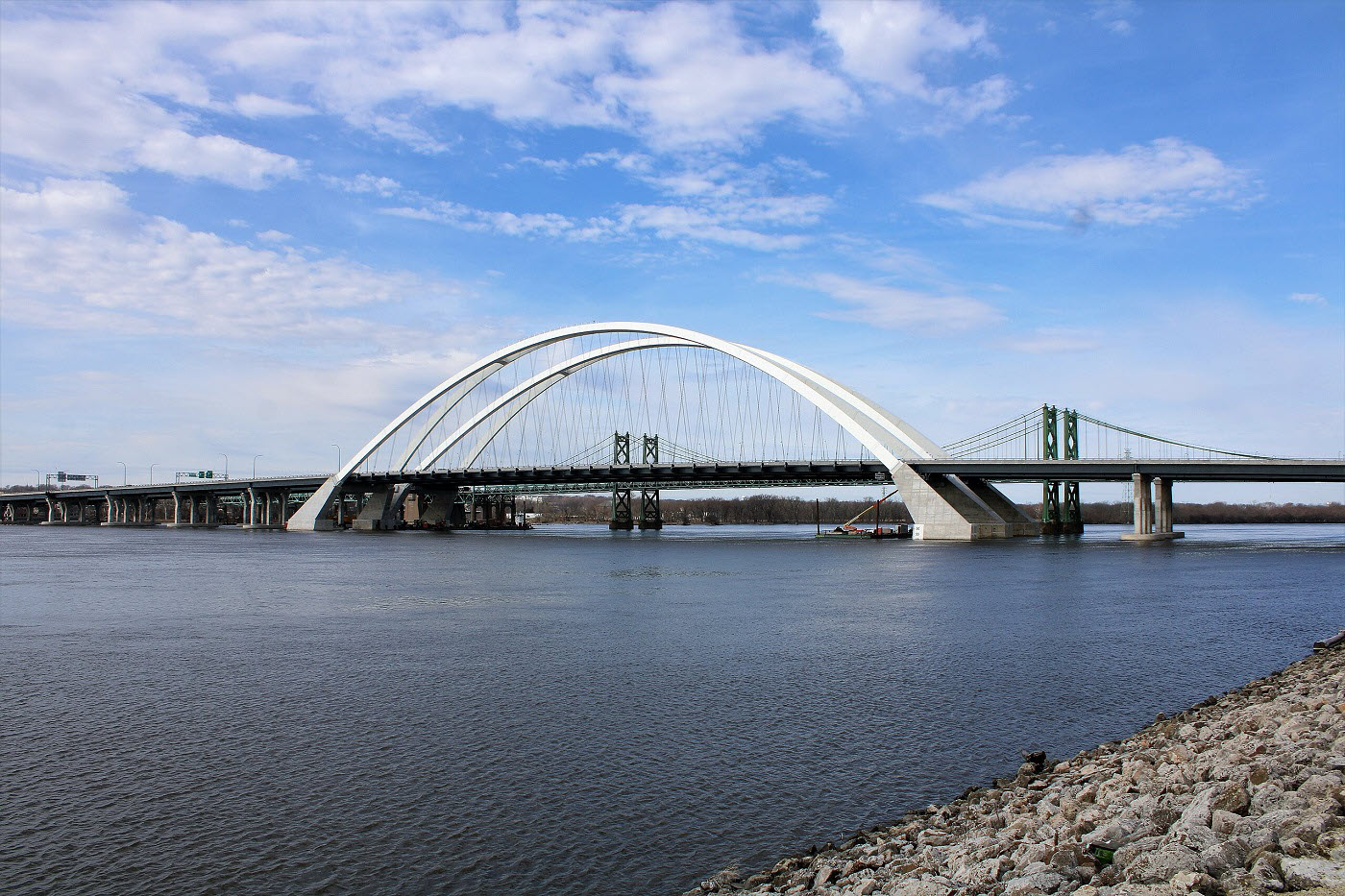
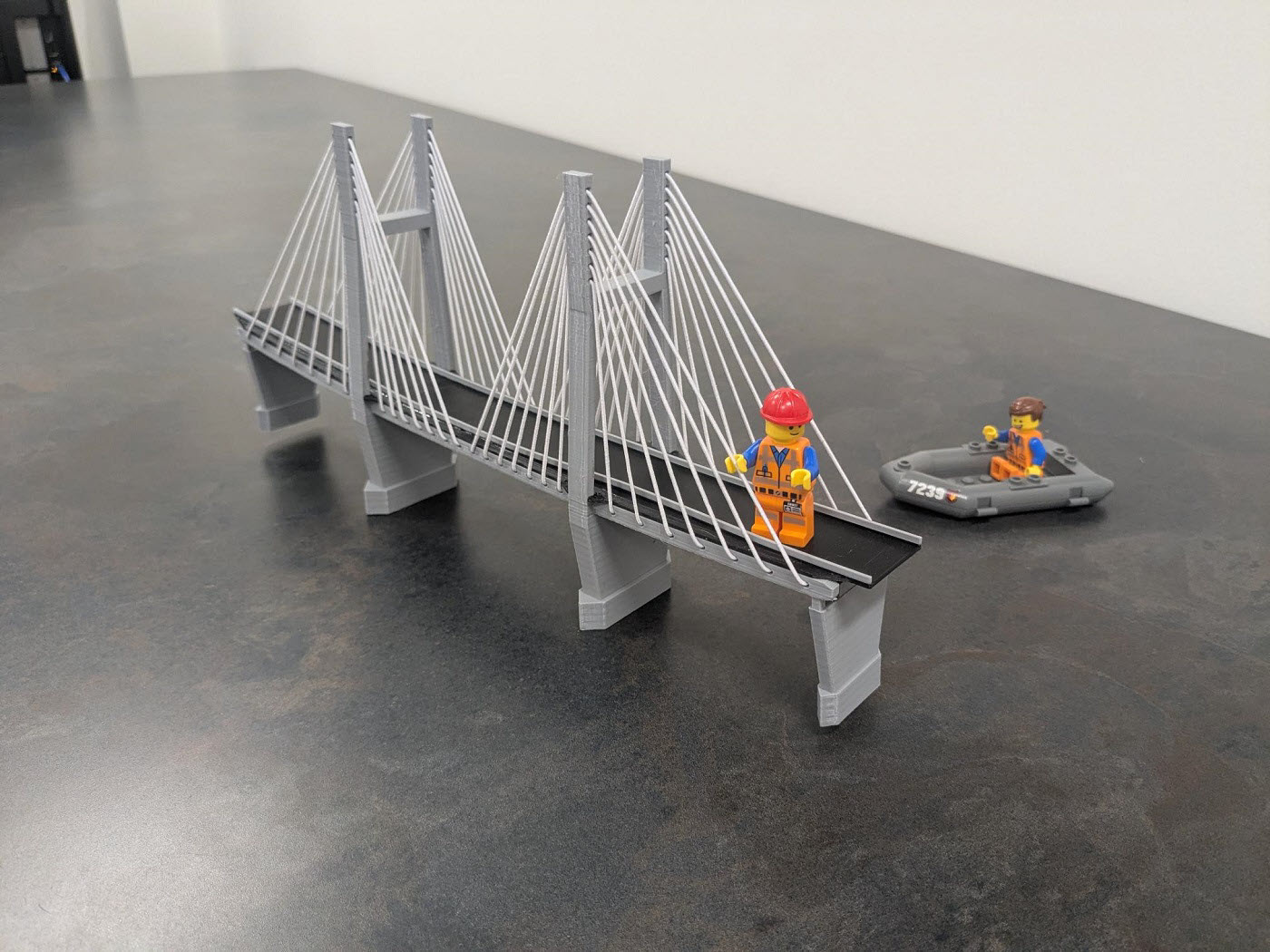
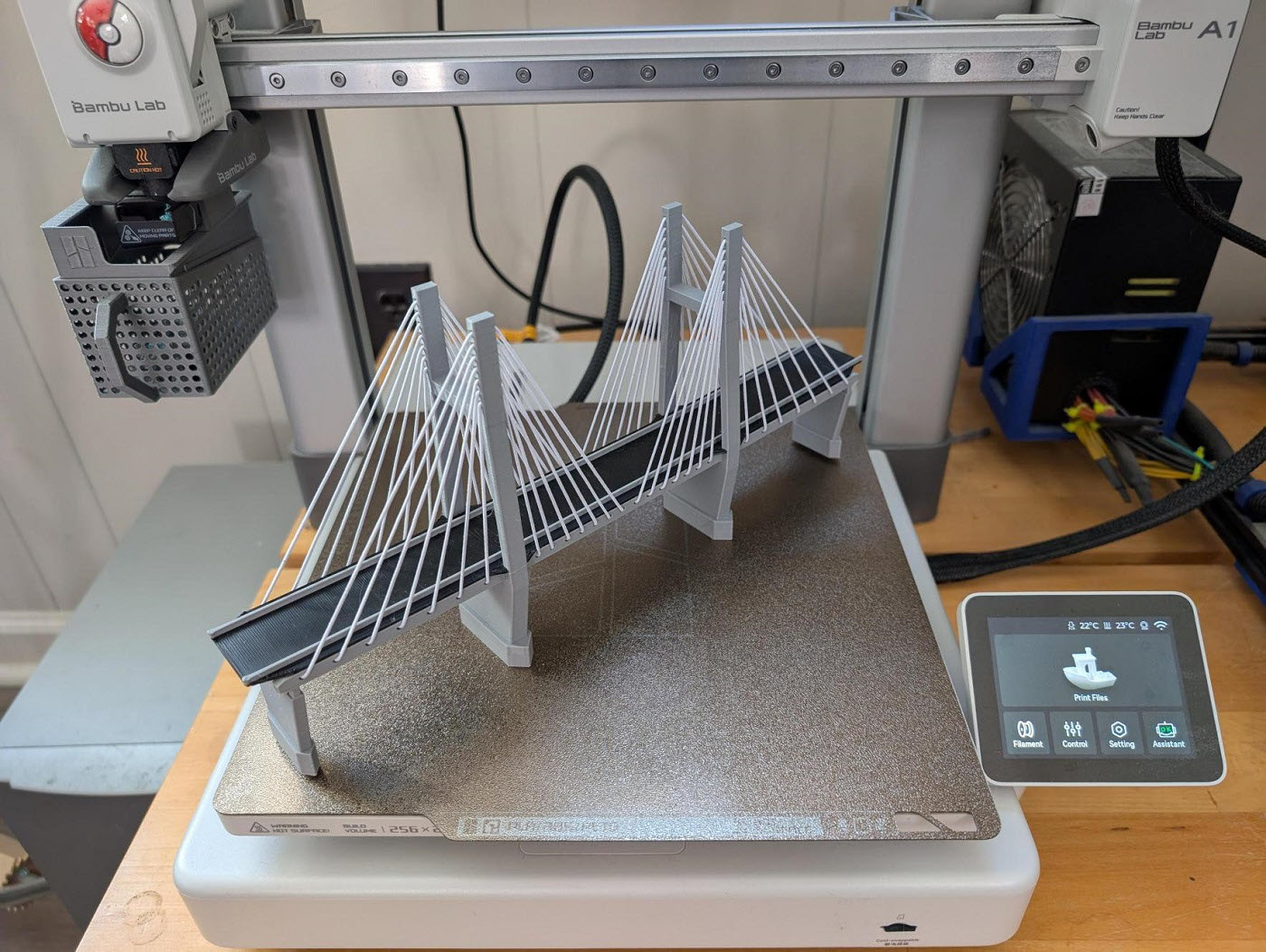
Erin: We decided to go with models that were already partially created from a video game we developed for our 130th anniversary a few years ago (see Note 2 below), or that had been modeled for other purposes. This eliminated the need to start from scratch, allowing us to make minor adjustments to the models to adapt to 3D printing. We selected the I-74 Mississippi River Bridge (a basket-handle arch bridge in Moline, Illinois), the Mears Memorial Bridge (a truss bridge in Nenana, Alaska), and the Quincy Bayview Bridge (cable-stayed bridge in Quincy, Illinois). We also have the Hawk Falls Bridge (a deck arch bridge in Carbon County, Pennsylvania) from another project, but ultimately, no one printed it.
 Farragutful
 Modjeski and Masters
 Me: What was the format for the day?
Erin: It was very informal. There was no set schedule. We just asked people to take their bridges with them to meetings, the coffee machine, to visit co-workers – anywhere they would go on a normal day at the office. We asked them to collect a photo or video throughout the day and send it to me later that week. My favorites are the LEGO man by the bridge and one of our employees holding the model bridge by a plaque of our founder, Ralph Modjeski.
 Modjeski and Masters
 Me: What software was used for design/visualization, what printers, how long did they take to print, what are the models made from
Geoffrey: Our visualization artist used Autodesk Maya and/or Autodesk 3DS Max. The majority of the bridges featured were printed on Bambu Labs printers, the P1S and the A1. The smaller models took 6-8 hours to print, depending on complexity, while a larger, multipart model we printed previously required several 24-hour prints plus assembly time. The prints all used PLA plastic, a common material used in 3D printing that is forgiving and easy to use.
 Modjeski and Masters
Since this was the first celebration of Bring Your Bridge to Work Day, we don’t really know yet how the lives of the bridges will turn out. Were the young bridges inspired when they saw their parents at work? What does the future have in store for these proud (miniature) spans?
To see what happens, we’ll check back in another 75 years or so.
Notes
Note 1: In a future column, we shall explore “Bridge Poetry for Valentine’s Day.” Here is my initial contribution:
I think that we shall never see
A tree as lovely as a bridge
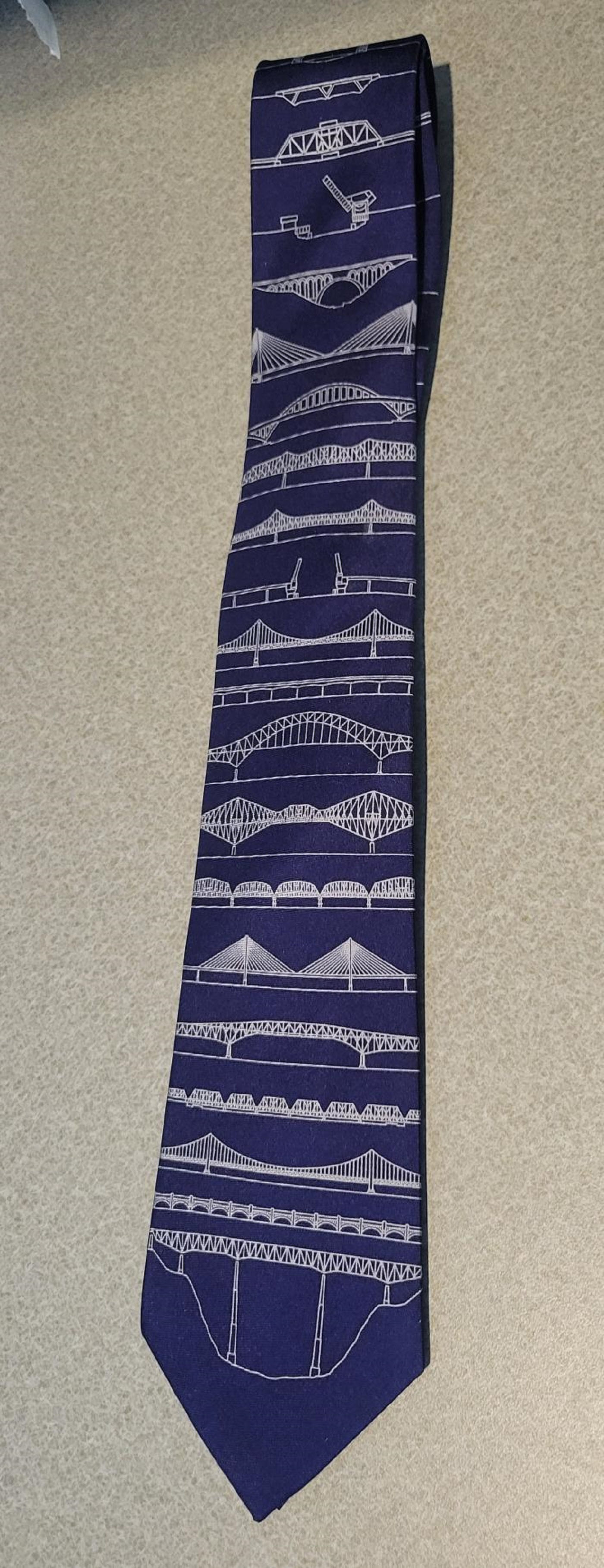
Note 2: In addition to semibridge holidays and bridge-based video games, Modjeski and Masters also has bridge ties (as in neckware):
 Modjeski and Masters