 Islam Mantawy, Rowan University
When Stephan Mansour was at CCC, the construction company worked on the Qatar Faculty of Islamic Studies in Doha, Qatar, which included bespoke complex architectural and engineering components.
Arabic calligraphy in various structural elements necessitated the creation of single-use traditional wood formwork molds, which would be costly, time-consuming, and nonreusable.
Further reading:
- What is hindering the adoption of 3D concrete printing?
- The future of construction? The case for 3D-printed, biobased materials
- 3D printing builds eco-friendly houses in Texas town
Since the QFIS project completion in 2015, additive construction – the use of 3D printing in construction – has been gathering momentum. At CCC, the project kicked off internal efforts to explore and expand the applications of 3D printing, using not just cement but also polymers and metals.
One realization of these efforts was the 2018 3D-printed house in Saudi Arabia, said Mansour, an additive construction global adviser and specialist, who has been a leader on 3D-printing-related standards from ASTM International and the International Organization for Standardization.
Specialty applications for additive construction
Additive construction is usually a good fit for specialty projects where traditional methods would be too task-intensive or time-consuming. For in situ and modular-style construction, 3D printing is faster than traditional methods because of time saved skipping the use of frameworks and molds.
One of the surprising bonuses of additive construction is its application in specialty projects that can help the architecture, engineering, and construction sector meet the sustainable development goals proposed by the United Nations. Doing so leverages the technology’s many advantages.
Case in point: Additive construction and manufacturing have the capacity to deliver more climate-resilient structures.
“We can 3D-print different optimally engineered and designed structures to mitigate the effects of earthquakes, hurricanes, tornadoes, and fires so houses don’t get completely destroyed with every severe event,” Mansour said.
One of the key mantras for good climate practice is reduce-reuse-recycle. 3D printing satisfies the first part of that equation by reducing the use of materials. Additive construction optimizes structural design elements using building information modeling.
“With 3D modeling, you get the best design using the minimum amount of material, optimized for the best structural and operational performance, which plays into environmentally conscious production,” Mansour said. He has seen that waste from additive construction is marginal compared with traditional construction because the technology uses raw materials efficiently.
 Islam Mantawy, Rowan University
And while concrete is less than optimal from an environmental standpoint – 1 ton of cement produces about 0.8 to 0.9 tons of carbon dioxide emissions, which results in approximately 8% of the world’s anthropogenic CO2 emissions – concrete structures withstand severe weather much better than wood equivalents, argues Islam Mantawy, Ph.D., P.E., an assistant professor of civil and environmental engineering at Rowan University. In addition, innovative binders in the concrete mix can help reduce emissions, Mantawy points out.
While plenty of other construction materials help meet sustainability standards, it’s helpful to start with concrete (especially for residential, commercial, and infrastructure elements) to iron out any kinks in the additive construction methodologies before moving on to other materials, Mansour said.
“The reason that everything is currently focused on cement-based materials is that it’s the lowest common denominator that everybody in the construction sector understands,” he said. “We know what performance results to expect based on existing and vetted parameters. Once we have standards in place through ISO, ASTM, et cetera, we can move to various other materials, especially those sourced and available locally.”
Associated challenges
It is these standards that present the biggest challenge to the larger-scale adoption of additive construction, a problem Mansour witnessed firsthand in the Saudi Arabian project.
“I have repeatedly heard and read that the construction sector doesn’t want to innovate, but I argue that they would love to do so if means existed to ensure new approaches deliver equal or better results when compared to traditional,” he said. “And that’s why standards are important. They help you identify and mitigate risks so construction stakeholders can ensure completed projects are safe and can stand the test of time and elements.”
Current standard development and cross collaboration efforts include those of ASTM Subcommittee F42.07.07 on Construction, American Concrete Institute 564–3D Printing with Cementitious Materials, International Code Council Evaluation Service committee on 3D Automated Construction Technology for 3D Concrete Walls, and the National Institute of Standards and Technology’s Additive Construction by Extrusion Consortium.
Mantawy worries that the traditional approach to construction persists even in 3D printing. Mimicking traditional construction while using 3D printing is a mistake because it does not fully leverage the capabilities the technology offers, Mantawy argues.
“Conventional construction is controlled by formwork, but additive construction enables freeform intricate designs and complex shapes,” Mantawy said. “But the conventional mindset still persists where people try to print shells and then place reinforcements and casts.”
Additive manufacturing needs a reboot in how construction is perceived and executed, he added.
Advancements in additive construction
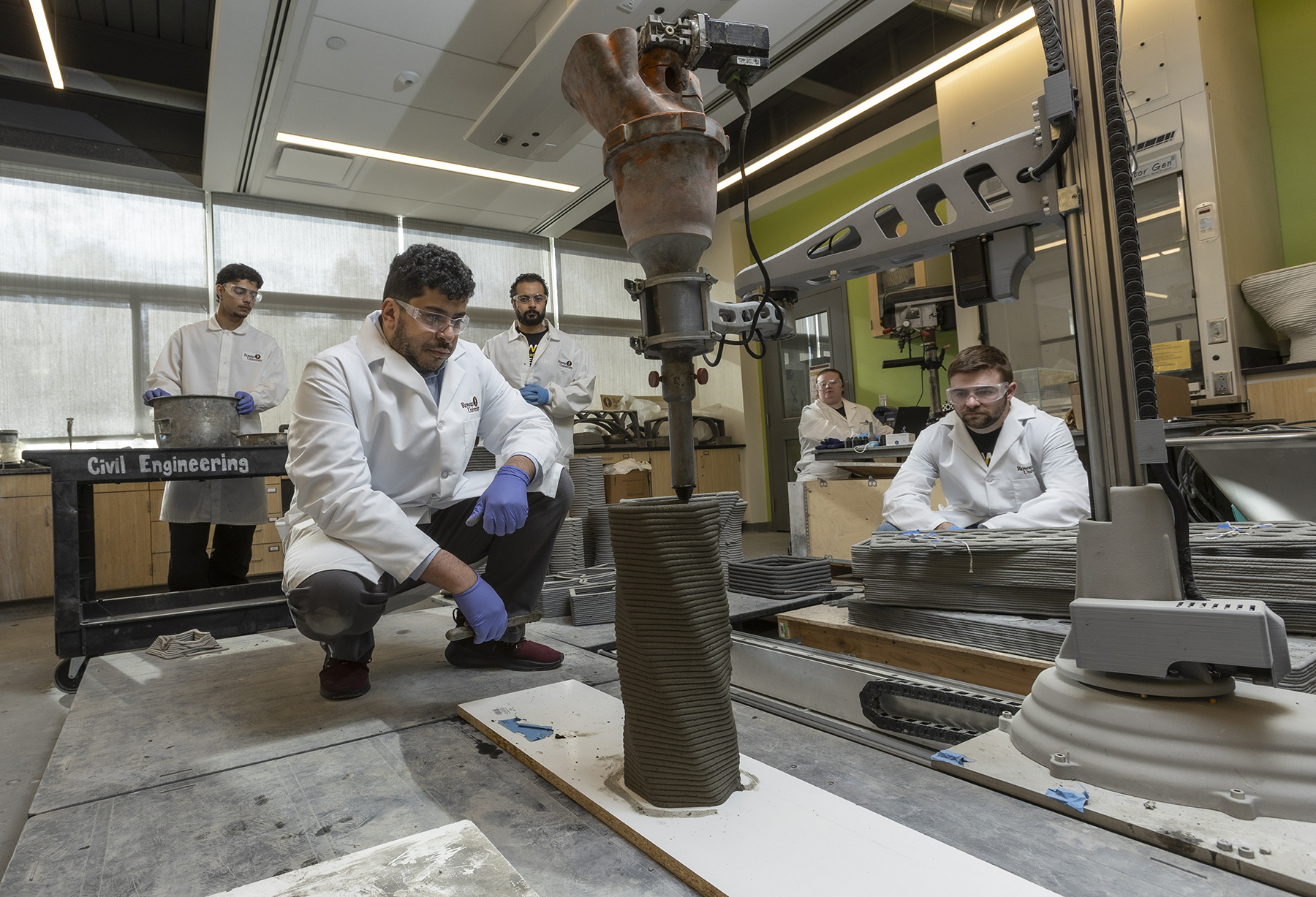
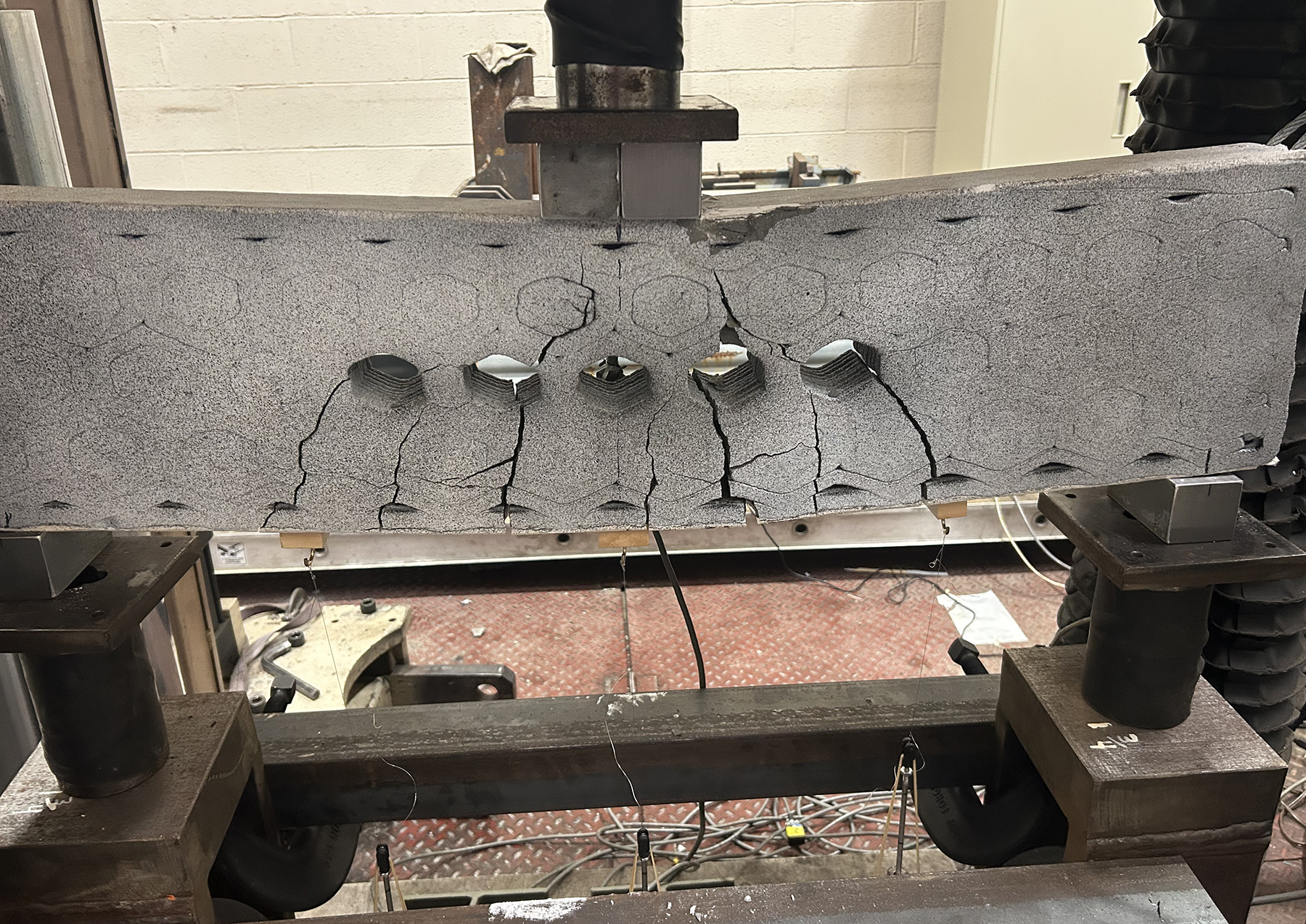
One of the goals of Mantawy’s Additive and Robotic Construction Laboratory at Rowan is to explore how to streamline the process of additive construction. Methods could include using materials mixed with additives for better flow without clogging printer nozzles and reinforcement in 3D-printed concrete structures.
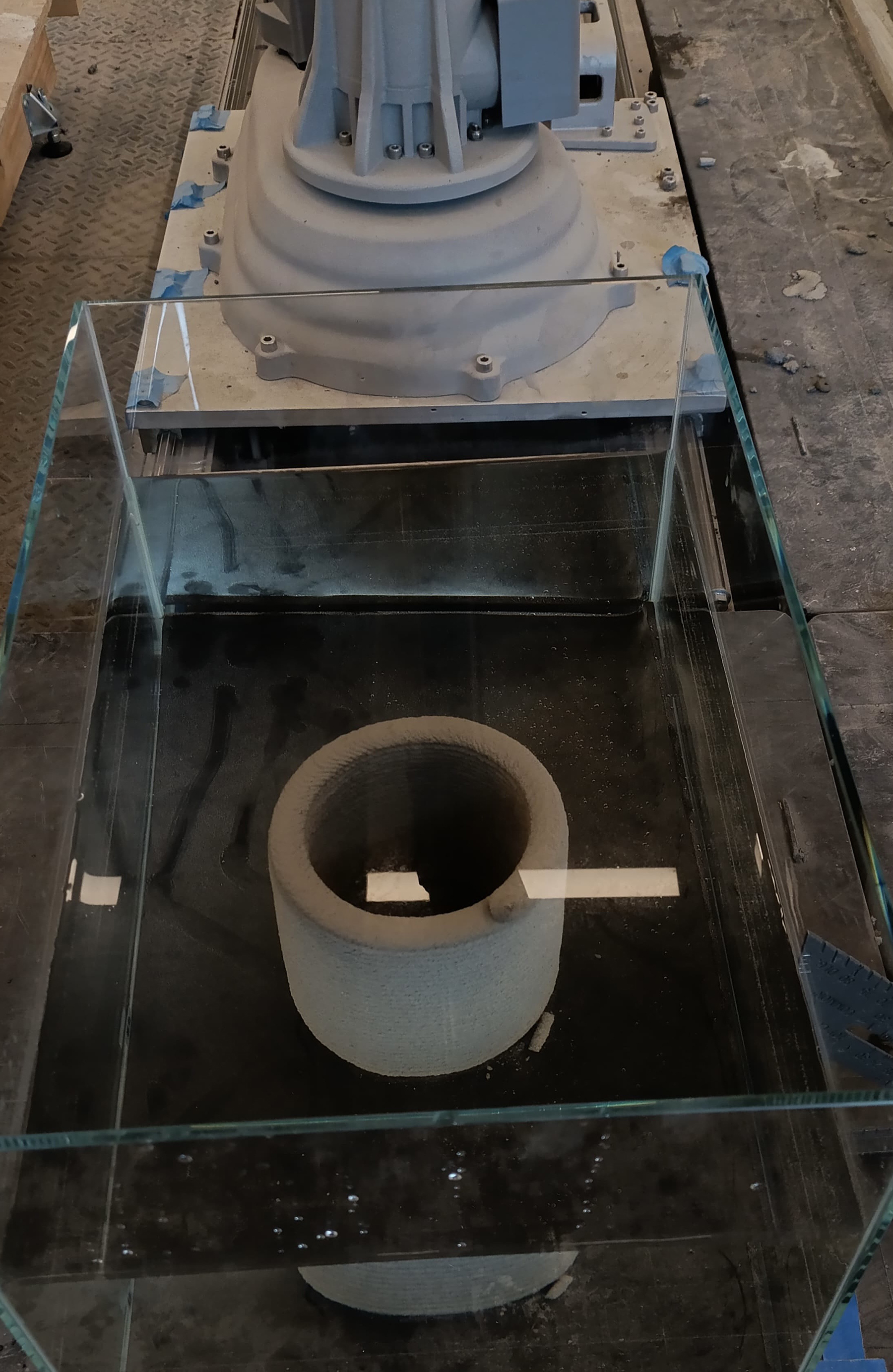
Other research covers concrete additive construction and metal additive manufacturing for infrastructure and the built environment. The lab develops different classes of concrete (cementitious-based, geopolymer, and polymer concrete) suitable for 3D printing in different environments and mediums such as cold weather, hot weather, and underwater.
Mantawy incorporates robotics and materials enforcement in the built structures as they are printed. The 3D printer is a robotic arm on a gantry system that prints the concrete layer by layer. A collaborative robot moves around with sensors and scanners to conduct quality testing and can also act as a robotic arm to pick and place reinforcement materials so that the reinforcements get better integrated into the final structure.
Mantawy has developed additive construction methods that place and integrate reinforcement in concrete structures as they are being printed.
Reality capture sensors and artificial intelligence can help detect moisture in the newly printed material and monitor flow, pressure, speed, and how the bead is set, determining if it’s too saggy or choppy, in which case it needs adjustments.
Looking beyond construction
In civil engineering, additive construction is useful in building bridge spans.
The Netherlands set up a robotic 3D-printed metal bridge made of steel in 2021 from company MX3D. Project goals were ambitious: Sensors collected structural measurements such as strain, displacement, and vibration and measured environmental factors such as air quality and temperature, enabling engineers to measure the bridge’s health in real time and monitor how it changes over its lifespan.

It was brought down in 2023 after its permit expired. The application was viewed as a window into how 3D printing can help in many civil engineering disciplines.
Despite its many advantages, additive construction is not always a one-size-fits-all solution. “You can’t force technology on a project,” Mansour said. “You have to look at each project and align the best tools, materials, and approaches that fit to deliver the best results.”
However, when use cases and technologies do align, additive construction can solve a number of challenges that plague the sector.
 Islam Mantawy, Rowan University
Get ready for ASCE2027
Maybe you have big ideas related to 3D printing or another topic altogether. Maybe you are looking for the right venue to share those big ideas. Maybe you want to get your big ideas in front of leading big thinkers from across the infrastructure space.
Maybe you should share your big ideas at ASCE2027: The Infrastructure and Engineering Experience – a first-of-its-kind event bringing together big thinkers from all across the infrastructure space, March 1-5, 2027, in Philadelphia.
The call for content is open now through March 4. Don’t wait. Get started today!