
 Josh Stamm, STV
 More than a decade ago, the city of College Park, Georgia, began envisioning a safer, more welcoming connection between its downtown area and the Georgia International Convention Center.
Camp Creek Parkway – one of the city’s busiest thoroughfares – posed a significant barrier for pedestrians and cyclists. Yet rather than seeing this as a limitation, city leaders saw an opportunity to use infrastructure not just for mobility but as a driver for long-term economic growth, particularly in support of the Six West development and an expanding local trail system.
Connectivity and growth
In the early stages, multiple concepts and routes were explored for a 10-foot-wide multiuse trail, including five unique bridge designs and several potential locations. However, space constraints and feasibility concerns quickly narrowed the options.
Further reading:
- Buffalo community comes together to shape, celebrate pedestrian bridge
- Dallas-area cyclists, pedestrians celebrate unique bridge over highway
- Building bridges: Capstone project is a highlight for West Point cadets
The selected site offered clear advantages. Located just west of Hartsfield-Jackson Atlanta International Airport, it included abandoned streets and properties acquired through previous noise-abatement programs. This eliminated the need for new right-of-way acquisition and streamlined the permitting process.
 Josh Stamm, STV
 To further avoid the requirement for right-of-way or easement acquisition, several roadways between the bridge and downtown College Park were converted to one-way with on-street parallel parking to allow for the installation of the 10-foot-wide multiuse path within the existing right-of-way. The addition of on-street parking along the trail alignment was integral to promoting alternative modes of transportation.
The bridge location also provided another benefit: visibility. Positioned within view of millions of travelers each year, the bridge would function as a gateway into College Park, reinforcing the city’s vision for a modern, connected community.
Building a bridge – together
From the outset, collaboration was central to the project’s success. Stratus (formerly Prime Engineering) and STV – firms that previously partnered on another high-profile trail project in Athens, Georgia – brought that shared experience to bear on early coordination efforts for what would become the Global Gateway Connector Bridge. Stratus led overall design as the project manager, civil engineer, architect, and construction manager, while STV served as the bridge engineer of record.
The design process was a careful balancing act between functionality, aesthetics, and engineering feasibility. Stratus presented a range of concepts – from simple overpasses to sculptural spans. Following multiple stakeholder meetings and public reviews, a distinctive and unique crossing arch design emerged as the clear favorite.
As the design took shape, the teams addressed critical challenges: accommodating Americans with Disabilities Act-compliant access across a 40-foot elevation change, minimizing conflicts with airspace lighting beneath the airport’s glide path, and keeping the arch height below Federal Aviation Administration thresholds that would require further oversight.
Coordination extended well beyond the engineering teams. Both firms worked closely with the city, the convention center (Georgia’s second largest), the Georgia Department of Transportation, the airport, and Delta Air Lines to ensure the bridge could be delivered with minimal disruption to airport operations or traffic.
The signature arch
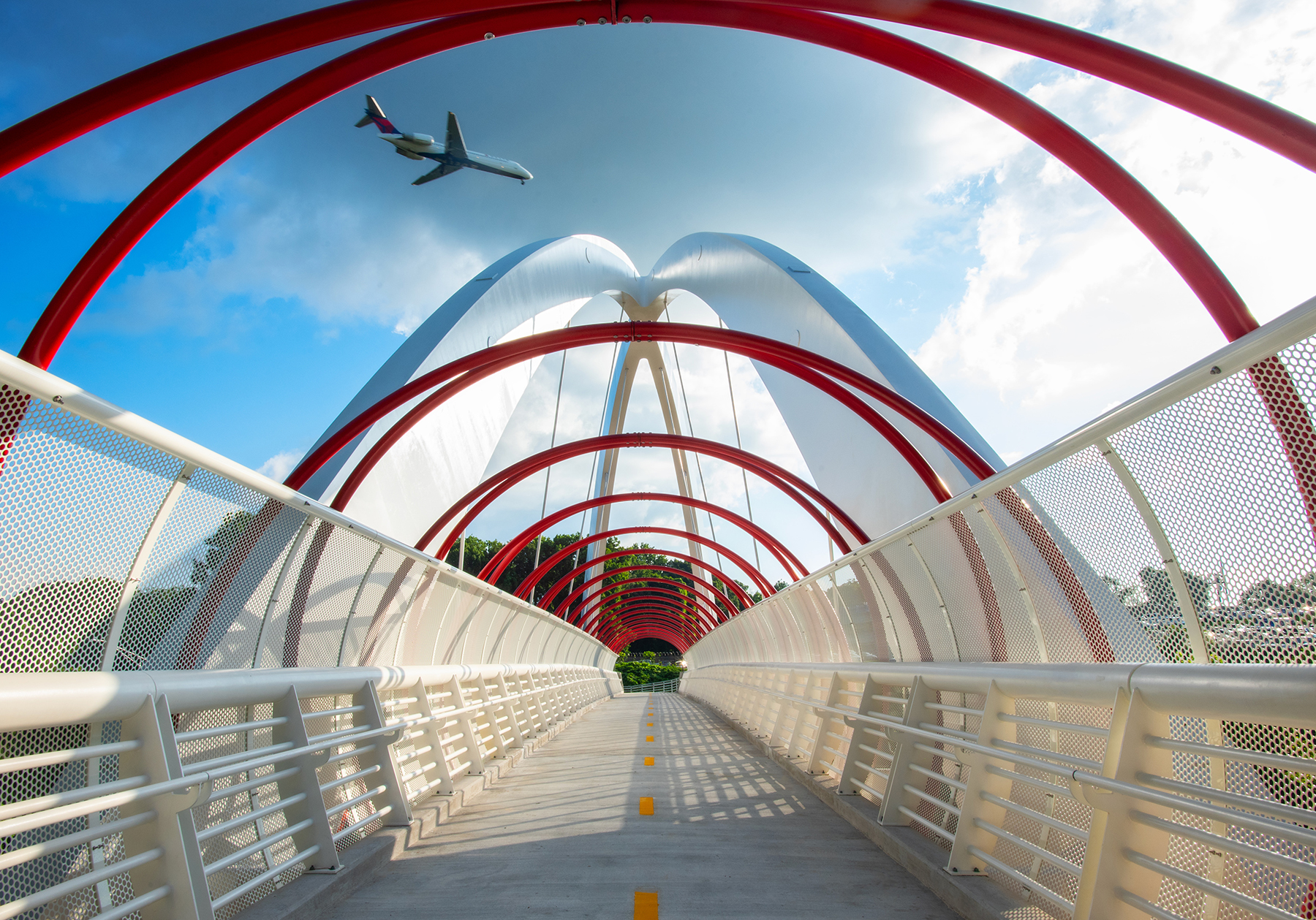
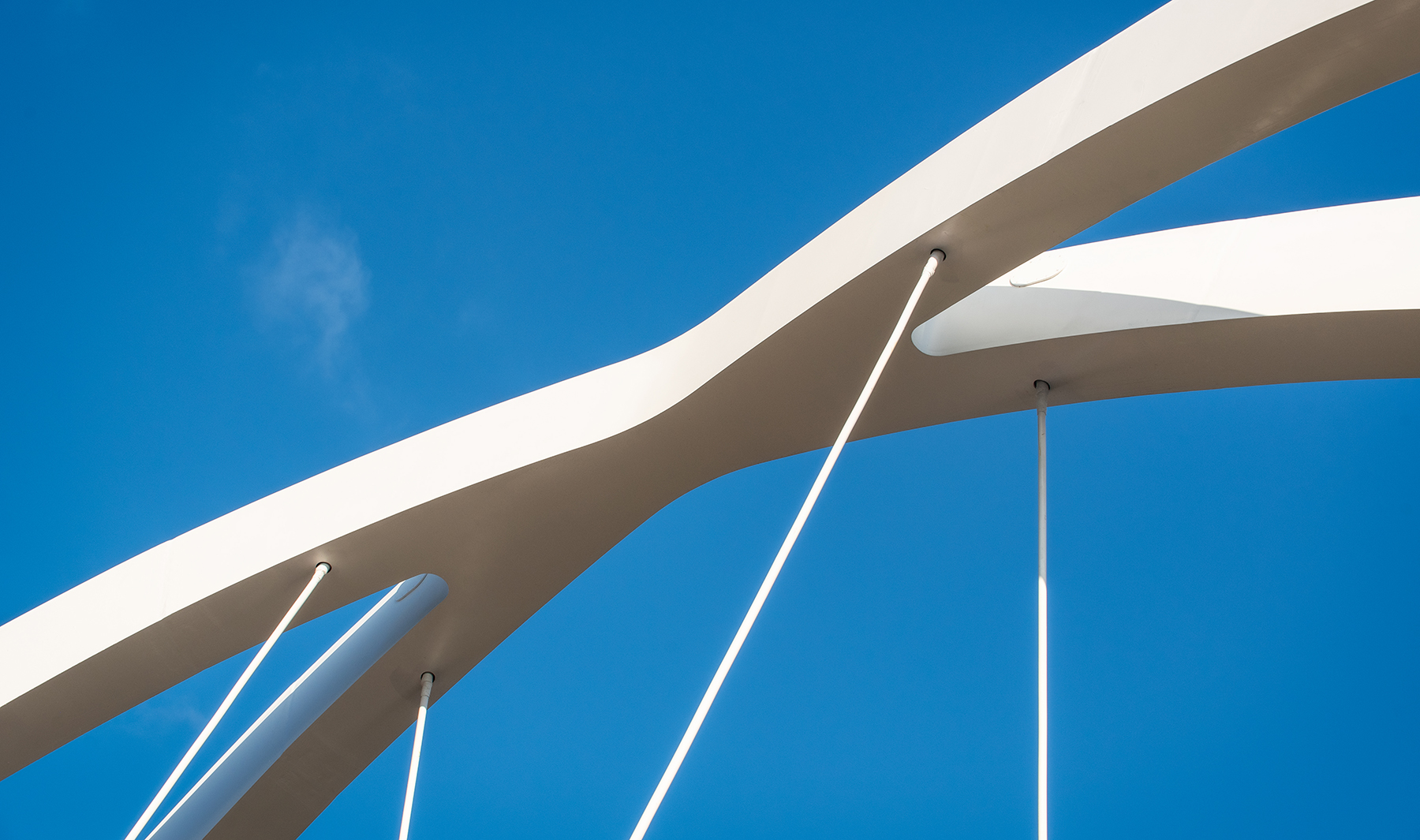
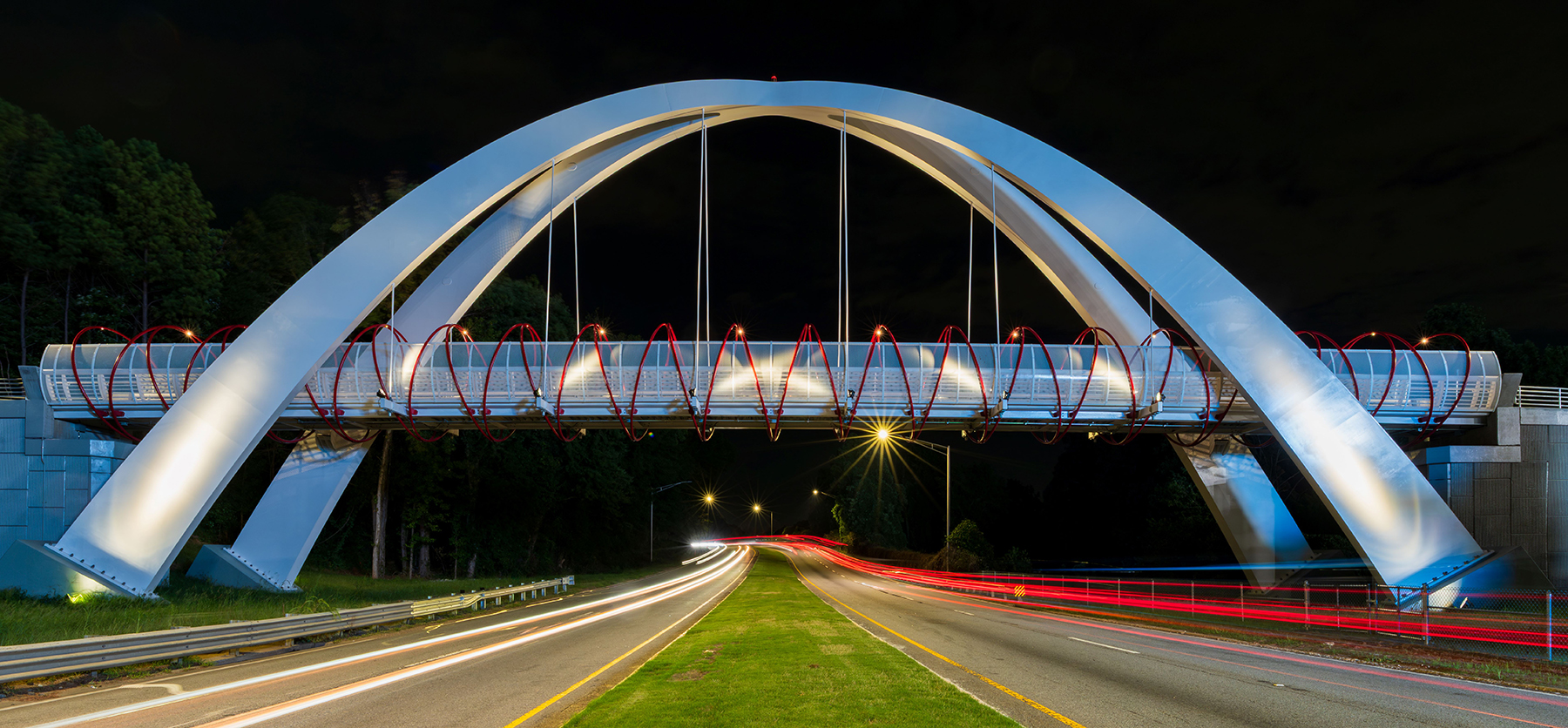
The heart of the bridge – an 80-foot-tall, hanger-supported through arch – spans four lanes of Camp Creek Parkway and represents an engineering feat and a civic statement. The 200-foot-long structure features dual steel arch ribs that intersect at midspan, creating two independent arches that visually and structurally cross through each other. While reminiscent of a conventional basket-handle arch, the intersecting configuration introduced added complexity in design analysis and fabrication.
The steel arch ribs were prefabricated by King Fabrication in Houston nearly a year before installation. Made up of variable-depth rectangular boxes composed of 3/4-inch steel plates and produced by one of the few U.S. fabricators capable of this precision, the arch was delivered in five major components. On-site, four field-welded splices near the top of the arch created the seamless illusion of continuous, interwoven arches.
 Josh Stamm, STV
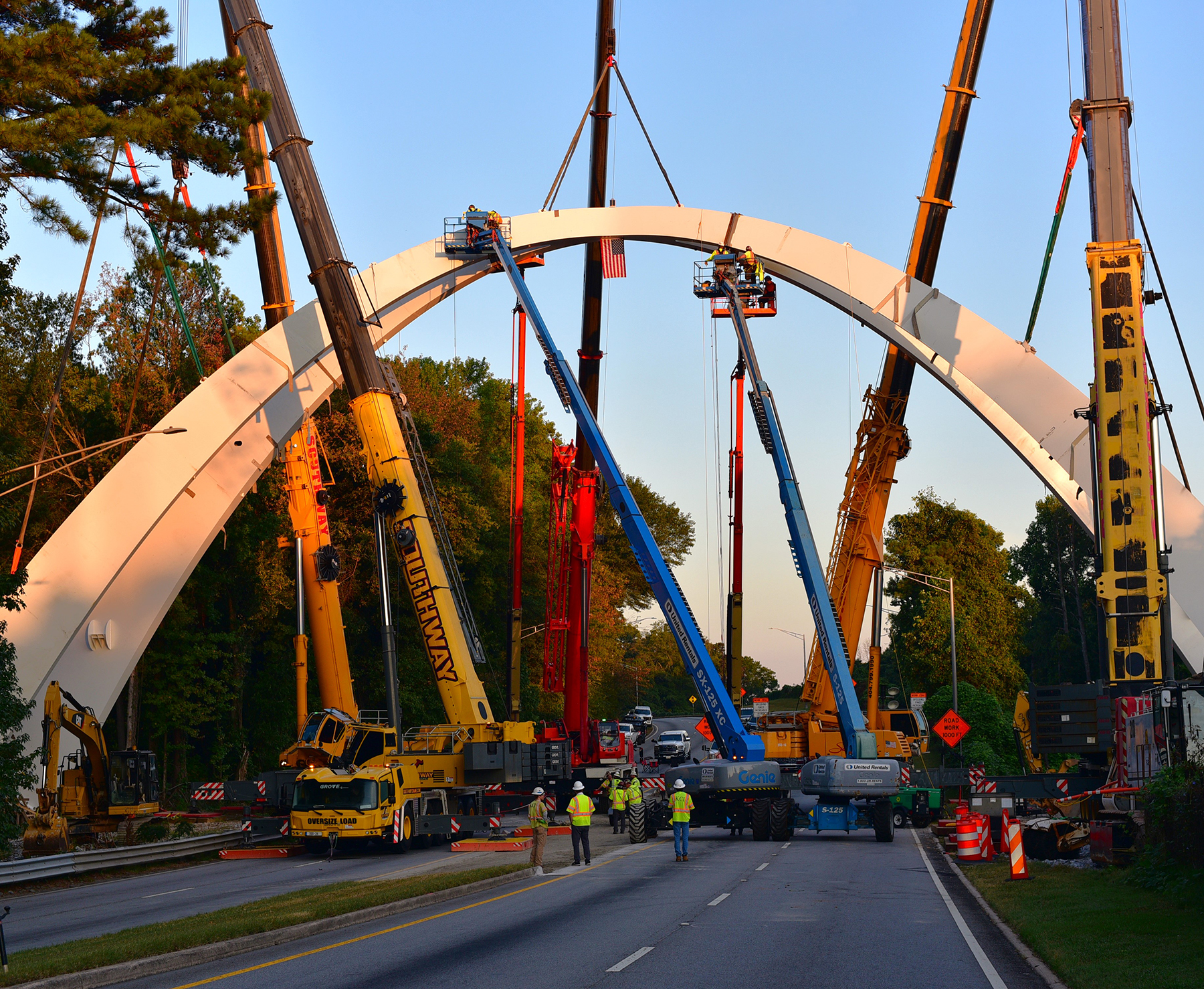
Erection took place in September 2024 and relied on a carefully choreographed lift plan involving five cranes and a 17-page procedural guide. C.W. Matthews Contracting Co. served as the contractor, and Banner Industrial Construction served as the erector, executing the weekend lift to minimize disruptions to the 26,000 vehicles that traverse the corridor daily.
Continual monitoring performed during on-site welding required real-time recalibration to maintain geometry. Structural engineers worked swiftly to confirm the integrity and alignment of the arch, developing mid-operation protocols to preserve safety and stability.
But there was one variable the team couldn’t control: Mother Nature.
Overcoming obstacles
Originally scheduled for completion over a single weekend, arch erection was extended into the following week due to unforeseen welding complications. As crews worked through the final connections, Hurricane Helene gathered strength off the Gulf Coast, putting pressure on the team to complete the arch erection as the cranes would need to be lowered for high winds.
In a pivotal on-site decision, the team prioritized core structural integrity over finishing details. Aesthetic welds and final touch-ups were temporarily deferred, making sure the arch could withstand forecasted winds as the hurricane was on track to pass through the Atlanta area. That pragmatic, safety-first approach protected the structure through the storm’s outer impacts.
Yet even after Helene passed, adverse conditions lingered. Cold temperatures, persistent humidity and intermittent rain created ongoing challenges for welding, deck placement, and the installation of hanger rods and architectural hoop features.
Simultaneously, the bridge’s proximity to the airport required continual coordination with the FAA. Navigation lighting systems, structure height limitations, and crane operations were all closely reviewed to ensure compliance with airspace restrictions.
Despite these hurdles, the project team pressed forward. Coordination, adaptability, and mutual trust among partners proved essential in maintaining momentum while upholding technical standards. The final connection welds and architectural elements were completed in phases, as weather permitted – without compromising safety or schedule.
A city’s new Gateway
The Global Gateway Connector Bridge and trail officially opened in June 2025, fulfilling a long-standing vision for the city of College Park and retired city engineer Jackson Myers, who was the driving force behind the project. More than a pedestrian bridge, it now serves as a signature landmark – a safe, welcoming link between the city’s downtown, the convention center, nearby hotels, and Metropolitan Atlanta Rapid Transit Authority transit.
It also establishes a strong foundation for future economic development and mobility, especially as the Six West project and additional trail connections take shape.
With its distinctive arch, thoughtful design, and seamless integration into the existing urban fabric, the bridge exemplifies how infrastructure can be both functional and inspirational.
For Stratus and STV, the bridge represents more than a successful project; it stands as a testament to true partnership. The challenges – technical, environmental, and logistical – were considerable. But so was the shared commitment to collaboration, problem-solving, and long-term impact.
 Kalyn Keeney, Stratus
Get ready for ASCE2027
Maybe you have big ideas like the ones discussed in this article. Maybe you are looking for the right venue to share those big ideas. Maybe you want to get your big ideas in front of leading big thinkers from across the infrastructure space.
Maybe you should share your big ideas at ASCE2027: The Infrastructure and Engineering Experience – a first-of-its-kind event bringing together big thinkers from all across the infrastructure space, March 1-5, 2027, in Philadelphia.
The call for content is open now through March 4. Don’t wait. Get started today!

