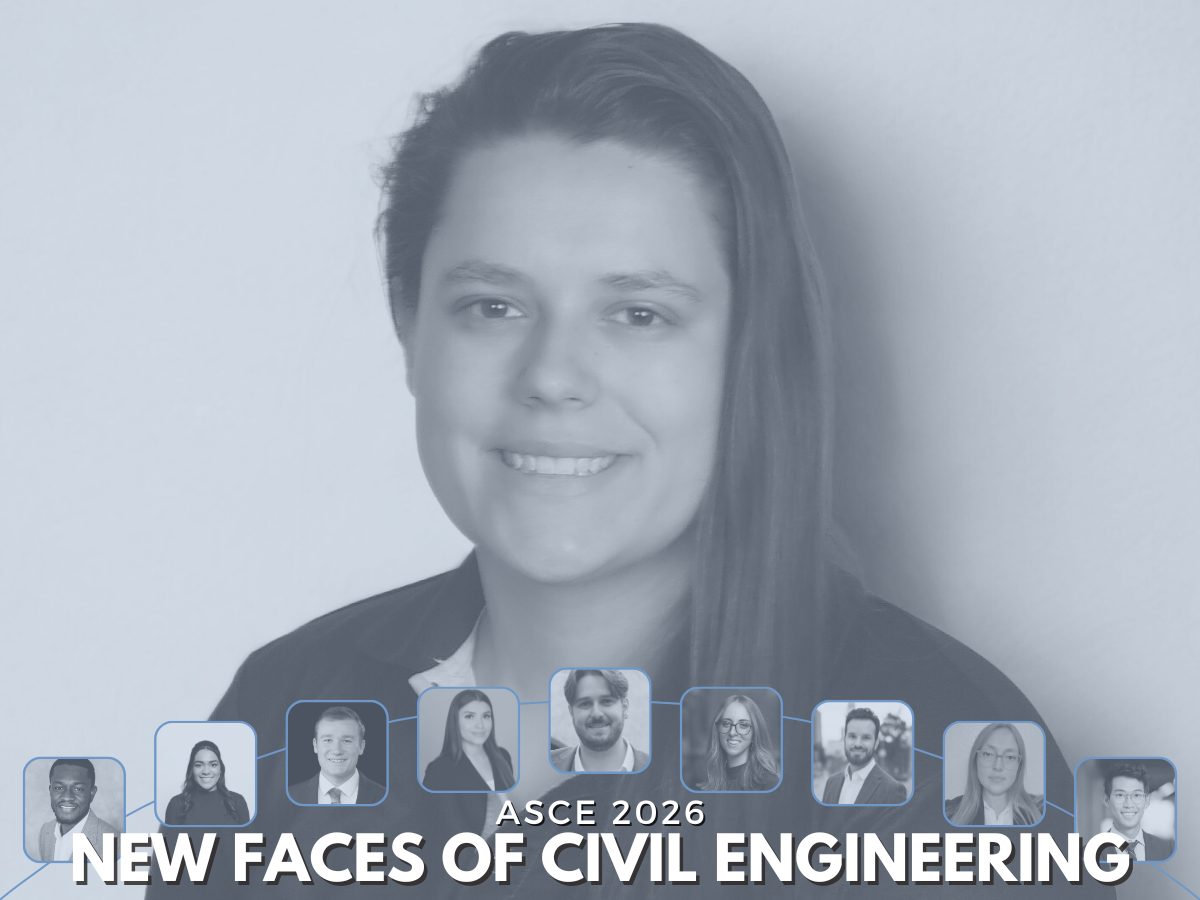
McKenzie White’s interest in engineering began at a young age.
Partly inspired by the movie Iron Man and, even earlier, Legos and Lincoln Logs, White’s passion for engineering started in her childhood. And fortunately, her family was very supportive.
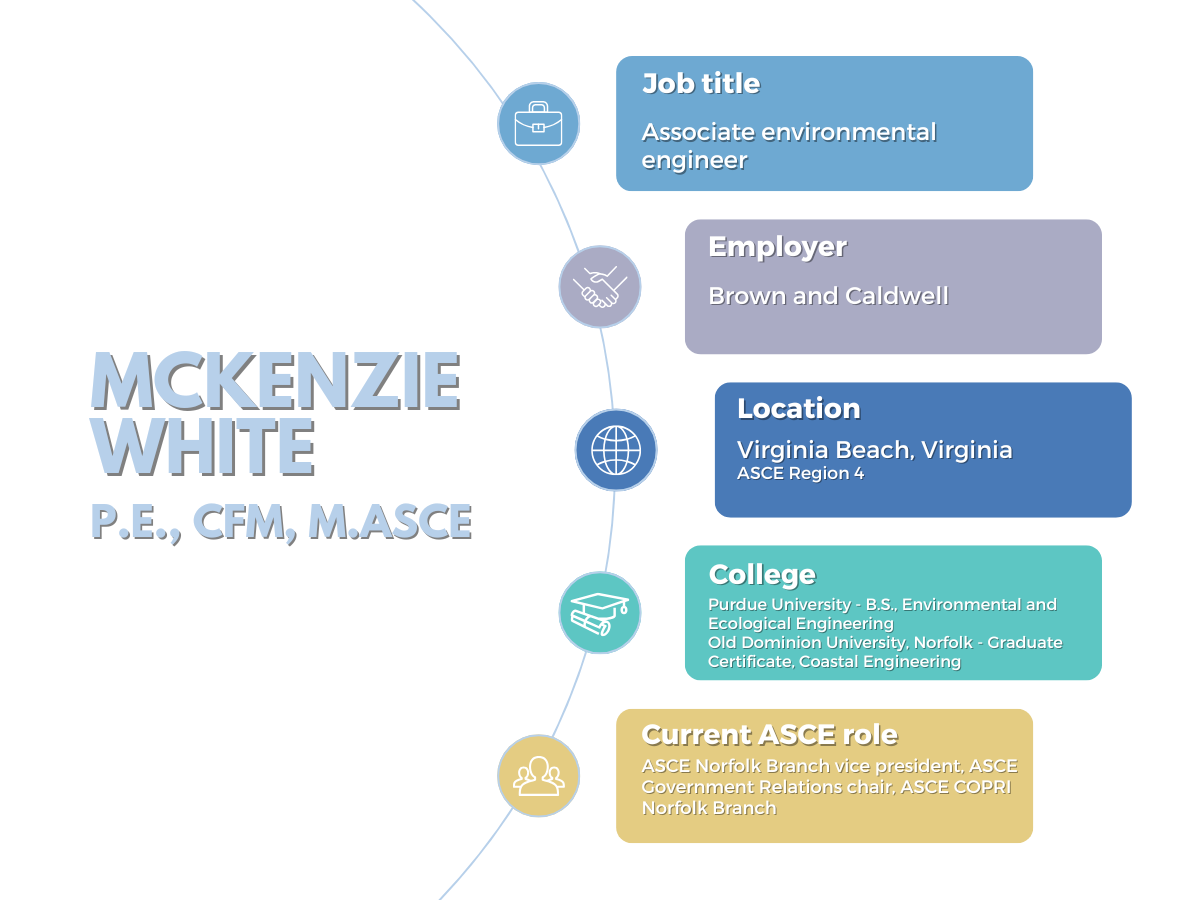
As she moved through school, she realized she had a knack for math and engineering. Now an associate environmental engineer at Brown and Caldwell, White is able to channel her lifelong interest in engineering into stormwater, stream restoration, and coastal projects.
But progressing in her career revealed that not everyone has had the same experience. And upon that realization, White decided to make herself a resource for those seeking to understand not just civil engineering, but how to learn, grow, and be involved in one’s community.
White took on the responsibility of mentoring children by joining Big Brothers Big Sisters of America, an organization that connects kids with mentors to support them in both academics and emotional development.
“I was involved in the school program, so I went to underprivileged schools, talking with the kids and connecting with them to ask, ‘Where do you need help? Where do you just need a little support? Is that someone to talk to or is it someone to work with on your math skills?’
The experience challenged the way she thinks about answering questions. It wasn’t easy at first, but White learned that teaching isn’t always black and white, and supporting mentees’ academic journeys often meant reframing what came naturally to herself.
As she has grown in her career and honed that skill, she has also worked to create a space where younger civil engineers feel comfortable asking her questions, something she didn’t always have when she was starting out.
And her desire to build relationships doesn’t end there. She now aims to serve as a resource for the communities she works with, making sure that they understand why her projects are important.
ASCE has honored White as a 2026 New Face of Civil Engineering.
She recently told her story to Civil Engineering Source.
Civil Engineering Source: What is the accomplishment or aspect of your career that you are most proud of so far?
White: I would say it's the connections I've been able to form with the younger engineers and scientists I get to work with.
When I was coming into the workforce, I felt alone, floundering, and like I was pretending I'm an adult; I didn’t know who to ask these “stupid” questions to. And I've really prided myself on flipping the script and being who I wish someone had been to me when I was coming up and being able to say, “All right, if you have a question you do not feel comfortable asking your supervisor, just ping me, just ask me, text me whatever you need.”
I still get questions like, “I don't know how to set up a print driver.” Is it technically my job to tell them how to do that? No, but being able to be that resource for people who are younger who don't necessarily know, I'm pretty proud of that.
Everyone says it's the relationships you make, but it's a cliche for a reason.
Source: What kind of impact do you want to make on the profession?
White: I think a lot of the disconnect I see from people is that civil engineers in general are really technical. We have a lot of really specific knowledge, and sometimes we aren’t great at making it easy for people to understand what we're saying and why we're saying it.
If you can't put it in terms for someone who's a contractor, who's building something, or someone whose neighborhood you're tearing up to put in a pipe, then you’re losing a little bit of what we're doing as civil engineers.
In my mind, civil engineers – possibly above all other types of engineers – are public servants. You focus on, “How can I help people? How can I keep them safe? How can I make their lives easier? How can I do this, that, and [the] other?” And if you aren't connecting to people and making sure they know why you're doing what you're doing, then you're losing a really good aspect of engineering.
So, as I keep going through this profession, what I hope to impress on people is to make those connections with people who aren't engineers and help them understand why we do what we do.
I do a lot of field work with stormwater, so I'm out there in the street wearing the yellow safety vest. And people walking along the along the street make the assumption that this person knows what's going on and that person is here as a resource.
So, I've gotten to have some really good conversations with people who are just walking down the street.
And I've gotten to help people, like somebody who just bought a house. I was walking them through having a sinkhole on their property that the city knows about and giving them steps they could take to fix that sinkhole and talk to the city about fixing it.
That homeowner had just moved in a week and a half prior, and they burst into tears because they didn't realize they had sinkholes on their property. And I was able to kind of allay that and tell them, “Here's what you can do as a person who's not a civil engineer, but a homeowner” and make that connection between the engineering world and putting it in a way that someone who doesn't speak that language understands and feels comfortable.
Source: Did this kind of communication come naturally to you or is it something you’ve developed throughout your career?
White: I think it's something that I've had to develop. I've been fortunate that engineering has come fairly naturally to me. I've always been interested in it. I've always been drawn to it, and being able to put it in terms that aren't spreadsheets and numbers is something I had to learn as I’ve gone along.
The first time you're out there, you use the regulations that say you can be somewhere like a shield. You're like, “I have a letter. It says I could be here. Please don't be mad at me.” And as you get more comfortable, you can say, “This is why I'm here. But talk to me, tell me why you want me to be here as well.”
I had a leg up because I'm a chatty human and that helps a lot, but learning how to change the language we're using and making it less technical and more approachable to people who don't speak the engineering language is definitely a skill I had to cultivate.
Source: Can you talk about your experience mentoring children through Big Brothers Big Sisters? What is the most powerful moment you've had during your experience?
White: I got involved with Big Brothers Big Sisters right around COVID. I saw that there was a lot of divisiveness that kind of felt hopeless, like I couldn’t fix it.
I can't, but what can I do? How can I help in some way? It's a phenomenal organization with a huge infrastructure and huge network.
I have a very strong math background, so I was brought in specifically to help work with a lot of kids on their math skills. Going through flashcards and having this little girl look at me and go, “Well, what's the point of doing plus zero?” It's hard to not dig deep into the parenting playbook from when I was a kid and just say “because I said so.”
Again, math had always come easy to me. And I have this kid who doesn't like math, doesn't want to learn math. It's reframing things again. It's learning and telling someone, “Hey, this is why this is important, but I get it. You don't like it, so let's learn it a different way.”
Where we ended up really connecting is putting it all back to money. Everything shouldn't be about money, but in math, it was easy to say, “If I give you more, what does this mean? How much money do you have?” And that connected really easily for her.
I remember I was so, so proud of her. She brought me a test, and it wasn't an A, but she had a huge jump in grade. Her teacher had written her notes saying, “You did such a good job.” Oh, she was so proud.
I feel like anyone who volunteers always says “I got more out of it than they did,” but I really did.
You have to take a step back and say, “All right, I can't assume that you have the same foundation I have.” I can't assume that they’ll get it. We had to kind of start over, and I think it's a lesson I'm going to have to keep relearning because I'm a stubborn human, so it's got to get pounded into my noggin over and over again.
There was a time I was doing a training exercise where I think I really failed the younger engineer I was with because I made the assumption that this person knows the basics of stormwater like I do, and that's not a fair assumption.
And I was getting back their portions, and saying, “These aren't really what I was looking for. They're not really up to snuff. Let's try this again.”
And it's one of those things where you have to tell them, “All right, if I'm saying something you already know or I sound like I'm patronizing, stop me. Tell me you already know it. That's fine. We're starting from the beginning.”
It’s something I think I’ll have to keep learning over and over and over again, especially as I start to get older and hopefully a little bit more experienced.
Source: What inspired you to start mentoring children?
White: My family situation is fairly stable, and I've been very fortunate that even at times when it wasn't, I always knew I had a rock in my mom and in my brother.
As I went through high school and college, I saw more and more people who don't have that. And I think it was very much the realization of how lucky I had been, how privileged I had been, and how good I had it.
And for a lot of kids, that's just not an option. There's no one they can vent to. There's no one to be a stable person for them. And I can't do that for every kid, but for the time being that was something I could do. So, I wanted to share the love and make sure to give other kids what I got to enjoy.