In a town of only 1,200 people, there aren’t many engineering career opportunities.
Robert Schomp’s hometown only had a few employers that visited: a nursing school, the military, and natural gas fracking companies.
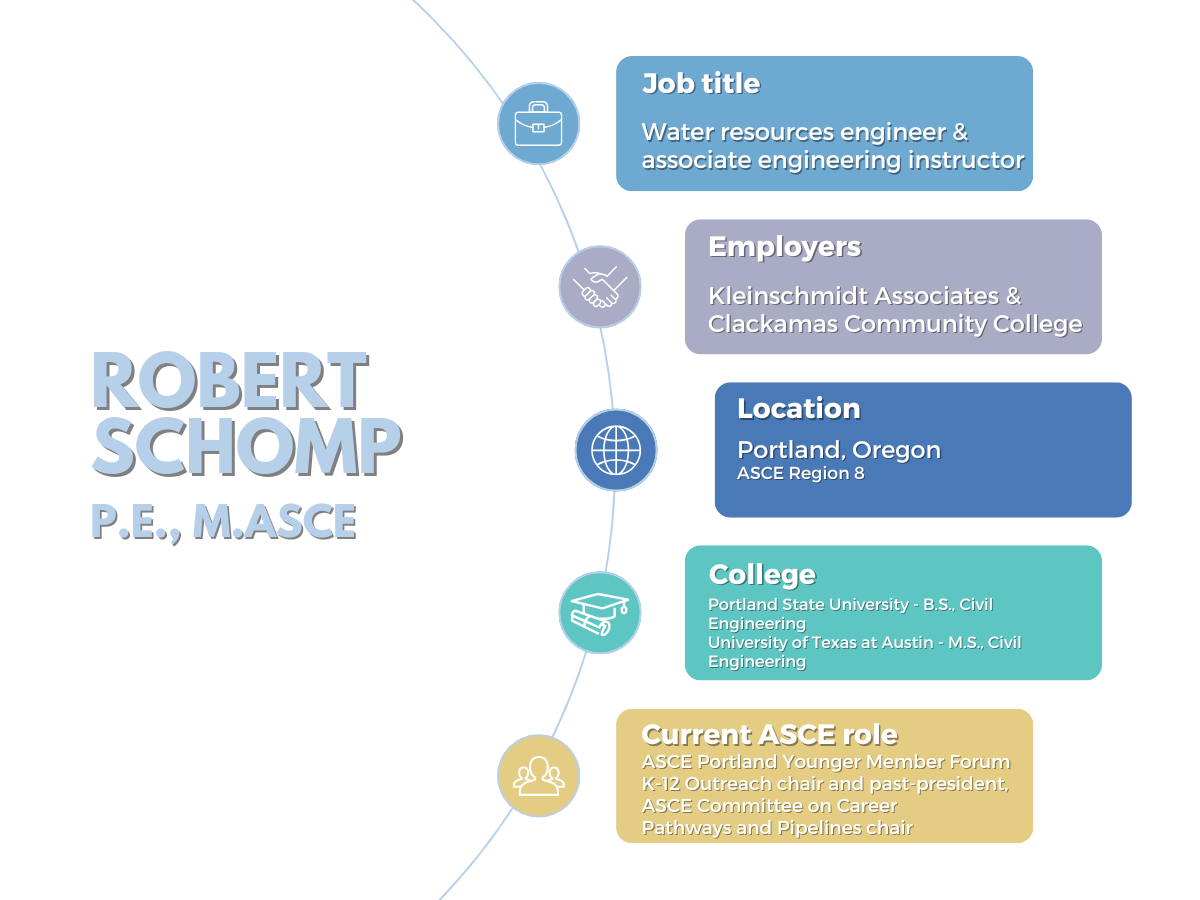
That’s why Schomp, who now works as a water resources engineer at Kleinschmidt Associates, took the plunge and moved to Oregon to study engineering.
The move didn’t come without challenges. Securing financial aid, changing majors after beginning in renewable energy engineering, and winding through a nontraditional career path were all hurdles Schomp had to overcome. But he kept going, and through triple enrollment in Clackamas Community College, the Oregon Institute of Technology, and Portland State University – something almost unheard of – Schomp was able to graduate and build the career of his dreams.
And his experiences growing up in a small town helped him find his compassionate, community-oriented approach to the profession.
In high school, Schomp worked at the local deli, finding social fulfillment in getting to know his customers. His desire to connect with his community persisted, and working as a teaching assistant in college only grew his passion for serving the community.
And when he was asked to come back and teach a class he took at Clackamas Community College, he jumped at the opportunity.
“It fills my heart because I took that class exactly 10 years ago. Now that I feel somewhat accomplished in my career, I like to tell students, ‘Hey, I'm you, but in the future, and I want to help you as much as I can,’” said Schomp.
He also uses his civil engineering acumen to help a friend who lives by a river prepare for flooding.
“With my skills that I learned both from school and from work, I built a highly detailed flood model of his house, and using river flow predictions, I can suggest when and what to sandbag before waters rise,” Schomp said.
Like making sandwiches as a teenager, handing them to customers, and seeing them smile, helping students and friends brings the direct connection that Schomp “could have never foreseen as a student.”
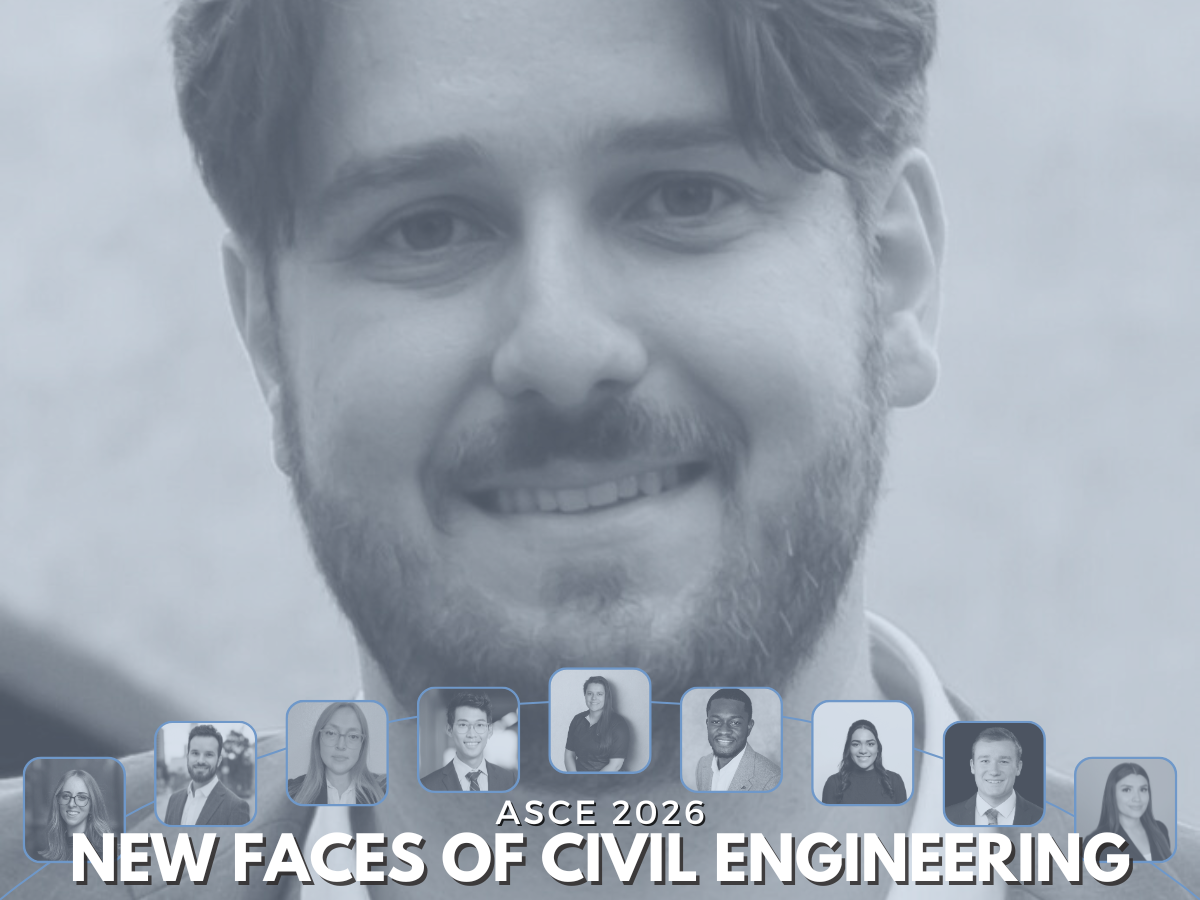
Schomp has been honored by ASCE as a 2026 New Face of Civil Engineering.
He recently shared his story with Civil Engineering Source.
Civil Engineering Source: What is the accomplishment or aspect of your career that you're most proud of so far?
Robert Schomp: A specific example is being able to teach at Clackamas Community College again. I teach the Introduction to Engineering class. I’ll be teaching it for the second time this winter as well.
We cover topics like student success, engineering practices, and one really fun thing is that I have panels of engineers – friends, colleagues, and co-workers – come and represent their engineering discipline and talk to students about the colleges they went to.
Because I didn't have a clear path to engineering in high school or in early college, I’m providing that and representing engineering to people who are still figuring out what they want to do. A third are still co-enrolled in high school, another third are freshmen at the community college level, and then another third are usually transferring from another degree or even returning from a profession and trying to reorient their career pathway.
It’s been really fulfilling to have been sitting in their seat wondering what the future would look like if I could afford it, where I would be, what it would take to become an engineer because at that time, it just felt like people on TV. You don't even know about licensure or anything like that yet. You're thinking, “Where is my next meal going to come from?” Being able to be on the other side now has been really exciting.
Source: What inspired your interest in teaching?
Schomp: Volunteering through ASCE gave me the confidence to say yes to that role. I do a lot of K-12 outreach talking to a variety of students from, you know, like third grade all the way up through high school. I organize and help with several programs at the high school and middle school levels to show people what engineering looks like and to encourage them to explore careers in STEM, whatever that might look like, and then also be available as a resource as they continue through school and look for colleges.
I received the offer to teach this class from the teacher who taught me that class 10 years ago; it was crazy full circle. Not only am I teaching this class, but he's now 10 years further in his tenure and I'm relieving him of some of this coursework so that he can take the next steps in his career: researching, teaching more advanced classes, and taking students on trips.
It felt like a big risk, but as soon as I received that email, I decided I would do it and figure out what that looks like on the work side.
I was a teaching assistant for my University of Texas at Austin civil engineering program’s hydraulics class, which I did for three semesters in a row. My absolute favorite part was hosting office hours, grading homework, helping people study and prepare for tests.
Source: What kind of impact do you want to make on the profession?
Schomp: I like to think of it as if there’s both a technical answer in terms of engineering, but also something on the softer side.
One thing that I really try to show to students we visit on K-12 outreach events as well as at the community college level is that civil engineering is a very caring profession. I always ask them in the very first class: What professions do you think are the most caring?
Usually, the answers are doctors and nurses, people who care for your health, which is true. But how many people do you think are traveling on a large bridge at any given time? It could be hundreds if not thousands. So, in my mind, engineered designs care for thousands or tens of thousands of people at a time.
The other side of it is caring for the environment, making sure that our built environment integrates well with the natural environment and that they can both live in harmony. You can care for the people and the planet at the same time with the same job.
I also want to make sure that civil engineering is an open book inviting people in and helping them know they can become one. You don't need to be a math whiz to become a civil engineer. You just have to work hard and have a continued level of interest to make it all the way through.
I do that in different ways. We have a mentorship program with our local high school where we help them with their paper straw bridge designs and doing crush testing and talking about civil engineering disciplines.
I feel like at least a couple of students have been captured (in the sense that they have continued to go at least into some type of engineering) just by doing a project like that because they've seen what that looks like as a job.
I think my true cause is still to give back to the community and be able to work in civil engineering and get technical fulfillment while also helping students.
Source: Can you talk about your nontraditional path to civil engineering? What were the biggest challenges and how did you overcome them? How does your path influence the way you connect with students today?
Schomp: One of my favorite things to tell the students that I teach now is not only am I teaching the same class I took, but I actually attended Clackamas Community College twice because when I took the mathematics placement test for Oregon Institute of Technology, I placed two classes below the minimum proficiency to even start the program. So, I worked full-time while taking the two math classes that I needed to qualify to even apply.
I really like telling students that story because some of them are taking those math classes for the exact same reason. And I always want to encourage students to understand that it's about perseverance rather than just being naturally gifted.
To go even further back chronologically, I was very dissuaded about even moving to Oregon, because the main requirement (for in-state tuition) is that you need to have bills in your name that establish your address. You also need to have worked in a job with a W-2 so you can show that you've been on the tax roll of that state. When I told my plan to my high school guidance counselor, they told me straight to my face that if I do that, I’ll be working at McDonald's for the rest of my life.
I think they were trying to scare me in the sense that, statistically speaking, people who take a year off between high school and college sometimes don’t go back when they start making money. But I had a plan. Being able to work, get in-state tuition, and get accepted in the program was huge, and I loved my time at Oregon Tech.
The next hurdle was switching degrees from renewable energy engineering to civil engineering, so switching degrees and schools.
For one year, I was triple-enrolled between Oregon Institute Technology, Clackamas Community College, and Portland State University. And I was driving and taking light rail – literally in circles – taking a class from each at different times of the day.
So, the first part was getting into school. The second part was financial aid. Programs like dual enrollment are already pushing the limits for most schools. Triple enrollment just didn't exist. I remember spending an immense amount of time with financial aid and the transfer coordinators between the schools, constantly making sure everything was lined up and that I was doing things correctly and that I wouldn't have to retake any classes or double up on anything or pay anything extra. But after I transferred, it was pretty smooth sailing. I finished my bachelor's degree from Portland State and then went and got my master's.
I tell my students about these difficulties in the sense that it was difficult. They can relate to that level of difficulty, but it might be other things like taking care of sick family members or learning how to be a college student or having to ride buses for hours to get to school.
There's also the part of being able to suggest how to apply for scholarships, how to get funding, and how to navigate the academic system because it's very difficult. And if you're not on track like I was for several years, it takes a lot of work to make sure you have a clear path to succeed and to graduate in a relative amount of time.
Source: What’s your strategy for connecting with students?
Schomp: In terms of space, I really enjoy talking in person, but I’ll email people, I'll do Zoom calls, I'll do any way that's easiest for the student.
We got to do anonymous surveys from the students at the end of class, and several students had remarked that their absolute favorite classes were ones where there was no presentation. It was just me discussing a topic or they were building something actively, like doing a cantilever plastic straw competition or a card tower.
I think it's just easiest for me to be myself, talk to the students, be available to be a resource, and to acknowledge when I don't know something. I know I'm the professor, but everyone has unique problems and unique ideas. I might be learning more from the students than I realize, and I’m happy I get to take those interpersonal skills back to work to make myself a better civil engineer as well as be a better person in life as a son, husband, and member of our community.