Pinn Winyoopongphun knows that leaving people out can be detrimental.
As a façade engineer – a discipline that he feels often gets overlooked – he has seen what happens when code regulators skip over them; for example, in the 2023 San Francisco storms that caused windows and panels to fall off buildings.
Winyoopongphun has made it a mission to shine a light on the discipline, something he fell in love with due to the intersection of architecture and engineering. And as he progressed in his career, he realized that it isn’t just façade engineering that needs technical attention, but marginalized communities whose voices might not always be heard.
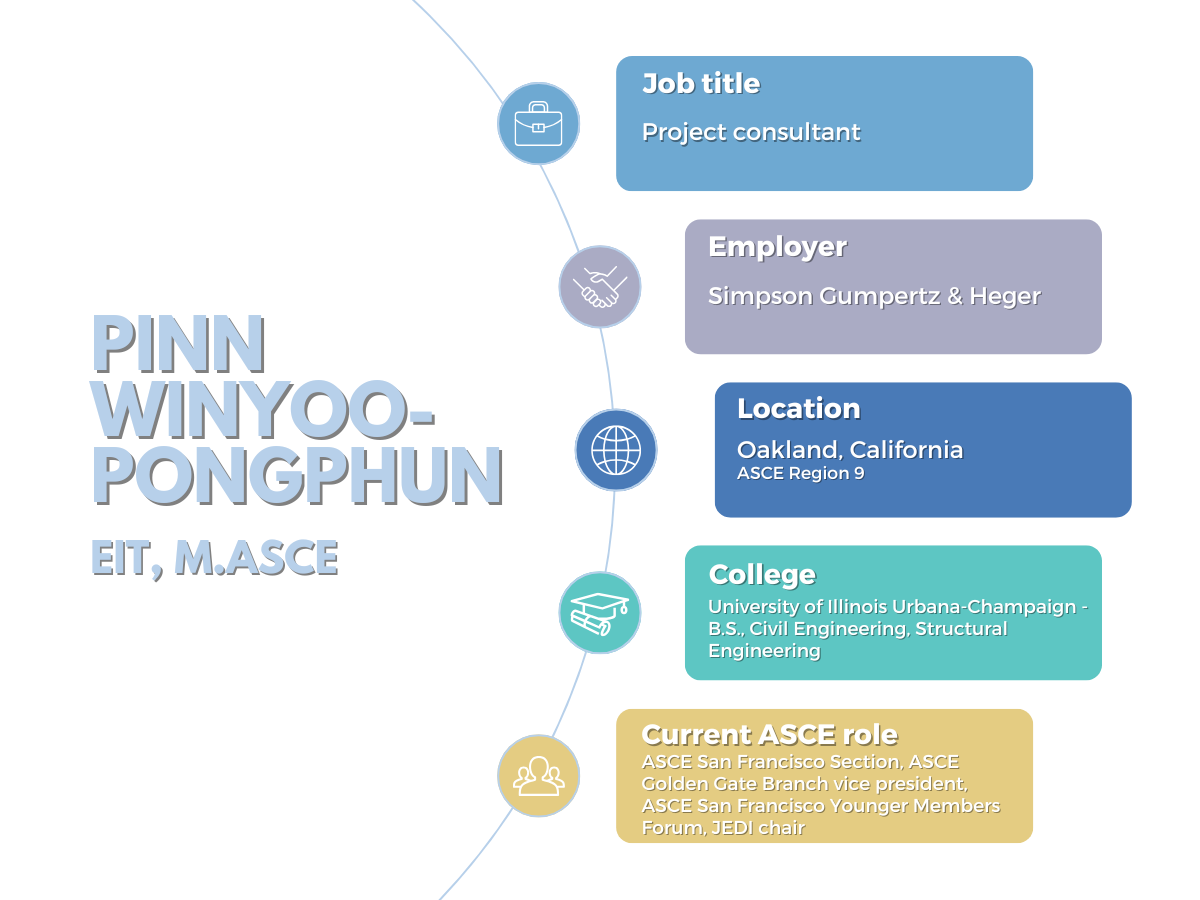
“Most of the communities that I work with and am committed to are marginalized communities, partially because I am a part of them, but also because people who I love and care about are a part of these communities,” said Winyoopongphun, EIT, a project consultant at Simpson Gumpertz & Heger.
Moving through his engineering career, he saw how women, minorities, and even younger engineers are sidelined, leaving important ideas out of projects that would benefit from different perspectives. And he has made it a priority to open opportunities for marginalized groups both in engineering and through volunteer work.
Winyoopongphun helped establish the DEI Council and employee resource group program at SGH. He has also expanded the firm’s volunteer activities to include fundraising activities for Elizabeth House, an Oakland homeless shelter for women and children, and Head for the Cure, a brain cancer research nonprofit. In his own time, he volunteers at the San Francisco LGBT Center, helping individuals with their resumes and career goals.
“Focusing on a marginalized community with intention is something that will never have a negative impact,” Winyoopongphun said. “Sometimes people don’t realize until they're in that marginalized position that they get treated differently or aren’t getting perceived at the same level in society as someone else.”
And Winyoopongphun has no intention of stopping.
“I just keep wanting to continue doing that, especially in the engineering world because engineering is about advancing, not regressing with our societal impacts,” he said.
ASCE has honored Winyoopongphun as a 2026 New Face of Civil Engineering.
He recently spoke with Civil Engineering Source about his story.
Civil Engineering Source: What is the accomplishment or aspect of your career that you're most proud of so far?
Pinn Winyoopongphun: One of the things I'm most proud of is finding ways to combine my technical experience with public impact and advocacy so early on in my career. Being able to merge those two things together was an accomplishment within and of itself.
Aside from all the technical projects I get to work on, making the decision to move from a traditional structural engineering path into façade design was very pivotal for me. It led me to multiple types of problem-solving situations, such as technical and aesthetically driven solutions, working on projects that people actively experience every day, and institutional projects where you get to see so many people experiencing your design.
One of my favorites so far has been with the University of California, Santa Cruz with Studio Gang, a woman-owned architectural company. It is the intersection between working with such high-profile architects and balancing their design intentions on such an intrinsic part of the building.
After I completed this envelope scope, I went back to campus to see our finished work for a post completion site walk, where I saw students walking into these buildings and professors using the lecture hall we designed.
The buildings are also very sustainable. They are all CLT, utilizing cross-laminated timber in their structural design.
A really big part of being involved in these amazing projects is seeing people use them afterwards. The project included four buildings, one huge main lecture hall called the ACAD, which is the academic center, and three dorms.
I remember walking through the site for the first time, the building was bare bones. And the last time I walked through the building, students were already moving into the space with cute little decor put up on the walls.
It's just a really, really fulfilling aspect to be able to see how much people are enjoying something that I designed and was a part of.
Source: What inspired your commitment to working with businesses owned by women and marginalized communities?
Winyoopongphun: It was being a minority myself in this field that lacks diversity, for sure.
I would say civil engineering is a very male, Caucasian-dominated space, especially in the U.S. I realized a lot of my peers and colleagues don't have enough representation, even though we have so many amazing female, ethnic, and queer engineers and architects.
In 2020, my company established a DEI council, and I was part of the Employee Resource Group task force. I wanted to be able to create a space where people can proudly showcase their accomplishments.
Before this, we had unofficial resource groups that people established for themselves. Now, the ERG task force has established funding and programs, which cover nine different minority groups within the company.
Fellow employees and engineers like myself volunteered and dedicated our time to writing the bylaw for this effort and got it reviewed by HR and the executive committee. But it really takes someone's initiative to start these efforts that make such an impact on so many people within the company.
Now that everything is established, people are able to join, people are able to be seen, and people are able to have support for events and establish impactful spaces for the community and themselves.
Source: What kind of impact do you want to make on the profession?
Winyoopongphun: First, I want to be able to incorporate my technical work into many aspects of the built environment.
What I do is a smaller niche within the building design world. People always think about the structure first or about the ground, things like the geotechnical aspects.
Many times, when façade engineers join a project, we come in after something fails; the envelope fails, the building doesn't meet the code requirements, the roof is leaking. Many times, we don't get to incorporate our work if the scope is overlooked by the owner or the architect.
I want to be able to push our field as a necessity in building design, something built into every project because we have seen in recent years so many projects that not only impose costs from damages afterwards but also pose a potential risk for the community. In 2023, San Francisco was hit with a strong wind event, and panels were falling off buildings because we did not have façade engineers inspecting these cladding elements as often as we should.
I also want to make it known in the industry how important the envelope in the façade field is because it's often overlooked for the aesthetics portion of it: “It looks really beautiful. It should work.”
Aside from the technical aspects, something I wanted to make an impact on is DEI and opening opportunities for people who are not seen within our community.
I see co-workers going on site and feeling marginalized because they're a minority in the field. I can't even imagine what others are experiencing in the construction space.
Even me, as a younger engineer, I was often overlooked on site because a lot of contractors are much more senior and experienced – even though I was the one designing the system. So, I'm the one telling them that they're doing something not per the design document, and they would tell me, “We've done this before on a previous job. Why are you telling us this is wrong?”
We're often overlooked, and in those spaces, I want to break down the ageism within our career, the sexism within our careers, all these divides that make absolutely no positive impact within our work.
All these things are done through engineer-driven community engagements like the DEI Council. We strive to hold events every month.
I also run the volunteering committee for my office. It's really great to see the team-building aspect, and it's awesome to see how much impact just 10 engineers can provide to our community.
One of my favorite events I've done was a park beautification in Golden Gate Park. It's many times larger than Central Park in New York, which is already huge. You can imagine how many national park employees are needed to keep this park running.
I contacted the National Park Service and told them we have a few engineers who were interested in volunteering. So, I organized a park beautification event, and we had a team bonding lunch after. It's so great to see how grateful these park workers are just to have some volunteers out there helping them plant trees and clean up some of the irrigation plots.
Source: Can you talk about your volunteer work? How does your commitment to supporting marginalized communities influence the way you approach your civil engineering career as a whole?
Winyoopongphun: There are three main organizations I have personally been working with and have involved my company with.
The first one is Elizabeth House, a homeless shelter for women and children in Oakland. They provide housing and food, and they're committed to helping these women reach a point where they can help themselves and find a career again.
Every year around the holidays, we do a charity raffle for Elizabeth House with our employees. I mean, the holidays is the best season for everyone to give back. So, we try to give back to our employees by having this raffle so they can win some prizes. But within the raffle itself, they buy raffle tickets, and all the proceeds go straight to providing household items for Elizabeth House.
We’re also on our fourth year working with Head for the Cure, a brain cancer research nonprofit that works with several medical institutes, including UCSF.
Within this organization itself, I focus on a cause that is close to some of our employees.
We’ve had a great turnout for the 5K every single year. The first year, we had 10 engineers come out. This past October, which is our fourth year, we had over 40 people come out to participate in the event. It has grown and grown into such a beautiful event. I think it touches a lot of our employees’ hearts that it's focused on someone we really care about and work with every day.
The last organization that I've been working with is the LGBTQ+ center in San Francisco.
This city is such a welcoming city for LGBTQ+ people. In the construction field, the culture can sometimes be unwelcoming to LGBTQ people. People who are LGBTQ are seen to not fit in, let's say. And I really wanted to break down that mentality within the space I’m in.
At the center, there are a lot of people who need resume reviews and professional guidance on getting jobs and being able to progress into the next phases of their lives.
An individual whom I work with was struggling with addiction. They were coming out of it, and I was seeing such progress within how they were engaging with the community and the desire they had to break into the next phase of their life.
I was able to help review their resume and equip them with skills as simple as Microsoft Word and PowerPoint.
In the corporate setting, we would imagine that everyone knows how to use these programs, but in reality not everybody has access to those kinds of platforms. So, being able to reach out and provide those resources for someone was a way to help me get in touch with the community in San Francisco.
Source: How does your commitment to supporting marginalized communities influence the way you approach your projects?
Winyoopongphun: I love working with such a diverse team.
I want to see the different aspects and mix of personalities who are receptive to working with a diverse team because you get such a mixing pot of ideas and solutions.
And this doesn’t just start with interviewing candidates. Within the DEI council, I worked with our HR team to diversify the university basis from which we hire. It’s interesting to see how opportunity skews, and it really starts from hiring, where we put ourselves into career fairs. Our commitment starts from there and from the people we hire.
I don't always have a say in the projects we choose to work on. But when we do get to work on projects with, for example, women-led architectural firms, I take the opportunity to spotlight women engineers within the project for ASCE’s younger members forum.
I love working on rehabilitation projects and projects with sustainability aspects built into them; doing cost and life-cycle analysis helps us understand the best route to take when it comes to material usage, how to be sustainable with the building, whether it’s better to fix it or to build a new building.
I think reaching out and getting support from many, many diverse voices within my company and the project team helps me bring communities together that I didn't know I was able to.