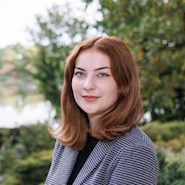
Mireille Lecourtois’ journey to civil engineering was a winding road.
She started college with the intention of becoming a marine biologist but veered toward a bachelor’s degree in environmental engineering and a master’s degree in civil engineering. What convinced her to make the change was hearing a story about scientists and engineers working together to create fishing nets with lights installed to keep sea turtles away.
“The way that the presenters were sharing that real-life scenario of how they applied an engineering solution really inspired me,” Lecourtois said. “It seemed like a simple solution, but back then, it was a big thing, and it made me realize that I could pursue a career where I can take care of the environment and do engineering at the same time.”
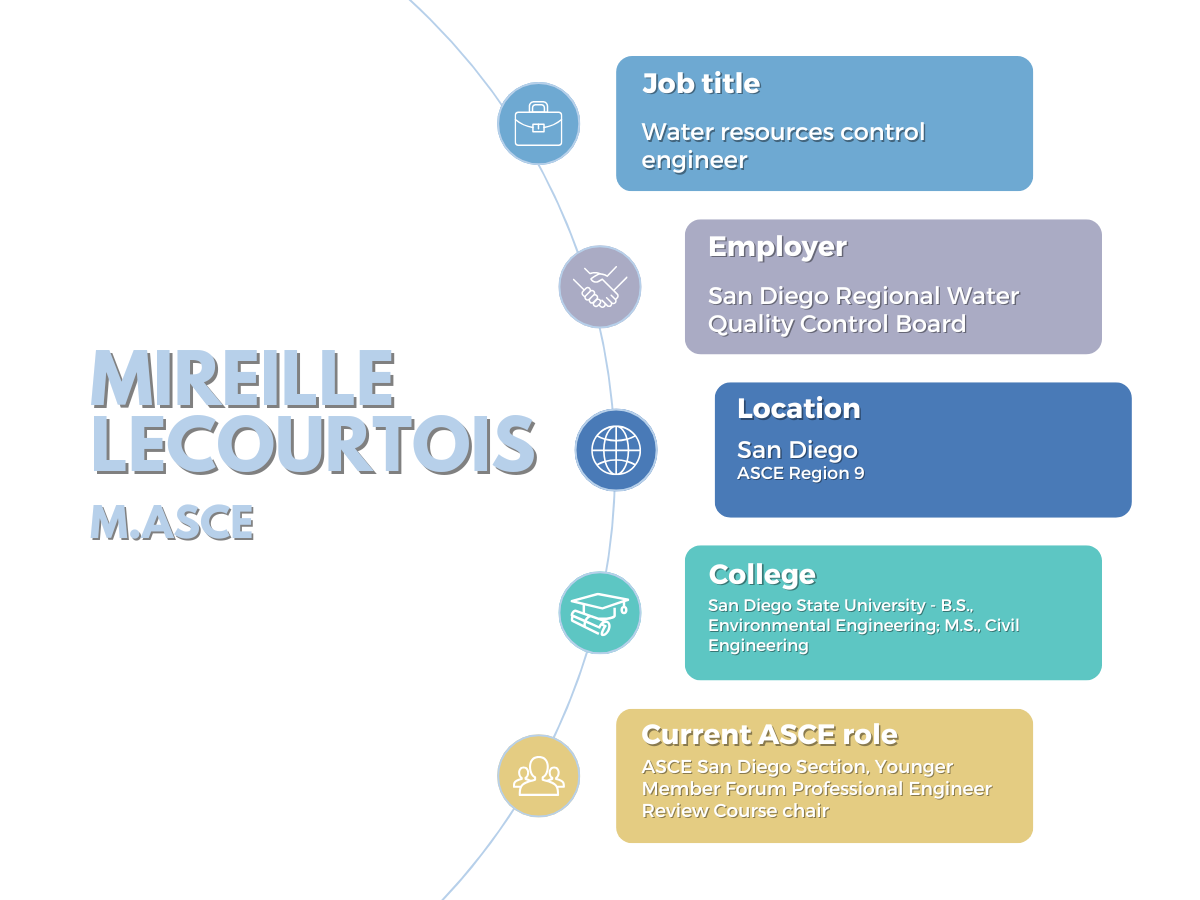
Lecourtois now works as a water resource control engineer at the San Diego Regional Water Quality Control Board, where she is able to lean into her interest in the environment to help communities.
But getting to the point where she had those career decisions to make was an uphill battle.
As a first-generation college student and Latina immigrant, Lecourtois didn’t always have access to resources like federal financial aid or the feelings of acceptance that other students had.
“I often had to carry the weight of proving that I belonged, where, in the new spaces that I was entering, seemed so easy for some people to accomplish,” she said.
Despite the setbacks she faced, Lecourtois was determined. She got creative, finding other financial aid and career opportunities that helped her achieve her goals. Even through tough challenges like failing an engineering course in college – an experience she now uses to motivate others to continue in the face of adversity – and navigating the U.S. education system and job market, Lecourtois was able to thrive.
Now, she wants to support others going through what she went through. She is dedicated to building inclusive spaces for underrepresented groups in civil engineering through mentorship and using social media to share her story with others.
“My experiences shape how I show up today and fuel my commitment for representation, advocacy, education, community involvement, mentorship, and most recently, immigrants’ rights,” she said.
Even though she has seen things slowly improving in civil engineering, she wants to keep moving the needle forward.
Lecourtois has been honored by ASCE as a 2026 New Face of Civil Engineering.
She recently discussed her career path with Civil Engineering Source.
Civil Engineering Source: What is the accomplishment or aspect of your career that you are most proud of so far?
Mireille Lecourtois: The accomplishment I'm most proud of receiving is the Superior Accomplishment Award from the State of California Water Resources Control Board.
After becoming a full-time staff at my agency, I was able to lead the development of a new enforcement order that protects water quality here in San Diego and Orange County, and it's one of my biggest accomplishments because it took a lot of work and dedication.
It also allowed me to grow as a technical expert in the field of water quality protection – specifically with bacterial pollution. As a public servant, I was able to work with 29 different municipalities across San Diego County and Orange County to hear and explore different ideas to address bacterial pollution at beaches and creeks.
There are 20 different beaches and creeks across San Diego where our water quality standards are not up to the best standards, and those specific bodies of water need more attention to protect human health.
This regulatory order that I worked on took about two to three years to develop. During that time frame, I had a lot of collaboration meetings with our different stakeholders where I had to walk the agencies through the importance of the work that we're doing for our shared goal to protect water quality. And then I also heard a lot of their dilemmas, like not having enough funding to be able to address the issue completely.
So, I was able to develop a recommendation to do visual flow observations of hot spots that could have high bacteria pollution during dry weather, and they appreciated that I considered the cost savings of monitoring while still addressing the board’s priorities.
It took a lot of internal work as well. I was able to develop the order on my own with guidance from my upper management.
I'm really proud of getting that award and being recognized in front of the board members and my colleagues. It’s definitely been the greatest accomplishment thus far in my technical career.
The order was adopted in March 2024, and it's a legal document that requires the municipalities to take action.
It went through a public process where we held workshops to involve not just the municipalities but other stakeholders like the general public. We also had technical meetings involving the municipalities, and those started in 2023, but the research started in 2021. So, the order took two to three years before adoption.
Source: What was it like to work with those communities and engage with them while you were working on the enforcement order?
Lecourtois: I oversee eight different watershed management areas that are involved, so I was able to see how there are different priorities in different areas of the region as well as disparities in the knowledge of water quality.
It’s really helpful to see public involvement because we get to hear directly from the people we serve what they think is important.
The municipalities might be more concerned about costs, but the general public is mostly concerned about public health and their well-being. So, it gave me a lot of perspective on what our communities need and what they think is important.
I will say, there wasn't a lot of community involvement because there's also a lack of education and maybe access to these technical spaces, so the general public doesn't always show up to our board meetings. And I think that's an area that we can work on.
Source: What kind of impact do you want to make on the profession?
Lecourtois: I always like to reflect on the work that I do and how far I've been able to get in life.
The impact that I want to make on the profession is to ensure that there is space within the engineering profession to have diverse voices because having these voices gives us more insight on not just the different problems that are out there, but also the different ideas and solutions that there can be. And that helps society in general progress further.
In the work that I do, I'd like to make sure that diverse voices are not just included, but also trusted and empowered. And I'd like the profession to emphasize that as well – trust and empower everyone no matter where they come from.
I say that because I'm a first-generation college graduate and I'm also an immigrant, which has shaped a lot of my views like where I've been able to see gaps in the profession.
I aim to build systems that protect our communities while also building pathways for those who might be historically underrepresented in engineering.
Source: Can you talk about your experience pursuing civil engineering as a first-generation college student and Latina engineer? How has that path influenced the way you approach your career and DEI work?
Lecourtois: First of all, I couldn't be an engineer without having the right education. And pursuing education itself was a challenge for me being a first-generation Latina immigrant.
I had to navigate systems that I had never seen before because my parents didn't go to college, and I didn't really have a lot of role models I knew who had pursued higher education or were in professional careers.
Coming from a family where I grew up in poverty and was underrepresented, going to college was like a dream come true because it meant that I would have opportunities in the future. My family is very proud of the career I’ve built; it's what they worked hard for when immigrating to the United States.
I had to learn how to advocate for myself in spaces that were not necessarily designed with someone like me in mind. But even though it's a heavy weight to carry and there were a lot of closed doors that I wasn't able to pursue – mostly because of my immigration status in the past – it made me become more resilient and pushed me to find opportunities that were available to me.
I didn't qualify for a lot of federal grants. Even though I came from a low-income family, I didn't qualify for FAFSA and so I had to find opportunities, for example, private scholarships to fund my education.
My experiences have influenced a lot of what I do in my career and in representing my community. I'm very proud to say that I'm part of the 2% of Latinas in engineering. Even though it's a small percentage, it's slowly increasing, and I believe that we can move that needle further. So, I try to use my social media, my mentorship experiences, and my involvement to show other young girls that they can also go far in life despite where they come from.
I always try to lead with empathy and the belief that representation changes outcomes. I strive to create environments where others don't have to question whether they belong.
Source: Were there any particularly powerful moments that you've had with people you’ve mentored?
Lecourtois: Some of the girls that I mentor or have mentored in the past think that their career, their dreams might end if they fail a course, but I always try to encourage them and share my personal experiences of having failed an engineering course before.
I think a lot of us engineers go through that: being new to the college campus, not understanding the academic rigor of the university.
In my first or second year, I failed an engineering course, and I thought that was the end of my dream to become an engineer. I realized how hard engineering was, but I didn't let that be the end of my dream. I decided to take the course again and do something new to help me prepare for the course the second time that I took it. So, I share those experiences with my mentees.
When one of my mentees shared that she wanted to switch majors because she had failed a course, I encouraged her to reflect on whether it was really just failing the course that made her want to switch majors.
Sharing my experience really inspired her to keep trying. She's taking the course again, and that makes me feel like sharing my experience can make a difference because it can inspire others younger than me to not give up on their dreams.
So, I believe that representation truly matters. And storytelling is important too. That's where I am in life right now. I'm trying to share my story more and be more active on social media to inspire the next generation of engineers.