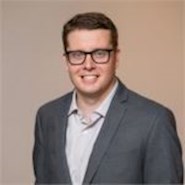
Sam Potts has the kind of charmingly quirky personality that might make you say, “There’s a guy who marches to the beat of his own drum.”
And in the case of Potts, whose twin loves are transportation engineering and marching band, you’d be more right than you could have known.
Potts is a true one-of-one.
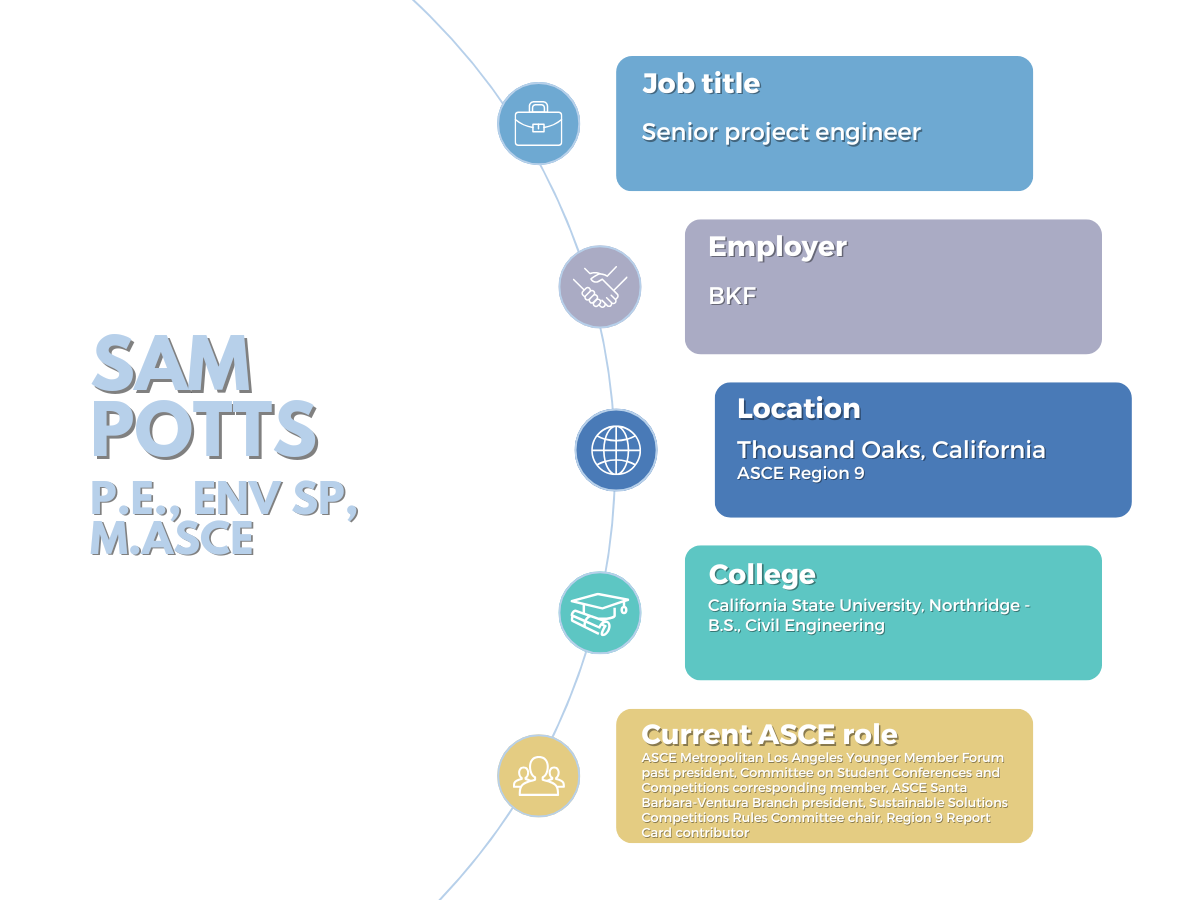
He works as a senior project engineer for BKF in Los Angeles with a resume that boasts 80 projects totaling more than $250 million in transportation improvements, specializing in pedestrian and bicycle infrastructure.
But he will tell you he will always be a musician at heart.
“Technically, I’m a euphonium player,” Potts said. “If you’re not a musician, I’ll say I’m a trombone player — which I am — but no one knows what a euphonium is, so I try to spare them the ‘Oh, what is that?’”
And back when he was approaching his high school graduation, he assumed he would continue to be a trombone – er, euphonium – player as his major right on into undergrad. Then something weird happened.
He accidentally missed his college music audition.
“I sat down with myself and said, ‘Hey, maybe this is a sign,’” Potts said. “I had already committed to California State University, Northridge, so I started looking into what other majors they offered. I saw civil engineering, and I grew up around all this construction with my dad being a building contractor. And I really liked math and science, so it seemed like a very natural migration for me.
“It was literally one phone call to CSUN. I said, ‘Hey, can I switch my major?’ And they're like, ‘Yes.’ And I'm like, ‘OK.’
“So then I started becoming a civil engineer.”
But this was not the end of his musical story. Remember the aforementioned twin loves of civil engineering and marching band?
Potts has volunteered as a marching band technician at his old high school for more than a decade, sharing his love of music and supporting the next generation.
Meanwhile, service has been a huge part of his engineering life as well. He’s been active with the ASCE Los Angeles Younger Member Forum and Los Angeles Section. He serves as the 2026 Santa Barbara-Ventura Branch president.
He has spent the past seven years – including as chair – on the Society-level Committee on Student Conferences and Competitions. He’s an L.A. guy born and raised, but he can lay claim to having attended five [SP1.1]different ASCE student symposia all over the country.
He has also served as the practitioner adviser for his alma mater CSUN’s ASCE Student Chapter for many years, earning awards for his service.
It’s a busy life – whether he’s in time with the marching band drum section or setting his own pace – and ASCE has honored Potts as a 2026 New Face of Civil Engineering.
He recently spoke with Civil Engineering Source about his career.
Civil Engineering Source: What in your career are you most proud of so far?
Sam Potts: I worked on a project that is only about five miles away from my home. It’s in the City of Calabasas and connects Calabasas High School to the nearby park.
The project included roadway widening, new signals, and some parking lot improvements. And I got to design a little pedestrian bridge and bridge foundation, new sidewalks, large retaining walls, slope stabilization features, and new drainage infrastructure. So it was a little bit of everything.
And I love just biking there because it’s so close and very tangible for me. To see that in my own backyard is probably, for me as a civil engineer, the thing I’m most proud of. The road is called “Mulholland Highway” – to be a civil engineer working on a road named after another famous civil engineer in history is pretty awesome.
Source: Is biking something you’re interested in?
Potts: Yes, it’s one of those things I started doing as a way for me to get to school. And it ended up being something I could do as a civil engineer. If biking has made my life more meaningful and healthier, then how can I bring that to other people? How can we build better bike infrastructure as part of a holistic transportation system?
Los Angeles is truly a car city. There are a lot of political obstacles in the way. Even the projects I work on run into their own political obstacles across jurisdictions.
We have to say, “We’re not changing this pretty deeply entrenched car culture,” while also highlighting all these like public health benefits and community benefits of bike infrastructure. But a lot of people don't like to see change, even if it's positive change. People love keeping things status quo. So the challenges is: how do we meet them where they are but then deliver benefits they may not have foreseen?
Source: How often do you get out on the bike?
Potts: I try to go every weekend, a little bike ride around my community. I don’t live in the most bikeable area, but we do have some nice Class 1 trails and multi-use paths. There’s a really nice bike path one along the L.A. River.
Sometimes I’ll take my bike to get food or do errands. And there are the weekends when I decide I’ll go into the canyons for climbs and get a good workout.
I mean, it just feels really good. It’s an important part of my mental health regimen. I get to explore the transportation and civil engineering space a bit while taking care of myself.
Source: Why is giving back – whether it be your old marching band or your old ASCE student chapter – so important to you? Where does that stem from?
Potts: I’m not entirely sure – maybe it comes from being a musician. In high school, I had four music teachers in four years. It was hard to get footing. A lot of it became figuring out how to teach myself and then the others around me to become better musicians.
So, ASCE felt like a natural fit — giving back to this new community of civil engineers that I found.
If you’re passionate about something, then it doesn’t feel like work. Sometimes I spend a lot of hours a week doing ASCE stuff, but it doesn’t feel like work. Seeing the impact on others’ lives is the only payment I need.
Source: What volunteering experiences stand out?
Potts: Giving back to students is super important. Students are in a unique space where they have a strong upward trajectory. They’re still finding their footing, but they’re learning, and what can we do to accelerate that learning?
I did four years of concrete canoe in college. It brought me a lot of joy, bringing people together to do the impossible: a floating boat of concrete. There’s a great picture I think my mom took of me holding up the paddle after we our petite finals race, all excited and screaming because we had won sixth place. [laughs]
So looking back on that, I think, “How can I bring a similar or even more positive experience to the next generation?” On a local scale, that’s been as a practitioner advisor; and globally, through the Committee on Student Conferences and Competitions.
Source: What would you like your legacy to be? What do you want people to think when they hear your name?
Potts: I want people to see someone reliable and respectful; someone able to make hard decisions in an ethical way.
I want to leave people a step above where they were before – I think that’s what it comes down to. We’re all trying to climb this ladder.
So for students, just trying to elevate our student symposia to give them a better experience. Or as a consultant, finding ways to deliver better projects to my clients.
I just want to make my community a little better than it was before.
Home feels natural to me. I’m literally in the same neighborhood where I grew up. So if we’re talking legacy, then how can I make the legacy of my home even better? Maybe it’s about seeing beyond yourself and seeing the bigger picture to what things will make a tangible impact on people’s lives.
My impact on my community is impacting the people around me and then they impact the people around them, so you get this ripple effect.
Maybe my legacy could be being a ripple machine.