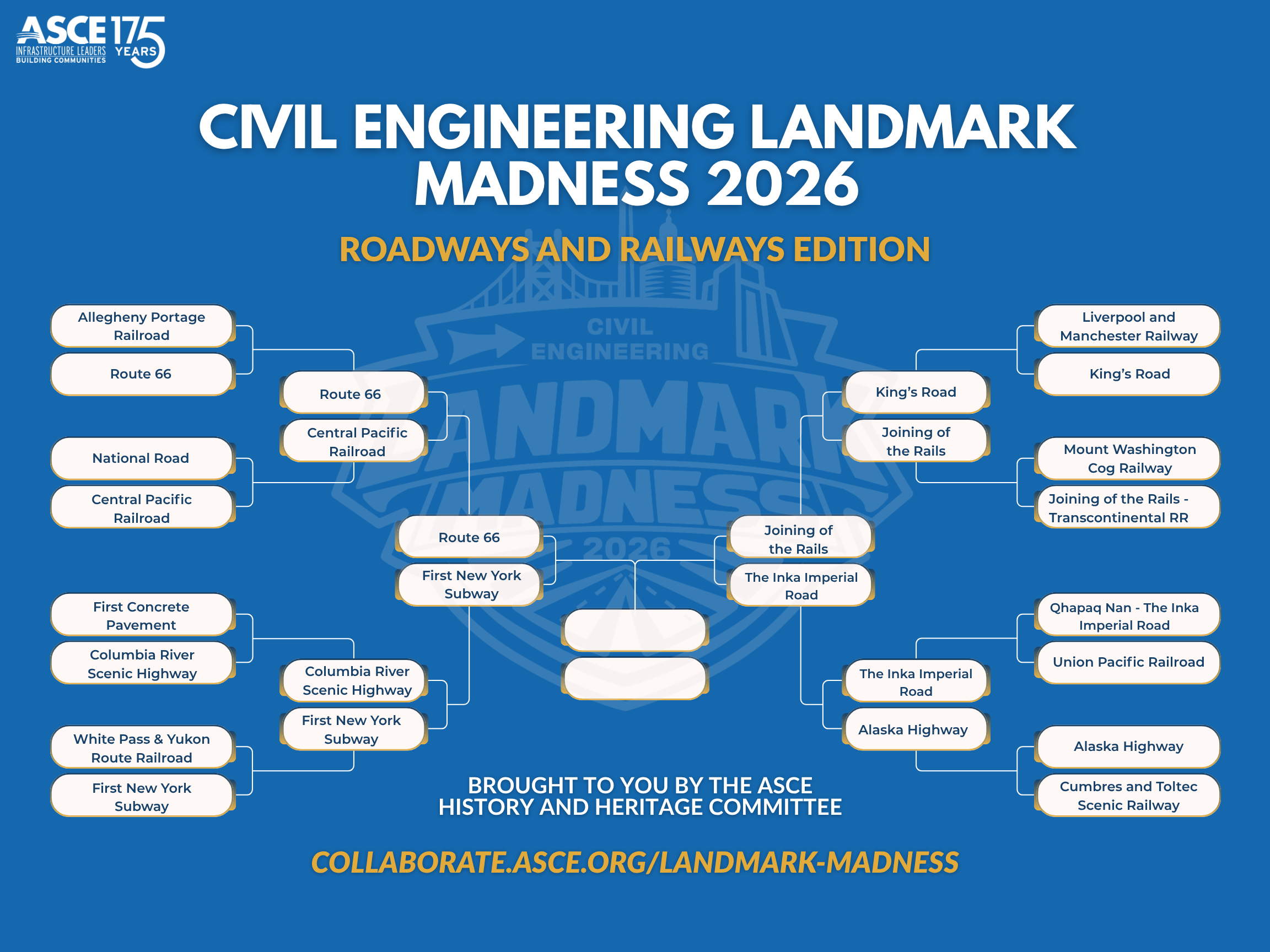
Hundreds of voters during the past two weeks have whittled the inaugural ASCE Civil Engineering Landmark Madness bracket down to an inaugural ASCE Civil Engineering Landmark Madness Final Four.
And what a quartet of historic civil engineering landmarks it is.
Route 66, the First New York Subway, the Joining of the Rails–Transcontinental Railroad, and Qhapaq Ñan: The Inka Imperial Road each emerged victoriously from quarterfinal matchups last week, setting up an epic showdown of history-making infrastructure.
ASCE Civil Engineering Landmark Madness celebrates the Society’s Historic Civil Engineering Landmark program. The 2026 bracket features a “Sweet 16” of the greatest railways and roadways as selected by the ASCE History and Heritage Committee.
Voting in the semifinals is open now and runs through Sunday, March 29.
To better inform your vote, History and Heritage Committee Vice Chair Michael Bartlett assembled a dream team of his fellow committee members to make impassioned cases for each of the remaining four landmarks.
So, hear what they have to say, see how it may sway your vote, and cast those ballots this week. Semifinal voting is open through March 29.

Why you should vote for Route 66
As argued by Jonathan Upchurch, Ph.D., P.E., Dist.M.ASCE, chair of the ASCE History and Heritage Committee
2026 is the centennial year for U.S. Route 66. One hundred years ago the number 66 was assigned to a new route from Chicago to Santa Monica, California. So it would be especially timely for Route 66 to win Civil Engineering Landmark Madness this year.
But more importantly, the Route 66 Historic Civil Engineering Landmark designation includes 15 civil engineering features – or elements – of historical significance. These include the Chain of Rocks Bridge over the Mississippi River, the Bridgeport Bridge over the Canadian River in Oklahoma, the Old Trails Bridge over the Colorado River, and the Arroyo Seco Parkway in Los Angeles.
Each of these elements is a worthy contribution to the Route 66 Landmark as a whole and each is listed on the National Register of Historic Places. Route 66 passes through eight states and 10 ASCE sections and is highly deserving of a Landmark Madness win!

Why you should vote for the First New York Subway
As argued by Erik Metzger, M.ASCE, chair of the ASCE Metropolitan Section History and Heritage Committee
The First New York Subway is my selection to win the inaugural ASCE Civil Engineering Landmark Madness bracket. It was the first major rapid-transit subway system in the United States when it opened in 1904 and is still in operation!
Today you can ride along the subway’s original route in Manhattan – from Brooklyn Bridge–City Hall to 145th Street – by taking the #6, shuttle, and #1 trains. The zigzag across 42nd Street might seem awkward, but the route was influenced by legal battles with property owners on lower Broadway.
Led by Chief Engineer William Barclay Parsons, the project was a trailblazer for construction in a dense urban area, especially with much of the route being built near the surface using cut-and-cover construction.
What could be a better choice than a landmark that begins only steps away from the former location of The Rotunda, where ASCE was founded in 1852?

Why you should vote for the Joining of the Rails
As argued by Chuck Spinks, P.E., M.ASCE, member of the ASCE History and Heritage Committee
The Joining of the Rails at Promontory, Utah, on May 10, 1869, thus completing the first transcontinental railroad, was the most significant civil engineering accomplishment in the United States in the 19th century.
At that time, no railroad in the world had crossed mountains as high or as rugged. It was the first use of high explosives, in the form of nitroglycerine, in construction in the U.S.
When construction started in Sacramento in 1863, the country was in the midst of the Civil War. Until the election of Leland Stanford as governor in 1862, the California political machine was run mostly by pro-slavery elected officials who supported the Confederacy.
The construction of the new railroad helped solidify California’s support for the Union and kept gold and silver from California and Nevada mines flowing to the Northern cause.
No projects in the 19th century U.S. eclipsed the Joining of the Rails!

Why you should vote for the Qhapaq Ñan
As argued by Olga Marin, MEng, C.Eng, F.ASCE, Region 10 governor, member of the ASCE History and Heritage Committee
The Qhapaq Ñan is more than an ancient road system; it is a powerful expression of the greatness of the Inka civilization, an empire that achieved extraordinary levels of organization, knowledge, and territorial integration across some of the most challenging landscapes on Earth.
Its alignment reveals a profound understanding of terrain, where routes were not imposed on nature but carefully negotiated with it. Stone pavements, terraces, and drainage solutions still perform centuries later, reflecting durability through precision and local knowledge.
For the Inka civilization, this network was the backbone of a highly sophisticated society, enabling governance, trade, communication, and cultural cohesion across vast distances. It also reflects a remarkable capacity to build upon and adapt infrastructure from earlier cultures, recognizing value and reusing knowledge and materials. Its design embodies sustainability long before the term existed: local materials, climatic adaptation, and minimal environmental disruption.
Recognizing the Inka Imperial Road with an ASCE Landmark Madness victory would honor a civilization whose engineering genius achieved lasting harmony between people, infrastructure, and the natural world.
See the complete bracket and vote in the Final Four of ASCE Civil Engineering Landmark Madness 2026.