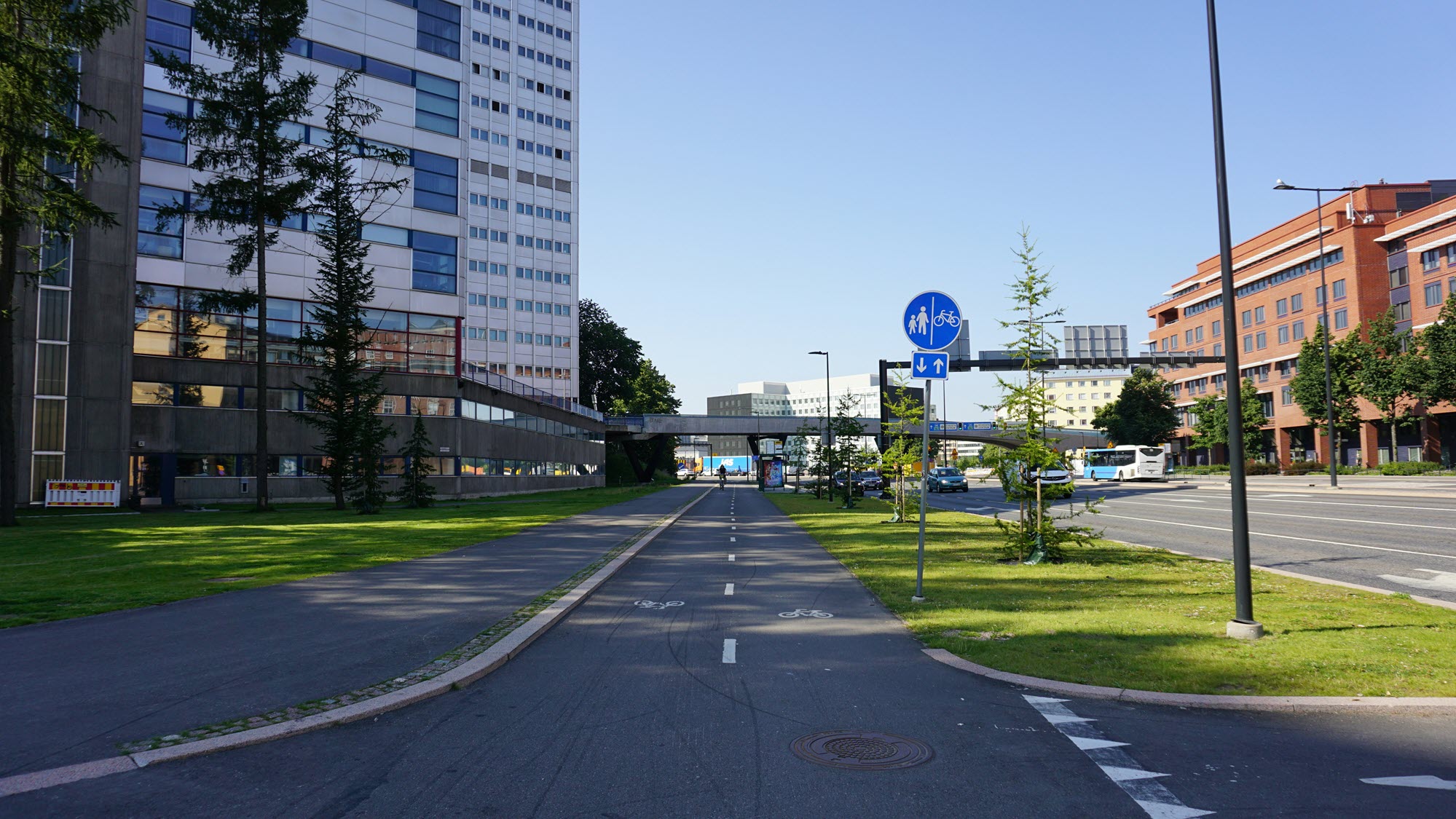
In the United States, with its sprawling network of roadways, it is easy to get around with a private vehicle.
But is a car always necessary?
A 2021 study for the Bureau of Transportation Statistics found that over half of all trips in the U.S. across all modes of transportation are under 3 miles – what could be a short bike ride. But in many areas, the infrastructure isn’t ready.
Cycling is becoming more popular across the U.S., drawing more attention to gaps in related infrastructure. Cycling itself has great benefits: health, mobility, decreased emissions, and greater access to one’s surrounding area. And oftentimes, bike infrastructure is more than meets the eye.
“It doesn't just accommodate people biking, it also accommodates people using micromobility and shared mobility,” said Jeremy Chrzan, P.E., PTOE, LEED AP, M.ASCE, multimodal design practice lead at Toole Design. “But at the forefront, providing bicycle infrastructure improves the safety of the street for all users.”
A popular movement
In 2024, U.S. cycling infrastructure guidance underwent a massive update with a new American Association of State Highway and Transportation Officials’ bike guide. Its emphasis on separated bike lanes challenged the idea of encouraging cyclists to share the road closely with vehicles.
“The design guidance of the past prioritized the highly confident rider or ‘vehicular cyclist’-style approach,” Chrzan said. “This time, we fundamentally changed the user that we're designing for,” he said. “And that shift is that we should be designing for bicyclists of all ages and abilities – what we sometimes call the interested but concerned bicyclist – and there is a need for separating bicyclists from vehicular traffic in many contexts.”
The data shows that people want this infrastructure.
In a 2020 survey by the Ohio Department of Transportation, 57% of respondents reported that they bike less frequently than they would like due to a lack of bike lanes or paths. Additionally, 92% of respondents reported that they would be comfortable biking on a path, and 83% would be comfortable using a protected bike lane. Those numbers present a stark difference from the 9% of respondents who would feel comfortable biking on the road or paved shoulder.
“Overwhelmingly, when we ask people where they would feel comfortable biking, most people are comfortable in completely separated bicycle facilities where they don't have to share space with traffic or have any sort of conflict with a motor vehicle,” said Cait Harley, statewide pedestrian and bicycle coordinator at ODOT.
In Ohio, bike infrastructure is a necessity. A 2024 ODOT transportation survey found that 35% of Ohioans rely on walking and biking infrastructure in their daily lives. The need is widely acknowledged – 72% of respondents indicated that improving biking and walking infrastructure is important.
When protected bike lanes are installed, they don’t go unused.
A June 2026 study of ridership for North America’s largest bikeshare (Citi Bike) and bike infrastructure in New York City found that within 12 months of installing protected bike lanes, there was an 18% increase in ridership at adjacent stations, an average monthly increase of 379 rides per station. And the phenomenon isn’t exclusive to New York City.
Another study by the National Association of City Transportation Officials evaluated cycling trends in seven U.S. cities. Researchers found that the installation of protected bike lanes increased ridership by 21% to 171%.
Bike lanes may be commonly associated with walkable cities, but their purpose extends to rural areas. Ohio’s Amish community, for example, relies heavily on bikes and e-bikes for travel.
“There have been some really great examples of bike and buggy lanes and trails in Ohio’s Amish Country to address these unique needs,” said Harley.
Bike infrastructure doesn’t only impact cyclists; it’s a communitywide phenomenon.
“Bike infrastructure is important because it provides a place for people to use not just bikes, but micromobility devices safely and efficiently,” said Perrin Falkner, P.E., M.ASCE, a project engineer at Toole Design.
There are also economic benefits. A 2020 study found that separated bike lanes can increase property values for residential and commercial properties. Bike lanes can also generate business. A study conducted in Davis, California, found that cyclists make more frequent shopping and dining trips than drivers and spend more per trip than drivers.
Safety for all
Despite the growing popularity of cycling, it isn’t without safety risks.
The number of preventable cyclist deaths increased by 1% in 2024 and 37% over the last 10 years.
Speed limits are one factor, but more recently, the popularity of larger vehicles has played a big role.
“Thirty or 40 years ago, there were a lot more sedans and smaller cars,” said Falkner. “Now we have a lot more large trucks and SUVs, and the way hoods are built is much more dangerous when there's a crash.
“With the older cars, people would potentially go above the car, but now they're getting crushed underneath,” she said.
Although it can be difficult to design around changing car designs, separated bike lanes can make things safer for cyclists.
According to the Federal Highway Administration, adding low-cost flexible delineators to existing bike lanes can reduce bicycle-vehicle crashes by up to 53%.
The safety benefits of protected bike lanes aren’t exclusive to cyclists; they improve safety for all road users – even drivers.
A 2019 study looked at 13 years of data across 12 major U.S. cities and found that cities with more bike facilities – most notably protected and separated bike lanes – had better traffic safety records. In fact, streets with protected bike lanes had 44% fewer deaths and 50% fewer serious injuries than typical streets in the country.
Several factors contribute to this trend, one being that the installation of bike lanes can reduce speeds on roadways. To install bike lanes, engineers often narrow lanes – or remove one entirely – and narrow streets naturally signal drivers to slow down, Chrzan said.
“You might have four lanes because in the peak 15 minutes of the day, a traffic analysis tool tells you that you need those four lanes,” he said. “But if you provide that, it means that the rest of the day when you’re not in peak traffic flow conditions, cars can go faster.
“Speed leads to safety issues, so it fundamentally makes the street safer if we convert it from a four-lane cross section to a three-lane cross section and add bike infrastructure on the outsides of that road,” said Chrzan.
Another factor is that as the number of cyclists increases, car operators learn to expect their presence.
“It adds clarity to the road,” said Kelley Yemen, director of the Office of Multimodal Planning for the city of Philadelphia.
Overcoming resistance
Getting bike infrastructure put in place doesn’t come without challenges.
“One of the bigger challenges of implementing any kind of roadway redesign is that you're changing it from what people are used to,” Yemen said.
Public opinion, although positive in surveys, can pose barriers when people come face-to-face with a change in their community. Bike lanes are often built with techniques such as “road diets” that reduce the amount of a roadway reserved for cars, which sometimes has perceived negative effects.
A concern that often comes up is the reduction or removal of street parking, which can cause concern about reduced access to an area. But this fear is often based on misconceptions of inadequate parking in the area. Typically, project evaluations find the opposite to be true, said Chrzan.
“There's just a perception that, ‘If I lose that spot right in front of my business, it’s going to put me out of business,” said Chrzan. “It runs counter to what we actually see when research occurs around how a business performs when one of these projects goes in.
“Almost inevitably, the business actually does better because they have more people biking slowly along their property frontage, able to easily stop and pop into these stores, unlike the driver of a motor vehicle that's traveling at 25 or 30 miles an hour,” he said.
Existing parking may have been used improperly in the first place.
When adding protected bike lanes to South Philadelphia’s Washington Avenue, Yemen and her team discovered issues with the available street parking: double parking due to a lack of loading space and people parking all day rather than coming and going. So, access was limited by the parking itself.
Yemen emphasized that getting projects done without backlash requires careful community engagement, especially because communities aren’t monoliths.
“One thing people say is, ‘How do you get the community on board?’” she said. “And there are lots of communities within any one community. So, it's how you get different groups of people (on board), especially when people can be polarized.”
To get support for this project, Yemen and her team met with different stakeholders to discuss the issue and inform them of the benefits of replacing the parking spaces with a bike lane.
“It was a lot of community conversation,” she said. “We did surveys. We were out there having public meetings. We were bringing along neighbors. We were having discussions with the business district about what this means.”
She also left room for tweaks, allowing the community to provide additional input before things were set in stone.
Falkner said part of what makes getting support challenging is that vehicle prioritization is the “status quo,” so a strong case must be made for bike lanes. At the same time, many cities are investing in other modes of transit, so bike lanes may have to compete for prioritization.
“In terms of getting municipalities on board, I think streets often function better when modes are separated, especially if they have higher traffic volumes,” she said. “Showing that there’s a lot of research on how bike lanes make it safer for all modes can be a good way to convince municipalities to invest in them.”
Sometimes, though, it’s politics that prevents bike infrastructure projects from proceeding, Chrzan said. Some leaders may be all about bike lanes, while others might be hesitant to fund these projects.
Another potential issue is limited connectivity. A single bike lane without connection to other streets doesn’t calm the nerves of cautious riders. Fortunately, many of today’s transportation plans account for that variable, and municipalities are looking at things on a broader scale as they implement this infrastructure, Chrzan said.
Where is bike infrastructure going?
The U.S. cycling movement is here to stay, but the nation’s bike infrastructure still lags behind many developed countries.
Harley believes it would be challenging to establish a nationwide bicycle network as strong as those in denser countries like Denmark or the Netherlands but sees a strong future for bike infrastructure in specific areas.
“It would take changes to policy, zoning, transit, and design for biking to be the safe and convenient option,” she said. “But we are starting to see that in a lot of our cities where it's becoming increasingly expensive or undesirable to drive, people are looking to biking for a more convenient, more reliable, more affordable way to get around.”
Bikeshare programs, too, are increasing access to cycling.
“In places like Philadelphia, where you don't have a garage or a place to store a bike easily, I think it's a huge part (of growth),” Yemen said.
Philadelphia’s Indigo system offers standard and low-income passes, providing a range of cycling options. The system has seen growth over the past year.
“That, to us, says this combination of providing bikes and infrastructure is providing more Philadelphians the opportunity to affordably get around their city,” she said.
E-bikes are another factor. With e-bikes, individuals can go beyond their short everyday trips.
“When we think about e-bikes and e-mobility, that radius expands from 3 miles to more like 6 miles being a reasonable trip,” said Harley.
Falkner noted that many cities offer rebates for e-bike purchases, making it easier for people to get their own.
Although there are differences in infrastructure and scale between the U.S. and other nations, Falkner believes that there is a strong future for bike infrastructure in the U.S.
“I think we can design our cities to look more like those,” she said. “And I think it's very possible.”