 NCDOTcommunications
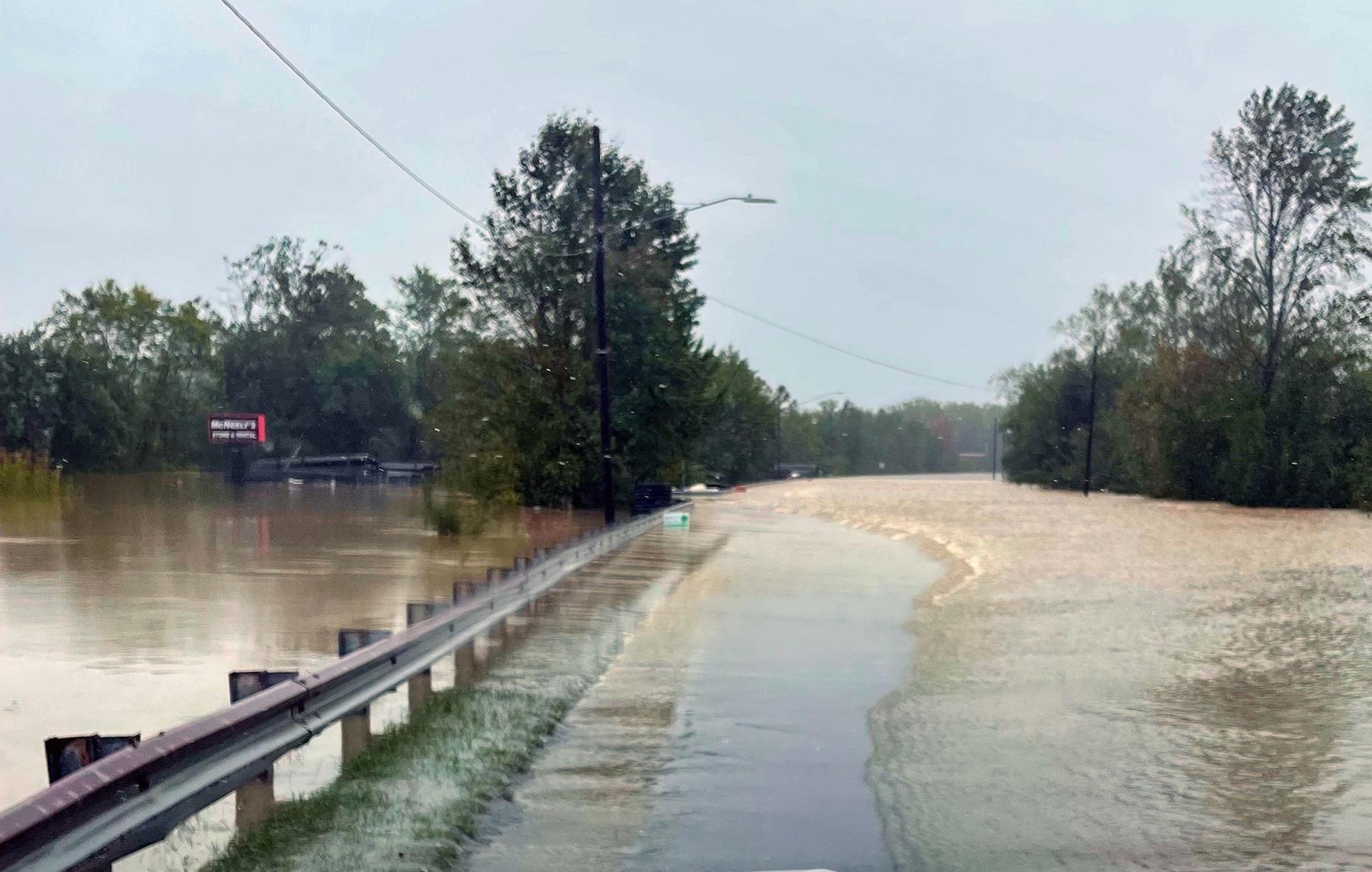
Two days before Hurricane Helene became North Carolina’s worst natural disaster, the state’s department of transportation received a surprising alert.
The NC Flood Inundation Mapping and Alert Network-Transportation system warned on Sept. 25, 2024, that the French Broad River could inundate Interstate 40 on the north side of Asheville with as much as 2 feet of water, a never-before-seen scenario.
Further reading:
- US school infrastructure stuck at D+ as advocates push for more investment
- AI, data centers drive surge in US energy demand as engineers work to keep up
- Infrastructure report cards reveal similar challenges in California, Florida, Texas
With this information, transportation officials identified locations vulnerable to flooding and prioritized poststorm inspections. This sort of preparation is a key component of resilience, which is critical to protecting infrastructure, said Patrick Norman, P.E., chief engineer for the North Carolina Department of Transportation.
“The system didn’t confirm what our engineers already suspected; it found a risk that our engineers didn’t even know we had,” Norman said at a recent ASCE webinar on the state of roads and bridges in the U.S. “It actually gave us enough lead time to act. That’s a different kind of value than you get from a gauge telling you the river is rising. One is about anticipation; the other is just observation.”
Norman said resilience comprises six elements: anticipating, preparing for, and adapting to changing conditions; withstanding disruptions; and responding and recovering rapidly. Those latter phases were crucial after Helene. With many areas of the Asheville region inaccessible, NCDOT used drones to assess damage and build 3D models that provided designers with real terrain information.
Resilience is a theme reflected throughout ASCE’s 2025 Report Card for America’s Infrastructure, which issued roads a D+ and bridges a C. The overall grade for the nation was a C.
The report card estimates the gap between infrastructure investment needs and funding at about $3.7 trillion between 2024 and 2033, including about $680 billion for roads and $370 billion for bridges. There have been recent increases in funding, chiefly the Infrastructure Investment and Jobs Act, which passed in 2021 and is operating on a short-term congressional extension after its authorization expired.
“The projected needs still definitely exceed the available resources,” said panel moderator Katherine Kortum, Ph.D., P.E., M.ASCE, a member of the Committee on America’s Infrastructure, which produces the report card every four years. “The recommendations that we have in the report card emphasize sustained investment and resilience and innovation in order to improve the long-term infrastructure performance.”
So much more than a grade
But the consequences of underfunding extend beyond infrastructure condition grades.
Panelist Rocky Moretti, the policy director at TRIP, a national transportation research nonprofit, cited his organization’s recent report, Addressing America's Traffic Safety Crisis, showing the economic consequences of traffic crashes at more than $400 billion per year in the U.S. He also noted that the nation’s Interstate Highway System was launched in 1956 and is showing its age in many places.
Investment in U.S. transportation is crucial for many reasons, foremost among them safety, Moretti said.
“Research shows that when you do a lot of cost-effective safety improvements, it’s significant; it makes the system safer,” he said. “That usually happens when highways are modernized.”
Moretti also pointed to Renewing the National Commitment to the Interstate Highway System: A Foundation for the Future, a 2019 Transportation Research Board report that called for annual investment in the interstate system to rise from $23 billion to $57 billion. Saving Lives, Time, and Money, a June TRIP report, meanwhile, shows the interstate system saves about 7,000 lives and over 1 billion hours of travel time each year. All told, the system provides $65 billion a year in benefits.
“We have an aging system that’s essentially going to need to be reconstructed,” Moretti said. “It costs a lot to build. It costs a lot to maintain, but the benefits far outweigh those costs.”
Norman sees the challenge firsthand on the state level.
From 2020 to 2027, the resurfacing and pavement preservation needs in North Carolina are projected to increase sharply. Resurfacing needs have risen by $447 million, while appropriations have only increased by $118 million. Pavement preservation needs have grown by $18 million, while appropriations have decreased by almost $6 million.
“At the current funding levels, we’re going to see our overall pavement conditions continue to worsen, highlighting the additional need for investment across our system,” Norman said. “Many of these roads are nearing the end of their service life and need complete reconstruction, and we just don’t have a good funding source for that.”
Beyond the numbers
Panelist Erick Fry, P.E., the transportation design corporate service line leader at KCI Technologies, pointed to another often-overlooked aspect of funding: inflation. He said the cost of construction over the last five years has increased by almost 70%. At the same time, agencies and consultants are paying more to recruit and retain engineers, further driving up project costs.
As for alternative revenue sources, Fry noted that some urban areas have funded transportation projects through local-option sales taxes or assessments on businesses within community improvement districts.
While federal funding for bridges has increased recently, largely thanks to the IIJA, Kortum said the distribution of bridges in good, fair, and poor condition has not changed significantly. That was reflected as the C grade for bridges was a repeat of 2021.
She noted that bridge projects are lengthy and that “improving the condition of a large and aging inventory is absolutely a long-term challenge.”
For both roads and bridges, “the central challenge is making the best use of our limited resources while addressing safety, resilience, and long-term needs. These are engineering questions, but they’re also questions of policies and priorities,” she added.
Also of note
- Both houses of Congress returned after the midterm elections with a crowded lame-duck session ahead. Government funding is near the top of the list as a continuing resolution expires Dec. 11. The outcome of any funding deal could have a significant impact on surface transportation funding, which expires the same day. The Water Resources Development Act of 2026 could be another priority.
- Indiana received a D+ on the 2026 Report Card for Indiana’s Infrastructure. In the first report card released by ASCE’s Indiana Section since 2010, bridges led the way with a B-, but four of seven categories fell in the D range.
- The Senate voted 73-25 on a procedural motion to advance consideration of the Bipartisan American Affordability and Jobs Act, a project-permitting reform package that would overhaul federal energy permitting. The focus will shift to the amendment process, as some lawmakers want changes to provisions related to tribal sovereignty and the National Environmental Policy Act.
- Former ASCE President Marsia Geldert-Murphey, P.E., was elected an Illinois state senator, defeating an incumbent. Geldert-Murphey, who led ASCE in 2024, ran on a platform that, among other things, included improved infrastructure.
- Of the 138 state and local ballot measures that ASCE supported during the election cycle, 95 were approved by voters. ASCE opposed four ballot measures, one of which was defeated.