

By Moufid Charafeddine, M.ASCE
Civil engineers are trained to think in projects: a bridge replacement, a culvert upgrade, a roadway widening, or a new pump station. Projects have clean boundaries and familiar milestones — scope, schedule, budget, substantial completion. But the public does not experience infrastructure as a sequence of projects. They experience it as performance: a predictable commute, safe water, and systems that hold up under stress.
The gap between project delivery and system performance is where many agencies struggle today. It is not a question of whether we build; it is whether the things we build can be operated, maintained, and renewed with the resources we actually have. In many communities, maintenance is no longer just a line item. It is the megaproject.
A central constraint is that the “truth” about assets is fragmented across eras and formats. Critical as-built information lives in paper archives, scanned plan sets, legacy CAD files, GIS layers created under different standards, and live operational signals. Each source is useful, but none is sufficient alone. When teams cannot reconcile old and new data into a coherent picture, execution slows: Scope is conservative, risk buffers grow, and preventable surprises become normalized.
The practical answer is not more data, nor another system requiring extra entry at the end of the day. The real inflection point is when asset intelligence becomes part of the work itself — available in real time and at the point of action to those who design, inspect, plan, and operate. When a shared view supports a foreman verifying a location or an engineer scoping a project, the organization stops paying the hidden tax of duplicate effort. Productivity rises because people stop re-finding what they already knew.
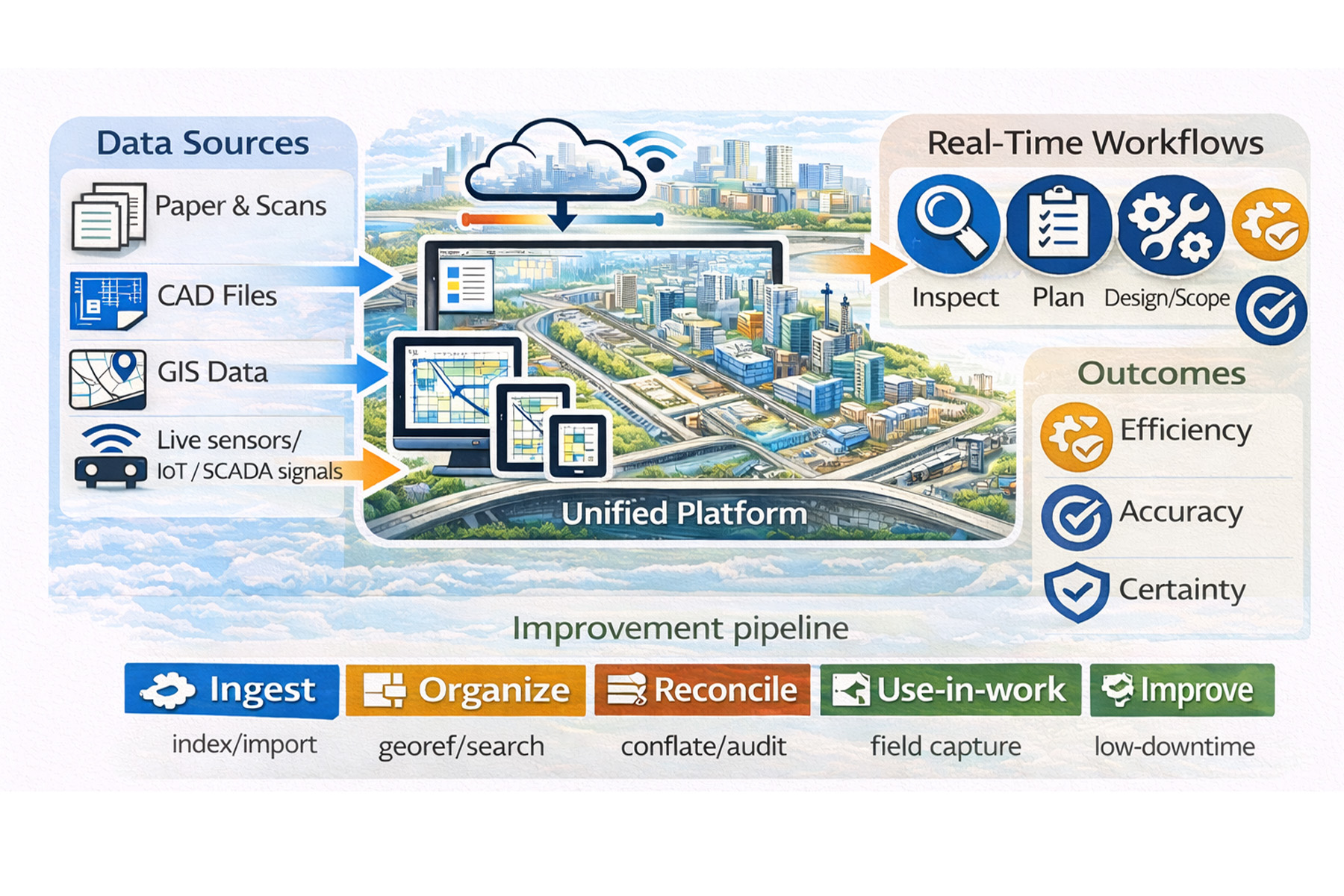
This shift requires three disciplined steps:
1. Establish a single operational view that ingests and reconciles legacy and modern sources (paper, CAD, GIS, and signals) without forcing departments into bespoke workflows.
2. Standardize identifiers and definitions so that updates accumulate into organizational certainty rather than conflicting versions.
3. Make contribution effortless because updates should be a byproduct of normal work — like inspections and project scoping versus a separate cleanup initiative.
Crucially, these capabilities must be sustainable. Many agencies fear transformation efforts that stall due to disruptive upgrades or brittle systems. A modern approach treats continuity as a design requirement: Software improvements should run smoothly without interrupting operations. If maintaining the platform requires specialized internal teams, owners inadvertently try to become software companies rather than delivering reliable infrastructure.
The strategic priority should focus on outcomes — service reliability, risk reduction, and life-cycle stewardship — relying on systems that evolve without derailing work. When teams trust the information they see and use it collaboratively, maintenance stops being reactive. It becomes a managed program with clear trade-offs, fewer surprises, and measurable performance.
If maintenance is the megaproject, civil engineering’s next leadership test is straightforward: Make the system legible enough that the right work happens at the right time — without creating overhead that pulls people away from the work itself.
Moufid Charafeddine, M.ASCE, is the CEO of InfraMappa. Contact him at [email protected].

This advertorial originally appeared in the March/April 2026 issue of Civil Engineering.
