
By Peter Overmohle, P.E., PTOE, PMP
Growing operational and safety concerns about several interstates in the Louisville metropolitan area spurred the Kentucky Transportation Cabinet to develop and implement a massive, best-value design-build project to fix these issues.
KYTC launched I-Move Kentucky in the fall of 2019, a multimillion-dollar initiative that expanded highway capacity, reduced congestion, and improved safety along three of the state’s most heavily traveled corridors: Interstates 265, 71, and 64.
To ensure a fall 2024 completion and minimize long-term traffic disruptions, KYTC consolidated multiple highway improvement projects — identified as highest priorities statewide through the Strategic Highway Investment Formula for Tomorrow initiative — into a single streamlined contract that delivered the following:
- A 12 ft wide travel lane on northbound and southbound I-265 to enlarge the corridor from four lanes to six between Kentucky Route 155 and I-71.
- A new collector-distributor, or C-D, lane on southbound I-71 to improve safety on the I-71/I-265 interchange.
- A 12 ft wide travel lane on northbound and southbound I-71 to enlarge the corridor from four lanes to six between I-265 and KY 329.
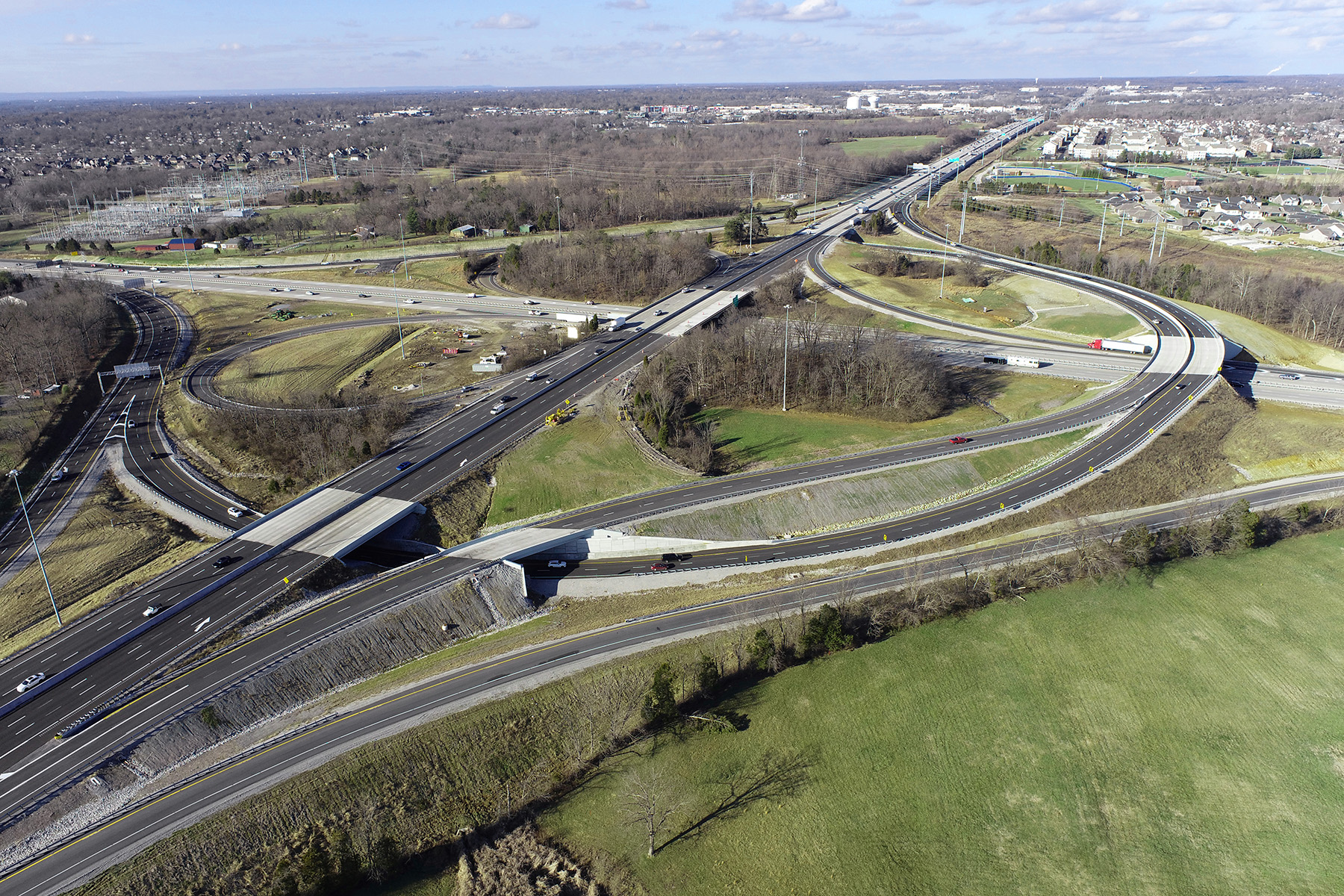
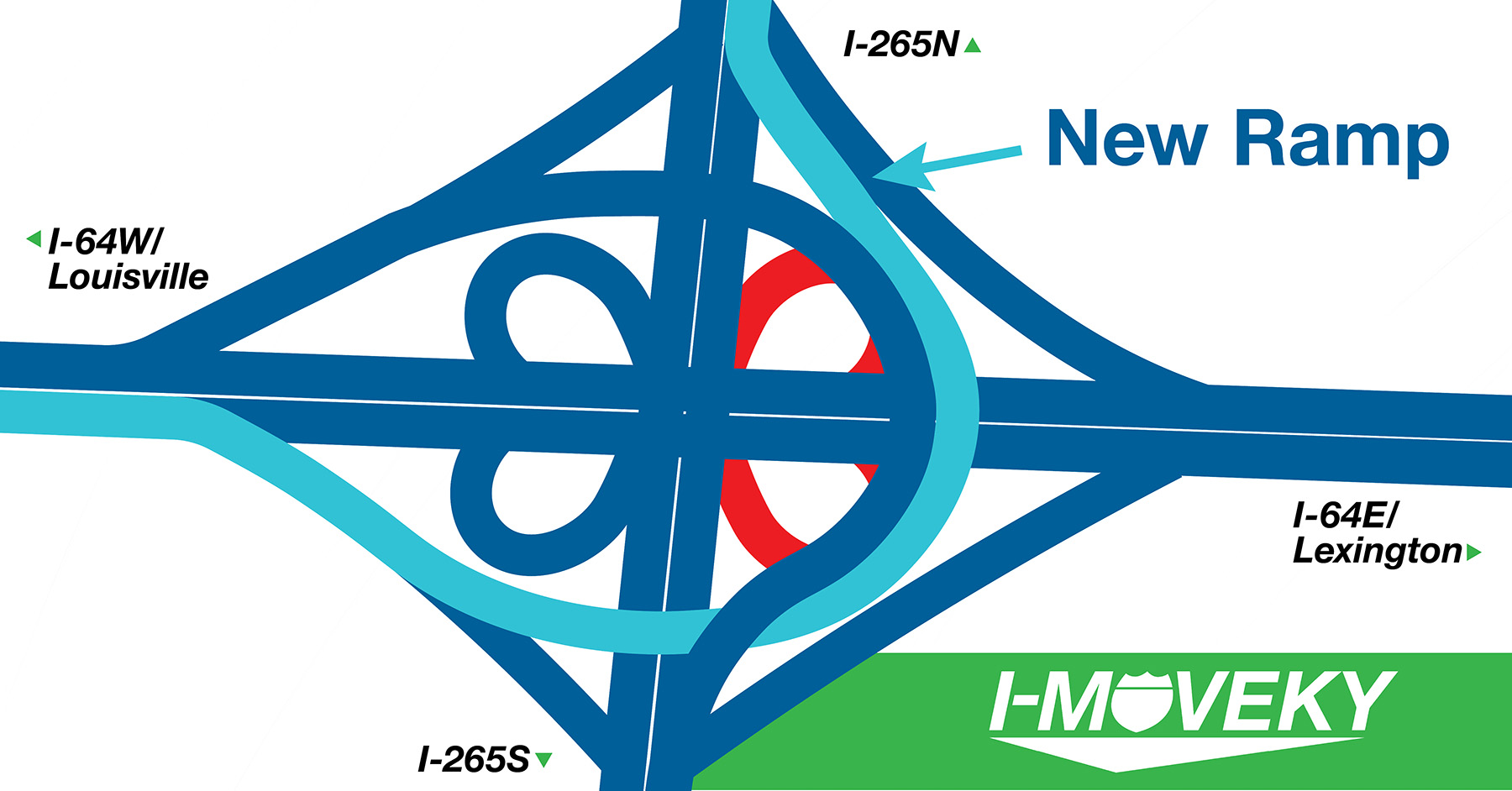
- A partial turbine interchange to replace the outdated I-265/I-64 cloverleaf interchange, eliminating high-volume loop ramps and reducing weaving traffic.
The project encompassed over 28 mi of roadway reconstruction and widening, five new bridges, eight bridge widenings, 5.7 mi of noise barrier walls, and nine reinforced-concrete box culvert extensions. Successfully delivering a project of this scale required an innovative approach to procurement and execution.
As the design lead, STV developed engineering solutions that met the project’s complex technical requirements while adhering to the state’s first-ever best-value design-build procurement model. This approach allowed for flexible project execution, integrating alternative technical concepts — design modifications that streamlined the work without compromising safety or performance. ATCs also furthered the impact of every dollar available in KYTC’s fixed budget.
Growing problems
The corridors affected by I-Move Kentucky serve as critical transportation arteries. Prior to this project, these corridors were known for high traffic volumes that exceeded capacity, aging infrastructure, outdated interchange designs, and frequent collisions.
A programming study of I-265 performed by Parsons Brinckerhoff for KYTC in 2015 revealed that these issues would only worsen with projected growth. The study showed that the stretch between KY 155 and I-71 had the highest crash rates and lowest level of service along the I-265 corridor. Without intervention, projections showed the corridor would reach level of service “F” by 2040, indicating severe congestion and gridlock during peak hours.
Additionally, more than 40 other roadway projects were contingent on these capacity improvements, making I-Move Kentucky a linchpin for the state’s transportation network. KYTC recognized that a single contract would guarantee faster delivery and more cost savings.
A new approach
Highway projects in Kentucky are typically awarded through low-bid contracts, in which the lowest-cost proposal is selected. However, as stated earlier, KYTC chose a best-value design-build model that prioritized cost-effectiveness, innovation, and long-term benefits.
KYTC set a fixed budget of $180 million, which required project teams to prioritize the elements that maximized the design and construction processes. To encourage cost-saving efficiencies and engineering creativity, teams were invited to propose ATCs. The best-value process also facilitated faster, more collaborative decision-making between KYTC, engineers, and contractors than a traditional procurement approach.
STV delivered roadway, utility, and structural design services, in addition to surveying and geotechnical engineering. Managing the project alongside five key subconsultants — Palmer Engineering, Burgess & Niple, DLZ, Gresham Smith, and Terracon — STV played a central role in integrating disciplines and ensuring seamless project execution.
Boosting value
One of the most impactful ATCs transformed the I-265/I-64 interchange. It was originally a cloverleaf design — prone to causing high-volume weaving conflicts, congestion, and crashes — but KYTC proposed a partial turbine interchange, and STV refined and optimized that idea through an ATC. The final design combined two bridges into a single structure to save costs and simplify construction. This approach also reduced right-of-way requirements, eliminating the need for land acquisition, and it allowed a continuous flow of traffic during construction.
Another ATC that emerged during the design phase reduced shoulder widths along I-71 and ramp 7A. While maintaining compliance with the American Association of State Highway and Transportation Officials’ safety standards, the adjustment minimized right-of-way disturbances and expedited construction by simplifying earthwork and pavement placement.
During construction, KYTC introduced another ATC in collaboration with the design-build team: thinner pavement, which lowered material costs without compromising durability.
Thanks to the flexibility of the best-value procurement model, the savings generated by these adjustments were reinvested into other areas of the project.
Managing traffic
One of the biggest obstacles to delivering I-Move Kentucky was keeping traffic moving safely and efficiently during construction. With multiple roadway reconstruction and interchange improvements happening simultaneously, maintaining the flow of traffic required extensive planning, phasing, and coordination between designers, contractors, and KYTC.
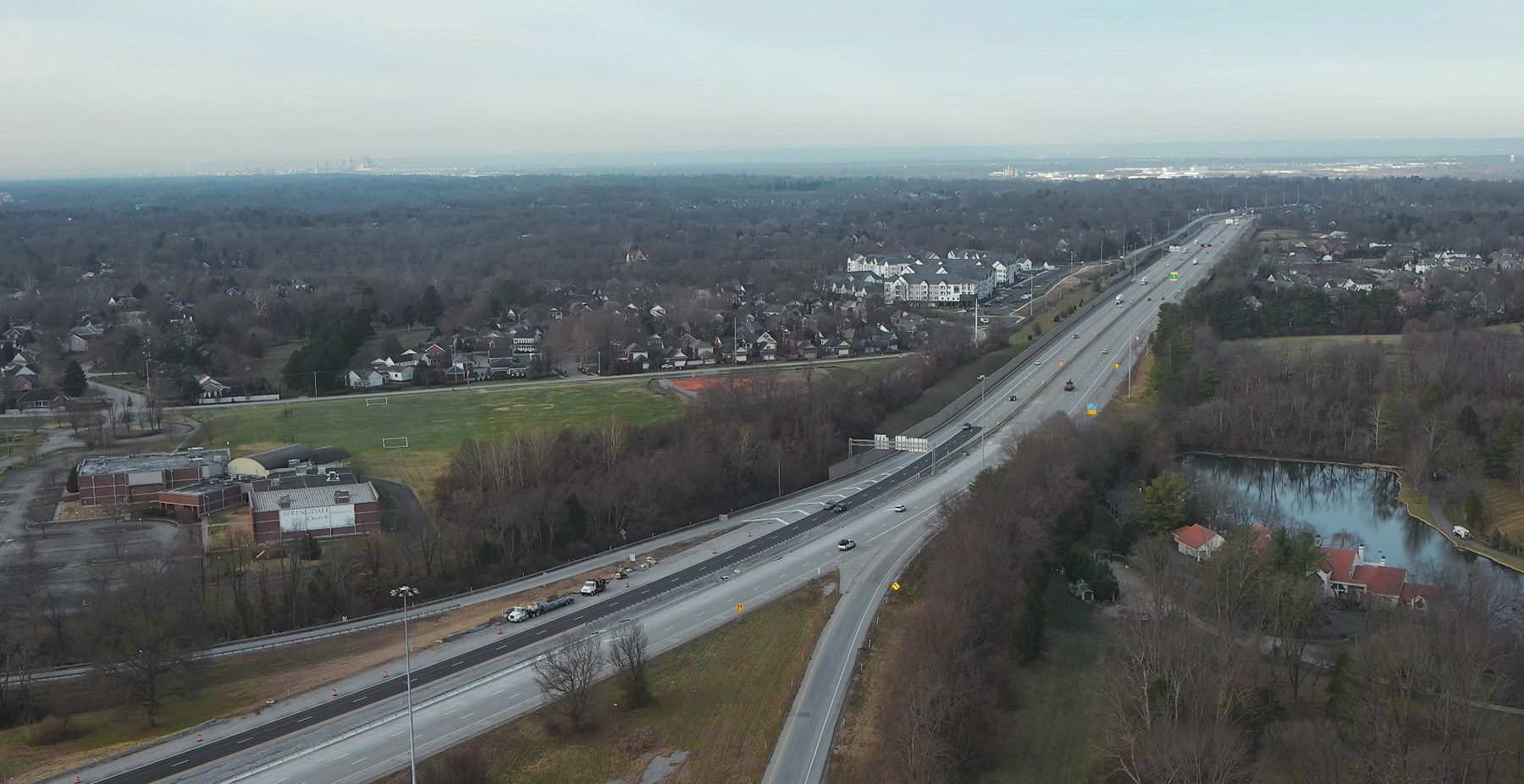
The project was built in phased sections to ensure that at least two lanes of traffic remained open in each direction at all times. Along I-71, this meant first shifting traffic onto the existing shoulders while widening the median, then shifting vehicles back to the center lanes while completing the new outside lanes.
The most complex maintenance-of-traffic challenges were at the I-265/I-64 and I-265/I-71 interchanges. Existing ramps and bridges were rebuilt while keeping them in operation. This required:
- Temporary lanes and detours to allow for continuous merging and exiting.
- Strategic use of crossover lanes to free up construction space.
- Coordination with KYTC, emergency responders, and local agencies to ensure that access routes were maintained.
A master traffic incident management plan was developed for the entire corridor, as well as individual plans for each construction phase. These plans accounted for emergency response coordination, traffic monitoring, and real-time communication with the public about lane shifts and temporary detours.
In addition to mitigating congestion during construction, maintenance-of-traffic strategies incorporated longer merge lanes, clear signage, and improved traffic flow patterns as permanent features of the new highway design.
Enduring impact
A significant long-term benefit of the I-Move Kentucky project is increased traffic capacity. For example, the widening of I-265 and I-71 from four to six lanes substantially bolstered the corridor’s ability to accommodate growing traffic volumes.
The project delivered major safety improvements as well, particularly at the I-265/I-64 and I-265/I-71 interchanges. The aforementioned cloverleaf interchange was a spot of frequent collisions because vehicles entering and exiting the highway were forced to merge into the travel lanes with limited room for acceleration and deceleration. The new partial turbine interchange eliminated these risks. Similarly, the addition of C-D lanes along I-71 streamlined ramp access, preventing abrupt slowdowns and reducing lane-changing conflicts. These design upgrades — coupled with improved sightlines, longer merge distances, and clearer traffic patterns — contribute to a safer driving environment.
The project also delivered critical long-term maintenance benefits by replacing aging structures. A key example is the replacement of an arch culvert with a full bridge structure under I-265 at Avoca Quarry Road. The original culvert functioned as a one-lane underpass and was deteriorating, presenting ongoing maintenance challenges for KYTC. So STV implemented an ATC by constructing a two-lane bridge in its place.
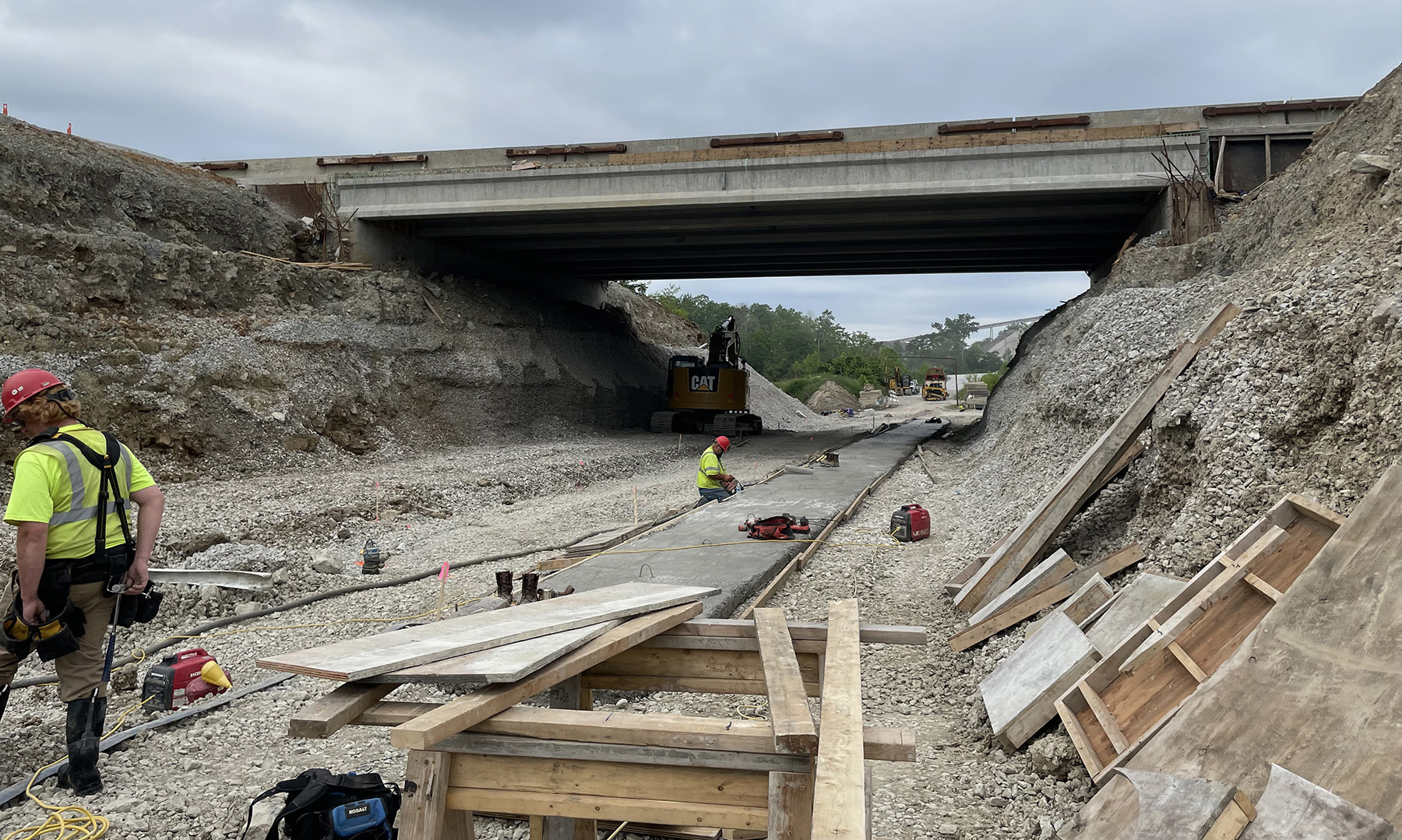
The box culvert replacement also enhanced local traffic mobility, reflecting how the team evaluated design decisions through the lens of durability and long-term performance. Eliminating long-term costly interventions means that KYTC can now redirect maintenance resources to other critical infrastructure needs across the state.
Finally, I-Move Kentucky has played a pivotal role in supporting Kentucky’s economy and freight movement. Louisville is home to UPS Worldport, and I-71 is a major ground route to Cincinnati, which is home to the Amazon Air Hub at the Cincinnati/Northern Kentucky International Airport. Improved highway capacity and interchange functionality now facilitate more reliable travel for freight carriers, especially between I-65 and I-71, which is a boon to the local economy. The project also benefits major industrial hubs along the corridor, such as a Ford truck plant and surrounding manufacturing and logistics centers.
The highway improvements have made Louisville’s transportation network more competitive for future business investments.
Investing in Kentucky's future
The success of I-Move Kentucky is a testament to the power of collaboration. The project not only brought together an exceptional team of engineers, planners, and technical specialists from STV’s four Kentucky offices, but its success was further solidified by the cohesive partnership among STV, KYTC, and all the other stakeholders, who worked in close partnership to foster open communication and a shared commitment to problem-solving.
The project’s scale and complexity demanded total buy-in from every team member and seamless coordination across multiple disciplines — all while navigating the challenges of the COVID-19 pandemic. The team adapted to remote collaboration, virtual coordination, and supply chain uncertainties, ensuring the project stayed on track.
Beyond its engineering achievements, I-Move Kentucky serves as a benchmark for best-value design-build procurement, demonstrating how design-build procurement, digital workflows, and strategic ATCs can maximize project value. The project can be viewed as a model for other states seeking to modernize aging transportation networks. For engineers, contractors, and transportation agencies nationwide, this project can be used as a case study in how to deliver complex highway projects on time and on budget.
More than just a highway expansion, I-Move Kentucky is a lasting investment in the state’s transportation infrastructure, proving that even in the most challenging circumstances, engineering excellence can rise to the occasion to make our communities better.
Peter Overmohle, P.E., PTOE, PMP, is vice president and the Kentucky and Ohio area manager at STV.
Project credits
Owner
Kentucky Transportation Cabinet
Project design services, surveying and geotechnical engineering, and engineer of record
STV offices in Glasgow, Lexington, Louisville, and Owensboro (all in Kentucky)
General contractor and paving
Hall contracting of Kentucky, Inc., Louisville
Blasting
Rame Contracting, Springfield, Kentucky
Subconsultants
Palmer Engineering, Louisville
Burgess & Niple, Louisville
DLZ, Lexington, Kentucky
Gresham Smith, Louisville
Terracon, Louisville
This article first appeared in the May/June 2026 issue of Civil Engineering as “Multi-Interstate Makeover.”
