 East Bay Municipal Utility District
With improved resilience as a priority, a large-scale upgrade to the Orinda Water Treatment Plant in California’s East Bay region is more than halfway complete.
Amid changing climate conditions, the $341 million Orinda Water Treatment Plant Disinfection Improvements Project will protect water quality for about 1.4 million residents served by the East Bay Municipal Utility District.
Further reading:
- Florida water reclamation facility expansion will set new standard
- Texas utility launches landmark water reuse project
- Benefits flow quickly as historic dam removal restores Klamath River
Developed in partnership with Carollo Engineers, Stantec, Arcadis, and FlatironDragados, the project will enhance the plant’s water treatment processes by integrating ultraviolet disinfection and a chlorine contact basin. Together, these additions will reduce dependence on chemical disinfection.
Lessons from drought and flooding
The need for the project first began to take shape during the 2014-15 drought, a period of record-low precipitation and unusually high temperatures. EBMUD sources about 90% of its drinking water from the Mokelumne River, which originates from snowmelt in the Sierra Nevada. However, with snowpack at historic low levels, EBMUD for the first time had to rely on supplemental supplies it had developed from alternative sources.
Following the drought, EBMUD retained Carollo to evaluate the feasibility of adding pretreatment to some of its water treatment plants.
“EBMUD was taking proactive steps with its water treatment systems to be better prepared for future conditions that were not very well defined at the time,” said Peter von Bucher, P.E., a project manager and vice president at Carollo. “They had lots of data showing excellent water quality, but extrapolating that forward would not present an accurate picture. It was clear that the region was facing future climate-related risks.”
 East Bay Municipal Utility District
In 2017, as Carollo was conducting the study, a series of atmospheric rivers descended on California’s central region, unleashing torrential rainfall. In the aftermath of the severe drought, these large storm events created a new challenge for the Orinda plant.
“With very little precipitation in the preceding years, a large amount of sediment and decaying vegetation had built up in our watershed,” said Tim Karlstrand, P.E., a project manager and senior civil engineer with EBMUD. “The intense rains flushed all those accumulated materials into our reservoir, introducing a heavy load of organic matter.”
When the plant’s existing chlorination process treated the organic-laden raw water, elevated levels of disinfection byproducts formed, including trihalomethanes. Although the event did not exceed regulatory limits, it came close enough to serve as a wake-up call,
according to von Bucher.
“It was a realization that this problem had to be addressed quickly,” he said.
The improvements are also needed to address risks from other climate-driven changes that pose even greater looming threats to the region’s water supply. “The Mokelumne River watershed is relatively pristine, but any change in our consistent water source may threaten our ability to provide water that meets regulatory requirements,” Karlstrand said.
While drought and flooding cycles could disrupt operations on the order of months, the impact of a major wildfire on water quality could persist for years, von Bucher noted. “EBMUD has a great system of local reservoirs and storage, but if we are talking about a whole watershed burning, that’s a different story,” he said. “That’s when local storage begins to run out.”
Enhancing disinfection performance
The Orinda plant’s existing disinfection system treated raw water with chlorine upstream of the filters where organic concentrations were higher. The new treatment process reverses that sequence: Filtration will occur first to optimize disinfection to minimize formation of disinfection byproducts.
“With UV and chlorine, we get a multibarrier approach to disinfection,” von Bucher said. “Chlorine is very effective at destroying viruses and eliminating giardia and bacteria. However, it’s basically ineffective against cryptosporidium. That’s where UV comes in – it’s great at taking care of cryptosporidium as well as bacteria and giardia, but not so great against viruses.
“Using both covers your bases and adds another level of protection, confidence, and safety to the disinfection process, regardless of the quality of water coming through the plant.”
Adaptive engineering
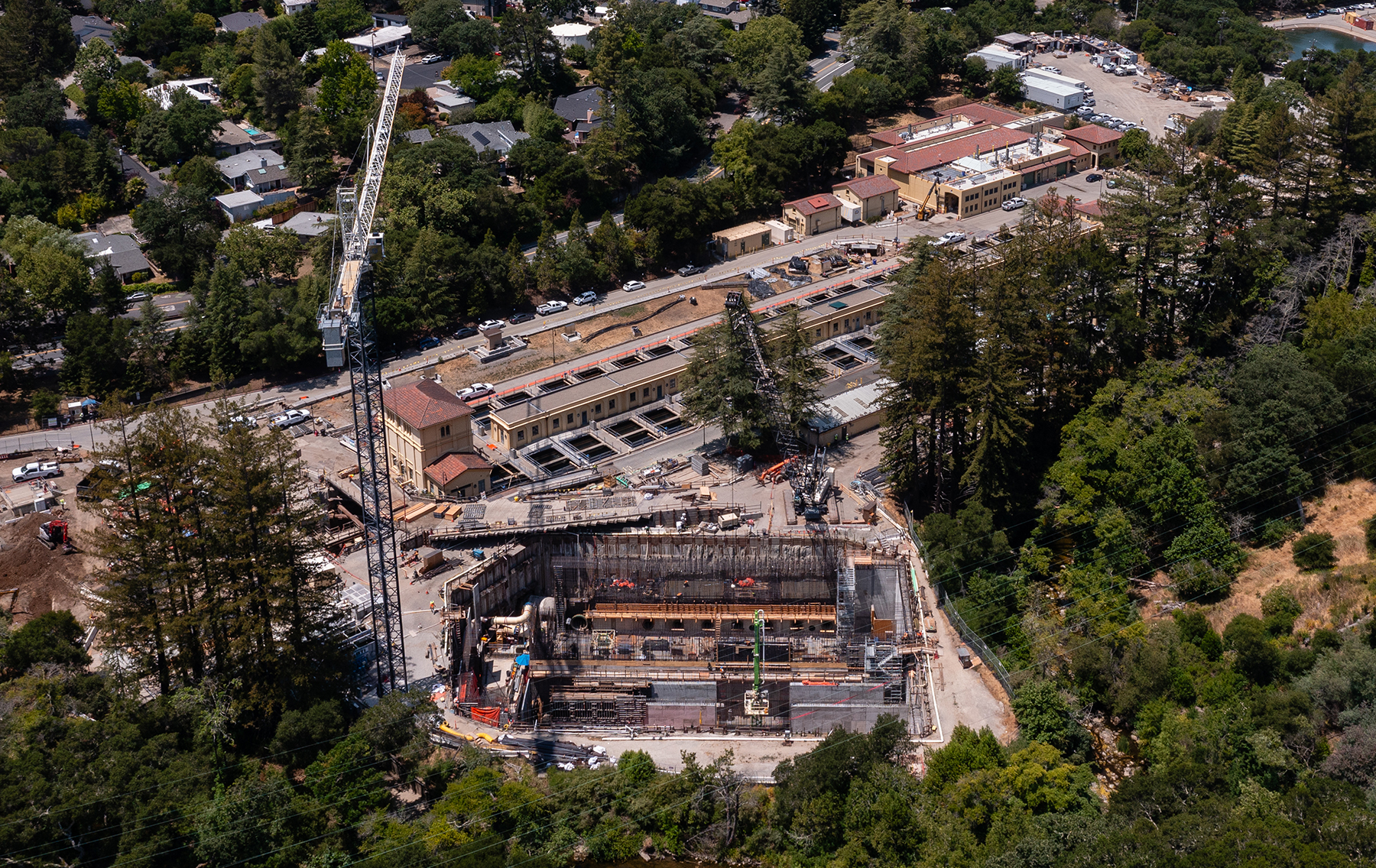
The Orinda plant is on an extremely compact site, presenting engineers with a clear limitation: no room to build outward.
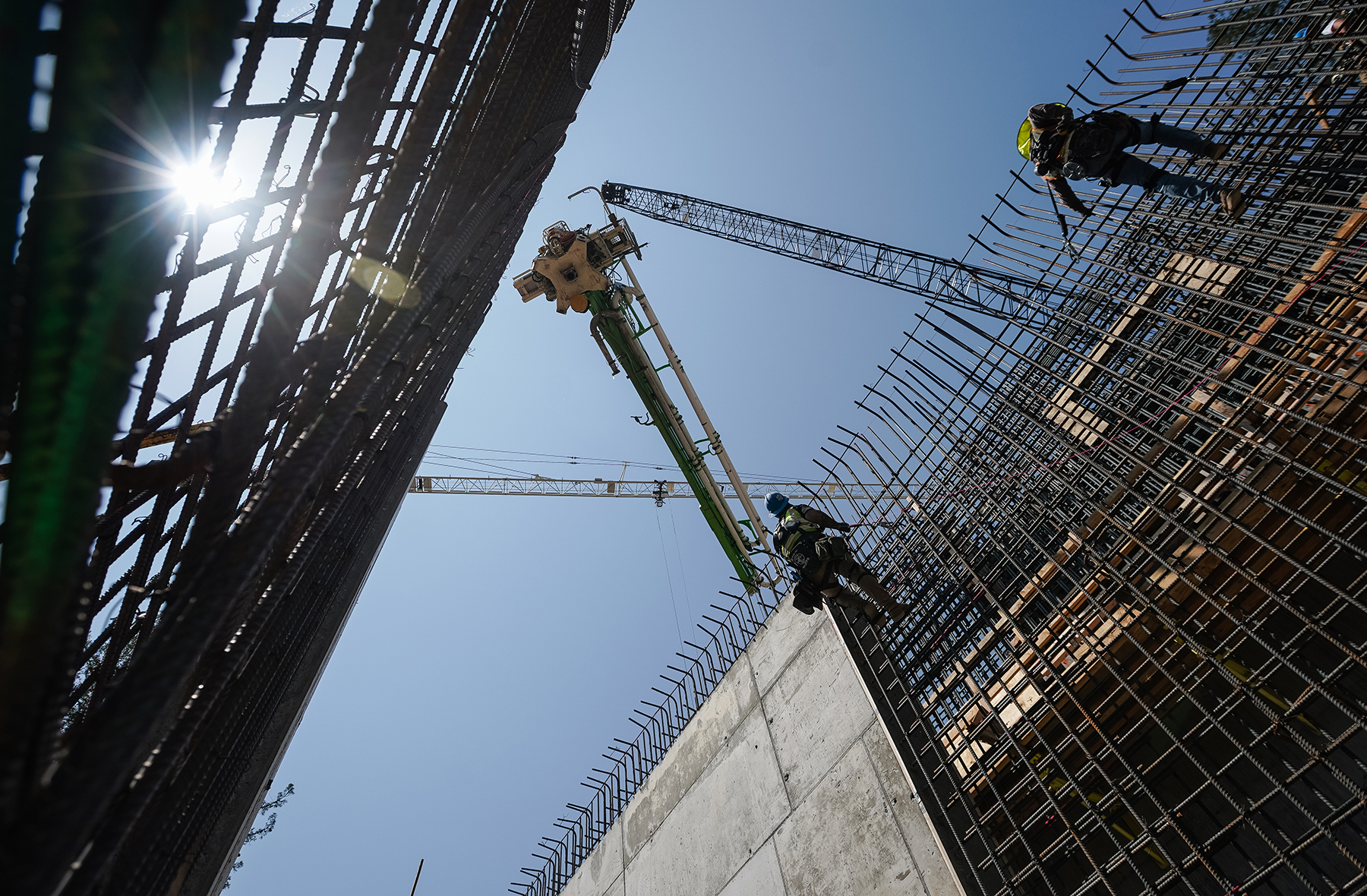
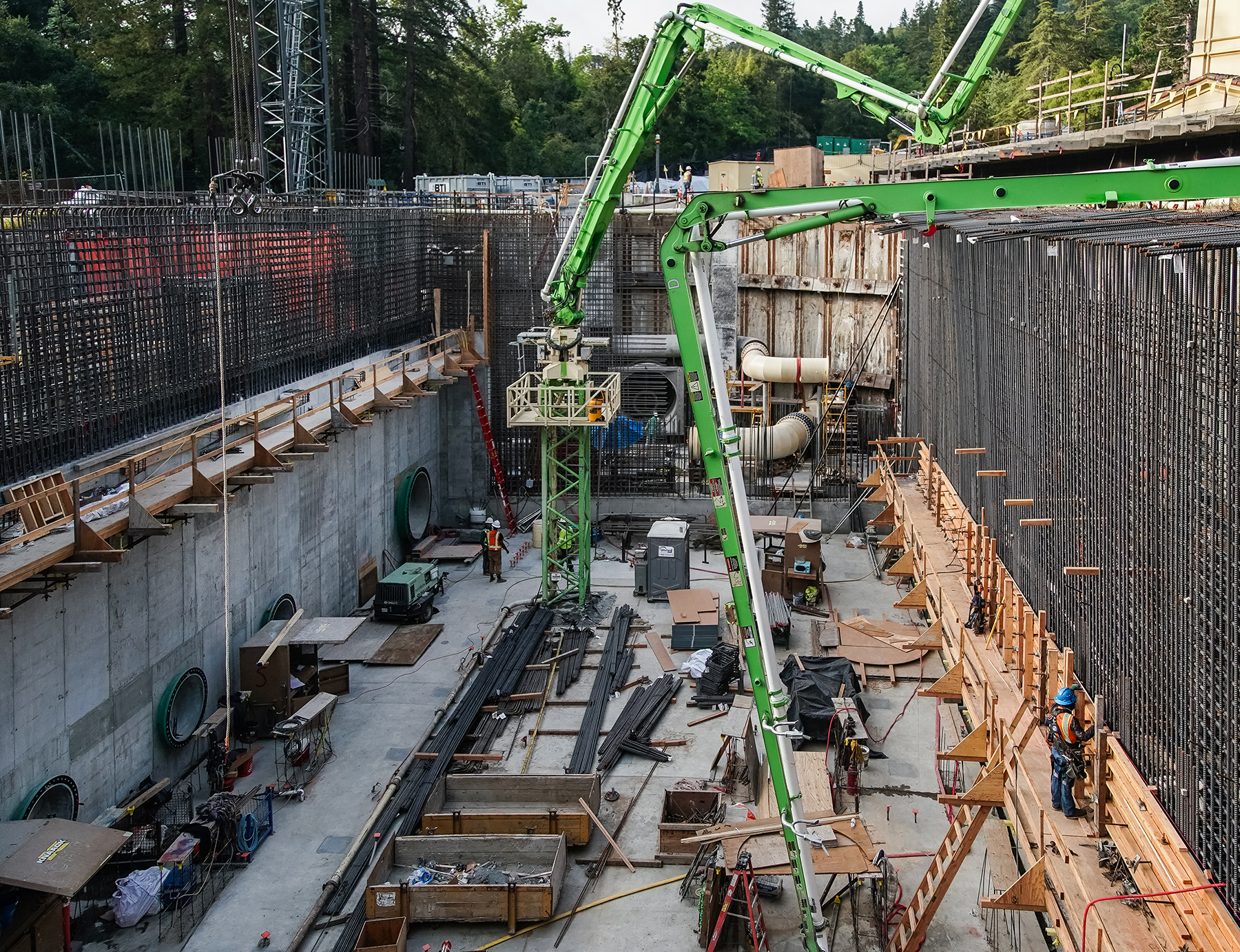
Using adaptive measures, the team’s solution was to take the project underground, installing the UV disinfection system and chlorine contact basin 65 feet below the surface. FlatironDragados is leading the excavation and construction of the below-ground infrastructure, including a two-story maintenance and UV electrical building that will sit above it.
“We had to build our way down in layers as we installed a secant pile shoring system with tiebacks, completing one level at a time,” said Matt Cook, area operations manager for FlatironDragados’ Northwest Region. “Because access for heavy equipment was so limited, we had to use a tower crane – something you don’t typically see on a water treatment project.”
To fit within the constraints of a tight underground space, Carollo adopted an unconventional approach to the chlorine contact basin.
Prioritizing disinfection efficiency, the team focused on a design that would optimize chlorine contact time within the available footprint. The result is a long and narrow basin configured in a serpentine shape that winds back and forth six times over two levels.
“The water moves at a consistent rate, providing uniform contact with the disinfectant,” von Bucher explained. “It’s a complicated structure, designed to create a wide point in the treatment process that increases the time that water interacts with chlorine. At the end of the process, we add ammonia, which produces chloramine – another step to help limit disinfection byproducts from forming.”
Five tunnels are also being built in the underground space to establish hydraulic connections that move water from the existing filtration plant to the UV disinfection facility and from the chlorine contact basin to an existing tunnel that conveys treated water from the plant to EBMUD’s water distribution system.
Adding further complexity, the improvements are being constructed adjacent to a creek and within 20 feet of a century-old concrete channel that delivers raw water to the facility. Notably, the plant is a must-run facility that operates 24/7, and the work is being completed while it remains in continuous operation.
“This is open-heart surgery of a critical plant,” von Bucher said. “We have to be extremely cautious; if the channel is compromised, the plant will shut down, as there is currently no redundancy in place.”
To ensure ground stability and protect existing infrastructure, FlatironDragados developed a geotechnical instrumentation program to continuously monitor underground conditions and detect any ground movement during construction that could threaten nearby structures. If excessive movements are recorded, FlatironDragados is prepared with compensation grouting systems to stabilize the soil.
Construction began in 2022, and the project is scheduled for completion in 2028.
“Although the contract allows for two planned shutdowns, the project team came together and, through many hours of planning and workshops, developed a plan to eliminate those outages,” Karlstrand said. “We are on track to complete the upgrades without any interruption to plant operations.”
 East Bay Municipal Utility District