 Arturo Garcia-Ayala, Eco Wave Power
Commercial wave power may arrive on the shores of the continental U.S. this year, converting the motion of ocean waves into electricity to help boost the resiliency and sustainability of the power grid.
But as new technology allows the industry to take its first footholds in the country, wave power’s hurdles to grid-scale expansion remain regulatory, infrastructural, and perceptual as well as technological.
Further reading:
- Demand for data centers soars; could small modular reactors meet the need?
- Tapping anaerobic digestion’s potential as a renewable energy source
- The renewable energy source right beneath our feet
In November, the Bonneville Power Administration signed a power purchase agreement to buy up to 20 megawatt-hours of energy per hour from Oregon-based wave energy testing facility PacWave. The agreement, which spans from 2026 to 2030, marks the first time a PPA covers wave power in the continental U.S.
Led by Oregon State University with funding from the U.S. Department of Energy and the state of Oregon, PacWave seeks to act as a standardized test bed for the marine energy industry.
The facility, known as PacWave South, located about 7 miles off the Oregon coast in about 240 feet of water, can accommodate up to 20 utility-scale wave energy converters and deliver up to 20 megawatts of power to shore. PacWave also operates a smaller PacWave North test site about 15 miles to the north that is not connected to the grid.
 CalWave
Work is underway for PacWave South to host WECs built by wave energy developer CalWave. The California-based company has designed what it calls xWave – wave capture technology that combines, under one architecture, high-efficiency power generation along multiple degrees of freedom with load mitigation.
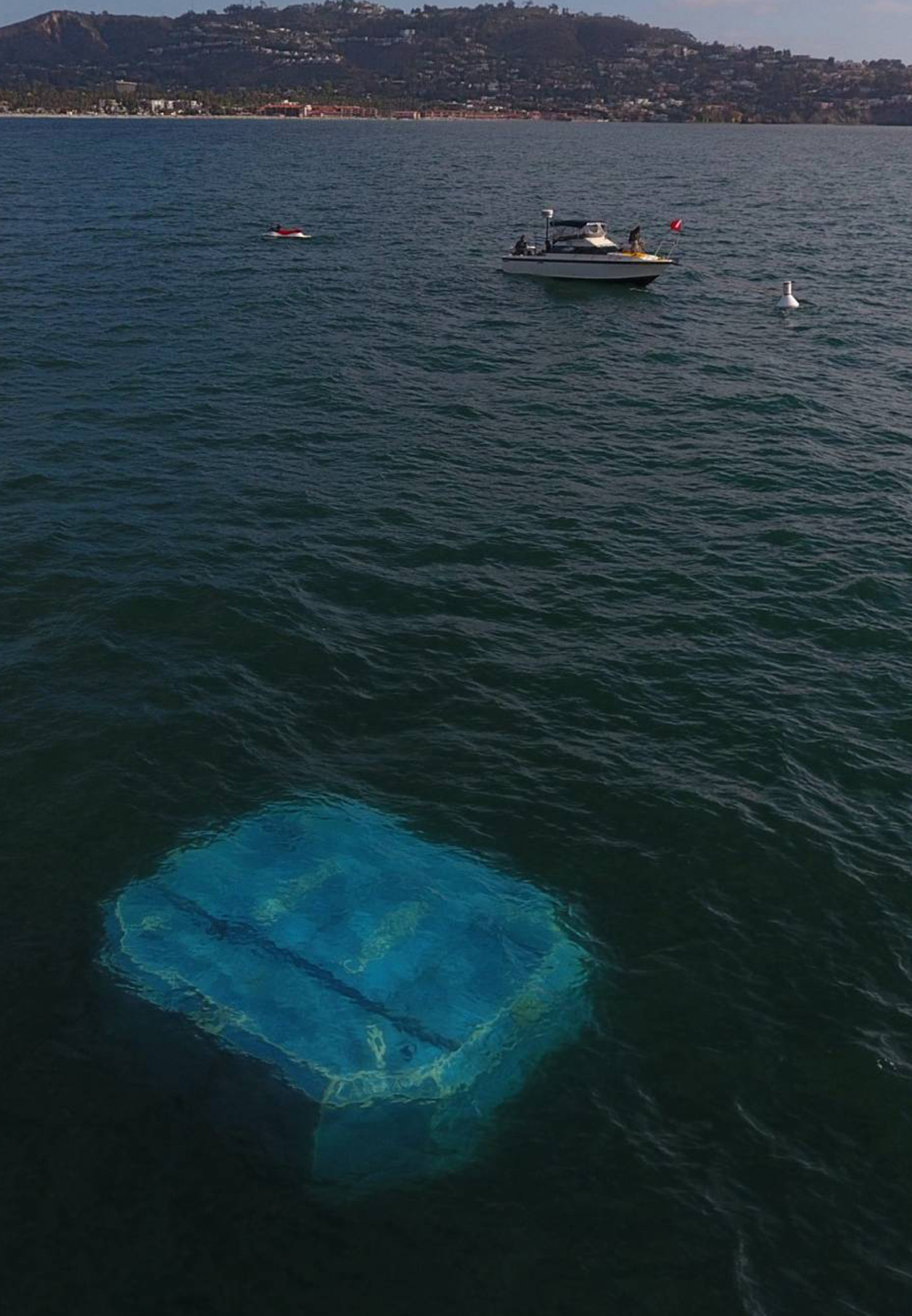
Because xWave WECs can actively and autonomously change the geometry of their wave absorber bodies, they can tune themselves to efficiently capture the energy of different wave sizes. The devices also sit fully submerged, as opposed to other designs that float on the water’s surface, allowing some protection from severe swells and storms. The company says xWave units are designed to survive 100-year storms and can operate for 20 years on the open ocean.
From September 2021 to July 2022, CalWave conducted an at-sea demonstration project off the coast of San Diego of its x1 pilot unit, a scaled-down version of the x200 unit that will run at PacWave. The pilot ran continuously for 10 months, 67% longer than planned, with zero intervention and zero decline in performance, according to CalWave.
Marine energy – the broader renewable power sector that includes waves, tides, river currents, and ocean currents – offers an untapped resource of abundant, clean energy. Because of water’s higher density than air, underwater turbines produce exponentially more power than wind turbines of the same diameter and rotor speed.
Tidal power also offers more consistent power than wind or solar. The total available marine energy in the U.S. amounted to 57% of the power generated in 2019, for example, according to the DOE.
Industry hurdles
But despite the country’s vast marine energy potential, “the permitting process for marine energy projects is long, fragmented, and not yet fully adapted to innovative technologies like ours, which slows deployment timelines significantly,” said Inna Braverman, co-founder and CEO of Swedish wave power company Eco Wave Power.
A 2024 report funded by the National Laboratory of the Rockies (formerly called the National Renewable Energy Laboratory) pointed to the lack of a national wave energy program and little political awareness of wave power as sources of regulatory uncertainty in the near future. The laws governing seabed ownership and lease rights also lack clear legal interpretation, according to the report, and these await actual legal challenges of real projects to achieve better definition.
What’s more, Braverman says that funding for wave energy remains limited compared with the more developed wind and solar sectors.
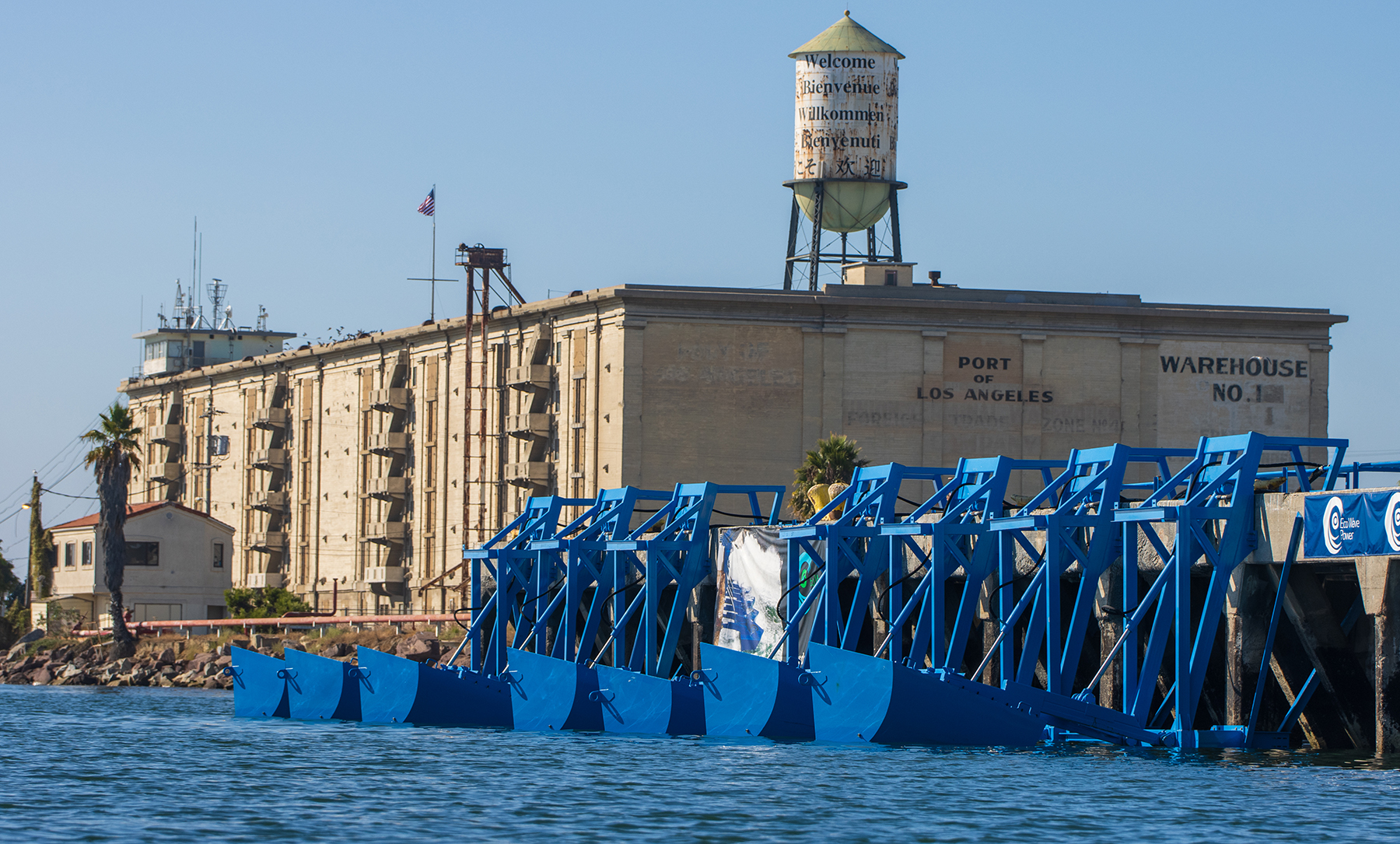
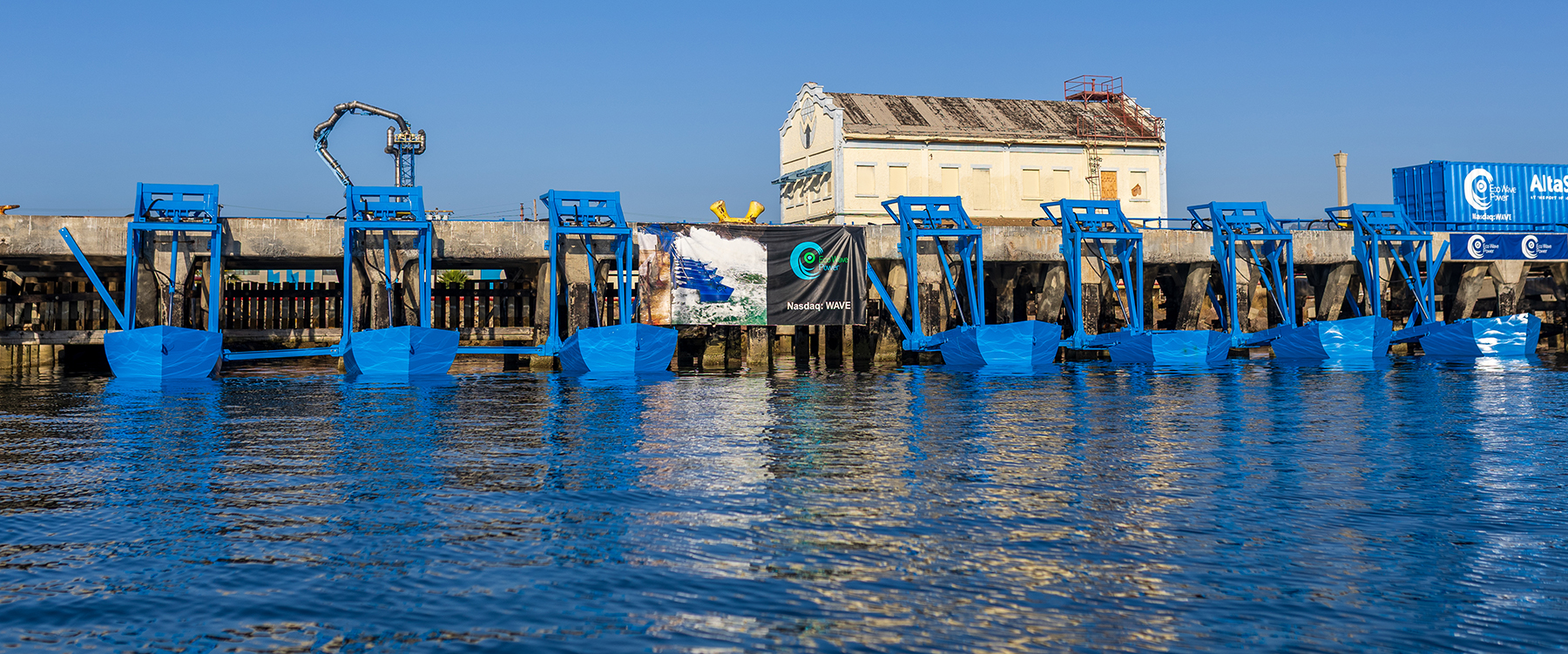
In September, Eco Wave launched its first U.S. project at the Port of Los Angeles. Developed in collaboration with blue economy nonprofit AltaSea and Shell Marine Renewable Energy, the demonstration project marked the first onshore wave energy installation in the country. The Source previously reported on the project as it prepared to launch in August 2023.
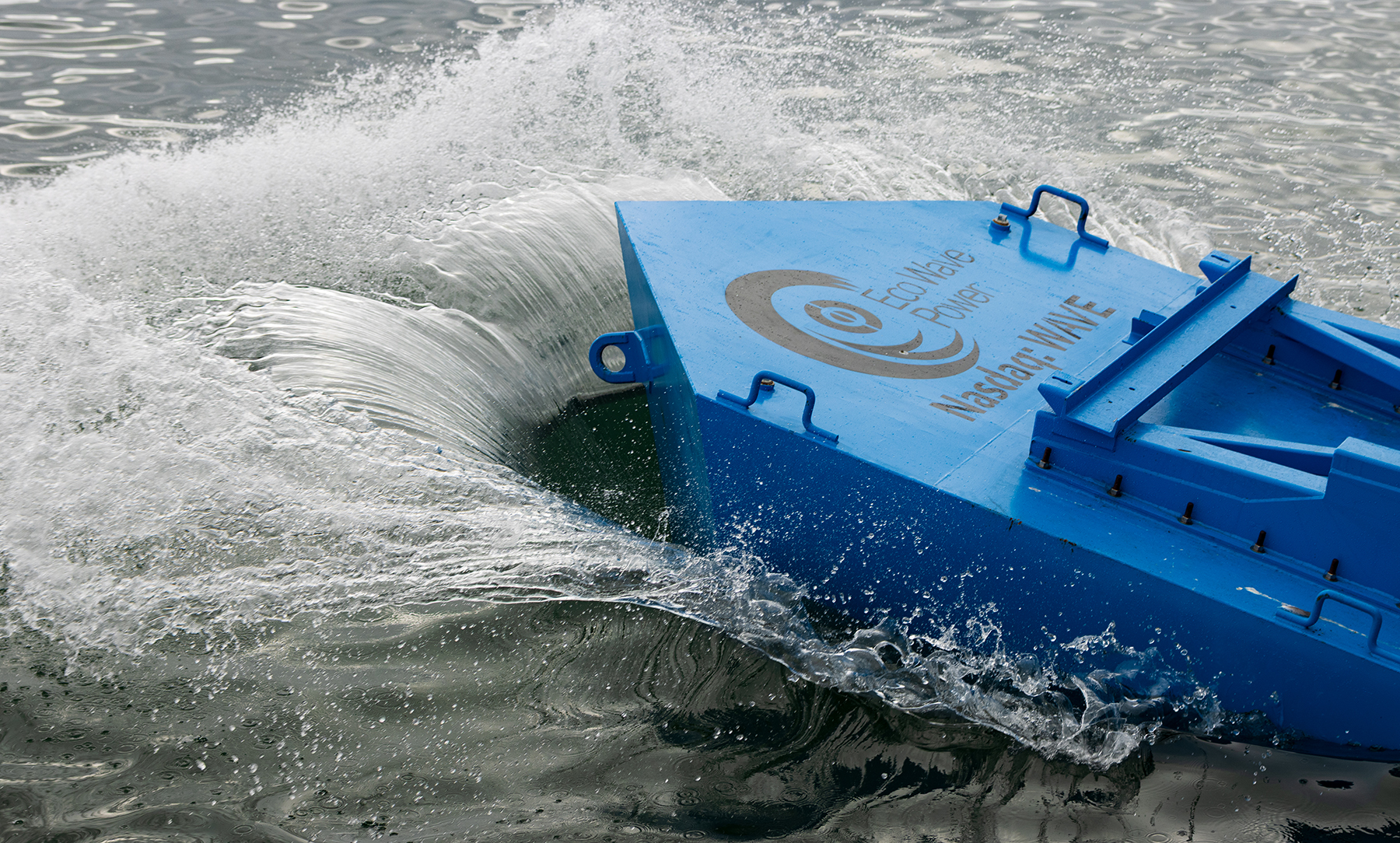
As opposed to moored WECs, Eco Wave technology employs floating paddles attached to existing shore structures at the water’s surface, allowing storm protection and avoiding disturbances to the seafloor. As waves pass underneath, the paddles move up and down to pressurize a hydraulic system that powers a generator.
Although not connected to the grid, the installation has an installed power capacity of 100 kilowatts.
Like CalWave, Eco Wave’s engineering focused on withstanding the variable and sometimes harsh conditions of the seas.
“Waves are not uniform, so our engineers had to develop a hydraulic and mechanical configuration capable of efficiently capturing energy from small, frequent waves without compromising durability during storms or extreme conditions,” Braverman said.
 Arturo Garcia-Ayala, Eco Wave Power
In addition to collecting environmental and engineering data, the Port of Los Angeles project looks to develop a licensing pathway for Eco Wave’s technology in the U.S. as it operates for about two years as part of a structured testing and monitoring program.
“The data collected will support feasibility assessments for larger commercial installations in California and other coastal states, paving the way for the first grid-connected, utility-scale wave energy deployments in the U.S.,” Braverman said.
Gaining traction
Legislators are beginning to take notice, signaling a possible expansion of America’s role in the wave energy space. California Senate Bill 605, signed into law in 2023, requires the California Energy Commission to “evaluate the feasibility, costs, and benefits of using wave energy and tidal energy” and to “identify suitable sea space for offshore wave energy and tidal energy projects in state and federal waters.”
And at the federal level, in 2024, Rep. Nanette Díaz Barragán, D-Calif., introduced the Marine Energy Technologies Acceleration Act, which proposes to invest $1 billion to commercialize and scale marine energy through research and development, demonstrations, resource mapping, and permit streamlining.
“State and federal funding for marine energy should be deployed strategically to accelerate commercialization and reduce risk for early adopters,” Braverman said. “Priority should go toward demonstration and precommercial projects that allow technology providers to validate performance at scale while giving utilities and port authorities real-world operational data. Funding should also support upgrades to port and coastal infrastructure, enabling faster interconnection and lowering installation costs for future stations.
“Demonstration projects such as the Port of Los Angeles project are vital to proving performance, derisking the technology, and building confidence among regulators, utilities, and investors.”
 Arturo Garcia-Ayala, Eco Wave Power
Get ready for ASCE2027
Maybe you have big ideas like the ones discussed in this article. Maybe you are looking for the right venue to share those big ideas. Maybe you want to get your big ideas in front of leading big thinkers from across the infrastructure space.
Maybe you should share your big ideas at ASCE2027: The Infrastructure and Engineering Experience – a first-of-its-kind event bringing together big thinkers from all across the infrastructure space, March 1-5, 2027, in Philadelphia.
The call for content is open now through March 4. Don’t wait. Get started today!