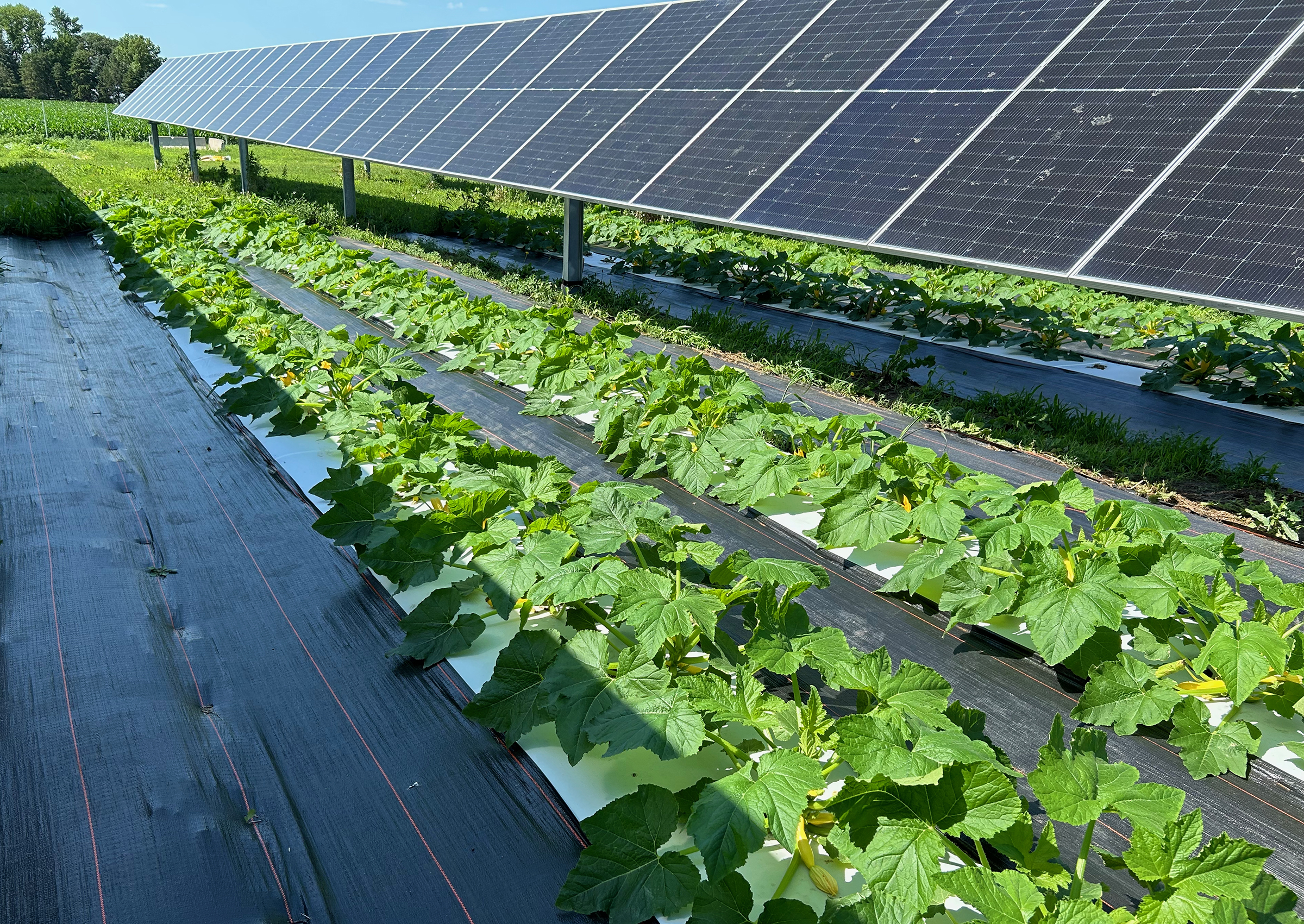
 Alliant Energy Solar Farm at Iowa State University
Large-scale photovoltaic systems require significant space. To further expand production of solar energy, many have looked to build solar arrays in rural areas, competing with arable land that might be used for agricultural purposes.
While some frame the use of farmland for solar production as an either/or situation, new research in agrivoltaics – or the colocation of solar arrays with agricultural pursuits, including farming and livestock grazing – shows the two may actually provide a “yes, and” opportunity. In fact, some of the latest studies suggest that these hybrid solar-agricultural projects can not just help further the adoption of renewable energy but also offer unexpected benefits to food and crop producers.
Further reading:
- Solar panels built over California canals generate power, save water
- Solar panels atop highways could redefine the word ‘sunroof’
- Multiuse sites make renewable energy more efficient and economically viable
“In the past, if you asked the public about what a solar farm might look like, people would think of a parking lot with solar panels or a large desert with concrete and crushed rock. Nobody wants that in their backyard,” said Matthew O’Neal, a professor of entomology at Iowa State University who works on projects at the Alliant Energy Solar Farm at Iowa State, a private-public partnership to study agrivoltaics applications. “But there is growing evidence you can not only use the same land to grow plants and raise livestock but also do other things that can benefit agriculture and the greater community.”
Pollinator support
Healthy, nutrient-dense crops rely on insect and animal species like honeybees, butterflies, birds, bats, and others to help spread pollen and fertilize plants. An open question, however, was whether solar panel arrays and their associated components supporting power generation, conversion, storage, safety, and structural support might interfere with the vital work of these pollinators.
“Beekeeping, in the U.S., is becoming less sustainable. Survival of hives from one year to the next is headed downward. And over the past 30 years, honeybees are less productive,” explained O’Neal. “We know that there are ways to improve honeybee productivity, but there isn’t a lot of public land we can modify to do that.”
But O’Neal and colleagues could make those kinds of modifications to the university’s agrivoltaics site, adding native, perennial flowering vegetation to help attract and support the bees close to the area where crops are being grown. They found that doing so led to a 412% increase in honey production for a collection of honeybee colonies, without interfering with energy generation or farming efforts.
“What we see is that people in Iowa are worried about the loss of farmland with the increase in solar farms,” O’Neal said. “But you can still grow plants under and around solar panels and, if you’re thoughtful about it, you can also support activities that even improve upon existing agricultural efforts in the area.”
Grazing lands
Taylor Bacon, a doctoral candidate in the Department of Soil and Crop Sciences at Colorado State University who has an undergraduate degree in engineering, has noted unexpected agrivoltaics benefits when it comes to livestock grazing.
“From a scale perspective, the amount of land we need for large-scale solar energy generation means we need to look for opportunities where there is already a large land footprint we can use – and animal grazing is one of those opportunities,” she said.
Bacon said several studies have shown that, particularly in sheep grazing, solar panels help reduce heat stress in the animals. In addition, these sites can maintain adequate grass productivity to feed future generations of livestock.
While there remain many open questions about how to simultaneously support both animals and energy generation efforts, the two seem more than compatible. Bacon and her team will be studying cattle in a pilot solar grazing site this summer to gather more data.
“From what we know so far, you can still support enough forage growth to graze sheep successfully. There don’t seem to be any downsides,” she said. “But we need to do more work to see if it’s scalable for other types of grazing.”
Improved working conditions
Pollinators and livestock are not the only animals benefiting from the conditions supported by agrivoltaics sites.
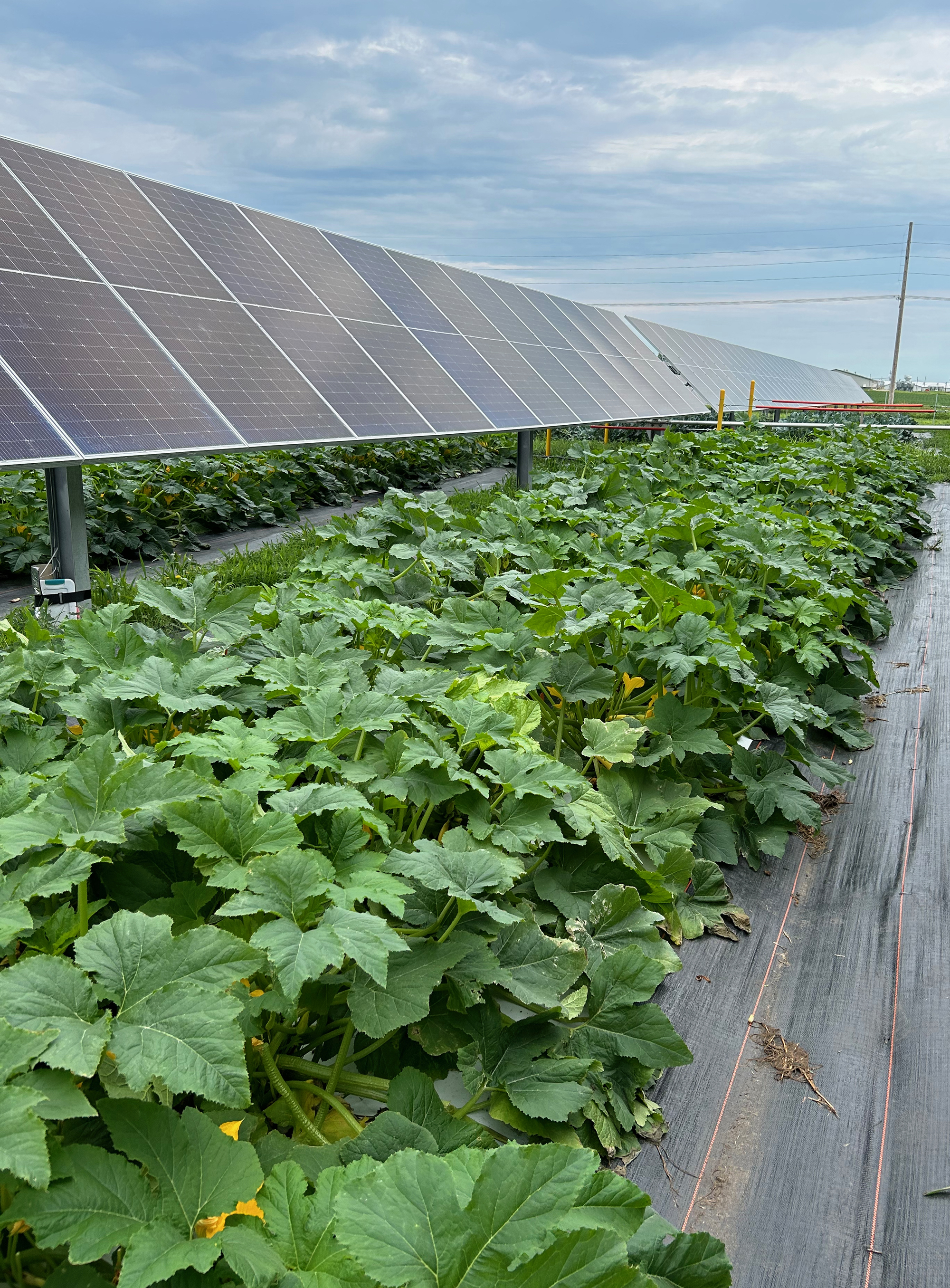 Alliant Energy Solar Farm at Iowa State University
Recent work presented by Talitha Neesham-McTiernan, a doctoral student at the University of Arizona’s Department of Geography, Development, and the Environment, at the 2025 American Geophysical Union annual meeting suggests that farmworkers appreciate the shelter from the sun that solar panels provide.
“In a lot of (food) sustainability conversations, we’re thinking about resource use and not about farmworkers and their bodies,” said Neesham-McTiernan in an AGU press release.
After noting that many fieldworkers would plan to work in the panels’ shade during the hottest part of the day at an agrivoltaics farm near Longmont, Colorado, she decided to take a closer look at what kind of benefits the solar panels offered workers.
Through targeted interviews, she learned that farmworkers were able to work in the shade, taking the “direct heat load off” and reducing the risk of heat-related illness. The workers also appreciated that they were able to keep their drinking water cool, which helped them regulate their body temperatures as well as reduce feelings of exhaustion at the end of the workday.
Neesham-McTiernan also measured wet bulb globe temperature, which denotes extreme heat risk and is used to determine unsafe outdoor work conditions at the agrivoltaics farm. She and her colleagues learned that agrivoltaics reduced that number, on average, up to 9.9 degrees Fahrenheit compared with open-air farms.
That difference reduces the potential of a stopped workday due to high temperatures. With this preliminary data in place, the research team hopes to gather more information about what other advantages agrivoltaics might provide workers across different climates and environments.
“(Agrivoltaics) isn’t a one-size-fits-all solution,” she said. “It can’t be used everywhere. But with the threat of heat, we need a catalog of ways we can protect farmworkers. Without them, we can’t feed ourselves. Protecting them and their bodies should be paramount to everyone.”
The right setup for maximum benefits
There is a need for continued research into agrivoltaics systems – and that work could yield even more unexpected benefits, depending on the specific area where the solar farm is located and what kind of agricultural activities take place there – Bacon said.
“We have a lot of one-off field studies, and we are learning that these systems look different in different climate regions whether you are in the western or southeastern United States,” she said. “There’s a need for more field research to understand all the different variables, but there is a lot of promising data showing that animals can do well in these grazing environments and that you can have higher productivity, growing more fruits and vegetables, under solar arrays than in open conditions.
“It offers some really cool potential synergies to make agriculture more climate resilient while you are also producing carbon-free electricity.”
In the meantime, however, she added, there is great opportunity for “creativity” in engineering and design to create novel systems and arrays to bring about even more synergistic benefits.
“So many projects have come from how to fit agriculture into existing solar arrays,” she said. “There’s a lot of room to design new arrays that aren’t energy first, everything else second. We can use the research that is happening to create new arrays that prioritize agriculture.
“On the construction side of things, there is also a lot of potential to develop new construction practices to set these sites up for success from the very beginning. There’s a lot of room here for interdisciplinary teams, including civil engineers, to come together and collaborate to support these multiple uses for land to ensure it benefits everyone.”

Get ready for ASCE2027
Maybe you have big ideas like ones surrounding renewable energy. Maybe you are looking for the right venue to share those big ideas. Maybe you want to get your big ideas in front of leading big thinkers from across the infrastructure space.
Maybe you should share your big ideas at ASCE2027: The Infrastructure and Engineering Experience – a first-of-its-kind event bringing together big thinkers from all across the infrastructure space, March 1-5, 2027, in Philadelphia.
The call for content is open now through March 4. Don’t wait. Get started today!