Columbus, Nebraska, is a lovely place, by all accounts. Not super easy to make quick grocery store runs there though. People always come up and talk to you.
“If you go to the Hy-Vee, you’re going to see two or 10 people you know,” said Braden Labenz, lifelong Nebraskan, with a laugh. “You can’t go anywhere without knowing somebody.”
Not that he’s complaining. “That community aspect is special and has shaped me both as a person and a professional,” Labenz added.
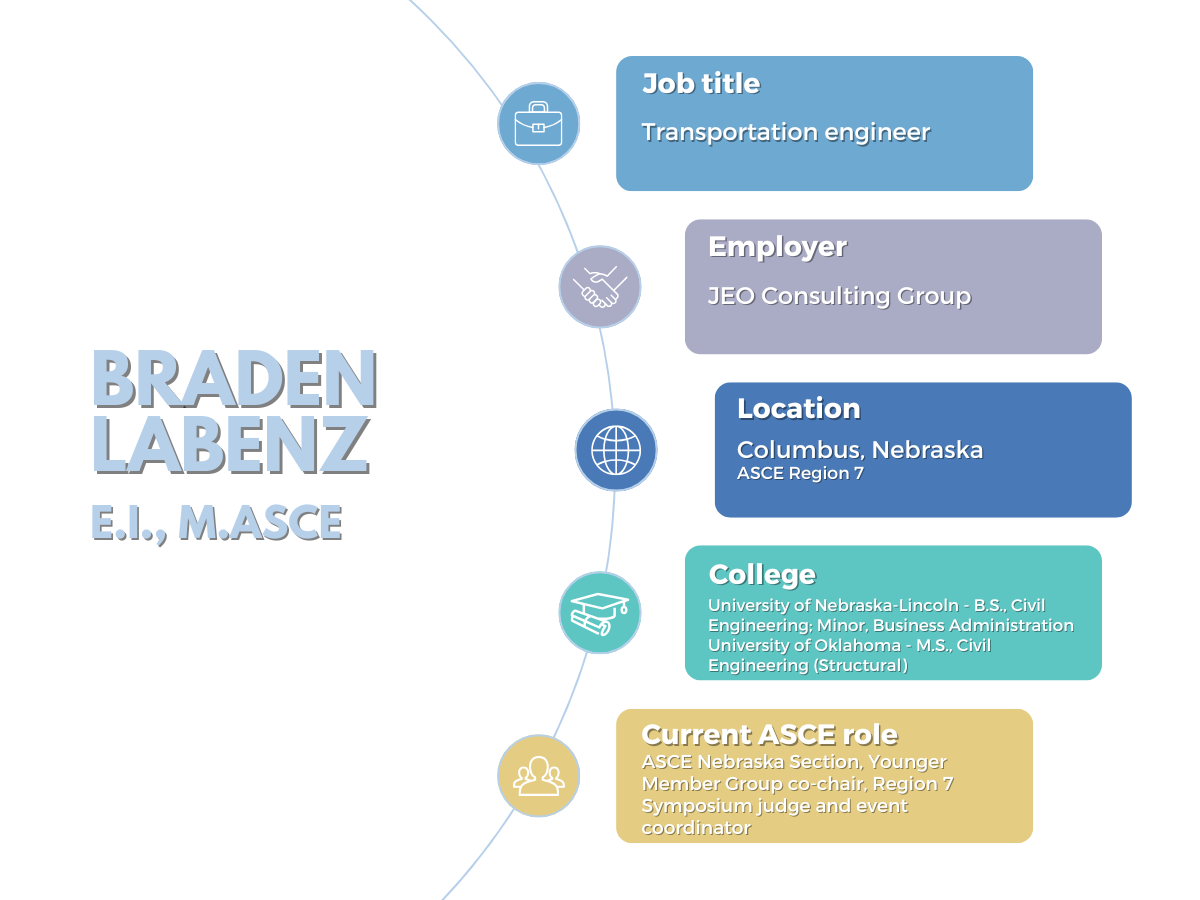
Labenz was born and raised in Columbus, Nebraska – a town of about 25,000, tucked on the eastern part of the state. He attended Scotus Central Catholic High School, and then the University of Nebraska–Omaha for his undergraduate degree. He earned his master’s degree from the University of Oklahoma, but, for the most part, Labenz is a hometown Cornhusker.
“Hardworking and community oriented,” is how he describes himself. “I enjoy helping people with their projects and catching up with everyone, even at the grocery store.”
When it was time to launch his civil engineering career, there was no question where he wanted to start: at home in Nebraska.
He spent three years as an engineer with the City of Columbus, and now he works for the JEO Consulting Group in nearby Wahoo, Nebraska, helping more communities thrive. Meanwhile, he’s been extremely active volunteering with several local and professional groups including the ASCE Nebraska Section and co-chairing the Nebraska Younger Member Group.
“As a professional working in Columbus, I have a different perspective of the city than when I was a kid,” Labenz said. “I’ve seen how things operate and recognize that the community is people driven.”
“I mean, if you go a couple miles in any direction, it’s endless cornfields. The collaboration within the Columbus community is what makes the city great.”
Last month, Labenz received the ASCE Region 7 Outstanding Young Civil Engineer in the Public Sector Award. ASCE has also honored him as a 2026 New Face of Civil Engineering.
The hometown kid that Columbus remembers from just a few years ago is growing into a community leader.
“People see me as a young leader who has a voice and isn’t afraid to share his opinion,” Labenz said. “It has been powerful to build that reputation over the last two years. During my third year working, people have appreciated my ideas and have come to view me as a professional rather than the kid who grew up down the street [laughs].”
“It takes time to build that trust, but over the past year, I’ve grown as a leader. I’ve used my voice to advocate for my ideas and for new engineers in other towns, at the University of Nebraska, and in ASCE. That’s what I want to be, a leader and voice for my communities.”
Labenz recently spoke with Civil Engineering Source about his career.
Civil Engineering Source: What experience or accomplishment are you most proud of?
Braden Labenz: I’ve been in the industry for three years now, almost to the day. Within those three years, I’d like to think I’ve made a big impact.
There are two big things I’m most proud of. One is the community impact I’ve had here in Columbus. I grew up here. I have driven every single road. It’s the community that raised me. So, having the opportunity to come back and improve the public infrastructure by designing roadways, improving public safety, and furthering community initiatives has been a special part of my early career.
The second thing, more specifically, is an idea that the city conceptualized related to the housing market. There’s a housing drought in Columbus, and we need to continue to build more homes. I helped increase the number of homes by hard-launching the Vitality Village project. The project recognized the housing shortage, and the city developed 23 acres, which brought in an extra 450 doors for community members to live in.
Seeing that project from start to finish has been extremely impactful. It is arguably the most ambitious project I’ve completed so far, and it is something I hang my hat on. I am proud to have been a driver on this project, and it reminds me of the real impact civil engineers can have on people’s lives.
Source: When you finished college, you could’ve gone the big-city route – Denver, Chicago, etc. How do you think being in Columbus helped you?
Labenz: Being in my hometown gave me a platform early in my career, along with real responsibility. In a smaller community, that responsibility comes with trust, and I’ve worked hard to earn a voice people can rely on. As a 25-year-old, not many people are going to trust you right away with the big-dollar decisions that come along with civil engineering projects. Which is totally understandable! But, I worked hard to learn about engineering from my mentor, Rick Bogus, and how a city operates by attending city council meetings and carefully studying the technical details. Over time, I gained the skills necessary to be successful in my role as a city engineer.
I also think coming back to Columbus accelerated my community impact, idea implementation, and many opportunities to build the skills required for an ambitious and impactful career.
Source: Why have you prioritized public communication so early in your career?
Labenz: Public communication is something I feel passionate about. Civil engineers need technical expertise, but if you can’t communicate that to the people it affects, you’re missing something.
Civil engineers serve communities. We build the roads, the sewer systems, the buildings – everything in the built environment to serve people.
So, I almost feel as if I’m a translator. I must be able to simultaneously communicate ideas technically to contractors and engineers and also in layman’s terms to community members. I translate community concerns into technical terms, figure out how to solve them, work with contractors, deliver the project back to the community, and then showcase the improvements.
These translation skills apply everywhere – in both rural and urban areas.
Source: What kind of legacy do you want to leave?
Labenz: Great question. There are so many avenues I want to take with this. Part of the journey is knowing there’s eventually an end. I’ve recently found myself asking this question to myself and discussing this idea with other seasoned engineers.
I want my career impact to last longer than my lifetime. I want to build a reputation and a legacy for being community-minded and community-driven. I want to be known for improving the quality of people’s lives, affecting them positively, and giving back to others. I want to inspire and mentor the next generation to think boldly because a project well done can change a community for generations.
I want to thank a few people who’ve helped me get to this point. My dad for giving me the groundwork and determination to work towards a great career. My mom for always supporting and encouraging me to chase my dreams. I also want to thank Rick Bogus, the Columbus city engineer, for his mentorship and inspiration that has developed my career to what it is today.
They’ve given me so much. And I couldn’t be more thankful.