

A few weeks ago, I was talking with my friend Niamh about Walter Mischel. Niamh is studying for her MCAT, and Mischel’s theory came up as we were taking the Green Line into the North End to get a little treat to fulfill our never-ending sweet tooth. You’re probably wondering: Who is Walter Mischel?
Well, he is a Stanford psychologist who conducted the “marshmallow experiment” in the 1960s and 1970s. In this study, young children were placed alone in a room and given one marshmallow. They were told that if they could go without eating it until the researcher returned, they would receive a second marshmallow as a reward. The researcher then left the room, leaving the child alone with temptation.
Mischel followed these children for years. He found that those who were able to delay gratification tended to have higher SAT scores, manage stress more effectively, and demonstrate stronger social and academic outcomes later in life. In contrast, children who chose the immediate reward (one marshmallow), were on average more likely to struggle in these areas among others.
His research suggested that the ability to delay gratification is linked to long-term success. Mischel theorized that individuals with greater self-control (often correlated with higher cognitive functioning) were better able to resist immediate rewards in pursuit of more meaningful, long-term goals. Those who acted impulsively were more likely to prioritize short- term satisfaction.
I can’t claim moral superiority here. I willingly took a 45-minute train for a treat. Still, his work raises an interesting question: How many marshmallows is an engineering degree worth?
The more I thought about this, the more I amused myself. I thought of the different types of engineering students. I thought of who would resist the urge to look at an exam that one of our professors hypothetically clumsily left open on a monitor one day. I thought of who wouldn’t. I wished I could track the progress of those students into their “adult life” the same way Mischel did. One student in particular I know would not look at the exam. He would resist the nonexistent temptation because of 1) the fear of getting caught and 2) the desire to learn the material (the stereotypically more honorable motive). I don’t think people think of motives enough. Maybe Mischel did and it just was not included in the Kaplan MCAT study guide section that I happened to be unintentionally reviewing that day. I don’t know. Finite element analysis keeps me busy enough not to go down these rabbit holes too far.
That being said, are the motivations behind our restraint just as important as the restraint itself? Is the student who avoids taking a shortcut out of fear of being caught the same as the student who avoids it to fully absorb the material? Is the child who resists one marshmallow out of fear of punishment the same as the child who waits because they want two?
I would argue no. Motivation matters.
The “greedy” child who waits for the marshmallow not out of fear, but out of vision is someone who I think has leadership potential. The same goes for the student who wants to maximize their education rather than avoid consequence. But that only holds true if their ambition extends beyond themselves. A future leader does not secretly relish their discipline while watching others give in to temptation. A leader encourages others to wait, too.
I saw this firsthand my sophomore year. A friend I barely knew at the time encouraged me to apply for an internship at a company he was also applying to. I had no internship experience, and neither did he. I asked him recently why he would suggest I apply when we were technically competing for the same limited opportunities. His answer was simple: he believed we were both qualified, and if I were more qualified, then I should get the job. We ended up applying to two companies together and receiving offers from both.
To me, that is leadership. That is someone who not only would have waited for two marshmallows, but who would have made sure we both had the chance to enjoy them. This realization spilled into everything else. I began to question what things were worth in marshmallows. Was an engineering degree worth a fixed number of marshmallows or was it worth as many as you made it worth? A degree is paper. Marshmallows are marshmallows. Somewhere in between calculating problem 3b on my FEA homework and this, I was losing my mind.
So I asked myself: How do we define intelligence? So many questions!
Engineers are smart. We take hard classes. We solve complex problems. But what about Gardner’s theory of multiple intelligences? Is the smartest person in the room the one with the highest grade or the one who is patient, adaptable, and multifaceted?
Gardner’s theory was easier for me to explain visually so I included an image below. If Gardner defines intelligence as logical, interpersonal, spatial, linguistic, and other distinct capacities, then engineers may only dominate one category: logical-mathematical. You don’t need to be musically gifted or bodily kinesthetic to understand Rayleigh-Ritz is a method for approximating eigenvalue or boundary condition problems by minimizing an energy function. But you absolutely need strong logical reasoning.
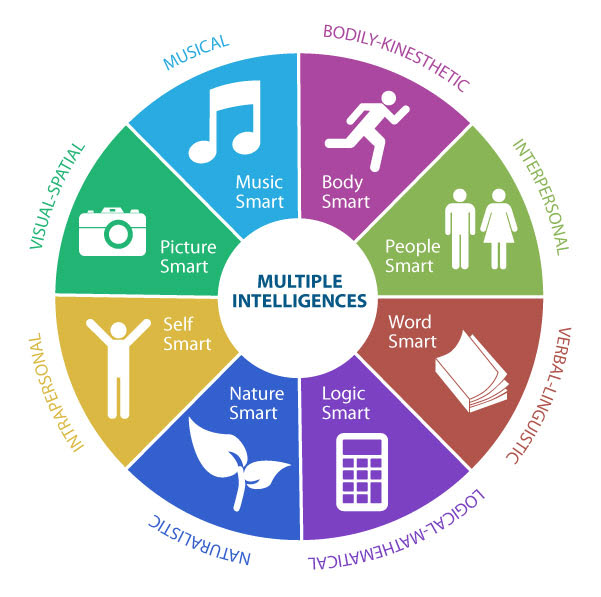 Sajaganesandip
You might be looking at this wheel and thinking to yourself, “I have most if not all of these and I am an engineer!” I am here to remind you that the average person would say that, and the average person also thinks they’re above average. Stay humble.
Maybe I’m tapping into my engineering management minor as I say this, but my point is that a “smart” person waits for the second marshmallow. Yes, this is true. But a leader inspires others to wait and shows them how to. To me, a leader should be the “smartest” person in the room. As engineers we spend so much time problem-solving and developing a different way of thinking that is useless if we cannot share it with others. We need to be able to share our findings with the interpersonal boss, the visual-spatial colleague, the verbal-linguistic intern. To me this is intelligence. It’s an understanding that is so thorough you can explain it despite someone else’s preferred method of learning.
Are you someone who would wait for a second marshmallow? Are you someone who would inspire others to do the same? Would you teach them? Could you?
Research suggests that while 85% to 90% of people are not truly self-aware, 95% of people think that they are. So, if you quickly concluded that you were the exception, think again!
The danger of low self-awareness is not ignorance, it’s certainty. When we are convinced that we are already “above average,” already disciplined, already intelligent, we stop examining ourselves. Without examination, there is no growth. This connects to intelligence. If intelligence is purely logical reasoning, then maybe self-awareness doesn’t matter. Solve the equation. Minimize the energy function. Approximate the eigenvalue. Sounds like a plan!
But if intelligence includes interpersonal skill, leadership, adaptability … if it includes the ability to inspire others to wait for the second marshmallow … then self-awareness is foundational (pun intended). You cannot lead others while misunderstanding yourself. You cannot communicate effectively if you are blind to how you come across. You cannot claim humility while silently assuming you are the most capable person in the room.
A true level of self-awareness is a delayed gratification of its own. It requires resisting the immediate comfort of thinking, “I’m already good at this.” It requires sitting alone in the room with the marshmallow of your ego and deciding whether you are willing to examine it.
The real test is not whether or not we can wait for the second marshmallow.
To me, intelligence stripped of ego is an understanding of the systems you study, the people you impact, and yourself. So, before you assume you are the discipled student, the natural leader, the above-average engineer, I ask that you pause. Question yourself. Invite feedback. Stay humble.
And maybe the smartest person in the room isn’t the one holding two marshmallows, it's the one still silently asking whether they deserve them.
