You never know when life’s next big project is going to find you.
Sometimes you dream it up in your sleep. Sometimes you need to research different possibilities in a book. Sometimes you need to get some dirt under your fingernails.
And sometimes …
“I literally – and when I say literally, I mean literally – ran into the sandstone pillar with the ‘ASCE Landmark’ plaque on it,” said Chip Rogers, laughing as he retells the story of how his ASCE Historic Civil Engineering Landmark odyssey began with a bang.
Chip is associate head coach for the Miami University field hockey team (with 17 consecutive conference regular season and tournament titles to their name). He also serves as the chair of USA Field Hockey, helping prepare the sport’s presence at the 2028 Summer Olympics in Los Angeles.
But in the world of civil engineering, Chip might be better known as the eldest son of the late Cranston “Chan” Rogers, an ASCE Distinguished Member whose work – including the famed Big Dig – shaped Boston infrastructure for decades.
So, when Chip was doing some work in Bellefontaine, Ohio, back in 2020, and – literally literally – ran into the landmark for the first concrete road in America, it immediately sparked a new idea.
“I took a picture of it because I was like, ‘Oh, it’s ASCE. My dad’s going to be happy about it,’ right?” Rogers said.
“My father was in his 90s at this point, so my mom showed him the picture on her iPad. He was a transportation engineer, so that concrete street, for him, was a big deal. He said, ‘Yep, that’s how we got started in this country; concrete is important,’ and he gave me a little two minute lecture.”
Thus, it began.
“I came back to Miami, did some research into the ASCE landmarks, and thought, ‘Oh my goodness, this is how I can spend time with my father,’” Rogers said. “I said to him, “OK, I’m going to travel and see all these landmarks, take pictures of them, and you’re going to tell me what the civil engineering achievement is, what you know about it. It was a way I could spend time with him.”
Five-plus years and a hard-to-fathom 192 landmarks later, the legendary transportation engineer’s son has become one of the world’s foremost experts in historic civil engineering landmarks.
And it’s in that Rogers family spirit of adventure and discovery that ASCE is launching its first Civil Engineering Landmark Madness this month – a 16 “team” tournament to determine landmark supremacy. The inaugural bracket features a “Sweet 16” of railways and roadways, as selected by members of the ASCE History and Heritage Committee.
You don’t have to be a distinguished member like father or have visited nearly 200 landmarks like son to participate either. Voting in the first round opens March 9 for anyone interested in participating and will follow each week round by round.
“It’s been phenomenal,” Rogers said. “One thing I love about this country is how different every place is. People ask me for my favorite landmark – and I’m an English and history major, so I love the story of places. Every trip, every landmark has a story.”
All over this land and back again
Rogers truly has been all over the map. His quest to see all the ASCE landmarks is only one piece of a remarkable puzzle.
He has visited the birth sites and gravesites of every U.S. president, all 50 state capital buildings, and 37 of the 39 places in the nation where three states meet.
He’s also going to the highest points of each state, the smallest towns in each state, the direct geographic center of each state, lighthouses, you name it.
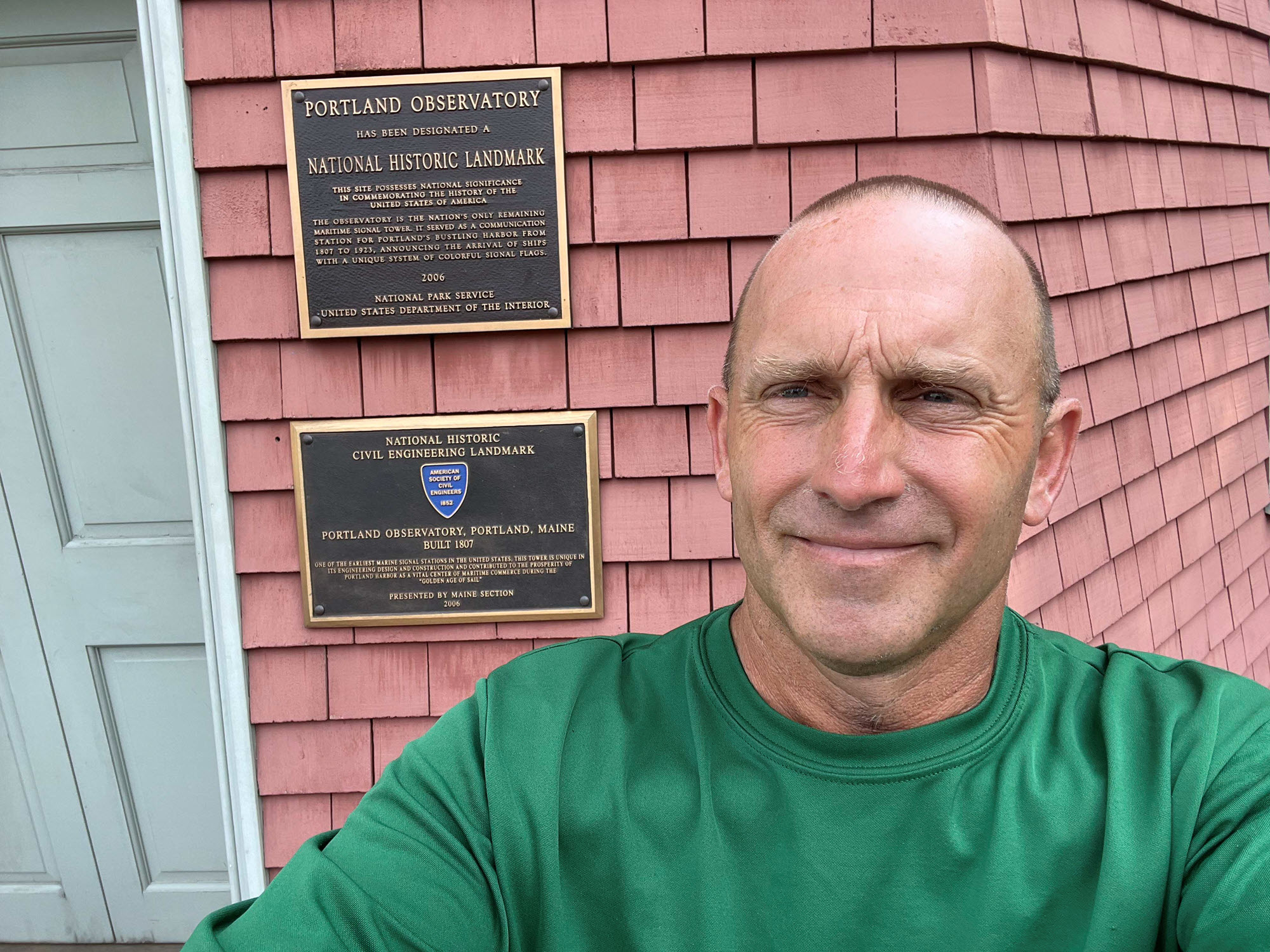 Chip Rogers
 All of this began as a kind of gift to his mother, Fran Rogers, the history buff who loved to travel but couldn’t.
“I was doing that for my mother. She was bedridden for many years,” Chip said. “So this was my way of sharing the world with her, if that makes sense.
“I used to send magnets home from my trips. They’d stick to the rails of her bed so she could see where I’d been.”
The “why” is a beautiful story. The “how” is more confounding.
Does Chip have an army of clones he sends out to various historic landmarks every month? No, it turns out he’s just very organized. Every time he travels anywhere, he has a list of related destinations to maximize the trip.
A recruiting trip to Michigan turned into a visit to the Second Street Bridge ASCE landmark in Allegan.
A tournament in Nashville allowed for a trip to Montgomery Bell’s Tunnel.
Hockey clinic in Chicago? Why not add a jaunt to the Milwaukee Metropolitan Sewage Treatment Plant?
Field Hockey Final Four in Chapel Hill, North Carolina? Who wouldn’t also want to check out the Dorton Arena in Raleigh while you’re at it?
“Everyone around me knows: every visit has an itinerary,” Rogers said. “I send pictures to my siblings in our family group chat. They laugh. They think it’s crazy but lovingly so.”
Along the way, Rogers connected with longtime ASCE History and Heritage Committee members Erik Metzger, Michael O’Connor, and Chuck Spinks, among others, who have connected him with different engineers at different landmarks. In turn, Rogers has helped the committee conduct site check-ins and locate long-lost ASCE plaques.
“All of these trips are meaningful because they let me engage with people around the country,” Rogers said. “I think we need more of that these days – interpersonal relationships, in-person connections.”
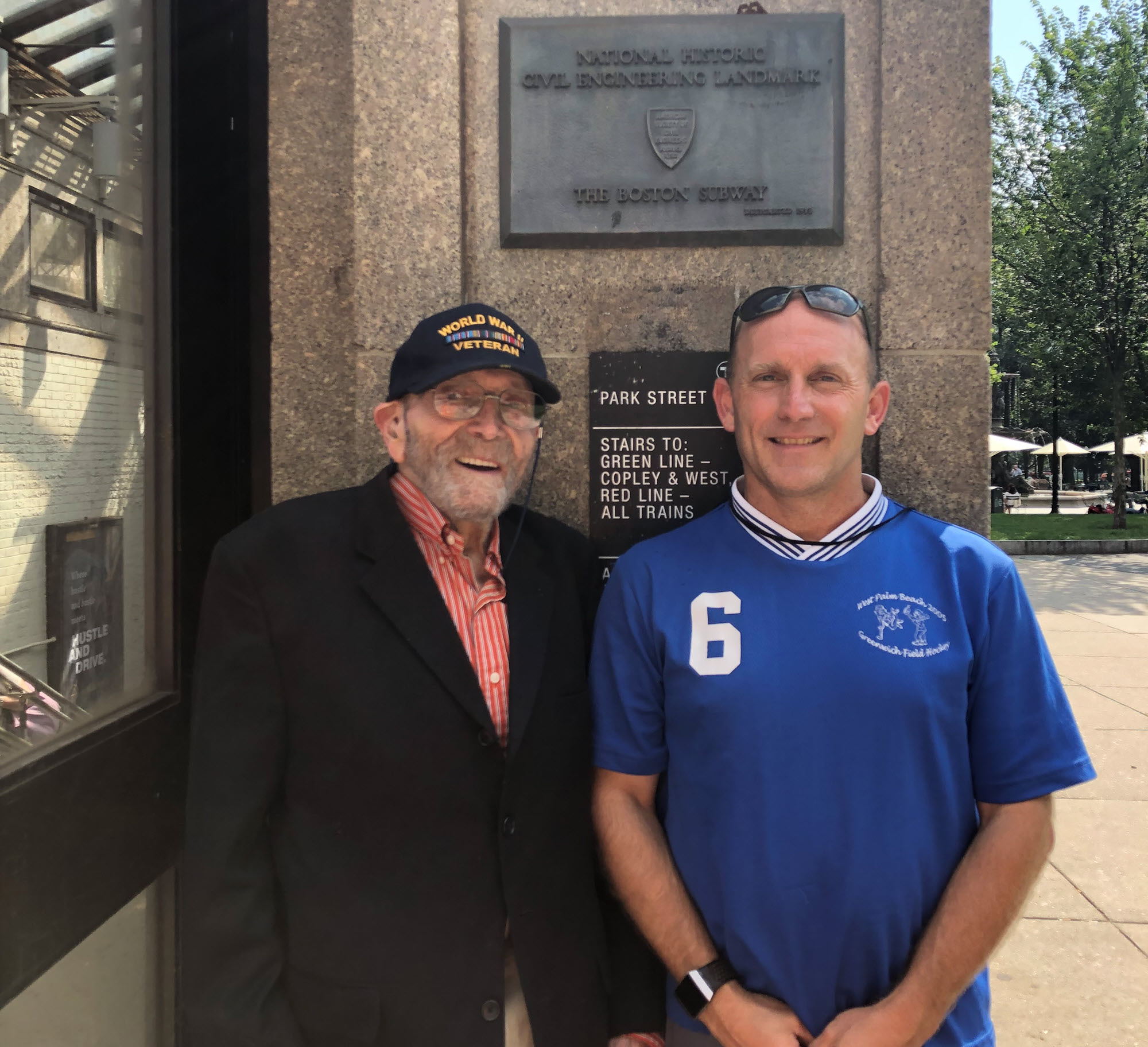 Chip Rogers
 Lasting memories
There was the day in Minnesota that Rogers drove 16 hours into three neighboring states and back to see two civil engineering landmarks, two tripoints, and one high point.
Or the time he mapped out a way to see seven ASCE landmarks across Pennsylvania in one day.
But the single most memorable day of this entire adventure for Rogers far outshines any possible second-best. It’s the day Chip spent with his dad a few years ago in Boston near the end of his life.
“He got dressed up in a coat and slacks for the trip, because he said he wanted to look good for our day together,” Chip said, choking back the emotions still tied up in the memory.
“I got him in the car, and we saw five landmarks together – just the two of us. My dad had been president of the Boston ASCE section years ago; he oversaw the Big Dig, just a brilliant civil engineer. He eventually got over the fact that I went into coaching and not engineering. We joked about it.
“That whole day was special. My mom said later that my dad loved it. He was ecstatic. My love of history, travel, and adventure, and his love of engineering came together.”
Cranston Rogers passed away June 18, 2024, at the age of 99. A World War II veteran, he was laid to rest in Arlington National Cemetery.
Fittingly enough, the family visited the Washington Monument – an ASCE landmark – the day of his interment.
“We went to the top of the monument and took a picture with the ASCE plaque,” Chip said. “My brothers said, ‘See? Still spending time with Dad.’”
And the travels aren’t stopping anytime soon.
When the RedHawk field hockey team travels to play the University of Iowa this spring, you better believe Chip has plans to visit the Hydraulics Lab on campus, built in 1919 and designated an ASCE landmark in 2005.
“This is how I honor my father,” Chip said. “This is how I stay close to him, keep his memory alive. I send pictures to my siblings: “Here’s where I am this week.” And it’s an honor. I’m keeping up the journey. It’s a way we can all remember him.
“And it’s a way I can give back to ASCE, which is really important to me. Being a civil engineer was important to my father. He loved it, and we loved that he loved it, and we were super proud of him. Still are, of course.
“My going and seeing the landmarks is spending time with him, but it’s also a way to thank ASCE for everything they gave to him. When I locate a plaque that’s been lost, or just confirm that it’s still there, and I can share that with ASCE, it’s a small way of saying thanks to an organization that gave so much to my father.”
Learn more about all ASCE’s Historic Civil Engineering Landmarks.
Learn more about Cranston Rogers’ distinguished career.
And get ready to vote in the first ASCE Civil Engineering Landmark Madness (voting opens March 9).