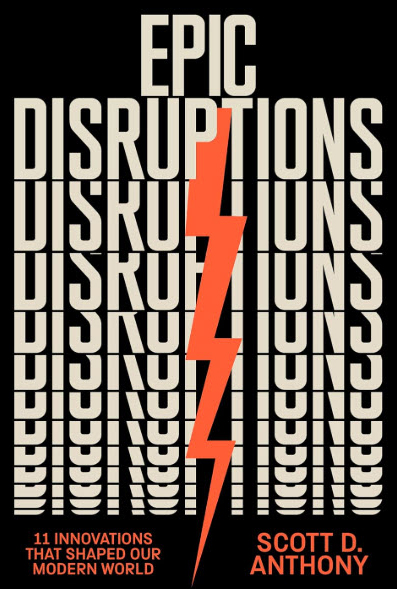
Epic Disruptions: 11 Innovations That Shaped Our Modern World, by Scott D. Anthony. Boston: Harvard Business Review Press, 2025; 288 pages, $32.
“Disruption” in its modern usage describes potentially fundamental shifts – frequently technology driven. The concept was envisioned a mere 30 years ago by the late Clayton “Clay” Christensen, a business consultant, academic researcher, and author who developed and popularized the concept of “disruptive innovations” and their importance.
In Epic Disruptions, his former student, protege, colleague, and friend Scott D. Anthony – who caught the disruption “bug” from Christensen as a student in 2000 and has dedicated much of his career to further study of the subject – carries his mentor’s work forward.
Further reading:
- ‘Undammed’ makes a strong case for dam removal
- New York City’s first subway was secretive, bold, brief – here’s Alfred Beach’s story
- Mega-project success: Author offers advice to land and deliver the big jobs
To do so, he works to correct common misunderstandings about what truly qualifies for the term, and he looks backward – in most cases decades or even centuries before the term “disruptive innovation” had even been articulated. To be disruptive, according to Christensen and Anthony, an innovation must transform an existing market, or create a new one, by “making the complicated simple and the expensive affordable.”
In setting out the “why?” for his book in particular, Anthony notes the importance of understanding disruption for businesses and those managing their careers and lives in the midst of these disruptions. Artificial intelligence, of course, is an obvious and very au courant example of this – though not one the book covers. Not because it doesn’t qualify, but because the author deliberately chose “stories that are generally complete, ones whose implications are clear” – a test AI is still too young to pass.
Another relevant piece of self-awareness that reflects well on the author is his explicitly stated thoughts on the type of book he has written.
“I’m neither a historian nor a trained academic,” Anthony writes, “so let’s call this not a history book but a history-ish book.” He continues that business books (of which he has written many) are, essentially, stories “with abstractions and simplifications in the name of helping to communicate an underlying concept clearly. Business books are all works of fiction. This book is, too, though one grounded in research with the endnotes to prove it.” Refreshingly candid.
Epic Disruptions’ 11 chapters cover a tremendous amount of ground. Some are iconic, somewhat predictable choices told well through a new lens, including the inventions of gunpowder, the printing press, the Model T, the transistor, and the iPhone.
Others are deliberately and delightfully eclectic: Sir Francis Bacon and Robert Boyle’s contributions to the scientific revolution; Florence Nightingale’s polar area chart demonstrating the importance of controlling disease to limit military mortality; and disposable diapers. Particularly fun – and unexpectedly so – are two seemingly opposite food-related entries: Julia Child’s massive success in bringing fine French cooking at home to the masses and McDonald’s invention and perfection of the fast-food business model.
Anthony also includes one final element in each chapter: a later “echo” of that innovation, sometimes in a very different and not obvious space. Without spoiling any surprises, Pampers’ echo is Amazon Web Services, while McDonald’s is Netflix.
In keeping with the author’s aforementioned transparency about what makes a good business book, Epic Disruptions reminds you at reasonable intervals of each selection’s connection to the book’s central ideas while stopping short of beating you over the head with repetition and research.
Pop culture references are sprinkled throughout, and one aside stands out: Anthony’s note (in the middle of the Child chapter) that “every disruption I’ve ever studied” fits the hero’s journey archetype: “Our hero starts a quest, suffers a setback, and, with the support of a mentor, helper, or friend, emerges triumphant.”
No matter the chapter or its particular topic, Anthony’s effortless and ebullient writing style, as well as his evident delight in telling each story, are very likely to carry you onward to the next (although the author notes that the book need not be read chronologically). Though “light” enough to dip in and out of, Epic Disruptions’ smart, educational, and detailed takes might just disrupt how you view revolutionary change.