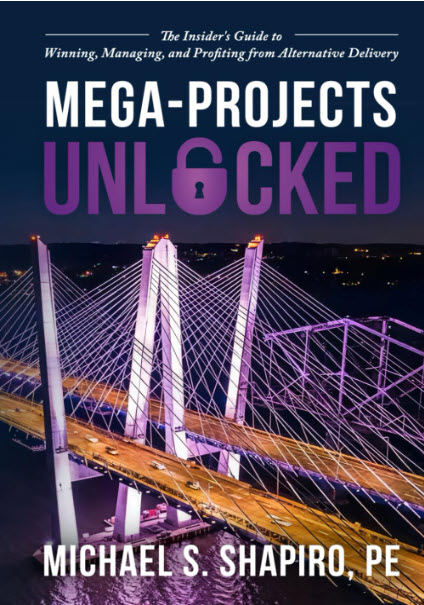
Mega-Projects Unlocked: The Insider’s Guide to Winning, Managing, and Profiting from Alternative Delivery, by Michael S. Shapiro, P.E. Fort Worth, Texas: Game Changer Publishing, 2025; 320 pages, $96.69 ($30.59 digital/paperback).
Alternative delivery mega-projects “are not for the meek or the inexperienced,” Michael S. Shapiro, P.E., M.ASCE, announces near the beginning of Mega-Projects Unlocked. While that may sound like an obvious piece of common sense, the author takes great pains to show, over and over, how important that is throughout the course of the book.
Further reading:
- New York City’s first subway was secretive, bold, brief – here’s Alfred Beach’s story
- An inside look: Resolving the danger surrounding NYC’s Citicorp Tower
- Author chronicles disturbing route that made ‘forever chemicals’ a societal menace
So what is a mega-project? Shapiro pegs it as a project with a construction value exceeding $1 billion, and his most frequent points of reference are highway and related transportation projects, mass transit, and bridges. To that point, the author is covering ground that he knows extremely well.
In a career spanning more than four decades in civil engineering, Shapiro has spent more than 30 years focused on alternative delivery.
In that time, he says he has worked on dozens of AD projects totaling more than $66 billion in construction value. And, helpfully for writing a book such as this one, those have included public-private partnerships, design-build, and other delivery models.
His roles on those projects have ranged from consultant to lead designer to owner’s representative to leading the design-build efforts. So in addition to his experience pursuing, and frequently landing, contracts for these mega-projects, he has seen them from other angles as well.
Unsurprisingly then, given Shapiro’s broad background, he notes that the intended audience for Mega-Projects Unlocked is not just contractors, subcontractors, designers, and consultants but also owners and developers. This is evidenced by the inclusion of a separate chapter each for Owner- and Developer-Specific Processes and Case Studies.
Mega-Projects Unlocked spends a significant portion of its volume focused on preparation in various forms, part of what the author calls a “systematic business approach” that is indispensable for success in this arena. For example, for project targeting Shapiro recommends beginning research and due diligence two years prior to a request for qualification being issued, ideally when projects are first added to a capital improvement plan.
He also discusses developing a formal “go/no-go” form for project evaluation, meeting with the owner, approaching potential teaming partners, and following many other key steps in the early stages. Additional preparation-oriented chapters cover assumptions during proposal preparation, a detailed proposal creation process, and the importance of training and developing a best practices manual for mega-projects.
Shapiro makes very liberal use of case studies throughout the book; in some cases these are longer and more detailed, and in others they are much more concise examples from a real-world project that help the author drive home specific points.
Also worth noting is the highly personal and very conversational writing style. There are many points where the vibe is akin to reading a podcast transcript from an expert speaking almost off the cuff from his own experience. It is disarming, more like a conversation than a lecture, and helpful for connecting with the author’s lived and worked experience in this area.
Packed with detailed advice and process recommendations, as well as lessons learned both the hard way and the easy way from actual projects (or project evaluations), Mega-Projects Unlocked is a look behind the curtain of a long and productive career aimed at pursuing, landing, and executing large projects successfully and profitably.