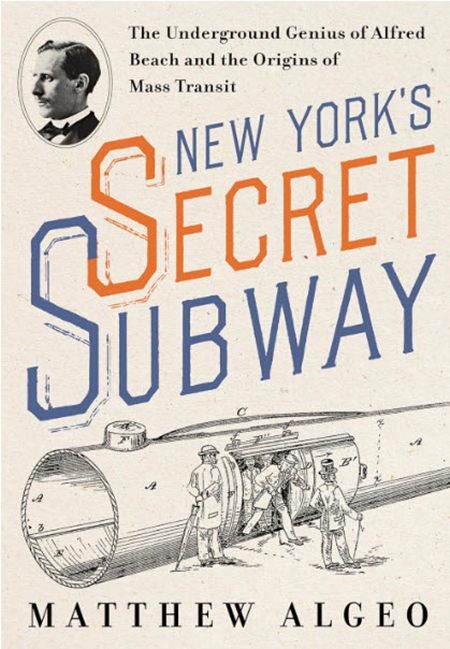
New York’s Secret Subway: The Underground Genius of Alfred Beach and the Origins of Mass Transit, by Matthew Algeo. Washington, D.C.: Island Press, 2025; 288 pages, $35.
New York City’s subway system debuted more than 120 years ago, in 1904. While an impressive feat, it was far from the first underground system; London’s Underground was the oldest, having been operational since 1863.
New York’s system was the ninth to come online and was not even the first in the U.S.; that honor belongs to the Tremont Street subway in Boston, which opened in 1897.
However, as we learn in New York’s Secret Subway, for a time in the 19th century it seemed that this history could have been very different.
Less than a decade after the end of the U.S. Civil War, New York City’s population was approaching 1 million, and its streets were, to put it kindly, a mess. Packed with pedestrians, horses, and horse-drawn vehicles, making the trip to Central Park from city hall could take hours, and the cleanliness left something to be desired as well.
Further reading:
- Advocating for water reuse 1 letter at a time – while also creating an earworm or 2
- In Earth’s human era, we must take bold steps, rethink infrastructure, authors write
- Author chronicles disturbing route that made ‘forever chemicals’ a societal menace
Enter a man named Alfred Beach and an ambitious and audacious idea: He would build, in secret and without a scrap of the legal authority to do so, a demonstration of a pneumatic subway system underneath Broadway to prove it could be done. And build it he did.
The 8-foot-diameter tunnel (bored by a tunneling machine that Beach himself invented) carried passengers 300 feet in cylindrical capsules, pushed by air generated by giant, steam-powered fans. Opening in 1870, complete with an elegant waiting room and richly upholstered seats in the railcars – Beach knew that the technology alone would not be enough to sell his idea – it was a sensation to some … and a perceived threat to others.
Author and journalist Matthew Algeo tells the wonderfully detailed and dramatic story, pulling the reader fully into the world of New York City at the dawn of the Gilded Age. Notorious Tammany Hall chief William “Boss” Tweed plays a portion of the villain’s role, along with a real estate and retail magnate named Alexander Stewart.
Tweed, a board member of a company of horse-drawn street cars, wanted to squash a potential new technology and competitor. Stewart, a constant opponent of any form of public transportation, rather shortsightedly took the view that a subway would be bad for his businesses.
Beach himself is a compelling character. Though certainly not a widely known historical figure today, he was the editor of Scientific American magazine, led one of the largest U.S. patent companies, and was a well-known scientific figure of the day. (Algeo says that Beach was the first person Thomas Edison demonstrated his phonograph to.)
Alas, despite its popular reception and support from the state legislature in passing bills authorizing the enlargement and expansion of the pneumatic line (eventually approved in 1873 despite much maneuvering against it), this version of the New York subway was not to be.
The project needed to secure additional funding to be viable, but the financial Panic of 1873 began one month after the subway had been signed into law. Lasting until 1877, the panic dashed any hope of the project getting off the ground.
While Algeo notes that ultimately, pneumatic subways were a “dead-end technology” that would likely have been surpassed by fully electrified subways anyway, there’s no denying the sheer delight of this short and mostly forgotten chapter of American transportation history.
While one man’s great idea, however relentlessly pursued, did not ultimately win out over corruption, bad timing, and the advance of technology, the marvelously well-told story of how the battle over the secret subway played out is a journey well worth taking.