 Andrew Adams via Unsplash
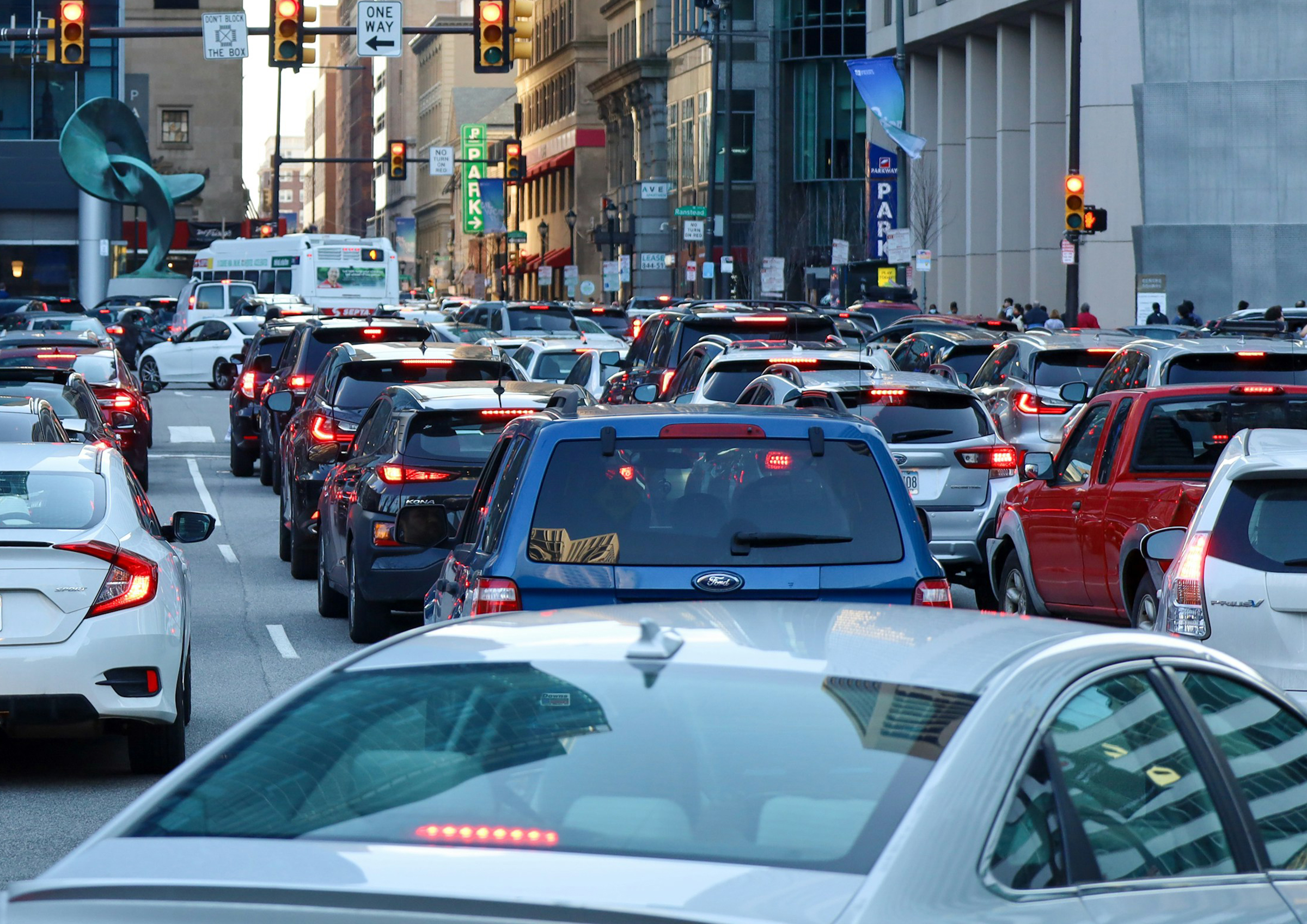
 Traffic congestion has returned to pre-pandemic levels in the U.S., although new norms around remote and hybrid work have spread that traffic across more hours of the day and more days of the week.
With much of urban land at or near buildout, transportation professionals are turning to operational strategies over new infrastructure for managing the steady increase of traffic demands.
Further reading:
- Today's technology can open up traffic to help speed emergency response vehicles
- 1.1-mile tunnel to make highway safer would be California’s longest
- Making our streets safer with proven highway safety countermeasures
Nationwide, the average driver sat through 63 hours of travel delays in 2024, up by 17% compared with 2019, wasting $1,480 worth of fuel, according to the 2025 Urban Mobility Report published by the Texas A&M Transportation Institute with cooperation from traffic-management company INRIX. The average annual delay per commuter now sits as the highest ever for urban areas of all population sizes.
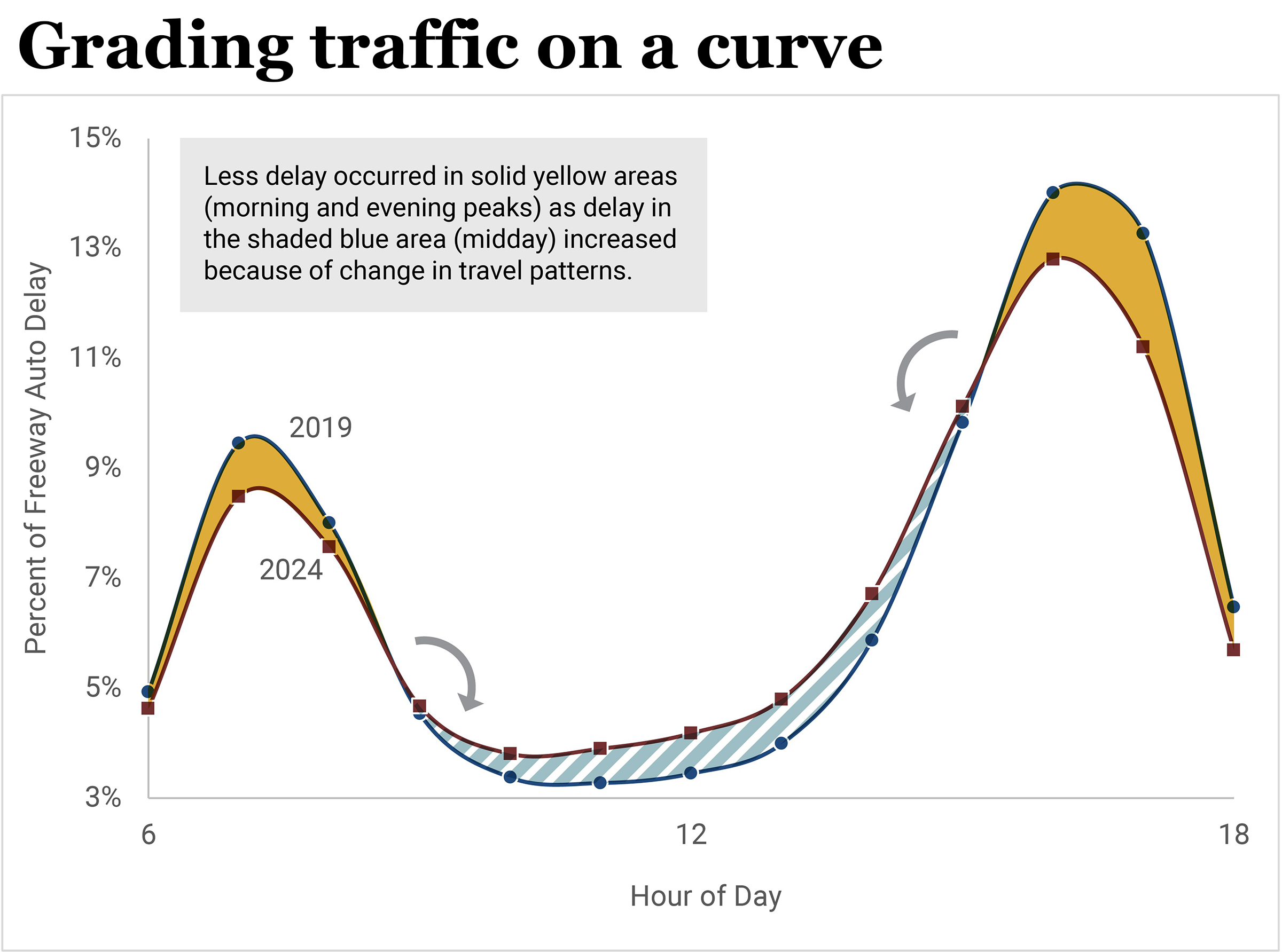
But the familiar morning and evening rush hours have flattened somewhat, feeding a rise in midday congestion and higher levels of travel on the weekends.
David Schrank, Ph.D., TTI senior research scientist and lead author of the study, attributed the redistribution partly to telecommuting habits that emerged during the pandemic.
“We’re seeing more delay occurring sort of middle of the morning into late morning and then sort of earlier in the afternoon than we used to,” Schrank said. “(It) looks like it is probably tied to this hybrid work because I know a lot of people who do exactly the same thing. ‘Why should I sit in traffic when I can be productive and work (from home), and then take half as long to get there at 9 or 10 in the morning?’”
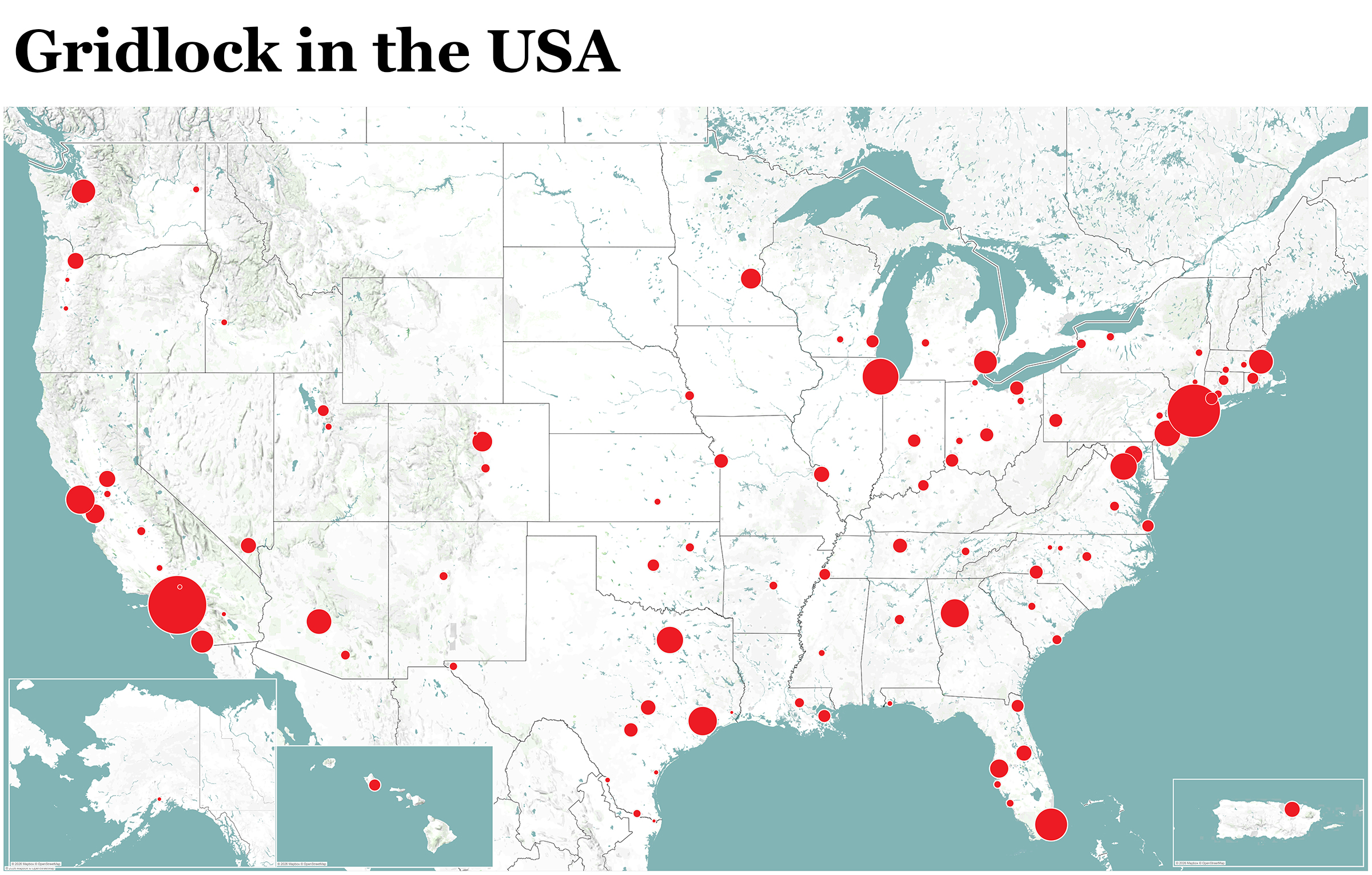
On a weekly basis, commuters will do their best to stay home on Mondays, making it the easiest commuting day of the week, says Schrank. Tuesdays, Wednesdays, and Thursdays have all climbed in traffic levels, with Thursdays now matching Fridays as the worst commuting days of the week when nonwork trips related to the weekend mix with commutes. Saturdays and Sundays have also risen in traffic and congestion.
Shifting patterns
Diniece Mendes, EIT, M.ASCE, the board president of ASCE’s Transportation and Development Institute, says she has seen the nationwide trends reflected in the New York area.
“Travel patterns have shifted significantly, and the pandemic accelerated those changes,” Mendes said. “Traditional peak periods have flattened and stretched across more hours of the day. Telework, shifting economic activity, and the rapid growth of e commerce all play a role.”
The rise of e-commerce and consumer expectations for home delivery have also increased truck traffic, raising the truck proportion of overall congestion cost from 10% in 2014 to 13% in 2024, according to the TTI report. However, the share of truck congestion contributed by the country’s largest 15 urban areas continued to decline in 2024, illustrating the spread of truck congestion across urban areas of all sizes.
While e-commerce has benefited communities by opening access to a wider variety of goods, it has created complex effects on urban congestion, says Mendes.
“It’s not a simple one to one replacement of personal-shopping trips,” Mendes said. “Instead, we’re seeing a significant increase in delivery-vehicle miles in both commercial and residential neighborhoods, and that activity now happens throughout the day and on weekends. These have implications for safety, air quality, and overall health.”
According to the TTI report, 2024 also saw an uptick in trip-time variability, meaning drivers had to leave earlier to ensure on-time arrival even if average trip times remained the same. The higher variability made it harder to plan a trip and suggested that operational strategies could be well suited to manage congestion.
Management over infrastructure
With traffic back, transportation professionals are favoring better management and new technologies for controlling traffic over building new lanes or roads.
“It’s not like a brand-new something is falling out of the sky as it relates to the infrastructure side of it,” Schrank said. “Where things are still evolving is with management and using technology.”
ASCE gave road infrastructure a D+ in its 2025 Report Card for America’s Infrastructure. In addition to more transportation funding, the report recommended new technologies and systems to optimize the capacity of the existing road network. It also categorized the condition of some 39% of the country’s roads as poor to mediocre, and it identified a $684 billion funding gap over the next 10 years.
“Congestion is fundamentally a systems management challenge,” Mendes said. “We can’t build our way out of it. We need to be better stewards of the infrastructure we have by supporting sustainable multimodal mobility, using demand management strategies, and applying every tool available – policy, technology, design, and enforcement. Regions that are succeeding are the ones balancing transportation investments with land use planning and economic development.
“New York and many other cities like it work because of our extensive transit network, and newer strategies like congestion pricing are already showing that pricing incentives can meaningfully reduce demand.”
In January 2025, New York City implemented its Central Business District Tolling Program, the first congestion pricing program in the county, that charges passenger vehicles $9 to enter lower Manhattan during peak hours. Six months after launch, the congestion pricing had reduced traffic by 11%, lowering delays throughout the metropolitan area, reducing crashes, and allowing for shorter bus trips, according to New York’s Metropolitan Transportation Authority.
Hybrid work is itself a traffic-management tool, says Schrank.
If the telework schedule of a single large company adds or removes several thousand vehicle trips per day to roadways, the various companies of a metro area can coordinate to stagger their work-from-home days throughout the week and avoid the scenario of everyone commuting on the same day. Such a setup could save everyone time at little cost to the companies.
Similarly, Schrank says that partnerships between major navigation apps also stand to improve efficiency. If, for example, all navigation apps try to reroute travelers around an interstate crash along the same arterial street, the alternate route would soon become congested. But if the different apps can work together to proactively spread the load across several routes, they can help improve the throughput of the system overall.
“Since the pandemic, congestion management has continued to evolve,” Mendes said. “We’re no longer thinking only in terms of adding lanes or expanding capacity – which is sometimes needed, but we have to be careful about inducing demand. Instead, many state and city agencies are taking a much more holistic approach that leans heavily on flexible demand management strategies and better multimodal integration, which offers more resilience in the system.”
Schrank views the pandemic as a sort of massive traffic experiment that empirically confirmed what traffic professionals have long theorized: Traffic added or removed during select times exerts an outsized impact on overall delays. During the pandemic, the country saw about a 19% reduction in travel centered during peak periods, and that reduction caused an approximate 50% reduction in delays, says Schrank.
“If these efficiencies can be gained with management – 1% here, 2% there – the amount of delay that it can reduce is a number that’s higher than 1 or 2%,” Schrank said.