 Mote Marine Laboratory & Aquarium
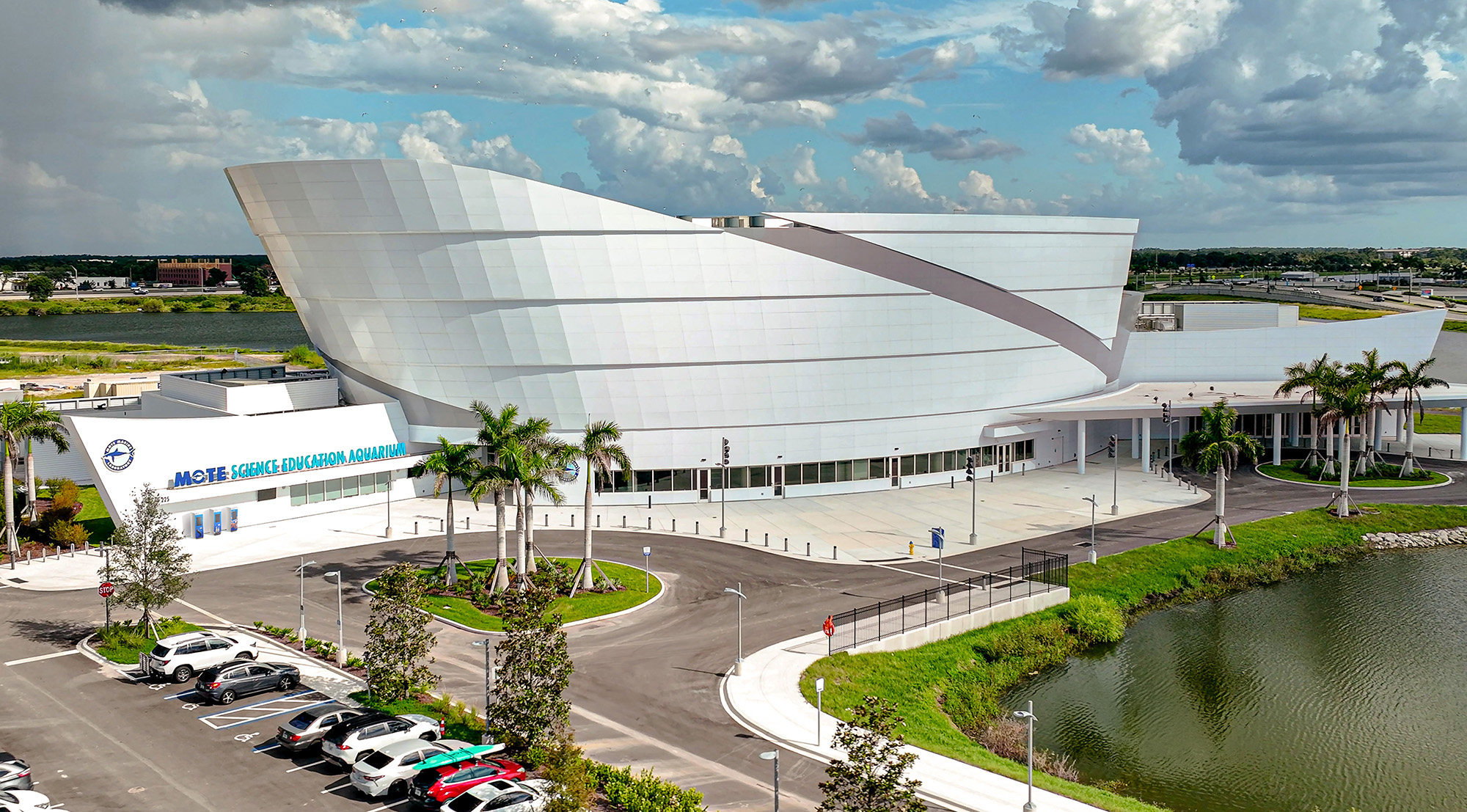
A unique aquarium appearing as a boat on the water opened in October in Sarasota, Florida, providing a new home for marine animals and marine science alike.
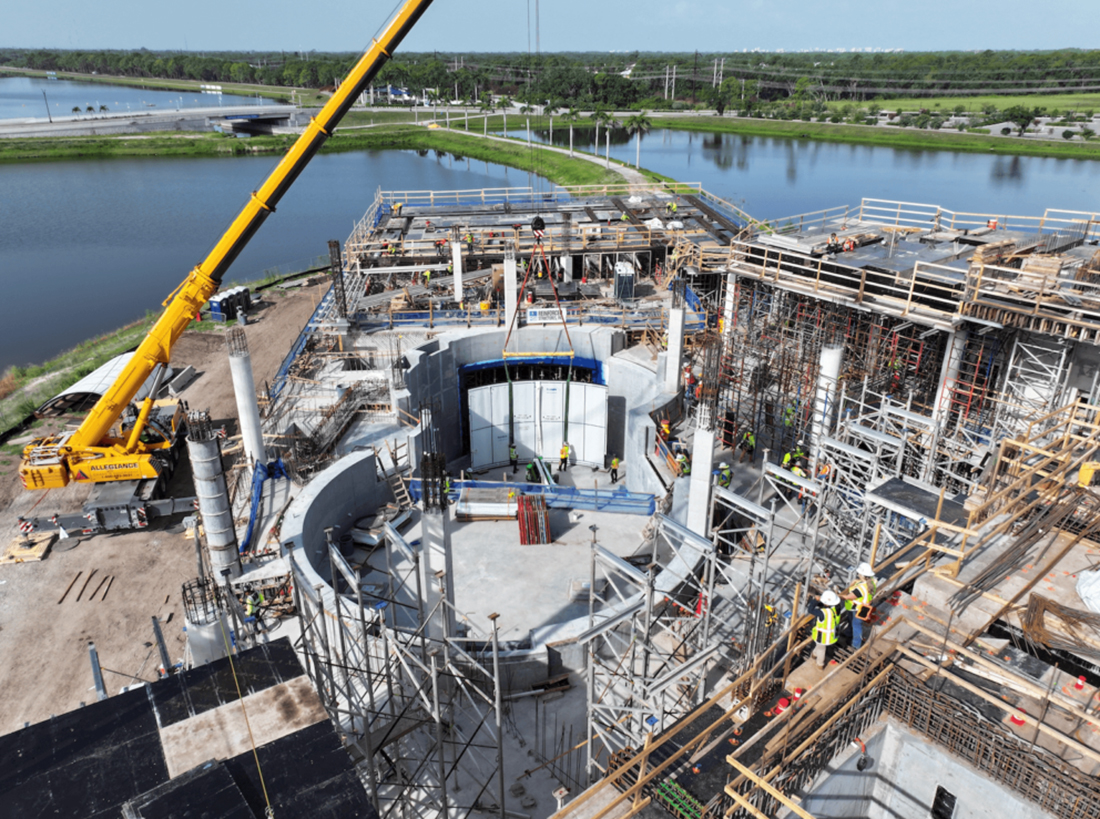
The planning and work that went into creating such an eye-catching building – not to mention the logistics of transporting the animals from their former location – required solutions to unusually complex structural, mechanical, and logistical issues.
Further reading:
- Solar ‘armadillo’ to power up in Taiwan
- Kruunuvuorensilta, Finland’s longest, tallest bridge, set to open with no cars allowed
- Nearing its centennial, Chicago’s Shedd Aquarium gets a face-lift
The design of the building, known as the Mote Science Education Aquarium and operated by the nonprofit Mote Marine Laboratory & Aquarium, navigated challenges around supporting and conditioning the 1 million gallons of water in the aquarium’s exhibits. The new location marks a new chapter in Mote’s mission to educate the public about ocean literacy, marine-science research, and conservation initiatives.
Founded in 1955, Mote operated its previous Mote Aquarium on a 10.5-acre campus on City Island in Sarasota from 1980 through its July 2025 closure. Over the years, the aquarium’s research and visitor traffic there grew, prompting the move.
“As Mote’s research enterprise expanded globally – and as demand for meaningful, hands-on science education increased – it became clear that a new, significantly larger and more advanced facility was needed to reach broader audiences and deepen impact,” Mote representative Kathryn Gentile said. She describes Mote SEA as the next step in the organization’s evolution.
 Mote Marine Laboratory & Aquarium
The new 146,000-square-foot aquarium sits on an artificial peninsula within an artificial lake in Sarasota’s Nathan Benderson Park, which extends to the south of Mote’s new, 12-acre campus. The park’s 400-acre lake hosts regattas, dragon boat races, and other aquatic events.
At three stories tall, the $130 million Mote SEA includes three research and display laboratories; a veterinary surgery and clinic service; three science, technology, engineering, and mathematics education classrooms; offices; a ballroom; a cafe; and an exterior terrace in addition to the aquarium’s exhibits.
Mote emphasized the project’s educational goals in its initial conversations with Atlanta-based TVS Design, the project’s design architect and architect of record.
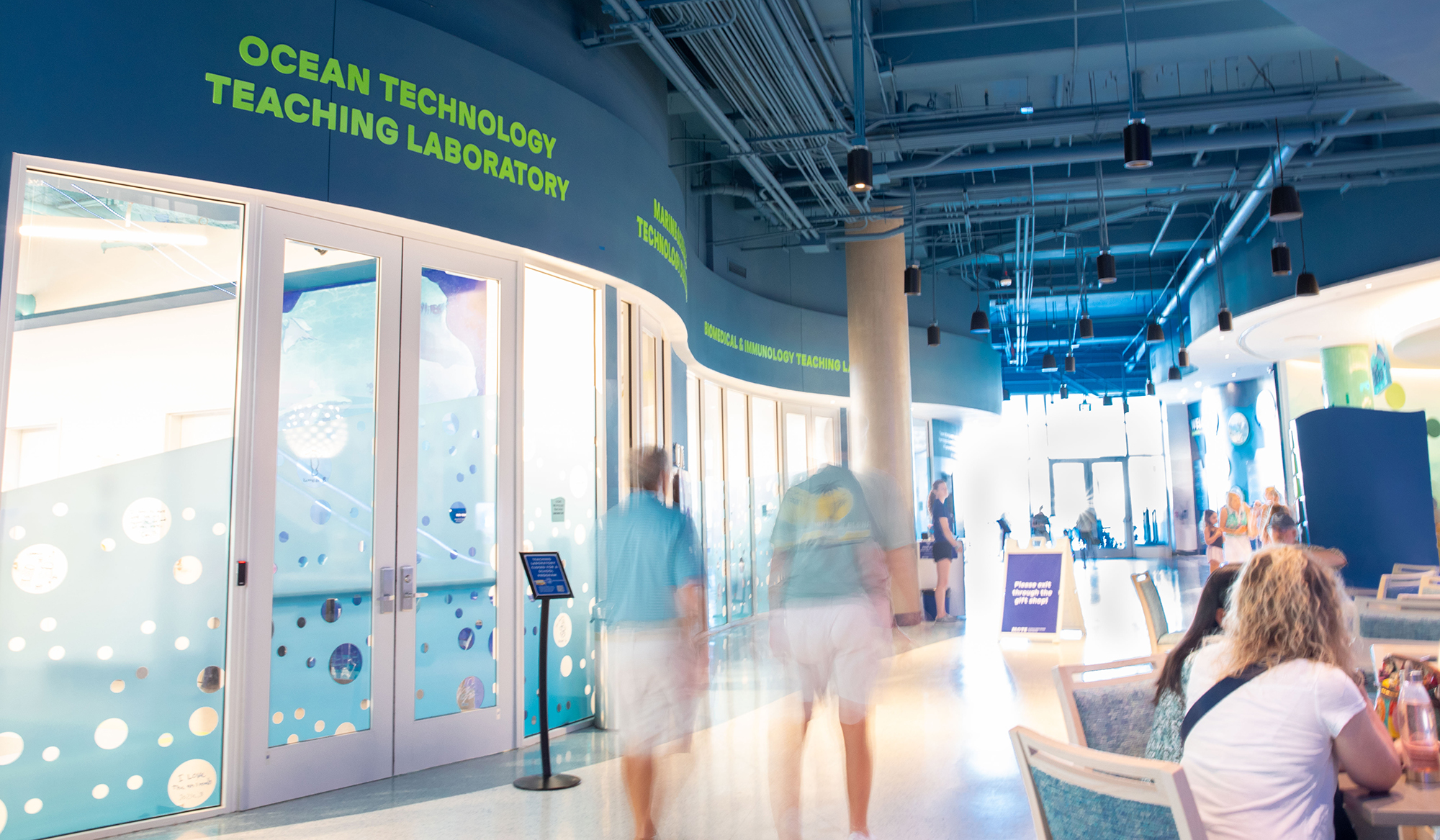
“They wanted education and science to be on the forefront,” said Rob O’Keefe, TVS principal in charge and lead designer. “So, what you notice when you walk in the front doors, the classrooms are to the right; it’s the first thing you see. They really thought of that as their mission in the heart of the facility.”
A boat on the water
Mote also shared a desire for the building to go vertical so that it could be seen from a long distance away, O’Keefe says.
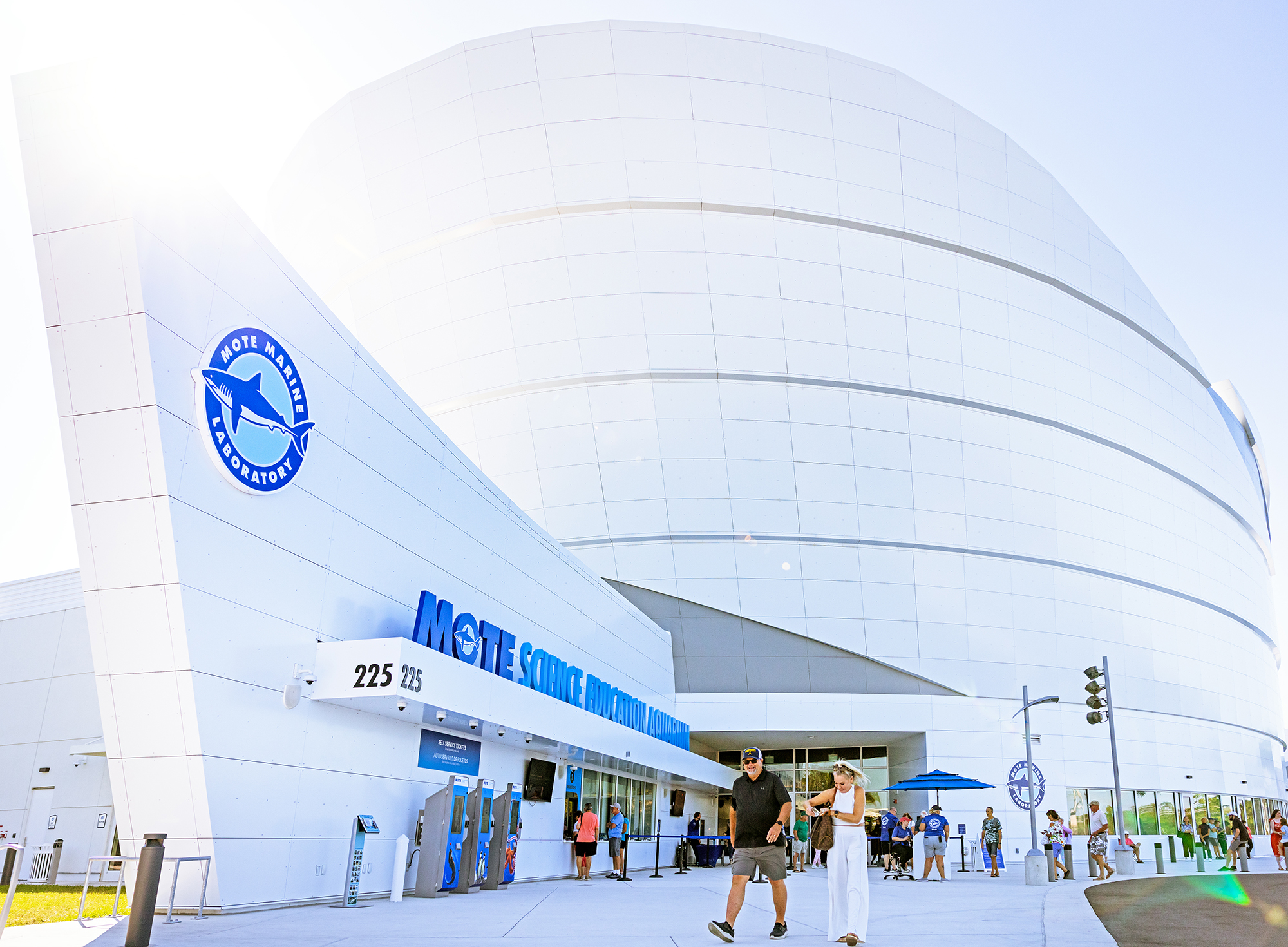
The building’s form, clad in metal panels, angles outward at its north and south ends to give the appearance of the bow and stern of a ship. TVS described the form to be “gesturally understood as a boat, charting the waters in search for new ideas and new information to bring back to its community.”
The peninsula, built from 140,000 cubic yards of dirt, also serves to further the appearance of a boat on the water, placing water in the foreground when looking at the building from the south, east, and west. While earlier designs envisioned the building on more of a centralized island, that idea created challenges around access, serviceability, and operations. TVS therefore advocated to landlock it more while still retaining its integrated feel with the park’s lake.
The project’s previous architect, Cambridge, Massachusetts-based CambridgeSeven, originally interpreted the building’s unique shape as “a water droplet suspended at that moment of tension as it hangs ready to drop.”
Mote President and CEO Michael Crosby’s interest in a nautical theme then helped shape the overall geometry to its final form, O’Keefe says.
“Over time, we started to layer in additional concepts of movement and fluidity,” O’Keefe said. “We started to layer on additional personality traits and design concepts onto just a basic form of a boat so that we could develop some more visual interests.”
 Mote Marine Laboratory & Aquarium
The building’s vertical nature also drove other design decisions, such as those guiding circulation and massing. Inside, Mote and TVS opted for a hub-and-spoke circulation model as opposed to a linear one to provide a bit more flexibility in how people circulate through the building.
Dublin, Ohio-based design studio Roto Group LLC worked on finer-scale circulation elements as the project’s exhibit design partner.
Designing for animals
Mote SEA’s residents include species ranging from gopher tortoises to jellyfish to penguins. In contrast to other buildings, aquariums must house a whole set of mechanical systems – the filters, pipes, and pumps known as life-support systems – that work to keep the animals alive. These systems maintain water characteristics such as chemistry, temperature, and clarity specific to each tank.
The life-support systems, in addition to carrying a load, can occupy up to a third of the overall building space, and therefore drove the design from the beginning, O’Keefe says.
The weight of the water itself also presented challenges. Altogether, the aquarium’s tanks hold 1 million gallons of saltwater, which is denser than freshwater, adding to the structure some 4,300 tons of load. Mote SEA’s first-floor centerpiece Gulf Coast tank alone – home to sharks, rays, and sea turtles – holds 400,000 gallons of water. Its two acrylic windows together weigh over 25 tons.
Another comparable tank housing manatees sits on the third floor, and it called for a “fun little exercise” to distribute the tank’s weight through the rest of the building, O’Keefe said.
Not only did the project have to accommodate the animals at their new location, it also had to get them there. The animals made the 13-mile trip through Sarasota from the old aquarium in specialized vehicles, Gentile says, with attention to individual needs.
“The transfer process started with ensuring the habitats at Mote SEA had appropriate water chemistry and microbial communities,” she said. “Each animal was carefully prepared for transport and monitored by Mote’s expert veterinary and animal care staff throughout the journey to ensure their well-being and safety. Animals were transported in specialized containers and vehicles built to maintain stable temperature, oxygenation, and water quality.”
Upon arrival, Mote SEA staff then guided the animals through a careful acclimation process, balancing water chemistry and minimizing handling. Gentile says that the animals have acclimated well to their new, larger home.
O’Keefe adds that since its opening, Mote SEA has drawn community excitement, including sold-out weekends.
“We love to hear that; we love to be a part of the process,” O’Keefe said. “Ultimately, it’s their building, not ours, and we want to make sure that we design it so it's more successful and sustainable.”
 Mote Marine Laboratory & Aquarium

What’s Your Big Idea?
Big infrastructure challenges require big infrastructure solutions, and ASCE2027 is your place for those big ideas.
ASCE2027: The Infrastructure and Engineering Experience is a first-of-its-kind event, bringing together big thinkers from all across the infrastructure space, March 1-5, 2027, in Philadelphia. Pack your big ideas and join the discussion.