 Courtesy of Parsons
As bridge asset managers rehabilitate aging infrastructure, they are turning to artificial intelligence models to predict defects. The technology has also helped analyze preexisting data to model bridges, improving the efficiency of planning and assessment.
Between 2015 and 2025, the number of U.S. bridges in good condition dropped from 47.3% to 43.7%, according to the Federal Highway Administration’s National Bridge Inventory. The FHWA inventory provides bridge counts and conditions to bridge owners and the general public.
Further reading:
- Is artificial intelligence conscious, and if so, could bridges be involved?
- Texas DOT works to leverage artificial intelligence’s power
- When intelligence is artificial, what happens to ours?
In 2025, 49.6% of bridges were ranked as fair and 6.7% as poor. Iowa (18.7%), West Virginia (17.8%), and South Dakota (16.1%) had the highest percentage of poor-condition bridges, while Nevada (1%), Arizona (1.1%), and Delaware (1.1%) had the lowest percentage.
Meanwhile, ASCE’s 2025 Report Card for America’s Infrastructure gave bridge infrastructure a grade of C and projected a $373 billion funding gap for bridges between 2024 and 2033. It also highlighted the growing proportion of bridges in fair condition, as the share of both good- and poor-condition bridges has shrunk. ASCE estimates the average age of U.S. bridges at 47 years old.
“As bridges in fair condition continue to age – presenting the possibility of being further downgraded – they also exemplify an opportunity because they can be preserved at a lower cost than bridges in poor condition,” the report card chapter’s authors wrote.
 Courtesy of HDR
 Predicting future conditions
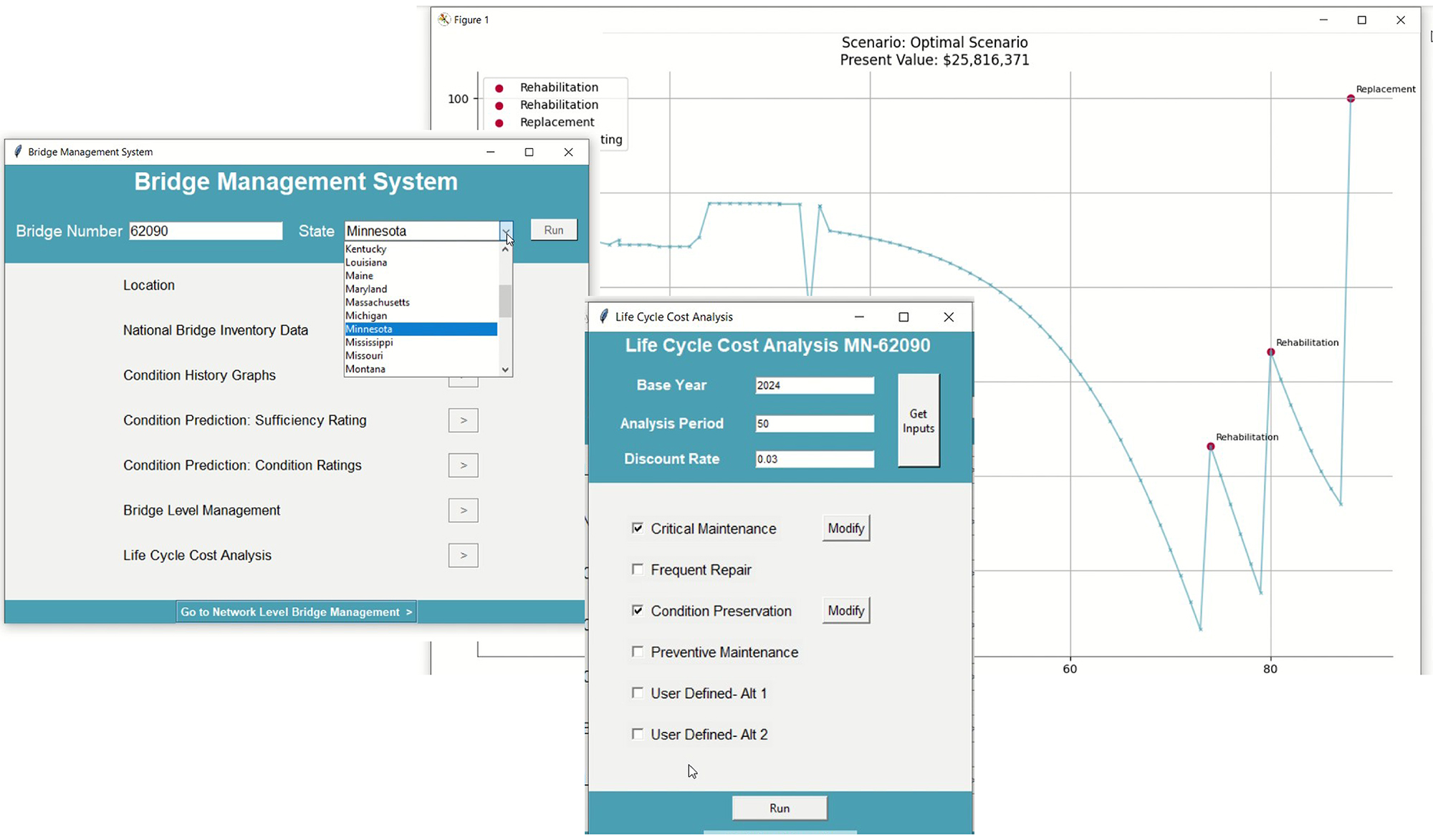
Capitalizing on that opportunity, Maryam Bostani, Ph.D., P.Eng., PMP, AI practice lead of bridges and structures at global architecture, engineering, and construction firm HDR, developed AI-based bridge-management systems to better prioritize limited rehabilitation dollars. She sees predictive systems shifting the industry from reactive repair cycles to a more cost-effective, proactive approach. Such a strategy could help prevent the snowballing of costs associated with deferred maintenance.
“Before bridge management, the idea was that they usually repair the bridge after deterioration or on a predefined schedule,” Bostani said. “But as we get more and more data and we get more confident in the data, we kind of want the bridge to tell us what’s going to be its condition in the future.”
Bostani trained AI models on public NBI data. The models looked for patterns to forecast future bridge performance and inform expert decision-making.
In addition to the predictions, users of the tool can test different intervention strategies and see how each affects long-term outcomes. By estimating the associated life-cycle cost for each scenario, the tool can help optimize a future balance between bridge condition and life-cycle cost.
To train such a model, Bostani first invested time cleaning the data, looking for small mistakes that would mislead the model. The structure number that identifies bridges, for example, sometimes changes over the life of a bridge. For a few of the bridges, it changed several times, meaning Bostani had to write programs to compare other bridge data and link disparate scans into a single history.
“The programs are learning from the data, so you need to make sure your data is good data,” Bostani said.
Once trained, the programs were backtested against existing past data. The most recent five to 10 years of data, for example, was intentionally withheld from the training set, so that it could be compared with the program’s predictive output. Additional verifications, such as statistical analyses and comparisons to other methods, were also applied.
Finally, at HDR, human engineers ultimately decide how to use the AI outputs. The programs are not relied upon for expert judgment, Bostani said.
“It’s just helping the expert by giving some idea that, ‘OK, maybe look at this bridge as well. Look at this. Maybe if you do it this way, it’s going to help you reduce your costs and make sure your bridges are in good condition,’” she said. “That’s the whole idea.”
Unlocking data
Jim Birdsall, Ph.D., P.E., chief technology officer of infrastructure for North America at Parsons Corp., also sees AI methods as an opportunity to activate existing data. The engineering firm has used drones for the past seven years in bridge inspections, capturing point clouds and photographs from many different angles. While the technology has produced a data-rich environment, a lack of structure has kept it largely inaccessible to stakeholders.
Recent AI analyses have effectively unlocked that data, Birdsall said. His team trained an AI program to produce a full structural model from a point cloud. While traditional 3D modeling previously required extensive surveying and legacy drawings, the program eliminates one of the most time-consuming manual steps.
“Once you have that three-dimensional model, you have a place to then start tagging information into it,” Birdsall said. “That’s really bringing it to life, so that broader individuals coming on-site – it might be a maintenance individual, it might be someone from the community – they’re able to quickly identify (and) digest that in an environment that they’re used to, which is a three-dimensional space, and bring that information into personal knowledge.”
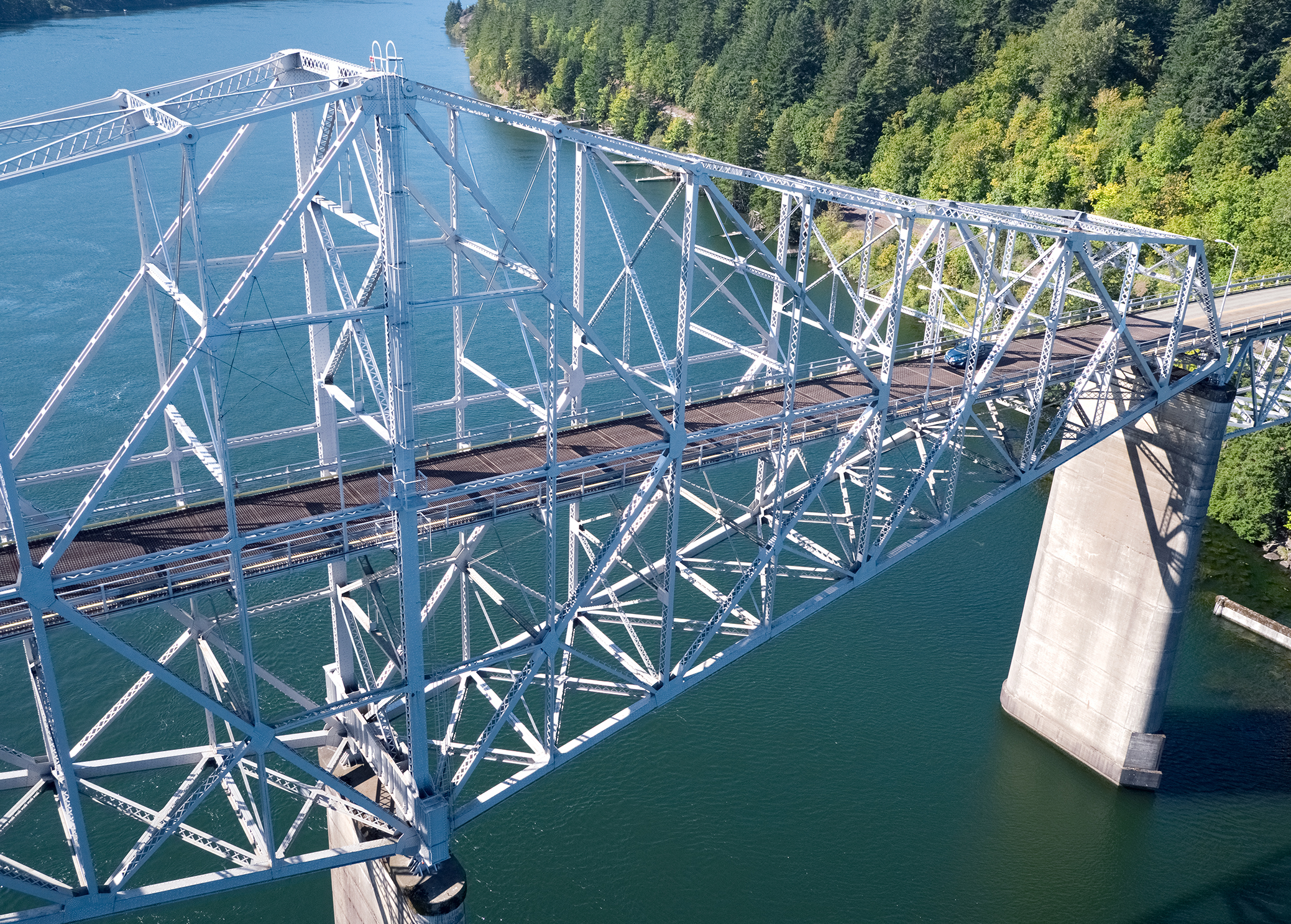
As one example, Parsons generated a building information model of the Bridge of the Gods in Oregon based on lidar scans and point-cloud data. The program identified general locations of nodes by looking at the different elements going into those nodes, then performed secondary, tertiary, and sometimes quaternary verifications using broader information.
While Birdsall doesn’t consider the result to be survey grade, “in terms of a broader-scale standpoint to create that three-dimensional model (and) provide that venue for broader information communication, it’s great.”
 Courtesy of HDR
AI-driven scan-to-BIM workflows could produce a boon for digital bridge inventories. The models would assist predictive strategies such as Bostani’s as well as inspection programs in general.
The main AI challenge now is pairing the right technology with the right project, Birdsall said.
“A technology capability is great, but if it’s off by itself, the value that it provides is actually pretty limited,” Birdsall said. “It’s when you take that capability, and you put it in the broader business process, that’s when you really have that bumper crop of value coming from it.”
The support from a firm’s executive level – and whether executives have a clear vision of what AI can offer to their organization’s capability and the broader industry – largely determines the success of a team’s foray into AI usage, he continued.
Birdsall is also optimistic about AI’s effect on those entering the industry now. Early career professionals able to replace physical manuals and notebooks with large-language models can claim an advantage in how quickly they come up to speed in a given area or project.
“The most important thing for early career professional individuals to ask is, ‘How can I help?’” said Birdsall. “Very commonly, individuals are working from a spread-out geographical location. They’re focused on their immediate task. But the value of what they’re doing comes in by how they know to interact and interface with their broader team members and broader delivery activities.”

Feed Your Brain
Interested in artificial intelligence and how it intersects with bridges? These are the kinds of topics you can expect at ASCE2027: The Infrastructure and Engineering Experience, a first-of-its-kind event bringing together subject-matter experts from all across the infrastructure space, March 1-5, 2027, in Philadelphia. So, yes, we know you’re excited about the Philly cheesesteaks, but ASCE2027 also is the perfect place to satisfy your appetite for learning.
Technical deep dives. Infrastructure expertise. Come feast!
Learn more about ASCE2027: The Infrastructure and Engineering Experience.