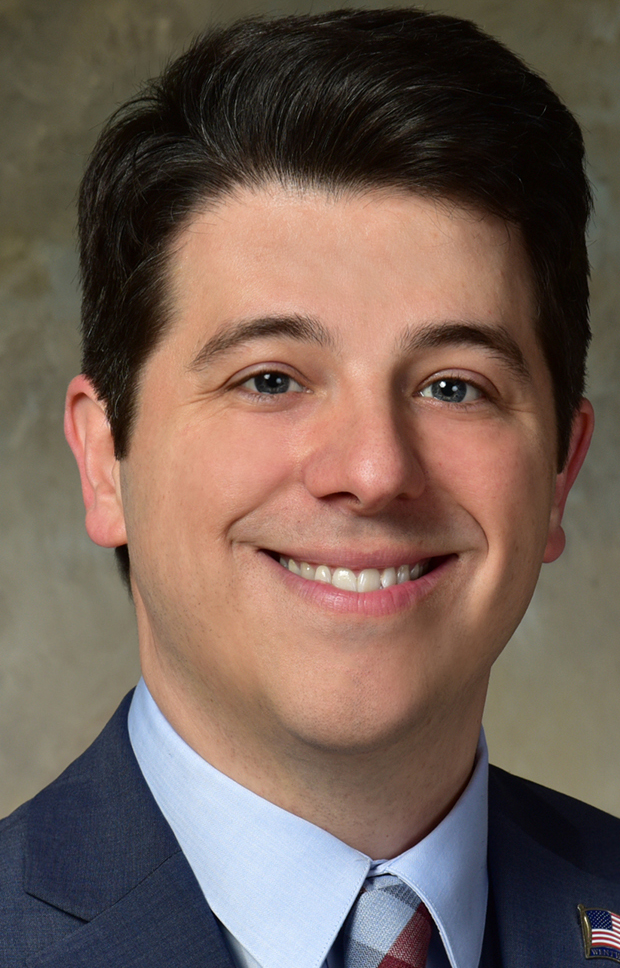
View from the C-suite is a monthly interview series with leaders in the civil engineering industry, designed to provide peers with insight into advancing their careers. This month’s installment features Nicholas Golon, P.E., M.ASCE, president and chief engineer at TFMoran in Bedford, New Hampshire. Golon is a past president of ASCE’s New Hampshire Section and previously served on the section’s board of directors.
Civil Engineering Source: How would you describe your leadership philosophy?
Nicholas Golon: Situational leadership. We have such a diverse group of people, and I can’t lead all of them the same way. Some folks need one-on-one attention and some folks I need to leave to their own devices to work through an assignment. I need to be able to adapt based on what the needs are. It looks different for different people, but a lot of my job is reassuring people that they are capable of doing their job and putting them in the best place to be successful because their successes are the company’s successes.
Further reading:
- Civil engineers can help firms and advance careers by speaking up, leader says
- From mentee to mentor: This civil engineering leader offers career growth advice
- There’s no single path up the career ladder for civil engineers, executive says
Source: What three nontechnical skills should all civil engineers cultivate in their practices?
NG: There are three things that all involve communication because that is typically not our strong suit. Verbal communication, nonverbal communication, and visual communication. Verbal communication: As engineers, we are tasked with presenting very robust concepts to clients or regulators, and it can be difficult to present a project message to the public. To be able to gather your thoughts and put them into a format that is easily digestible is a powerful skill. The best engineers can do the math and then explain why the client should implement what we’re proposing.
Nonverbal communication: There is training involved here. I wouldn’t call it a “poker face,” but you need to learn to be stoic and keep that professional edge where you’re really listening and engaging.
Visual communication: A visual aid can be a powerful tool because everybody learns differently. I often have to draw concepts on whiteboards around my office so that I can explain them better.
Source: What is your greatest career accomplishment?
NG: Becoming an owner, a principal, of TFMoran in 2020 was an important step for me. Not only because of that ownership element, but it’s something that my dad and I talked about. He passed away at Christmas in 2019. When I think of an accomplishment, being able to maintain that connection to my dad throughout the course of … every day, that’s special. I get emotional about it even though people say not to wear your emotions on your sleeve because that’s who I am.
At age 45, I’ve come to the realization as to who I am and what my strengths and weaknesses are. I try and reinforce the weaknesses the best I can, and I know what my best capabilities are. And sometimes, that can be leading with emotion because it’s honest, transparent, and it can connect me to the people I’m working with.
Source: What is one of your career regrets? And what did you learn from it?
NG: I like to think I don’t have any regrets because, good decision or bad decision, my decisions have brought me to where I am today. At the same time, I remember a time early in my career, my best college friend shared a really neat job opportunity with me in Atlanta at a company that seemed like it had a great culture.
It was a yearlong opportunity, and I could have worked with my friend. The company wined and dined me and was going to buy me a house. … I thought it would be amazing. I had the opportunity to try something new … and I didn’t take it.
I’m very happy with where I am and the decisions I made, but I wish I would have taken that chance to see what would have happened. For any young professionals who read this, take this regret to heart and take a risk.
Source: Who has helped shape your civil engineering career?
NG: My dad played a huge role in shaping my career.
Also, my seventh-grade shop teacher. That year that I decided I wanted to be a civil engineer. There was a truss-building competition for the school, and I created an elaborate design.
My teacher said I didn’t have time to build it, but he knew I was a little pigheaded and gave me the opportunity to stay after class to finish it. The point of the competition was to see whose truss held the most weight, and it turned out my truss was so strong they didn’t have enough weight to break it.

It was this euphoric moment for me, and I asked my teacher if there was a job where I could do this when I grew up. That’s when he told me about civil engineering.
Source: What are you currently learning?
NG: How to be the president of TFMoran. We had a lengthy succession plan, and I learned a lot from the past president before I moved into his role, but the reality is I’m learning as I go. The company’s tenets of honesty and transparency are the same, but my leadership style is different than his was, and I’m learning that I always have to be ready to pivot.
I walk into my office each morning around 8 a.m. with my list of things to get done for the day, and by 8:05 a.m., there are usually things that have popped up that are more important to the company for me to do instead.
I’m enjoying learning this role as I go, and I’m very appreciative of the supporting cast I have around me.