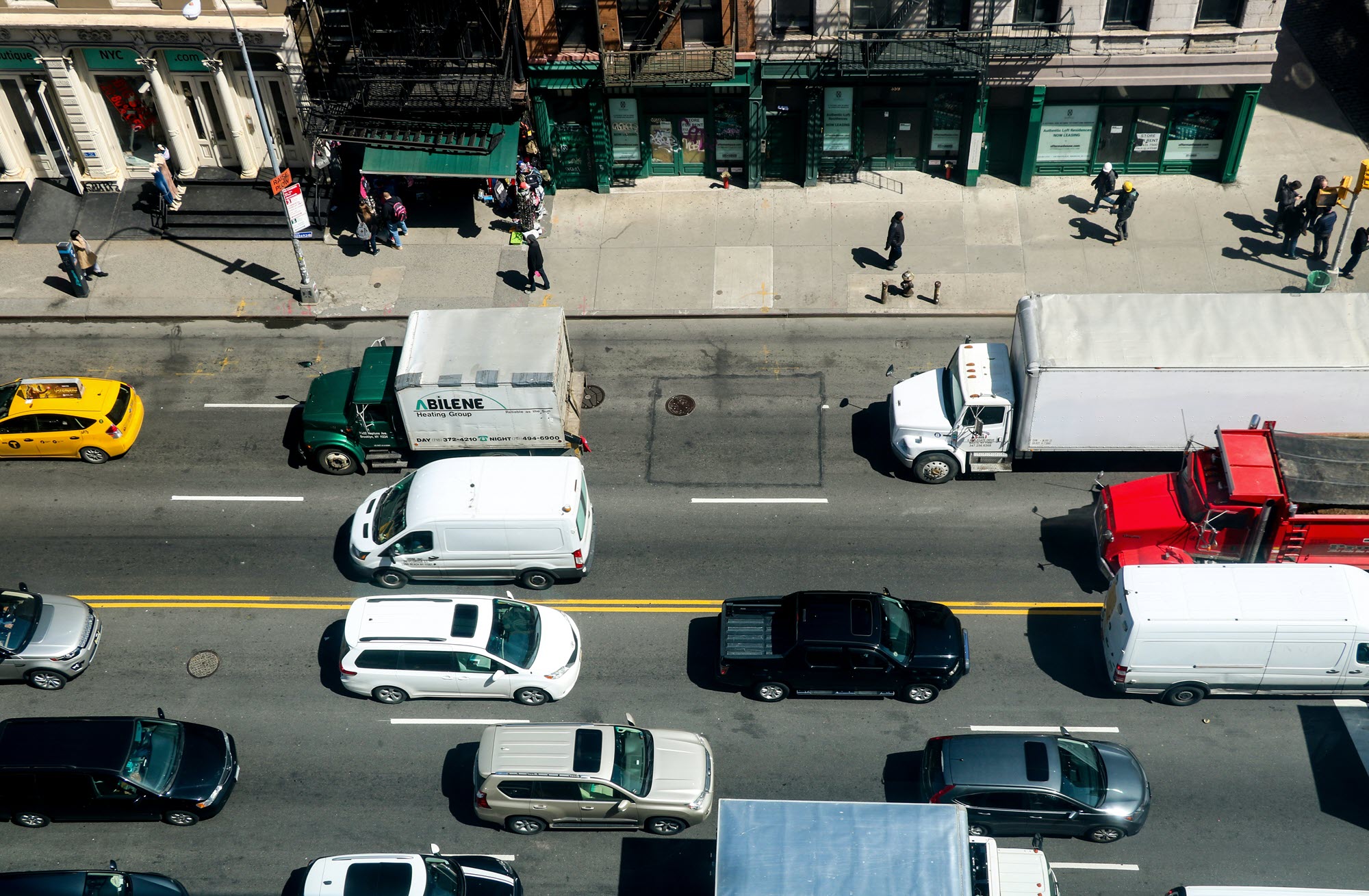
The numbers are in: nationwide traffic deaths dropped by 6.7% in 2025.
That year, there were 36,640 crash fatalities, as opposed to over 39,000 in 2024, according to data from the National Highway Traffic Safety Administration. This marked the second-lowest fatality rate in recorded U.S. history: 1.1 fatalities per 100 million vehicle miles traveled.
The drop signals that things are headed in the right direction. But what is behind these positive traffic statistics?
Civil engineers say it’s impossible to credit the numbers to one specific factor. Infrastructure improvements, traffic safety campaigns, and a growing emphasis on “complete streets” – roads designed with nondrivers in mind – all could have contributed.
Although nationwide fatalities are down, not all states or localities have experienced the same positive trend; improving the numbers is an ongoing process.
Complex problems, complex solutions
“As we talk about trends and fatalities, it's important to acknowledge the change in the nationwide average,” said Kristina Swallow, P.E., F.ASCE, Pres.18.ASCE, assistant city manager of Tucson, Arizona, and former director of the Nevada Department of Transportation. “But what are we seeing in individual communities, and where are we seeing actual sustained changes?”
When designing a roadway, engineers consider a variety of factors, including road context and intent, desired travel speed, vehicle volumes, and increasingly pedestrian and bicyclist volumes and crossings, Swallow said.
When it comes to intersections, civil engineers are more frequently turning to roundabouts. According to the Federal Highway Administration, roundabouts reduce fatal and injury crashes by 82% compared with two-way stop-controlled intersections and by 78% compared with signalized intersections.
Lauren Kilgore, M.ASCE, a roadway engineer at Kimley-Horn and a 2026 New Face of Civil Engineering, said roundabouts can help reduce variations in driver behavior at intersections.
“People are going to have different interpretations on what to do when the light turns yellow,” she said.
Removing the light – or the option to run a stop sign – removes that inconsistency. It also simplifies drivers’ decision-making.
“So, you're able to make that decision of, ‘Can I go make this turn?’ a lot quicker than if you were coming to a stop sign and you have to look left, look right, and look left one more time,” Kilgore said. “And that helps the traffic go.”
Roundabout entry angles also prevent head-on collisions.
“Maybe there’s a little sideswipe; you can't control everything,” she said. “But we're trying to use geometry as our friend in these things, and that's the best way to go about that.”
Improving safety doesn’t always require a major change. John Borkowski, P.E., PTOE, PTP, RSP1, practice leader for traffic at KCI Technologies, said that even things that seem small likely have major impacts on safety.
“Specifics like dynamic curve warning signs, rectangular rapid flash beacons, and ADA compliance are some of the infrastructure improvements that appear to be making roads safer,” he said.
Even with safety improvements, drivers can behave erratically, which is where enforcement comes into play.
Speed safety camera enforcement has proved effective. According to the NHTSA, studies have shown that the implementation of SSC systems can reduce roadway fatalities and injuries by as much as 37%.
“In some communities, they have photo enforcement, and they have found that this leads to reduced speeding and speed variation, which leads to fewer high-speed crashes, and fewer fatalities in the long run,” said Swallow. “So, photo enforcement does work.”
But photo enforcement brings up several important concerns.
“(Photo enforcement) is really tricky because there are a whole lot of complexities to consider,” she continued. “How do we navigate the positive outcomes on the road and … ensure that (enforcement) is equitable in terms of the costs and impacts? How do we balance positive outcomes with concerns regarding security, safety, and privacy?”
Are our streets complete?
Complete streets are designed to include pedestrians, cyclists, and public transit users navigating the roads alongside personal motor vehicles. They include sidewalks, bike and bus lanes, accessible stops, pedestrian crossing signals, and other similar improvements.
And “more and more areas seem to be embracing complete streets initiatives and context-sensitive design solutions as they design or maintain their infrastructure,” Borkowski noted.
In many areas across the country, roadways have always been designed exclusively for cars. Today, “our challenge as engineers is to really identify and design for all users,” said Swallow.
“Our systems are frequently designed primarily for cars, and we, as drivers, tend to be blind to pedestrians, to the people who are walking, the people who are biking, the people who are on scooters – until you stop and watch for them,” she added.
Complete streets are more commonly found in areas with heavy pedestrian traffic, but there are ways to integrate these principles on all types of roads.
“As we balance accessibility and mobility needs in our communities, we're not going to provide a crosswalk at every location,” Swallow said. “But can we provide appropriate and safe crossings where needed? If the bus stop is across the road from an apartment complex, consider providing a crosswalk for the riders or relocating the bus stop to the crosswalk location.”
For these features to work, crossings must be obvious to drivers. And to work properly, signals need to be adapted to match speed – drivers going 45 mph see things very differently than those going 25.
“If I'm driving 45 miles an hour, I am not seeing what the pedestrian thinks I should see,” Swallow said. “The pedestrian thinks, ‘I'm right here, I see the car, the car should see me, why aren't they stopping?’
“The problem is that the driver is looking far downstream because that's where your focus goes,” she said. “The faster you go, the smaller and further away your focus is.”
Civil engineers have a variety of signaling tools that can make crossings more obvious. Stop signs are one option. On faster roads, elevated indicators, such as rectangular rapid flashing beacons, can increase visibility.
One example is the High-intensity Activated crossWalK. When activated, these crossings use multiple indicators to alert drivers to pedestrians, including the signature double red lights over a single yellow light, high-visibility crosswalk markings, stop bars, and other necessary signage for the area, such as school zone signs.
They are very effective, with driver yield rates exceeding 95%.
Fortunately, these safety concepts are catching on.
Municipalities across the country have embraced the principles of Vision Zero, “a strategy to eliminate all traffic fatalities and severe injuries, while increasing safe, healthy, equitable mobility for all,” the program states.
Vision Zero originated in Sweden in the 1990s and is now used in over 70 communities across the U.S. It is centered on the idea that traffic deaths are preventable as opposed to inevitable and uses a systems-based approach rather than focusing on individual responsibility. Complete streets align with this philosophy, and they are catching on across the Vision Zero Network.
“I do think the Vision Zero program and the support the federal government has been giving to providing grants to initiate or maintain Vision Zero programs for various towns, cities, and other areas is making a difference,” Borkowski said.
Through the Safe Streets and Roads for All program established in the Infrastructure Investment and Jobs Act, the federal government provides grants for roadway safety improvements.
And when these projects are successful, neighboring communities might be more inclined to join.
Borkowski said Vision Zero’s growing popularity reflects a shift from reactive to proactive safety plans.
“Making vulnerable road users more of a priority is essential to cutting into the ongoing traffic fatalities on our roads,” he added.
A balancing act
Continuing the national trend – and turning negative local trends around – is a careful combination of policy, design, technology, and education for drivers.
To address concerns about photo enforcement, Georgia passed House Bill 651 that added new requirements for school zone speed cameras, including clear warning signs, periodic accuracy testing, more comprehensive citations, and stricter rules for the issuance and enforcement of citations. The state is working on aligning the bill with the Georgia Manual on Uniform Traffic Control Devices for Streets and Highways.
“We're in a gray area reading the law that goes into effect next year; we're trying to play Tetris to come up with the perfect combination of signage and sign assemblies that are going to be compliant with (the Georgia MUTCD),” Kilgore said.
She believes the biggest improvement would be including roadway engineers in conversations about roadway projects from the beginning. She also recommends keeping pedestrian safety “at the forefront of any type of roadway project” and having more compliance measures in place: “Is it accessible for everyone?”
On the technology side, automakers continue to add new safety features.
“In many cases, these features are becoming standard on their vehicles, therefore, not requiring a buyer to wrestle with the decision to add or not add them,” Borkowski said. “As long as the driver is well informed of these safety features and knows how to use them and what they help with, this should only continue to help our society.”
He emphasized that as technology changes, driver education is paramount.
“With evolving technologies, consideration should be given to more frequent driver education on the rules of the road, understanding the available technologies on the roadways and in the vehicles, and how those all work towards creating a safer driving environment,” he said.
Roadway technology modernization doesn’t only exist within a personal vehicle. Autonomous vehicles are gaining popularity, and as driverless vehicles evolve, they could minimize the impact of dangerous human behaviors behind the wheel.
“Depending on how they're programmed, they could be more reliable than a human driver who could be distracted, impaired, tired, or just have a slower reaction time,” Swallow said.
However, the technology is still developing and has some issues, she noted.
One drawback is an AV’s need for clear road markings and signage. Waymo’s robotaxis, for example, rely on these cues for safety.
“When those types of technologies are introduced, we have to make sure that we have really good signing and marking out on the pavement,” Kilgore said. “That way, those detectors have a consistent target to keep the Waymo in the middle of the lane.”
And beyond technology, more AVs still mean more vehicles on the road and more traffic as a result, said Swallow.
AV policy, too, is a work in progress.
Despite the challenges of policy and technology, Swallow emphasized that in the end, civil engineers are the ones designing the roads, and just because things have been done a certain way before doesn’t mean there isn’t room for flexibility.
“I think there is an opportunity to have more open conversations about the intent of the road I'm designing, who is using it, and how to make it safe for everyone,” she said.