
Claim Reduction is a monthly series by the ASCE Committee on Claims Reduction and Management designed to help engineers learn from problems that others have encountered.
A construction project rarely proceeds exactly as depicted on the original design documents. Drawings are clarified, details are revised, requests for information are answered, unforeseen conditions emerge, and changes occur during construction. Some of those changes result from errors or omissions in the design documents. Others result from owner decisions, contractor means and methods, field conditions, code interpretations, coordination issues, or simply the normal development of a design through construction.
When additional cost or delay follows a design change, however, there can be a tendency to work backward from the outcome: the documents changed; therefore, the design must have been deficient; and because the design was deficient, the design professional must have been negligent.
That reasoning skips an essential step.
As discussed in the prior article, “The Design Professional’s Standard of Care: Legal Foundations, Contractual Risks, and Evolving Protections,” architects and engineers generally are not required to produce perfect documents or guarantee a particular result. Their professional performance is measured against the skill and care ordinarily exercised by similarly situated professionals under similar circumstances and, where applicable, in the same or similar locality.
Accordingly, identifying an error or omission is not the end of a standard-of-care analysis. It is usually the beginning.
1. Error is not synonymous with negligence
One of the most important distinctions in evaluating professional liability is the difference between an error and a negligent error.
Engineering requires judgment. Design professionals make assumptions, select among technically acceptable alternatives, interpret codes and standards, coordinate information supplied by others, and develop designs within limitations of time, budget, scope, and available information. Reasonable professionals can sometimes reach different conclusions without either conclusion necessarily falling below the standard of care.
Similarly, the existence of a drawing discrepancy, omitted detail, specification conflict, or subsequent design revision does not by itself establish negligence.
The relevant question is not simply:
Was there an error?
The better question is:
Given the information reasonably available when the professional performed the service, did the professional exercise the skill and care ordinarily expected of a similarly situated professional under the same or similar circumstances?
The distinction is critical because the first question is often answered with hindsight. The second attempts to evaluate the professional's conduct at the time the professional acted.
2. Avoiding the hindsight standard
Construction disputes are usually evaluated after the problem has become obvious.
- The failed component has been opened.
- Additional testing has been performed.
- The concealed condition is now visible.
- The contractor has discovered an interference.
- The building official has issued an interpretation.
The equipment manufacturer has provided additional information.
Another consultant has proposed a different design.
The forensic reviewer, therefore, knows things that the original designer may not reasonably have known at the time the challenged professional service was performed.
A sound standard-of-care analysis should resist allowing that later knowledge to redefine what should have been known earlier.
This creates an important analytical principle:
Professional conduct should generally be evaluated using the information, standards, circumstances, and reasonable professional knowledge existing when the service was performed – not solely through information developed after the event.
The distinction does not excuse a professional who failed to obtain information that a reasonably prudent professional should have obtained. Instead, it requires a separate inquiry: Was obtaining that information itself part of the applicable standard of care?
That question is very different from assuming that because the information eventually became available, the designer should necessarily have possessed it from the outset.
3. Standard of care is circumstance-specific
The published article emphasized that professional performance is evaluated under the same or similar circumstances and discussed the importance of locality. The same principle extends well beyond geography.
Local practice may also affect how professional responsibilities are customarily allocated among project participants. A design responsibility routinely performed by the engineer in one jurisdiction or market may, under different local practices, be assigned to a fabricator, specialty engineer, contractor, or other participant. Accordingly, locality may be relevant not only to how a professional service is performed, but also to determining which participant would ordinarily be expected to perform it.
The circumstances may include the project's type and complexity; the professional's contractual scope; the phase of design; information supplied by the owner and other consultants; applicable codes and standards; available site information; schedule and budget constraints; the degree of design development; and the professional's role in the project-delivery system.
A 30% design submission should not necessarily be evaluated as though it were an issued-for-construction set. Likewise, a structural engineer retained for a limited specialty scope should not automatically be evaluated as though responsible for overall architectural coordination.
This is where the scope of services and standard of care intersect.
Before asking whether a professional performed a service negligently, the reviewer should first determine whether that service was actually within the design professional's responsibility.
4. Codes establish requirements, but do not eliminate professional judgment
Code compliance is frequently treated as synonymous with standard-of-care compliance. The relationship is more nuanced.
Applicable building codes, regulations, and mandatory standards are important evidence of the requirements confronting a design professional. Failure to address a clearly applicable mandatory requirement may provide powerful evidence of a departure from reasonable professional practice.
But code compliance does not answer every standard-of-care question.
Codes frequently require interpretation. Different provisions can interact or appear inconsistent. Authorities having jurisdiction may interpret requirements differently. Some engineering standards provide multiple permissible analytical approaches. And many professional decisions involve matters that codes do not prescribe at all.
Conversely, demonstrating that a design technically satisfies the minimum requirements of a code does not necessarily establish that every aspect of the professional's performance satisfied the standard of care.
The inquiry therefore remains broader:
What would a reasonably prudent professional have done under these particular circumstances?
5. Design changes require a causation analysis
The distinction becomes especially important when an owner seeks to recover the cost of a construction change.
Assume that an engineer's original detail would have required $100,000 to construct. During construction, the detail is determined to be deficient and is replaced with a technically appropriate detail costing $130,000.
It is tempting to identify the $130,000 change order as the owner's damages.
That calculation may be incorrect.
Had the appropriate detail been included originally, the owner presumably would have paid its construction cost in the original contract price. The relevant damages inquiry therefore may involve the incremental consequences of the error, rather than the entire cost of the corrected work.
For example:
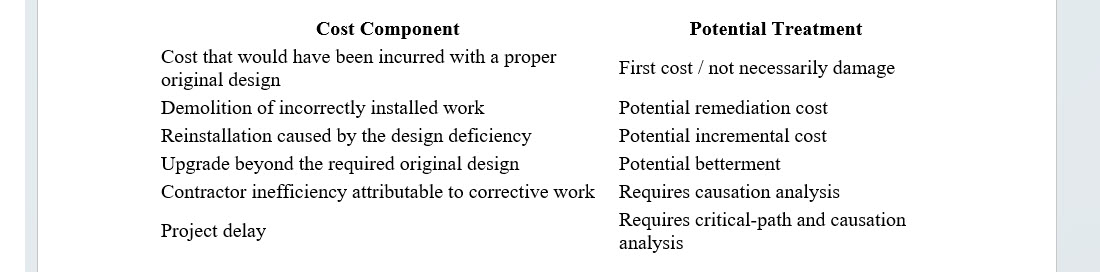
This distinction prevents the standard-of-care inquiry from becoming conflated with the damages analysis.
6. A four-part analytical framework
For claim evaluation, the analysis can be organized into four separate questions:
- Duty – What was the professional required to do?
Begin with the governing agreement and scope of services, then consider applicable codes, regulations, and professional requirements in effect when the service was performed, the design professional’s role, the project delivery method, and the responsibilities assigned to other participants.
- Standard of care – How was that service reasonably expected to be performed?
Evaluate the professional’s conduct against similarly situated practitioners under comparable circumstances, including applicable local practices and requirements where relevant, using information reasonably available at the time.
- Departure from the standard of care – Did the professional's conduct fall below that standard?
An unfavorable result is insufficient. The analysis should identify the particular act or omission and explain why it departed from reasonable professional practice. A design error or omission, standing alone, does not establish professional negligence; the relevant question is whether the professional failed to exercise the skill and care reasonably expected under the circumstances.
- Causation and damages – What consequences resulted from that departure?
Even where a departure from the applicable standard of care is established, the analysis must distinguish consequences actually caused by that departure from first costs, betterment, owner changes, contractor responsibility, concurrent causes, and costs that would have been incurred regardless.
This produces a useful progression:
Duty → Standard of care → Departure from the standard of care → Causation → Damages
Each step should be independently established. A weakness at one step should not be filled by assumptions drawn from another.
7. Documentation of professional judgment
The prior article recommended documenting professional judgment as an important risk-management practice. That recommendation deserves particular emphasis when applying the standard of care.
Years after a design decision was made, the final drawing may show what the engineer decided but reveal very little about why.
Contemporaneous calculations, design narratives, meeting minutes, code analyses, correspondence, assumptions, alternatives considered, review comments, and responses to those comments can provide the context necessary to reconstruct the decision.
Documentation is particularly valuable where several technically reasonable alternatives existed. A later expert may prefer a different solution. Preference, however, is not necessarily proof of negligence.
The relevant question remains whether the approach selected at the time fell within the range of reasonable professional judgment.
8. The role of the standard-of-care expert
A standard-of-care expert should not simply redesign the project.
Nor should the analysis amount to:
“I would have done it differently; therefore, the original engineer was negligent.”
The expert's task is to identify the applicable professional standard and evaluate whether the challenged conduct fell outside the range of reasonable professional practice.
That requires consideration of the contemporaneous circumstances, applicable professional practices, contractual scope, information available to the designer, and the alternatives reasonably available at the time.
The distinction between professional preference and professional negligence is fundamental.
Two competent engineers may legitimately select different solutions. The existence of a preferable alternative – for even an objectively better one – does not necessarily establish that the selected alternative was professionally unreasonable.
9. A practical claim-reduction checklist
When confronted with an alleged design error, the project team should avoid beginning with the cost of the change order. Instead, work through the issue sequentially:
- Identify the alleged act or omission.
- Determine who contractually held responsibility for that issue.
- Establish the applicable standard of care at the time the service was performed, including relevant local practices and requirements where applicable.
- Identify the information reasonably available to the professional.
- Determine whether the professional's conduct departed from that standard.
- Establish the causal connection between any departure and the claimed consequence.
- Separate remediation from first cost and betterment.
- Analyze schedule consequences independently rather than assuming every change caused project delay.
- Consider responsibility of other participants and concurrent causes.
- Document the analysis before positions become entrenched.
This approach can be useful not only after a claim has arisen but also during construction, when the parties still have an opportunity to resolve technical issues without automatically converting them into professional-liability disputes.
Conclusion
The standard of care is not a test of whether a design could have been better. Nor is it a test of whether a drawing contained an error, a specification required clarification, or construction ultimately cost more than anticipated.
It is a test of professional reasonableness under the circumstances existing at the time.
That distinction is important for engineers, owners, contractors, insurers, attorneys, and experts alike. When an unfavorable project outcome is treated as proof of negligence, hindsight replaces professional judgment and every design change risks becoming a professional-liability claim.
A disciplined analysis separates the issues. First determine the professional's duty. Then establish the applicable standard of care. Determine whether the conduct departed from that standard. Only then evaluate whether the departure caused additional cost or delay and what portion of that consequence constitutes actual damage.
That approach does not insulate design professionals from responsibility for negligent work. It does something more important: it places responsibility where it belongs.
Professional negligence should be established by a demonstrated departure from reasonable professional practice – not inferred merely from the existence of an error, change, additional cost, or unfavorable outcome.
Learn more at ASCE’s Risk Management Hub.
Read more helpful insights from the committee’s Claim Reduction series on the Civil Engineering Source.
Want to learn more about risk management? Have thoughts of your own to share? Join the ASCE Community of Practice on Risk Management, where professionals just like you are sharing practical risk management knowledge across multiple disciplines.

