By Kayt Sukel
To ensure the integrity of a concrete structure, a civil engineer dons a specialized augmented reality headset. The engineer doesn’t have to lean into the rebar, measuring tape in hand. Instead, the AR device overlays digital images and other pertinent data onto the real-world view of the built structure.
As a result, this civil engineer can immediately verify that the rebar positioning meets all design and safety specifications or adjust accordingly.
This may sound like a science fiction movie scene, but advances in AR technology could help streamline civil engineering projects of all shapes and sizes, according to Fernando Moreu, Ph.D., P.E., F.ASCE, associate professor in the Gerald May Department of Civil, Construction and Environmental Engineering at the University of New Mexico.
“I worked for 10 and a half years in the industry, mostly in structural design. When I did inspections of reinforced concrete with tape, I had to do it manually, and sometimes I couldn’t reach the reinforcement rebar,” he said.
But the ability to visualize this crucial structural information using AR, leveraging a detailed digital model of the structure’s design, not only makes such an inspection much easier, but it also allows civil engineers to create “a permanent record for the civil engineering flow from the cradle to the grave” that can be used by all infrastructure stakeholders from designers to facilities managers, Moreu said.
Beyond gaming
Unlike virtual reality or a fully computer-generated 3D simulated environment, AR makes use of the real world as a background, augmenting it with overlaid digital images, text, sounds, or other data. AR has already been used in a variety of computer games and apps for entertainment purposes. But its use is becoming more prevalent in various industries, particularly for education and training purposes.
Doctors and nurses are using AR (along with virtual and extended realities) as teaching tools. And some universities are using it to provide interactive instruction to engineering students. For example, the University of Kansas recently published a paper discussing how the use of an AR program helped improve learning outcomes in a structural analysis course for aspiring civil and mechanical engineers.
Civil engineers and construction stakeholders see the benefit in using AR beyond training. There is the inspection example given by Moreu above (the resulting AR application received an award for the most practical solution at the International Workshop on Structural Health Monitoring 2025 at Stanford University in September). Furthermore, Tom Beach, Ph.D., a professor in built environment informatics at Cardiff University’s School of Engineering, said there are many other use cases in the construction and civil engineering realms that are worth pursuing.
“There is an intuitiveness to AR,” Beach said. “One of the big (benefits) is the ability to use it on-site more than you could with other types of 3D visualizations,” helping engineers solve problems on the fly. Beach said he could see a building site manager using an AR headset to perform periodic construction quality checks, or regulatory and permit officers using similar solutions as they conduct their own inspections.
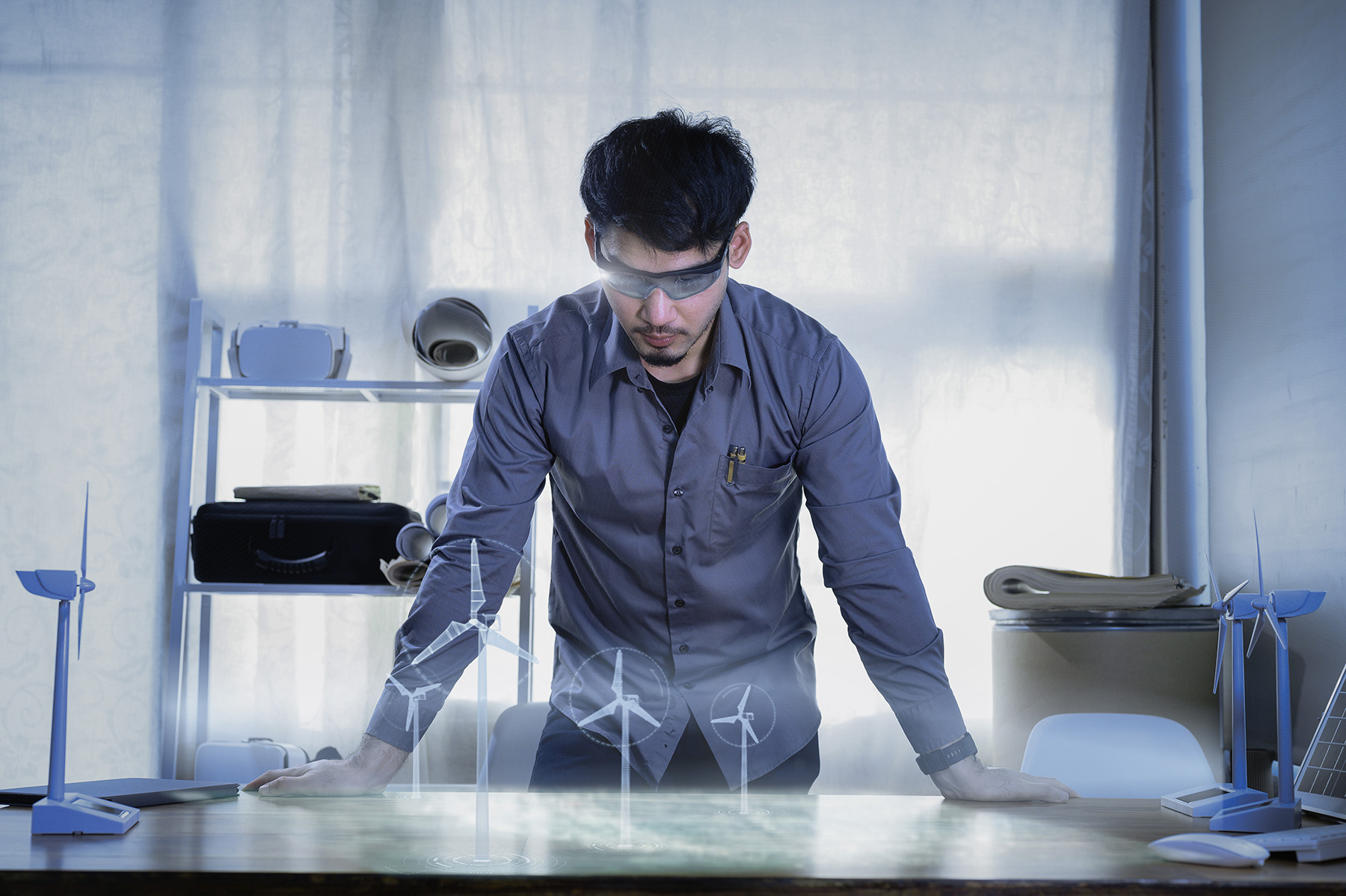
Moreu added that AR, which can overlay digital twin information onto a physical structure, could also help with emergency planning. “We can measure rain and flooding with sensors and then create a simulation of the flooding to let people know when to evacuate,” Moreu said.
Moreu emphasized that with AR, team members can see the consequences of any design changes or decisions in an almost real-world environment. And this builds trust among the stakeholders, who may come from different disciplines and have specific points of view about how design decisions are made.
“People can see the value of moving from 2D quality assurance to 3D. You can talk about tolerances, for example, but with AR, you can show people what any changes will do in the plan, making it much easier to understand,” Moreu explained. “Sharing information makes friends. When it’s difficult to share, (people) are more resistant. ... Now, you can (use the model) to go ‘to the future’ and see what will happen if you choose a particular design option.”
Barriers to implementation
Despite the advantages of AR in infrastructure design and construction, adoption to date has been quite low. When Beach and his colleagues published research six years ago as to why more construction sites were not using AR, they discovered that the cost of the technology was a significant barrier. What’s more, many organizations reported feeling limited by AR hardware.
Headsets “did not have a long battery life. You needed to be in the range of Wi-Fi to make proper use of” the technology, Beach said. “Some of those concerns have been alleviated as the technology has advanced and costs have come down. High-capacity batteries are now much more common ... and with the advent of 5G, so long as you are in a 5G-enabled area, you don’t even need Wi-Fi.”
But one of the greatest obstacles to adoption, in the past and today, Beach said, is the need for an accurate, detailed model to create the appropriate data overlays.
“The usefulness of AR on-site is only really as good as the data that’s put into the models back in the office,” Beach said. “But having a good-quality model benefits you throughout the whole building life cycle.”
Moreu agreed that a detailed model is vital to success, and that requires that civil engineers learn computer programming or work with computer scientists or electrical engineers to build what they need for their specific situation.
“AR in civil engineering is 100% programming. It’s not like a phone where you can download an app,” Moreu said. Civil engineers “need to collaborate with AR developers to make this technology applicable.”
The future of AR in civil engineering
Because the industry is finally seeing the value in AR technology and headset costs have come down enough to make AR use more cost-effective, the number of use cases, from workforce training to building inspection, will only grow, Moreu believes.
He is working to develop new applications to help engineers build and maintain safe, compliant, and high-quality infrastructure such as railroads, roads, and bridges — even from afar, thanks to AR’s detailed building information models.
Moreu noted that with AR, civil engineers can become “the human in the loop” in new solutions, visualizing important information about new and existing built structures to facilitate human-machine collaboration to prioritize and direct fixes. It was the second part of his presentation at IWSHM 2025 — and where he hopes the field will ultimately go.
“This kind of application will be very valuable to share remote information so the human can tell the robot what to do,” he said. “It’s very exciting.”
Kayt Sukel is a science and technology writer based outside Houston.
This article first appeared in the March/April 2026 issue of Civil Engineering as “Augmenting the Reality of Engineering and Construction.”