
By Robert Moses, Ph.D., M.ASCE
The first human settlements on Mars will face unique engineering challenges. Here’s how civil engineers can help make humanity a two-planet species.
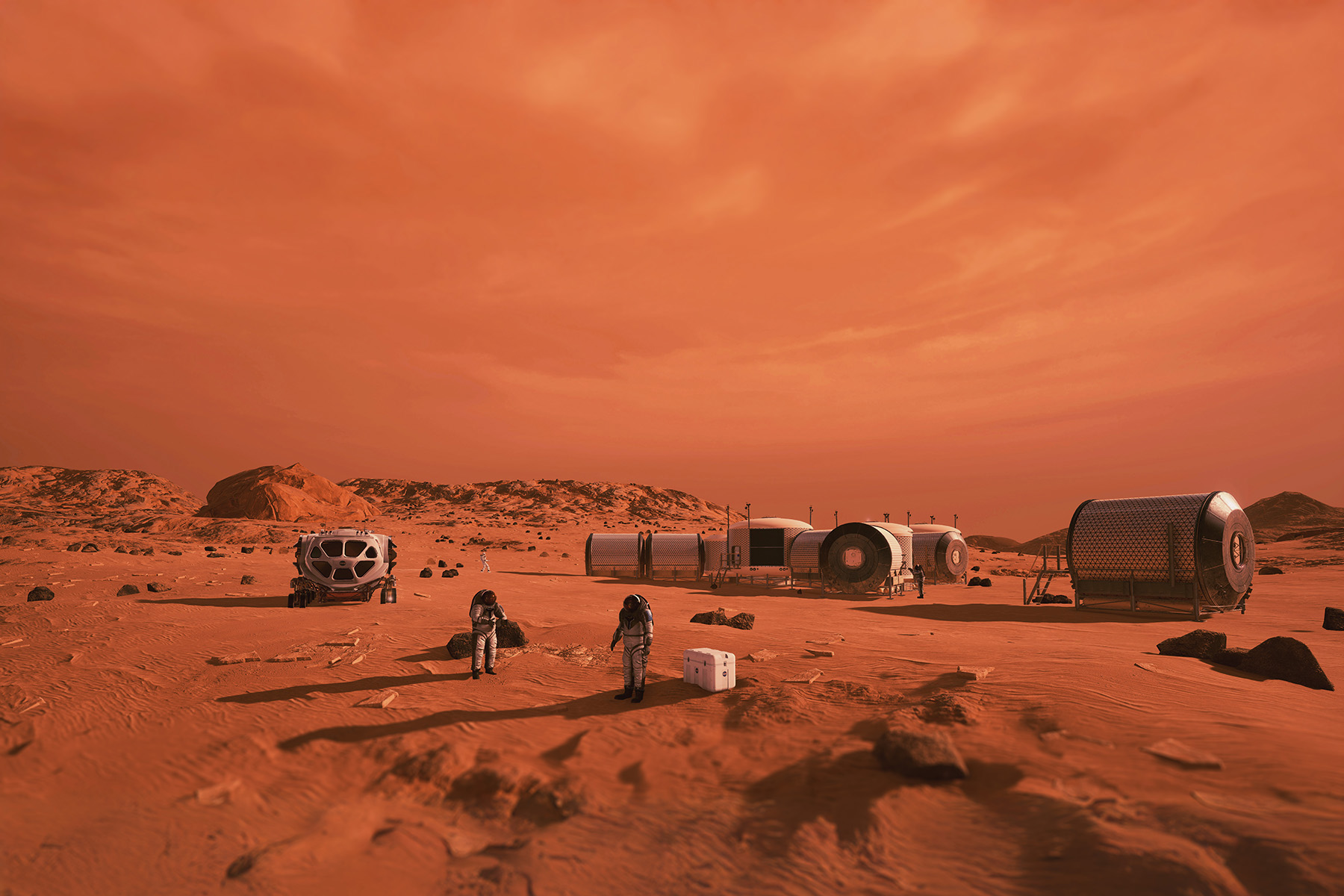
Living on Mars will be a test of skill and fortitude, to say the least. Humans cannot survive on Mars in its natural state. Yet Mars holds abundant resources that could sustain a permanent human presence if those resources were properly used. Once on planet, mining and engineering processes — powered by concentrated sunlight and nuclear reactors and operated by an optimal ensemble of astronauts, robotics, and autonomous systems — could transform those Martian resources into human settlements.
As a retired NASA aerospace technologist and a member of the ASCE Aerospace Division’s Space Engineering and Construction Committee, I feel strongly that, with the right infrastructure, humans can not only live on Mars but also thrive. Indeed, they can even make Mars into a kind of “superstore” in space, supplying goods and services to a growing spacefaring society throughout our solar system.
Civil engineers will play a vital role in creating the right infrastructure. Some principles and expertise gained here on Earth will apply to building settlements on Mars. However, there are key obstacles to overcome before civil engineering activities can take place on the Red Planet.
Resource riches
First the good news. Mars is a special place within our solar system. Indeed, it is the only planet we know of on which humans can create habitable, self-sufficient colonies. That’s because Mars “is unique in that it possesses all the raw materials required to support not only life, but a new branch of human civilization,” as noted by Robert Zubrin, the aerospace engineer and longtime advocate for Mars exploration, in the book, Deep Space Commodities: Exploration, Production and Trading. And while the moon has similar resources, these resources can be found in much more “readily accessible” forms on Mars, Zubin explained.
NASA has a term for this: ISRU, which stands for in situ resource utilization. The space agency defines ISRU as “the harnessing of local natural resources at mission destinations, instead of taking all needed supplies from Earth, to enhance the capabilities of human exploration.” On Mars, such resources are abundant.
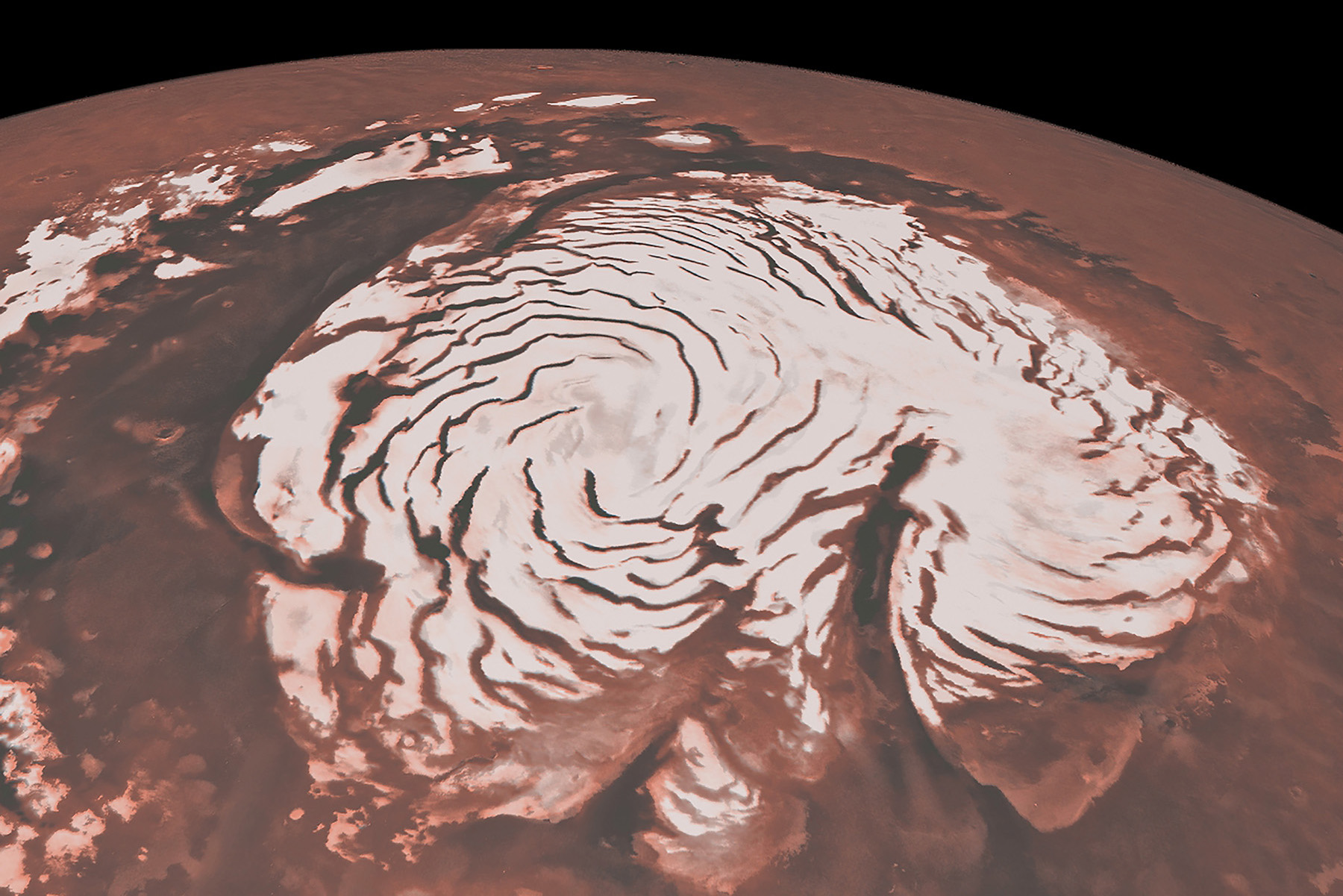
For example, Mars features vast amounts of water in the form of ice lakes located at high latitudes and at the poles, which are protected from sublimation by a layer of regolith. Besides its use for drinking, this water can also provide hydrogen and oxygen, which a human settlement can use for various purposes. Water concentration in the Martian regolith varies from 3% to more than 40%, depending on location. Water could be extracted from regolith by various methods, including microwaving the regolith or using a Rodriguez well, which NASA notes is a well-established method of obtaining water from ice on Earth.
The atmosphere of Mars is 95% carbon dioxide, which offers a rich source of carbon and oxygen that can be extracted using existing technologies. Carbon can be combined with hydrogen to make methane for propellants and plastics for spare parts as well as radiation shielding. The atmospheric carbon dioxide can be extracted easily via either cooling or compression. The Martian atmosphere also features inert gases such as argon and nitrogen, which are essential to creating an atmosphere within the settlement that is similar to Earth’s.
Martian regolith contains important minerals such as nickel, titanium, iron, sulfur, magnesium, calcium, phosphorus, chlorine, bromine, aluminum, silicon, sodium, manganese, chromium, deuterium, and possibly others, localized in a volcanic geology that tends to concentrate minerals, similar to what happens on Earth. There are also mineral deposits created by meteoroid impacts.
The most common material measured by the Viking landers, which reached Mars during the mid-1970s, was silicon dioxide, which made up roughly 40% of the soil samples by weight. Silicon dioxide is the basic constituent of glass, which thus can be readily produced on Mars using sand-melting techniques similar to those that have been used on Earth for thousands of years.
Permanent presence
To establish a permanent human presence on Mars, civil engineers, scientists, and others will need to help the pioneering astronauts generate and distribute electricity and heat. This can be accomplished by various means, including solar concentrators, nuclear reactors, advanced nuclear batteries, and other technologies and procedures.
Breathable air can be provided via solid oxide electrolysis, water electrolysis, and other techniques.
Ice can be melted into water, which will have to be purified and distributed. This will require the use of solar tents, Rodriguez wells, and recirculating flow systems to prevent refreezing, among other methods.
Fuel, polymers, and plastics can be made from the hydrogen in water produced from Martian ice and the carbon in the Martian atmosphere.
Steel can be produced from Martian regolith via the sponge iron process — also known as the direct reduced iron method — which requires iron mixed with hydrogen and carbon monoxide gases at temperatures achievable on Mars.
Another building material under consideration is basalt, which could replace steel in rebar. Martian basalt is a volcanic rock similar to Earth’s basalt. It is primarily found on Mars’s surface and is rich in iron and magnesium, which is thought to contribute to the surface’s reddish color. While the Martian crust is largely basaltic, it also exhibits a complex igneous history, containing a diversity of other volcanic rocks as well. Basalt rebar will be a lighter, stronger, and more corrosion-resistant alternative to steel, with non-conductive properties and a long lifespan.
Since water sublimates and freezes quickly on Mars, concrete that uses water will freeze before it cures under ambient conditions (“outside”). Another type of construction material being considered for Mars is concrete made with non-hydrated binders such as sulfur or polymers and plastics that are available on Mars.
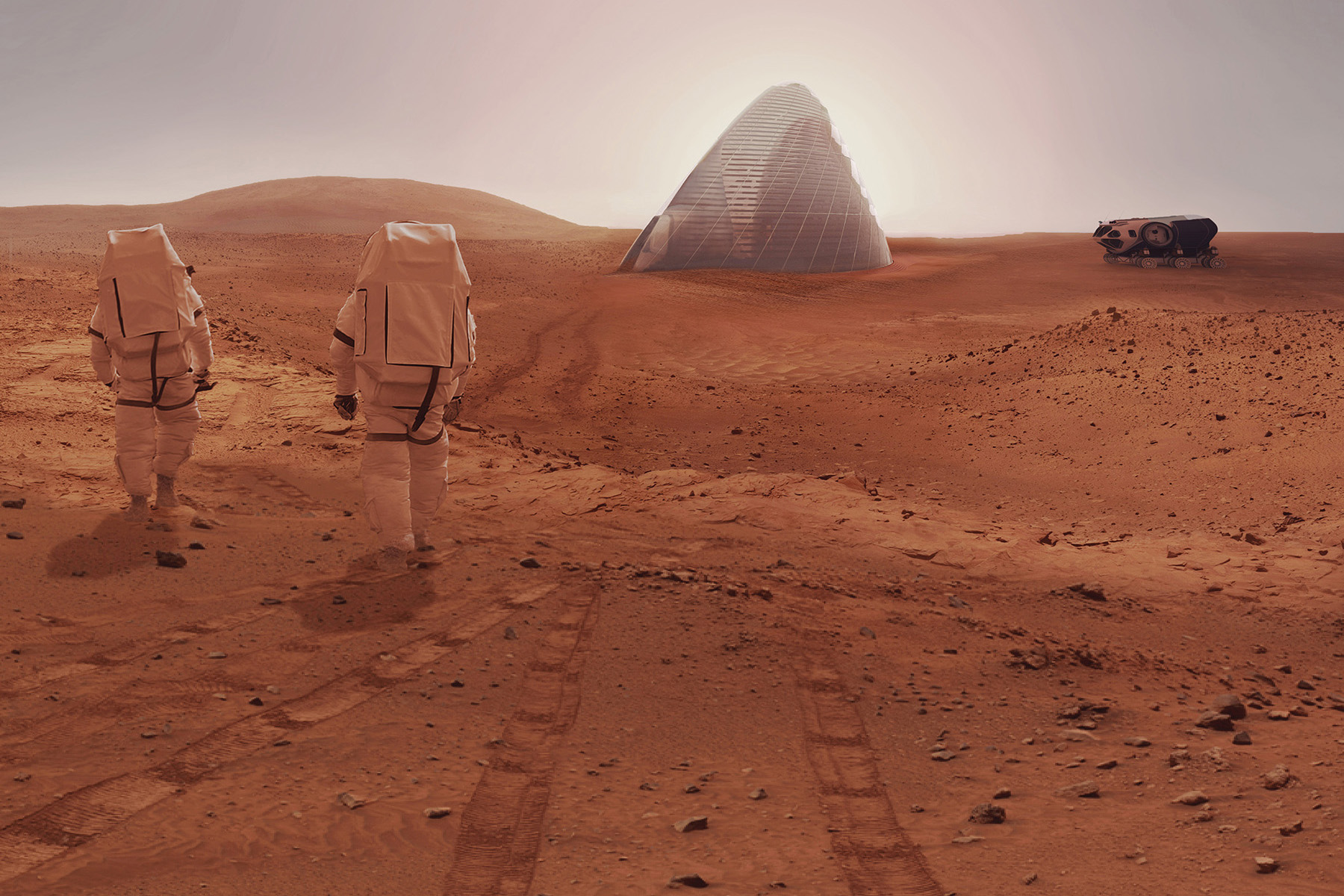
Martian ice is also a potential building material, as demonstrated in the Ice House design that won NASA’s 3D-Printed Habitat Challenge in 2015. At the same time, the ice on Mars can reach depths of several kilometers, which will complicate the use of underground pipes to distribute water.
Knowns and unknowns
Despite these resources, the construction of infrastructure on Mars will be substantially more difficult than similar work on Earth and potentially far more hazardous. Because Mars is farther from the sun than the Earth is, the sunlight that reaches Mars is dimmer, with only about 43% of the intensity.
Moreover, the thin, dusty atmosphere creates a reddish, hazy daytime sky on Mars, but the sunsets have a blue glow because the fine dust scatters blue light forward, away from the sun’s direct path. The lack of a significant atmosphere, and hence very little greenhouse warming, combined with its distance from the sun, means that Mars, for the most part, is a very cold place.
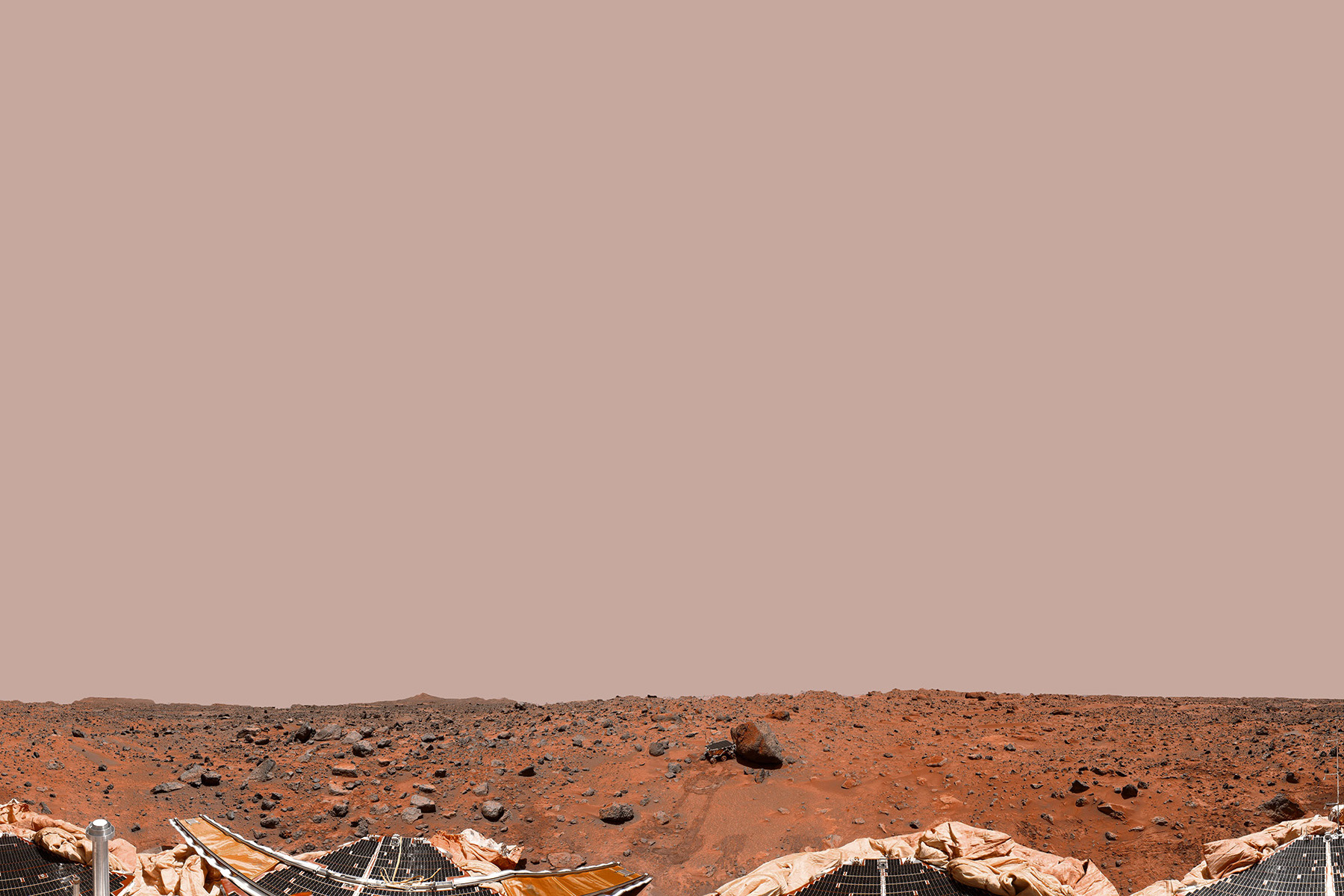
The only significant weather phenomena on Mars are strong winds and dust storms, which can obscure the sun for long periods of time, sometimes exceeding several weeks. Due to the dust, sunlight on Mars is usually fairly diffuse, coming from many directions at once, rather like an overcast day on Earth. This makes it harder to concentrate sunlight using reflectors. Nonetheless, sunlight can be used for power generation by solar panels and for growing plants in greenhouses.
When designing Mars habitats, civil engineers and others will need to consider the planet’s very low atmospheric pressure, lack of breathable air, freezing temperatures, low gravity (only one-third of Earth’s), seismic activity, and vulnerability to meteorite impacts.
For example, consider NASA’s InSight lander, which set down on Mars in 2018. By the time its mission ended in 2022, the probe’s seismometer had detected more than 1,300 seismic events on the Red Planet. Many of these quakes are believed to result from sudden releases of energy in the planet’s interior, caused by rocks cracking under heat and pressure or volcanic activity. But the InSight mission also detected seismic waves caused by meteorite strikes, including the largest strike yet observed on Mars, on December 24, 2021, which produced an impact crater measuring 492 ft across and 70 ft deep.
The designers of a Martian settlement will need to keep in mind that nearly everything brought to Mars must be recyclable and reusable, from plastic cargo bags to the steel and other materials in space vehicles that land on the planet. At the same time, the astronaut construction crews will need to be resupplied regularly with consumables such as food and water.
And there will be numerous safety issues, including exposure to high radiation levels in space; the psychological stress from the sense of isolation and confinement the astronauts might experience; the great distances and resulting communication delays between Mars and Earth that will make emergency medical care and rescue difficult; and certain space-related medical risks such as possible bone loss and altered cardiovascular function if a lengthy journey to or from Mars is taken in microgravity. But these are not insurmountable problems.
Better shielding, for example, can protect astronauts on the Martian surface, and robotic construction equipment can be controlled remotely by human operators from safe underground settings. Autonomous equipment is another option. And while the design of construction equipment for Mars is still in the very early days of development at NASA, that also means there remain many opportunities to innovate processes and tools tailored specifically for Martian conditions.
Furthermore, there are knowledge gaps that must be filled before proceeding with civil engineering activities on Mars. There remain many unknowns, such as the behavior of construction materials made from Martian resources, what new processes will make the best use of those natural resources, and what equipment concepts will best serve the required construction practices, among others.
Earth analog sites built for training the crews and verifying the materials, processes, and equipment do not fully represent conditions on the planet. For construction materials derived from local resources, durability in the extreme surface environment will also be an unknown, as will be the resilience of autonomous operations and teleoperations in the face of the dusty and extreme surface environment of the Red Planet.
Also, getting equipment to the surface of Mars requires an understanding of potentially unfamiliar aerospace engineering and space terminology. Size, weight, and power, often designated “SWaP,” are common considerations in the space industry. Mission architects, systems designers, and aerospace engineers work with a range of values for each of these three metrics to plan for payloads and mission systems that will be launched into orbit.
When building infrastructure on Earth, the SWaP metrics hardly enter the conversation. But building infrastructure in space is far trickier. For example, the International Space Station was constructed over roughly a dozen years from multiple payloads restricted by the capacity of the space shuttle fleet.
Construction crews featured astronauts in space suits or astronauts who worked remote manipulator devices from inside a shuttle — conditions completely unknown to construction workers on Earth. The development of a permanent human presence on Mars will be far more challenging than the work on the space station.
A functional framework
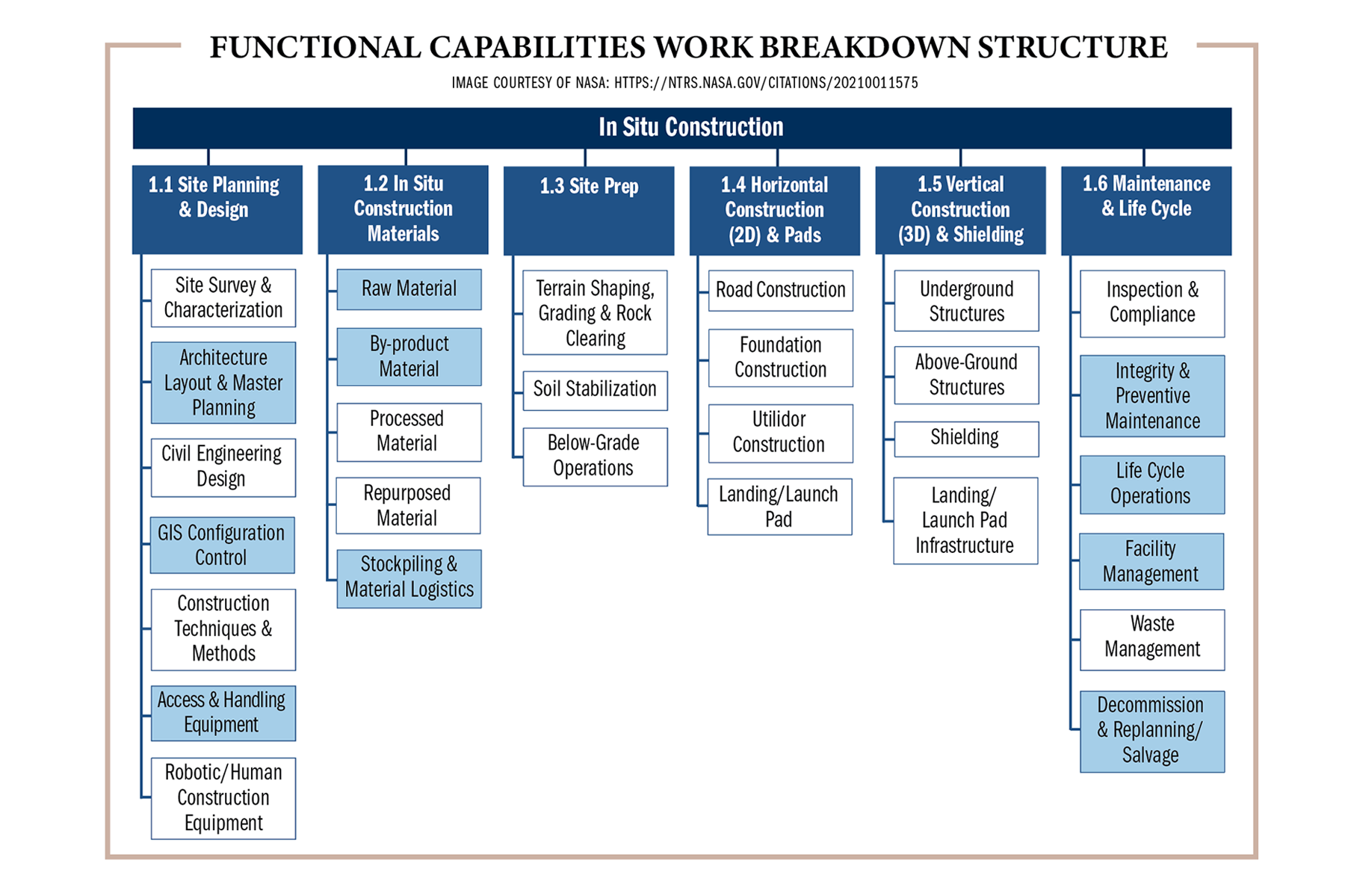
To bridge the communication gap between aerospace engineering on the one hand, and civil engineering and settlement construction on the other hand, NASA created a framework of functional capabilities that categorizes the types of processes needed and when they would be phased into settlement building projects on the moon or Mars (below). The Functional Capabilities Work Breakdown Structure uses construction industry terminology common to aerospace and civil engineers. This framework can be applied to the elements of civil engineering, whether on Earth, the moon, or Mars: surveying and mapping, structural design and analysis, soils and geotechnical, water and sewer, transportation, construction, and environmental impact.
The white boxes in the work breakdown structure align with civil engineering disciplines. The light blue boxes require input from civil engineering and could also come under civil engineering management.
There are several technical gaps to bridge in applying civil engineering on Mars. For instance, under 1.1 Site Planning and Design lies “Civil Engineering Design.” On Earth, the selection of building materials and dimensions is well-grounded in decades of successful projects. On Mars, those building materials do not exist. Consequently, the use of Martian resources as building materials will have to be tested.
Some experiments using simulated Mars regolith have been conducted in labs on Earth. And while Earth’s moon differs substantially from Mars in terms of resources and other critical factors, the lunar surface can serve as a testing ground for verifying the performance of new and modified systems to use and for processing space resources prior to sending these systems to Mars.
Ultimately, though, the construction of infrastructure projects on Mars will require that the materials, techniques, methods, and equipment all be validated on the planet itself. Therefore, the design of material validation experiments that can be conducted on the Martian surface by robots and/or astronauts is a vital role for civil engineers to perform.
Once the required material properties and performance can be validated on Mars, civil engineers can then help develop the best practices for acquiring those materials at scale from Martian resources. These best practices will involve mining operations and practices in general that are tailored to or reinvented for Mars’s environmental conditions.
Site selections
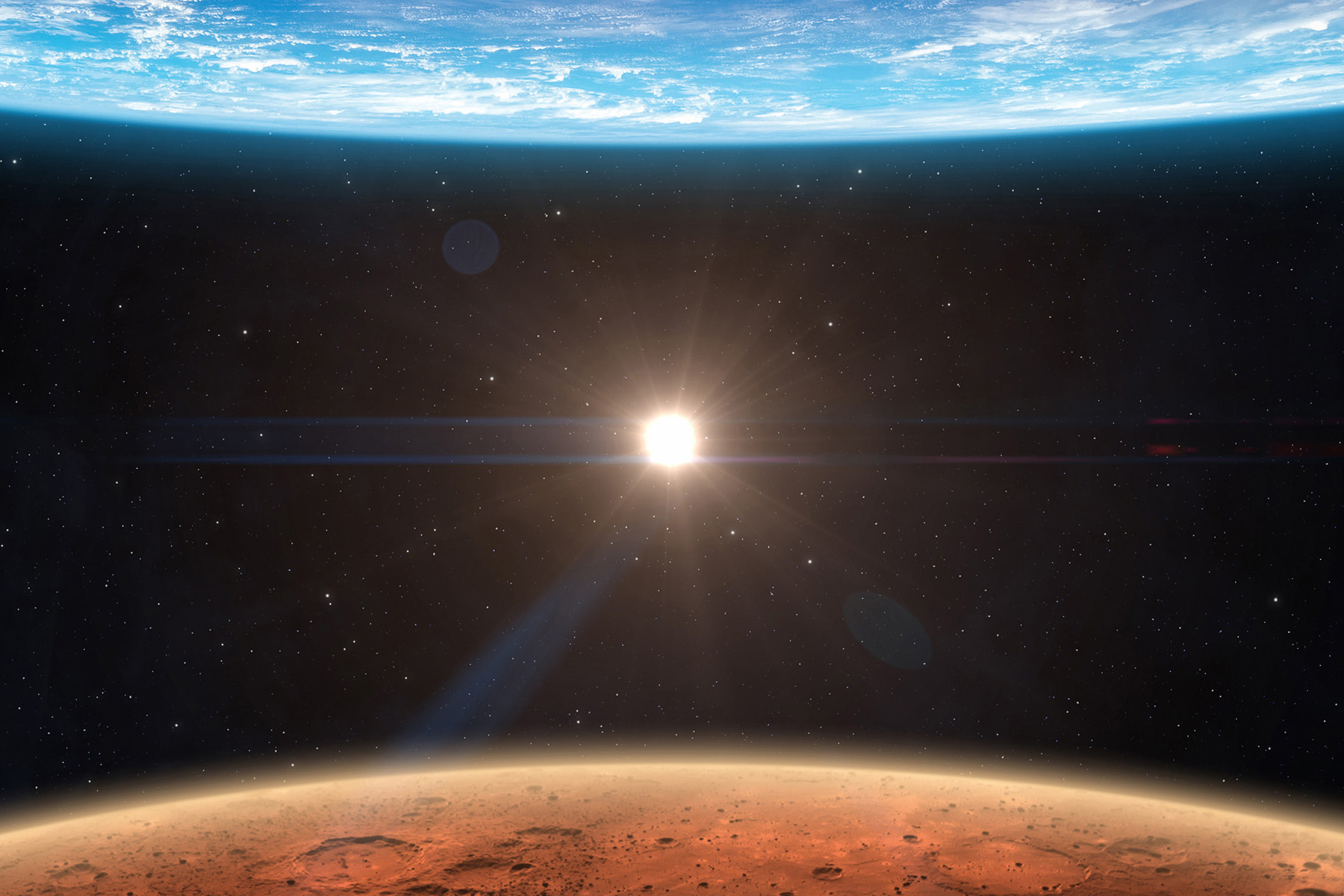
In terms of potential settlement locations, civil engineering expertise will be paramount for establishing a continuous supply of water for habitation, energy, and propulsion purposes. Future settlement sites might be selected partly because of their proximity to large ice lakes. Lava tubes offer access to the Martian subsurface, where astronauts can be shielded from harmful space radiation and establish habitation at controlled temperatures and pressures. Mars’s two moons may also offer some resources, which could be accessed by establishing a base camp in the planet’s orbit.
Site preparation will be a critical issue. Some equipment concepts for excavation and grading have been developed and tested in simulated lunar and Martian surface environments on Earth. Equipment concepts for regolith compaction and soil stabilization have been developed and tested. Even so, there is plenty of room for improvement and innovation.
Horizontal construction includes roads used repeatedly by rovers; foundations that can support habitats and other vertical structures subjected to thermal loads, vibratory quakes, and other lunar and Martian conditions; utilidors that insulate and shield utility lines like water, sewer, electricity, and communications cables from the freezing temperatures and micrometeorites; and landing/launch pads that prevent rocket plumes from large reusable landers from spraying regolith, which could damage the lander or infrastructure nearby or send debris into orbit.
System and equipment concepts are still early in development, with landing/launch pads receiving the most attention in this category. The deep frost line on Mars poses significant challenges for utilidor designs.
Vertical construction will perhaps be the most exacting work, as well as the most necessary. To transport a fully operational habitat module, weighing 20 to 30 tons, to the Martian surface will be problematic in terms of descent into the Martian atmosphere and landing technologies.
Thus, an alternative solution could be landing lighter payloads — such as power generation and distribution equipment, construction rovers, and surface navigation and communication systems — to begin the construction of key elements of the settlement. This approach, of course, assumes that Mars holds suitable construction materials. Once those resources have been validated as suitable, then civil engineers can derive design guidelines and construction criteria for their use to protect crew and equipment on Mars.
Different habitats
From a broad perspective, NASA classifies space habitats into three main classes, based on their construction and deployment.
Class I habitats are fully manufactured and assembled on Earth before being launched, similar to the initial assembly of modules for the International Space Station.
Class II habitats are prefabricated on Earth but assembled in space or on a planetary surface. Examples include inflatable modules that are launched compactly and expanded once in orbit. Robots and teleoperated equipment are necessary to assist astronauts in implementing and maintaining Class II habitats.
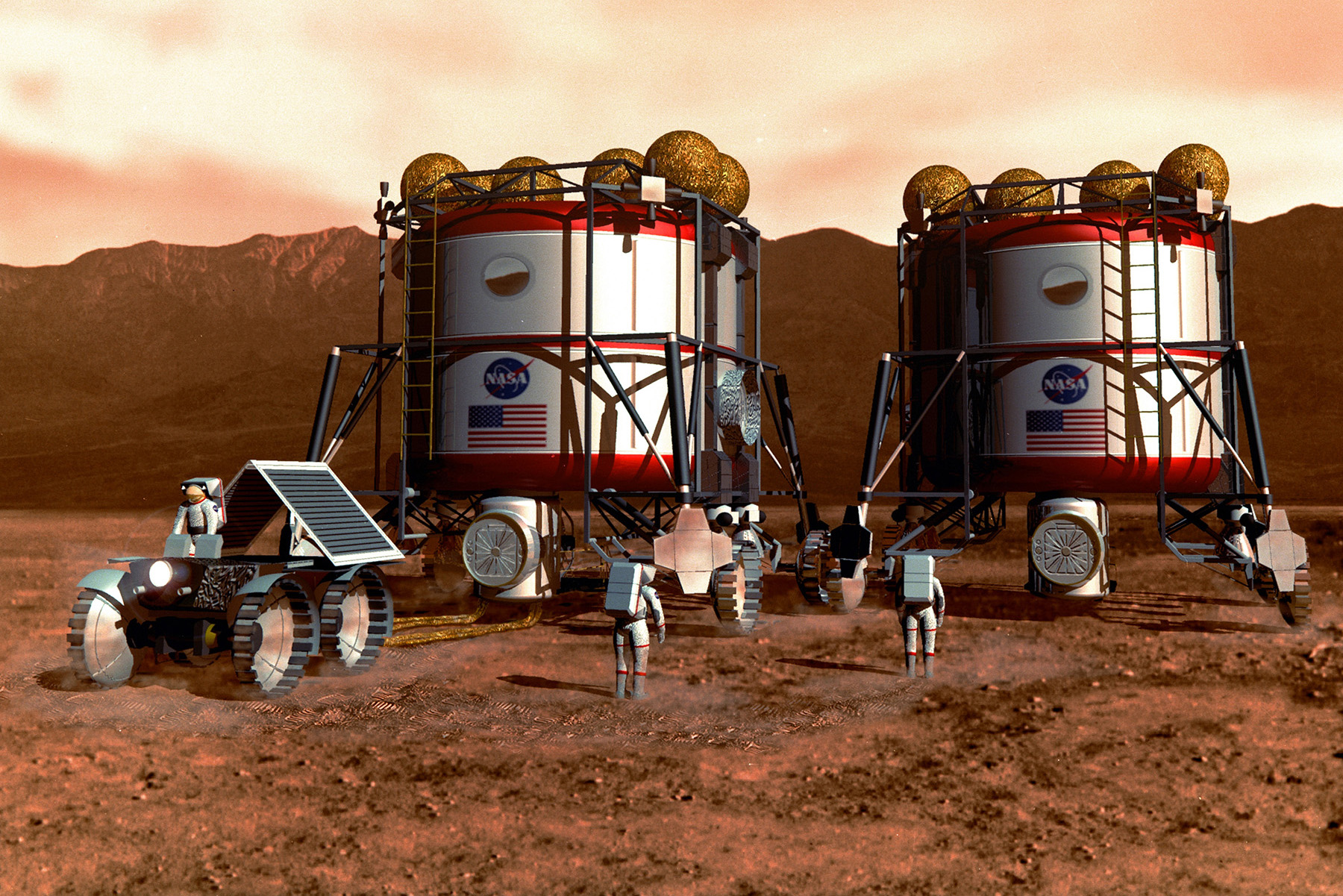
Class III habitats are built on-site using local resources, such as the Martian regolith. This approach is crucial for long-term, sustainable settlements, as it reduces the need to transport all materials from Earth. Construction methods being considered for Class III habitats include 3D printing and using microwave or solar sintering techniques, though these approaches are still being developed. Solar sintering is a sustainable manufacturing method that uses concentrated sunlight to heat and fuse powdered materials, like sand or regolith, into solid objects. Construction of Class III habitats would require robots, teleoperated equipment, and some autonomous systems technologies.
Another concept for civil engineers to ponder is whether a large dome can be built from Martian resources that allows sunlight inside while protecting crew and contents from space radiation and other harmful conditions on Mars.
Humanity’s second home
The many obstacles to establishing a permanent human settlement on Mars seem small compared to our desire to meet the challenge. Civil engineers can play a major role going forward in helping to build habitable infrastructure and determine how resources will be used to protect and sustain human life on Mars. Together with other engineers, scientists, and the astronauts themselves, we can all work to make humanity a two-planet species.
This article is dedicated to Dennis Meyer Bushnell, chief scientist of NASA’s Langley Research Center, who died in October 2025. Without his contributions and collaborations on Mars ISRU, this article would not have been possible.
The author and his colleague, Morgan Gendel, from Planetary Shelter LLC, will discuss the development of shelters and protective barriers on the moon and Mars made primarily from in situ bulk regolith during ASCE’s Earth and Space 2026 conference. The conference is scheduled for April 13–16, 2026, at Texas A&M University in College Station, Texas.
“A Closer Look at SpaceX’s Mars Plan,” by Jon Kelvey.
“The Economic Viability of Mars Colonization,” by Robert Zubrin.
“Frontier In-Situ Resource Utilization for Enabling Sustained Human Presence on Mars,” by Robert W. Moses and Dennis M. Bushnell.
Mars: Prospective Energy and Material Resources. Viorel Badescu (Ed.).
“Requirements Development Framework for Lunar In-Situ Surface Construction of Infrastructure,” by Robert W. Moses and Robert P. Mueller.
Robert Moses, Ph.D., M.ASCE, is a retired NASA aerospace technologist and the founder of Two-Planet Species LLC, in Richmond, Virginia. He is a member of the ASCE Aerospace Division’s Space Engineering and Construction Committee.
This article first appeared in the March/April 2026 issue of Civil Engineering as “A Second Home.”
