By Kayt Sukel
The United States is facing an unprecedented housing crisis. The U.S. Chamber of Commerce estimates the country is short more than 4.7 million homes, and with an ongoing dearth of skilled construction workers, it is imperative to find solutions that will help quickly build or refurbish homes that the average citizen can afford.
Jordan Easterling, founder and chief executive officer at Building Swell, a technology company that supports prefabricated construction, said finding solutions to the housing crisis can be a challenge, especially since the construction industry, for the most part, still relies on many of the same materials and processes it did 50 years ago. For example, the average home takes approximately 10 months to build from start to finish and can require an average of 24 different subcontractors.
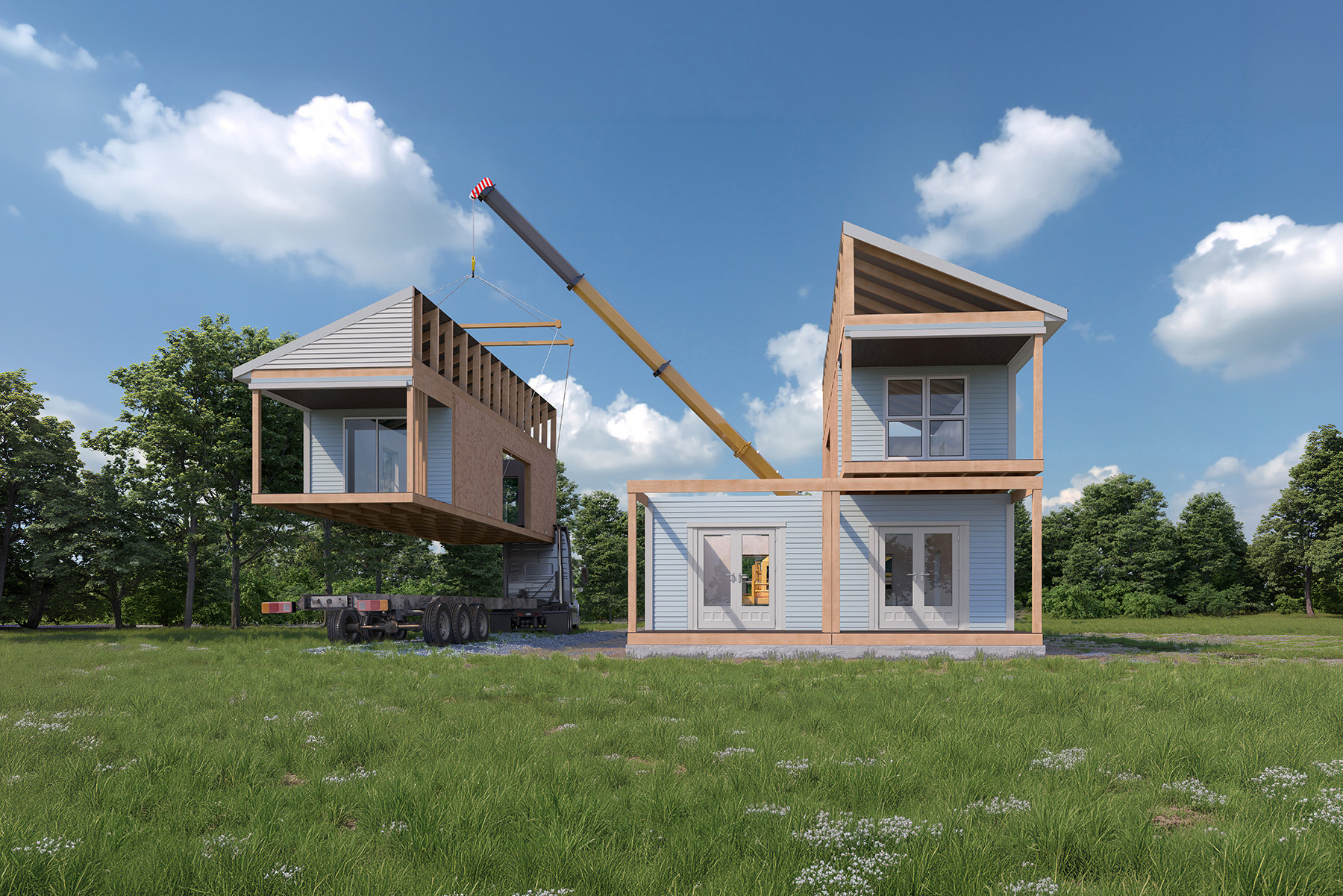
Modular construction, a building method that leverages factories to build standardized elements that are later put together on site, could provide the winning combination of speed, quality, and cost savings to increase home production and help more people become homeowners, Easterling said.
“By doing the design work up front and working with general contractors as well as mechanical, electrical, and plumbing contractors, you can create the structural elements or even more complex parts of a building inside the controlled setting of a manufacturing facility,” he said. “It gives you a greater degree of control over the overall quality of the construction, as well as modules that can be easily erected or installed with a smaller labor force.”
Modular construction is not a new concept, and it is already widely in use to various degrees. The tiny house craze, for example, has resulted in several companies that pre-fabricate small dwellings. And those working in commercial construction may already be using panelized roof structures or unitized curtain walls to enclose buildings. But Panagiota Karava, Ph.D., a professor of civil and construction engineering at Purdue University, believes we have only begun to scratch the surface of what industrializing the construction industry could offer future building efforts. She and her colleagues are working on the NextHouse project to develop the next generation of factory-built housing.
“The ability to build in a factory gives you the opportunity to innovate and iterate through the design process so that you can optimize materials, reduce waste, increase productivity, and ultimately lower costs,” she said. “I view NextHouse as an innovation platform — one where we can embed high-performance features and greater capabilities into homes using advanced manufacturing and automation.”
The idea, she said, is to create modules that can be easily assembled, much like putting together Lego bricks or IKEA furniture components. Each module, however, can contain enhanced functionality, from plumbing to smart sensors, to make more sustainable, higher-quality homes. Designing the factory that can produce such modules, said Karava, requires a multidisciplinary team, including architects, engineers, policymakers, and workforce trainers. Together, they can create a manufacturing facility that employs the kind of robotic systems and automation processes that have transformed so many other industries.
In fact, Karava can see a future in which people build their homes the same way they might customize a high-end car, like a BMW or Audi, on a website.
“This is the digital era. We could create a platform where the homebuyer goes (to a website) and designs their factory-built home,” she said. “They can pick the different modules they want and get feedback on code compliance, materials, availability, costs, and more based on what they want and then go ahead and order it.”
With a combination of “data and awareness,” Karava added, consumers could gain transparency into all aspects of their specific build beforehand.
“There’s so much more to a home than just the things we see on the outside. The insulation around your plumbing, the quality of your windows, your HVAC system — they can be really abstract, but they are really important,” she said. “With the right digital platform in place, people could, before anything is built, understand the quality of these different pieces so that we can, ultimately, make better homes that allow people to live better lives.”
Industrializing construction is not without its obstacles. Building Swell is working to provide the software elements to support more scalable fabrication processes. But moving toward this type of approach can be challenging for construction veterans who are accustomed to the traditional way of building things, Easterling explained. This involves more than just training workers to understand how to assemble these modules on jobsites. The design of buildings, from the very beginning, will require a new approach.
“Today, there’s a lot of deferred design, where design teams are still making decisions sometimes two years into a started project,” he said. With prefab or modular construction, however, designers must make even seemingly trivial decisions, like the tile backsplash behind a stove, at the very beginning of a project before manufacturing starts. Easterling said while that “frontloads” design, it can make the downstream part of a project run more smoothly, with fewer change orders.
Another challenge involves policy and legislation. Different states, even cities and communities within a state, may have different building codes. That makes creating a standard process to fabricate modules a challenge. While the automotive industry has had some luck in adding customization into production runs, modular construction factories will need significant volume to see the goal of reduced costs. That volume decreases when every community has different design specifications requiring a new manufacturing process to be run.
“Without standardized codes, a building or product that you could use in, say, Fremont, California, can’t be used in San Jose,” said Easterling. “It makes things complicated. And if we could standardize the regulatory side of things, it would help us to scale up modular construction across the entire industry.”
Karava is confident that as more pilot projects between innovation ecosystems like NextHouse and industry stakeholders come together, the benefits of increased efficiency and quality will not only help change policy but help the industry adapt to this new way of building. As research, industry, and communities continue to work together, fabrication processes will be further refined, and modular construction’s value to addressing not just the housing crisis, but sustainable building in general, will become clear.
“It’s time for the entire construction industry to reshape. If we can start from homes and show the benefits of industrialization there, we can continue to increase quality, increase sustainability, and lower costs,” said Karava. “We just need to create an innovation ecosystem, the right environment from policy to deployment, to show the value modular construction can bring.”
Kayt Sukel is a science and technology writer based in Overland Park, Kansas.
This article first appeared in the July/August 2026 issue of Civil Engineering as “The Industrialization of Construction.”