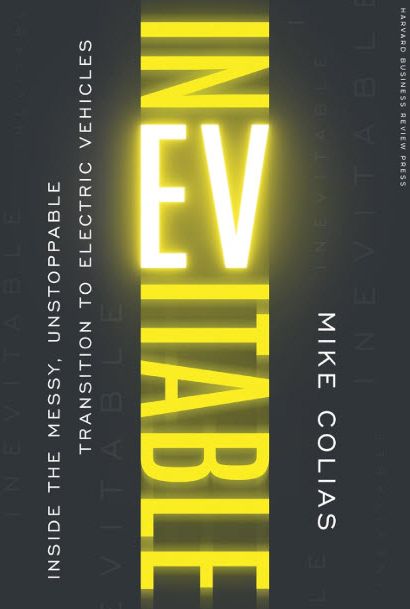
Inevitable: Inside the Messy, Unstoppable Transition to Electric Vehicles, by Mike Colias. Boston: Harvard Business Review Press, 2025; 320 pages, $32.
The global share of electric vehicles sold reached an all-time high of 26.1% in May. Given the rapid rise in oil and gas prices due to the war in Iran and the closure of the Strait of Hormuz, combined with the increasing number of EVs available, such growth should not be surprising.
Author Mike Colias would likely say that even without the war, hitting ever-higher EV sales marks is not just unsurprising … it was inevitable. His book, bearing that exact title, is informed by years of deep research, analysis, and conversations demonstrating that – whether they will say it publicly or privately – an increasing number of automobile executives and analysts agree.
Further reading:
- Ithiel Town’s lattice bridge transformed American construction, book argues
- ‘Disruptive innovation’ is a narrower term than you might think, author argues
- ‘Undammed’ makes a strong case for dam removal
Inevitable makes clear that the forecasted inevitability does not mean EVs are dominant yet, as that 26% figure shows. And Colias also plainly states that gasoline engines won’t disappear as quickly as, say, VHS tapes did. “Let’s get this out of the way,” he writes early on. “Combustion-engine cars are going to be around for a long time. Twenty years from now, an American car shopper probably will still be able to walk into a showroom and buy a car with a gas engine – there may even still be ample selection.”
But he is equally clear about the consensus that the wave will not be stopped this time, and he details why. Inevitable makes the case – succinctly in its introduction and in impressive detail further in – that a few key factors are driving EV adoption.
These include the Chinese government’s enormous investments in EV charging infrastructure, which have allowed the country’s prominent automaker, BYD, to equal and ultimately pass Tesla in terms of battery-only vehicles sold, as Chinese EV exports to Europe expanded. Colias further notes that “where the pain points of EV ownership – high prices and charging headaches – have been removed, consumers have embraced them.”
Taking those facts together with traditional automakers’ checkered history of developing successful EVs, the author draws a straight line to a conclusion: “For the first time ever, what legacy carmakers decide to do isn’t necessarily what the market will do,” he writes. “The threat from Chinese EV makers and the many other newcomers is greater than any previous threat to these companies. It’s existential.”
The author is no newcomer to this topic. A longtime journalist at the Wall Street Journal who now works for Reuters, the Detroit-based Colias has covered the automobile industry since 2010. It quickly becomes apparent how thoroughly he absorbed the massive shifts already underway when he started covering the industry and how much they have accelerated. He also works backward to give a thorough accounting of the various fits and starts, often half-hearted at best, that had defined automakers’ stabs at EVs in recent decades.
Those efforts included General Motors’ pioneering EV1 in the 1990s (whose forced demise, orchestrated by GM itself, was immortalized in the documentary Who Killed the Electric Car?), the rise in popularity of gas-electric hybrids such as the Toyota Prius, and later efforts such as the Chevrolet Volt.
Automakers that were first and foremost combustion-engine experts were the common thread in almost all these efforts, which were initially either failures or, at best, qualified successes in a global automotive industry that generates $2 trillion to $3 trillion annually.
As Inevitable points out, designing and manufacturing an EV is dramatically different from a comparable gasoline car. Supply chains are different, much of the core engineering and technology expertise needed is different, and batteries strong enough to power a passenger vehicle – while cheaper and better than they were a few decades ago – remain extremely expensive.
It is here, Colias notes, that traditional automakers were either unable or unwilling to create and capitalize on advantages that the newer companies have exploited – none more so than Tesla. “This book is not about Tesla. But it wouldn’t exist without Tesla,” he writes. “Whether in name or not, Tesla’s influence is on every page. The extent to which (Tesla CEO Elon) Musk forced traditional automakers down the electric path cannot be overstated.”
One last thing to understand about Inevitable is that it is not a book evangelizing the shift toward EVs. Instead, this lengthy piece of journalism documents that shift and how it came to pass.
The title’s reference to a messy transition is not mere rhetoric: The messes are reported and discussed for all to see. They include likely future “messes,” such as the environmental concerns surrounding disposal of so many large spent batteries, geopolitical concerns related to access to the rare minerals needed to manufacture them, and others.
There are so many unknowns, from the economic to the psychological to the technological, that Colias kicks off his concluding chapter by saying, “If you’re looking for a tidy, conclusive ending to this book, prepare to be disappointed.”
Inevitable is deeply researched and reported and unfolds like a true “story” in the best sense. It tells us much more than we probably understood about a piece of history that most of us have been living through, while giving us an idea of where the road may be leading us – and perhaps what vehicles will be taking us there.