Infrastructure in the Anthropocene (Second Edition), by Mikhail Chester and Braden Allenby. Tempe, Arizona: Arizona State University’s Metis Center for Infrastructure and Sustainable Engineering, 2025; 525 pages, $36.
“Today’s design principles seem to reflect those of the last century, when the types of services we demanded of our infrastructure were stable,” write the authors of this deeply researched tome. “But stability is no longer the norm. … The rate at which we are deploying new technologies embedded within infrastructure appears to be outpacing the infrastructure itself.”
Further reading:
- Water infrastructure engineers confront an uncertain, changing climate
- Author chronicles disturbing route that made ‘forever chemicals’ a societal menace
- In easy-to-understand manner, author stresses infrastructure’s importance
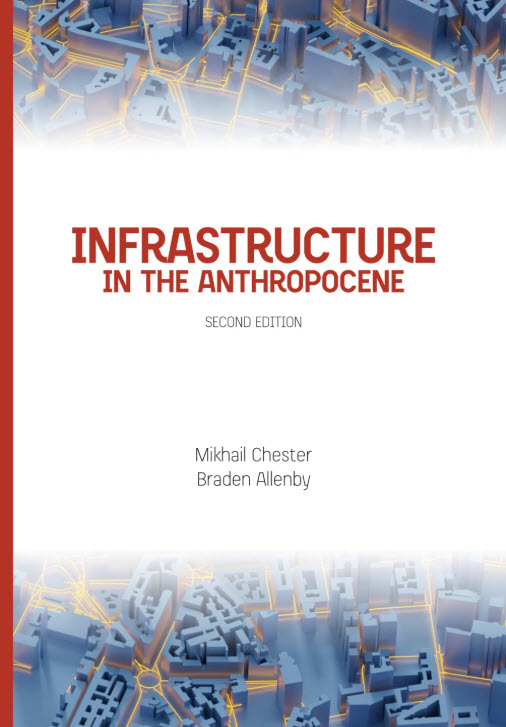
That reality, and the need to rethink what infrastructure consists of and how it is created and managed, is what moved Arizona State University engineering professors Mikhail Chester, Ph.D., M.ASCE, and Braden Allenby, Ph.D., to publish Infrastructure in the Anthropocene. In this human-centric and human-driven era of the planet, the questions and issues that the authors explore could hardly be more urgent as we find ourselves confronting ever more frequent destabilizing forces, from climate change to cyber warfare to artificial intelligence.
Though the densely written book is structured like a combination of a textbook and a very high-level thesis, one can easily see how it would be useful – and eye-opening – to current practitioners and thinkers in infrastructure fields and beyond.
Chester and Allenby strongly recommend that readers proceed consecutively through the book’s sections to fully grasp their points. Defining infrastructure in today’s world as a “wickedly complex” process with commensurate challenges related to resilience, governance, climate concerns, and artificial intelligence, they methodically explain and document that we can no longer afford to regard infrastructure as merely the physical human-made building blocks of modern civilization (buildings, transportation, water, electricity, etc.).
Instead, they argue that we must fully recognize the “tripartite” nature of infrastructure in this era: an interwoven tapestry comprising the physical assets, the governance of those assets, and the large and critical educational and research apparatus that supports the entire enterprise.
When everyone’s well-being and so much of our day-to-day lives depends on the proper functioning of these increasingly interlinked systems, neglecting any of the legs of that three-legged stool will eventually have outsized consequences.
Although this book is officially listed as a second edition, it is a vast expansion (more than 2.5 times as long) of what the authors published in 2021 under a slightly different title. That book, they explain, did not go into significant depth, something they aimed to change this time.
In addition to expanding their own writing and insights, this time the primary authors have adapted (with permission and attribution) additional material that they co-authored with others or contributed to in advisory roles. In this way, in addition to Chester and Allenby’s individual expertise (Chester in civil, environmental, and sustainable engineering and Allenby in engineering, ethics, and economics), Infrastructure in the Anthropocene can fairly be considered the work of five additional scholars – a “community of researchers” as they put it.
And make no mistake: This is a book about managing serious challenges that does not make any attempt to oversimplify them or pretend that any of the shifts in thinking and action will be easy to accomplish or without tradeoffs.
“For an enterprise to thrive in the face of chaos and complexity it has two options: attempt to reduce that complexity or adapt to it,” the authors write. “Attempts by infrastructure agencies to reduce complexity,” such as disregarding uncertain climate futures or the vulnerability of infrastructure to cyberattacks, “appear ill-fated.”
Infrastructure in the Anthropocene forces us to confront just how complex a world we have created and the new paths we must forge to maintain it.